A Europe against the Revolution (1792-1797)
The "seven coalitions" are often described as a tidy sequence, each one born from the last and ending on a battlefield. Reality was messier. The traditional count, which this article follows, varies from one historian to another, particularly for the years 1792-1797. Each coalition was an alliance of convenience between powers that distrusted one another almost as much as they feared France: subsidy treaties, armies that failed to coordinate, separate peaces signed as soon as one sovereign saw an advantage in it.
It all began with the Revolution. On 20 April 1792, France declared war on the King of Bohemia and Hungary, that is, on Austria, soon joined by Prussia. Prussian and Austrian armies entered Champagne but were halted at Valmy on 20 September 1792, and the victory of Jemappes on 6 November opened Belgium to the French. The execution of Louis XVI on 21 January 1793 convinced the European courts that this was a common cause. In early February the Convention declared war on Great Britain and the United Provinces; Spain, Sardinia, Naples and other states joined in. This was the First Coalition.

The coalition looked formidable, yet it fell apart quickly. The French, who had raised masses of volunteers and then decreed the levée en masse in August 1793, drove the enemy armies back. The victory of Fleurus on 26 June 1794 gave them Belgium again. The powers, moreover, did not share the same aims: Prussia and Austria had their eyes on Poland, whose partitions occupied their chancelleries as much as France did. Prussia made peace at Basel on 5 April 1795, Spain on 22 July. Austria remained, which Bonaparte defeated in Italy in 1796-1797, and which accepted the peace of Campo Formio on 17 October 1797. Only Great Britain, sheltered by the Channel and by its fleet, stayed at war.
The Second Coalition and the Peace of Amiens (1798-1803)
The Second Coalition grew out of the Egyptian expedition. By settling in the eastern Mediterranean, France alarmed Russia, the Ottoman Empire and Great Britain, which Nelson had reassured by destroying the French fleet at Aboukir on 1 August 1798. In 1799 Great Britain, Russia, Austria, the Ottoman Empire and the Kingdom of Naples were all committed against the Republic. The early stages favoured the allies: the Russian general Suvorov drove the French out of northern Italy in the spring and summer.
The turning point came in Switzerland. On 25 and 26 September 1799, Masséna crushed a Russian corps at Zurich, and Tsar Paul I, displeased with his Austrian and British allies, withdrew his country from the war. When Bonaparte, back from Egypt, became First Consul after 18 Brumaire, the coalition had already lost its most powerful member. He crossed the Alps in the spring of 1800 and won at Marengo on 14 June; Moreau defeated the Austrians at Hohenlinden on 3 December. Austria signed the peace of Lunéville on 9 February 1801, which confirmed French gains on the left bank of the Rhine.
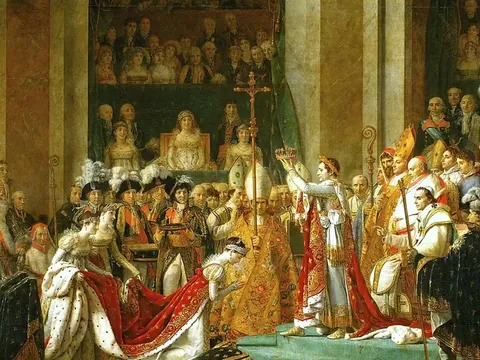
London remained. Both adversaries were exhausted: France needed trade, and Great Britain needed a respite after eight years of war. The treaty of Amiens was signed on 25 March 1802. It settled almost nothing. Great Britain was to evacuate Malta, which it kept; Bonaparte went on extending his influence in Italy, Switzerland and the Netherlands. On 18 May 1803 the British declared war again. A few weeks later French troops occupied Hanover, a possession of the King of England, and gathered an army near Boulogne meant to cross the Channel. On 18 May 1804 Napoleon became emperor; William Pitt, who returned to head the British government that same month, set about rebuilding a continental alliance against him.
1805: the Third Coalition, from Boulogne to Austerlitz
Pitt knew that Great Britain could not defeat France on land. His instrument was money: subsidies to arm the continental powers. An Anglo-Russian treaty was signed in St Petersburg on 11 April 1805; Austria, humiliated by Lunéville and uneasy at the spread of French influence in Italy, where Napoleon had been crowned king in May, joined the alliance in the summer, along with Sweden and Naples. They counted on a converging attack: Austrian armies in Bavaria and Italy, with Russian columns in support.
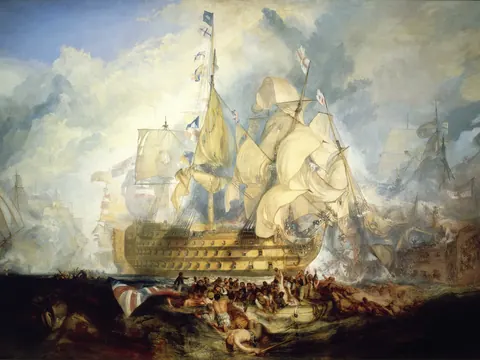
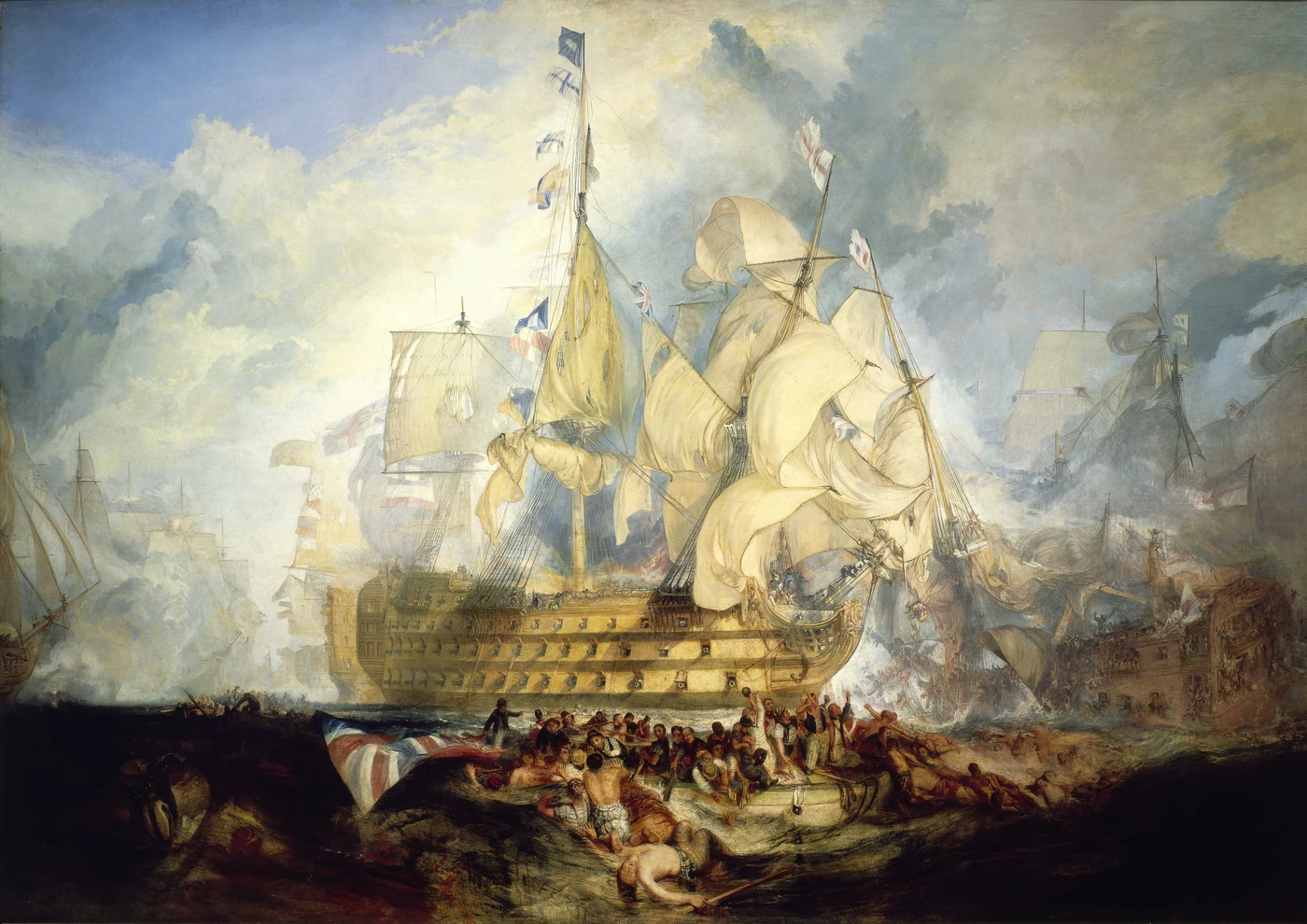
Napoleon reacted with a speed he had not yet shown on this scale. He broke camp at Boulogne at the end of August, marched the Grande Armée towards the Danube and shut General Mack's army up in Ulm, which capitulated on 20 October. The next day, at the other end of Europe, the Franco-Spanish fleet was destroyed off Cape Trafalgar by Nelson, who died in the action. The sea now belonged to the Royal Navy and the plan to invade England was finally buried, though this changed nothing on the continent.
Napoleon entered Vienna on 13 November, then defeated the Russian and Austrian armies at Austerlitz on 2 December 1805, before the eyes of the two emperors. Austria sued for peace. The treaty of Pressburg of 26 December took Venetia, Istria and Dalmatia from it, while the Tyrol passed to Bavaria; Bavaria and Württemberg became kingdoms. The tsar withdrew his troops. Pitt, watching his work collapse, died on 23 January 1806. A few months later, on 6 August, Francis II renounced the crown of the Holy Roman Empire that his predecessors had worn for centuries; on 12 July sixteen German princes had already united in the Confederation of the Rhine under Napoleon's protectorate.
Prussia and Russia: the Fourth Coalition (1806-1807)
Prussia, which had stayed neutral in 1805, saw the Confederation of the Rhine as a challenge, and Napoleon's offer to hand Hanover, which he had just given to Prussia, back to Great Britain as a betrayal. It formed the Fourth Coalition with Russia, Great Britain and Saxony, issued an ultimatum on 1 October 1806 and took the field, confident in an army inherited from Frederick the Great. On 14 October the Grande Armée crushed the Prussians at Jena and Auerstedt; Napoleon entered Berlin on the 27th. Within a few weeks the Prussian monarchy had practically ceased to exist as a military power.
Napoleon drew a new weapon from this victory. By the Berlin Decree of 21 November 1806 he declared the British Isles under blockade and forbade all trade with them: this was the Continental System, which would drag the Empire into ever more distant wars. The campaign continued in Poland against the Russians, in a bitter winter. The battle of Eylau, on 7 and 8 February 1807, was bloody and settled nothing. Friedland, on 14 June, finally gave Napoleon his victory, and Tsar Alexander I asked to negotiate.
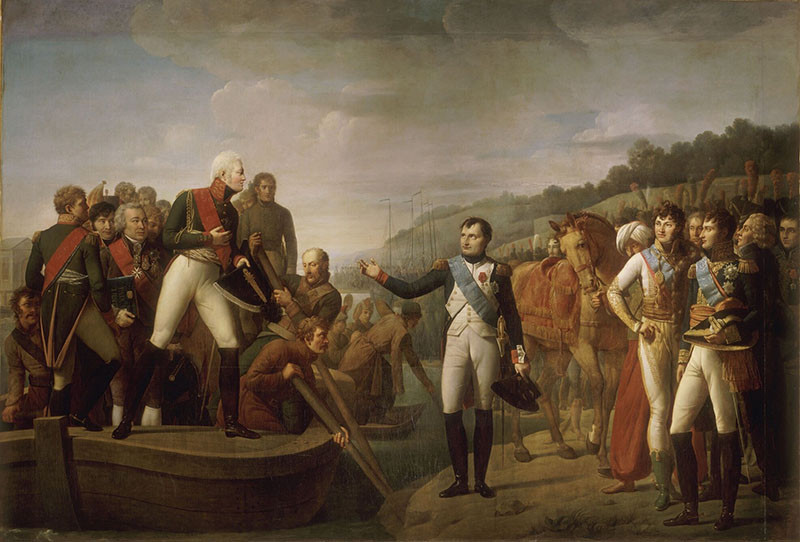
The treaties of Tilsit, signed on 7 July with Russia and on 9 July with Prussia, redrew the map of central Europe. Prussia lost about half its territory. From its Polish provinces Napoleon created the Duchy of Warsaw, entrusted to the King of Saxony, and from Prussian lands in the west, to which others were added, the Kingdom of Westphalia for his brother Jérôme. Russia lost nothing; it became France's ally and agreed to join the Blockade. This was the high point of the Napoleonic system, but its foundations were shakier than they looked, for neither emperor had given up his ambitions.
Austria alone, then a subdued Europe (1809-1811)
The Fifth Coalition was the least coalesced of them all: in 1809 Austria, sure it could profit from Napoleon's entanglement in Spain, attacked almost alone, with London's financial support. Russia, France's ally since Tilsit, stayed out. After the setback at Essling in May, Napoleon won at Wagram on 5 and 6 July, and Austria signed the peace of Schönbrunn on 14 October, which cost it territory and part of its Adriatic provinces. The campaign is told in detail in the article on the Austrian campaign of 1809. On the British side, the Walcheren expedition, sent that summer to the Scheldt to threaten Antwerp, ended in fiasco, ravaged by disease, and withdrew in December.
The following years saw the Empire at its greatest extent. In 1810 Napoleon married the Archduchess Marie-Louise, daughter of the Emperor of Austria, and Austria became for a time a cautious ally. But the French army was tied down in the west by the war in Spain and Portugal, where Wellington's troops, backed by London, played a growing role, and the Blockade, which Russia ceased to respect from the end of 1810, widened the gap between the two emperors. The war of 1812 against Russia, which is not counted among the seven, was its direct sequel.
The Sixth Coalition (1813-1814)
The Russian catastrophe upset the balance. On 30 December 1812 the Prussian general Yorck signed the Convention of Tauroggen with the Russians, neutralising his corps. On 28 February 1813 Russia and Prussia concluded the alliance of Kalisch, and Frederick William III declared war on France in mid-March. Napoleon had rebuilt an army, largely of conscripts, with which he won at Lützen on 2 May and at Bautzen on 20 and 21 May, without being able to turn these successes into a decisive victory for lack of cavalry. An armistice was signed on 4 June. Great Britain, through the agreements of June, financed the Russian and Prussian armies.
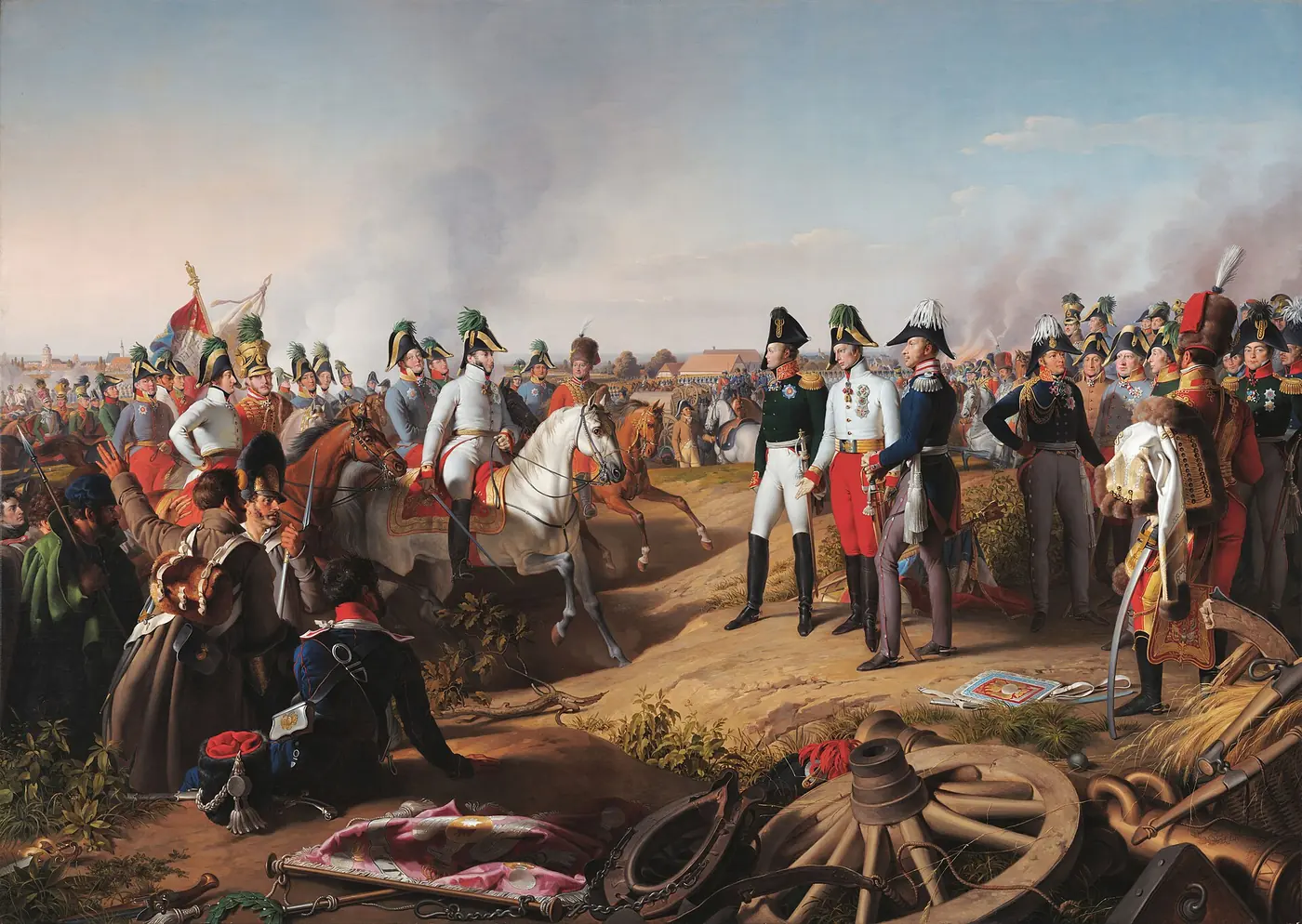
Everything then turned on Vienna. Chancellor Metternich offered his mediation, then found Napoleon unyielding on essentials. Austria declared war on 12 August 1813. The Grande Armée won again at Dresden on 26 and 27 August, but the allies, who had resolved to avoid direct engagements with the Emperor and to go after his lieutenants instead, tightened the noose. At Leipzig, from 16 to 19 October 1813, the "Battle of the Nations", Napoleon was beaten by the Russian, Austrian, Prussian and Swedish armies; Bavaria, a few days earlier, had left the Confederation of the Rhine to join the allies. Germany was lost.
In November the allies had peace proposals conveyed to him at Frankfurt through Baron de Saint-Aignan, based on France's "natural" frontiers, the Rhine, the Alps and the Pyrenees. Napoleon was slow to answer and, when he accepted in December, the terms were no longer the same. The allies crossed the Rhine at the turn of the year. The campaign of France, from January to March 1814, was perhaps his most brilliant tactically: Champaubert, Montmirail, Montereau, successes wrung from armies far superior in number. But the congress of Châtillon, opened in February, failed, and the treaty of Chaumont, dated 1 March 1814, bound Great Britain, Austria, Russia and Prussia for twenty years, to pursue the war to the end and then guarantee its results.
Paris capitulated on 30 and 31 March, and the allied sovereigns entered it. The Senate pronounced the Emperor's deposition on 2 April; Napoleon abdicated on 6 April, then signed the treaty of Fontainebleau on the 11th, which left him sovereignty over the island of Elba. The treaty of Paris of 30 May 1814 brought France back to roughly its frontiers of 1792 and imposed neither indemnity nor occupation: the victors spared the government of Louis XVIII, whom they had just restored.
The Seventh Coalition and Vienna (1815)
At the Congress of Vienna, opened in the autumn of 1814, the allied powers quarrelled over the spoils of the Empire, and Poland and Saxony caused tensions sharp enough for Talleyrand, who represented France, to find a way of making himself heard. It was in this climate that Napoleon left Elba and landed at Golfe-Juan on 1 March 1815. On 13 March the powers declared him an outlaw. On the 25th, Great Britain, Austria, Prussia and Russia renewed the treaty of Chaumont at Vienna, each undertaking to supply 150,000 men. The Seventh Coalition thus formed in less than a month, which shows how used Europe had become to acting together.
Napoleon tried to strike before the Russian and Austrian armies arrived, attacking in Belgium Wellington's Anglo-allied army and Blücher's Prussian army. Ligny, on 16 June, went his way, but at Waterloo, on 18 June, the two allied armies joined forces and beat him. He abdicated a second time on 22 June, and the British sent him to Saint Helena, where he arrived in October. The episodes of this campaign are recounted in the article on the Hundred Days.
The second peace of Paris, signed on 20 November 1815, was harsher than the first: France was brought back to its frontiers of 1790, paid an indemnity of 700 million francs and had to bear an allied military occupation, which ended in 1818. On the same day the four powers renewed their alliance, and France formally joined them at Aix-la-Chapelle in November 1818, as the fifth power of the "Concert of Europe".
Why the coalitions finally won
For twenty years France had the advantage over each coalition taken separately. The reason lay less in one man's genius, though Napoleon's weighs heavily after 1799, than in the nature of these alliances: each power sought to protect its own interests, and it was enough to beat them one after the other. Prussia in 1795, Russia in 1799 and in 1807, Austria in 1797, 1801, 1805 and 1809: each separate peace brought the whole down. Only Great Britain was constant, through its geography and its finances, and it was Britain that paid. It handed considerable subsidies to the continental powers, and the Royal Navy guaranteed its mastery of the seas.
In 1813-1814 the allies drew the lessons of these failures. They gave up independent armies that were beaten one after another in favour of effective coordination, based on the Trachenberg plan, which avoided direct confrontation with Napoleon and favoured going after his marshals. Above all they resolved to sign no more separate peaces: the treaty of Chaumont forbade them to treat with the enemy in isolation, and the pledge held until 1815. Napoleon, for his part, had weakened his own position by his choices: the entanglement in Spain, the war in Russia, the hostility of peoples squeezed by the Blockade and conscription, and the refusal of the honourable peaces offered to him during those months.
The legacy is lasting. The victors of 1815 no longer sought merely to defeat France: they wanted to prevent any single power from dominating the continent again. At Vienna and then at Aix-la-Chapelle they built a balance that, despite the revolutions of 1830 and 1848, avoided a general war in Europe for nearly a century. Some historians, Paul Schroeder among them, see in it a profound change in how states conceive collective security; one must add the general exhaustion of a continent emerging from more than twenty years of war.
Further reading
- Thierry Lentz, Nouvelle histoire du Premier Empire, 4 vols., Fayard, 2002-2010.
- Paul W. Schroeder, The Transformation of European Politics, 1763-1848, Oxford University Press, 1994.
- Charles Esdaile, Napoleon's Wars. An International History, 1803-1815, Allen Lane, 2007.
- Munro Price, Napoleon. The End of Glory, Oxford University Press, 2014.