The Battle of Waterloo, fought on Sunday 18 June 1815 south of Brussels, was Napoleon's last. Against Wellington's Anglo-allied army, entrenched on the Mont-Saint-Jean ridge, the Army of the North launched assault after assault all afternoon — Hougoumont, d'Erlon's attack, Ney's great cavalry charges, the capture of La Haye Sainte — while Blücher's Prussians gradually entered the battle on its right flank. The repulse of the Imperial Guard at about 19:30 turned into a rout. Four days later Napoleon abdicated: Waterloo ended the Hundred Days and the First Empire.
Forces at play
Outcome: Decisive French defeat

France
- Napoléon
- Ney
- Soult
- Reille
- d'Erlon
- Lobau
- Grouchy (à Wavre)
72,000 to 74,000 men, over 250 guns
Casualties: 24,000 to 26,000 killed and wounded, including 6,000 to 7,000 prisoners; ~15,000 deserted afterwards





United Kingdom · Prussia · Netherlands · Hanover · Brunswick · Nassau
- Wellington
- Blücher
- Uxbridge
- Picton
- Prince d'Orange
- Bülow
- Zieten
~68,000 Anglo-allied; ~48,000 Prussians engaged
Casualties: ~17,000 killed and wounded (Wellington); ~7,000 (Blücher)
Flags: David Liuzzo; Oren neu dag, CC BY-SA 2.5, Wikimedia Commons
Battle coordinates
Waterloo
Coordinates 50.6780° N · 4.4116° E
Interactive tactical map
Follow the battle hour by hour — hover over or tap a unit for its details.
The two armies face to face
After a night of rain, Wellington holds the Mont-Saint-Jean ridge, his infantry sheltered on the reverse slope, with three strongpoints out in front: Hougoumont, La Haye Sainte and Papelotte. Napoleon, waiting for the ground to dry, has deployed his army symmetrically on both sides of the main road around La Belle Alliance. At Wavre, Bülow’s corps is on the march.
At Le Caillou, Napoleon dismisses the idea of recalling Grouchy: he has, he says, “ninety chances in a hundred” of beating the English, and it will be “no more than eating breakfast”.
Positions reconstructed from accounts of the battle and placed on the actual locations of the farms and villages. Timings, on which sources do not always agree, are indicative.
Battle narrative
The return from Elba and the Seventh Coalition
On 1 March 1815 Napoleon landed at Golfe-Juan; on 20 March he was in the Tuileries without having fought a single engagement. The powers gathered at the Congress of Vienna did not wait for him to settle in before answering: on 13 March they had declared him an outlaw, and a few days later the United Kingdom, Russia, Austria and Prussia each undertook to keep an army in the field until he fell. The Seventh Coalition was formed before the Empire had even been restored.
With his peace letters left unanswered, Napoleon had only one military option: to strike before the coalition had gathered its strength. Only two armies were already within reach, cantoned in Belgium close to France's northern border: Wellington's Anglo-allied army around Brussels and Marshal Blücher's Prussian army around Namur. The Austrians and Russians could not intervene before the summer.
The calculation was simple and risky. Destroying Wellington and Blücher separately might drive the British back to the sea, perhaps knock Prussia out of the war, and above all buy time to raise fresh troops before the Austrians and Russians arrived. By early June Napoleon had some 300,000 men under arms; the troops he would commit at Waterloo amounted to less than a third of that, but they were mostly loyal veterans.
The Belgian campaign: Ligny and Quatre Bras
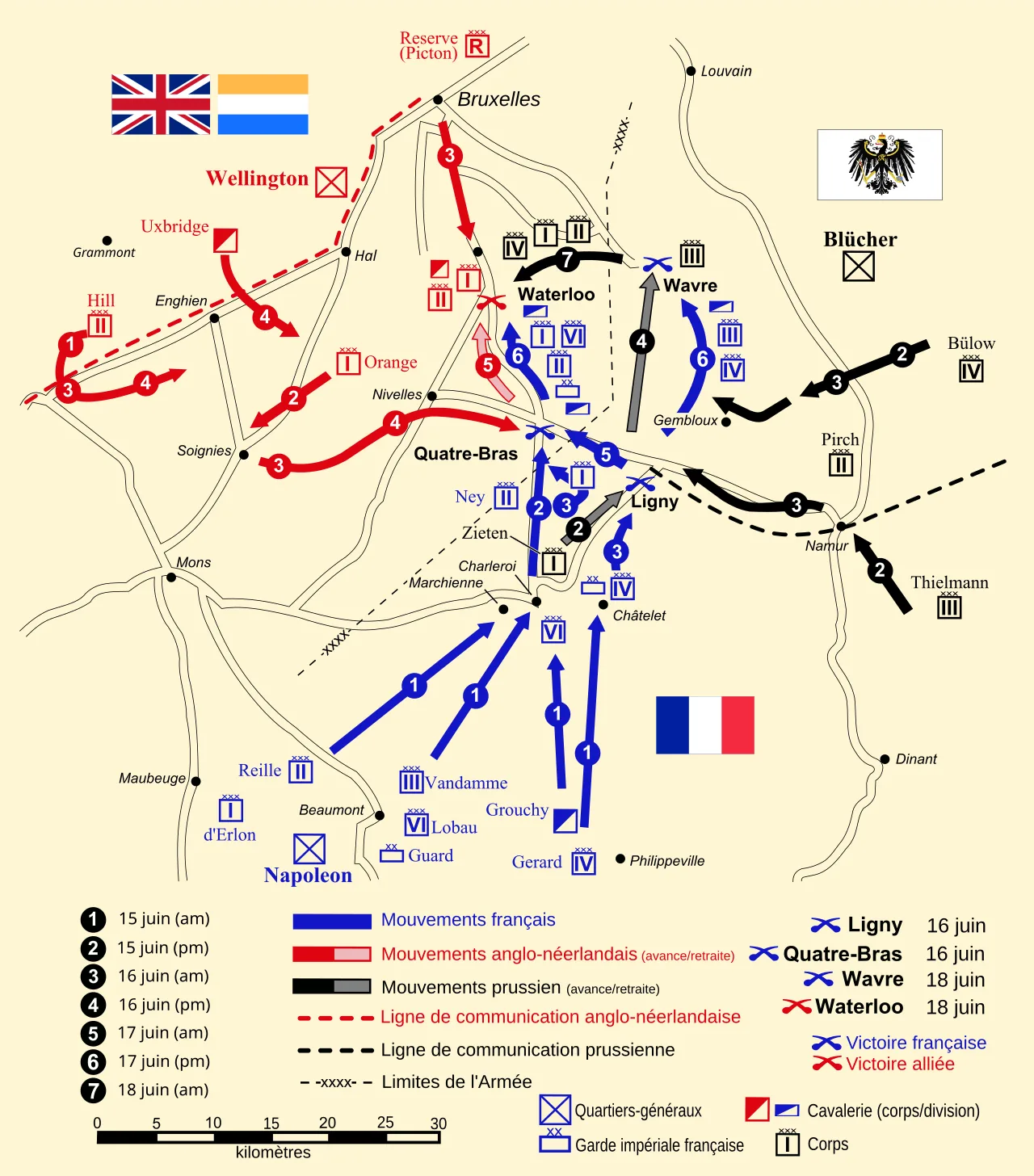
The Army of the North crossed the border near Charleroi before dawn on 15 June and swept aside the coalition outposts. Napoleon had secured the central position he was seeking, between the two enemy armies. He divided his forces into three: a left wing under Marshal Ney, a right wing under Marshal Grouchy, and a reserve kept under his own hand.
Wellington was caught off guard. During the night of 15 to 16 June, at the Duchess of Richmond's ball in Brussels, he learned how fast the French had advanced and ordered his army to concentrate at the Quatre Bras crossroads. Dutch officers, General Constant de Rebecque and Prince Bernhard of Saxe-Weimar, had already taken it upon themselves to hold that crossroads against his original orders: their initiative preserved the link between the two coalition armies.
On 16 June two battles were fought a few kilometres apart. At Ligny, Napoleon defeated Blücher, who lost some 12,000 men; the old marshal, aged 72, narrowly escaped capture after his horse went down. At Quatre Bras, Ney failed to carry the crossroads, and d'Erlon's corps, tossed between contradictory orders, marched all day between the two battlefields without fighting on either.
The campaign was decided the next day, and it slipped out of French hands. The Prussians did not fall back eastwards along their lines of communication but northwards to Wavre, parallel to Wellington's retreat and within supporting distance of him. Napoleon did not learn this in time. On 17 June it was only late in the morning that he gave Grouchy some 33,000 men to pursue the Prussians; he then joined Ney at Quatre Bras around 13:00 to find the position empty. Wellington had withdrawn to a ridge he had had reconnoitred the year before — Mont-Saint-Jean, south of the village of Waterloo and the Forest of Soignes. Rain and mud turned the pursuit into a laborious march, with no serious engagement beyond a cavalry action at Genappe.
The three armies
The Army of the North fielded between roughly 72,000 and 74,000 men at Waterloo, depending on the count, with more than 250 guns. It had not been filled out by conscription: its soldiers were mostly veterans, fiercely devoted to the Emperor. Its cavalry was numerous and formidable, with fourteen regiments of armoured heavy cavalry and seven of lancers. Its weaknesses lay elsewhere: officers had been posted as they reported for duty, many commanded men who did not know them, and the staffs were unused to working together. Marshal Soult, chief of staff in place of Berthier, who had not rejoined the Emperor, lacked his predecessor's precision.
Wellington's army, some 68,000 men on the field, was a mosaic: about 25,000 British, 17,000 Dutch and Belgians, 10,000 Hanoverians, 7,000 Brunswickers, 6,000 men of the King's German Legion and 3,000 Nassauers. Wellington would call it "an infamous army, very weak and ill-equipped". The British troops were regulars, often veterans of the Peninsular War; part of the allied contingents was young or had served in Napoleonic armies only a few years before. Wellington had also left 17,000 men at Halle, 13 kilometres to the west, against a possible outflanking move.
The Prussian army was in the middle of reorganisation: reserve regiments and Landwehr poorly equipped, artillery incomplete. It did, however, possess a remarkably well-trained general staff under Gneisenau, which allowed it to regroup after Ligny and intervene at Waterloo less than forty-eight hours later. Two and a half corps, about 48,000 men, would be engaged over the afternoon: Bülow's IV Corps, Zieten's I Corps and part of Pirch's II Corps.
The ground at Mont-Saint-Jean
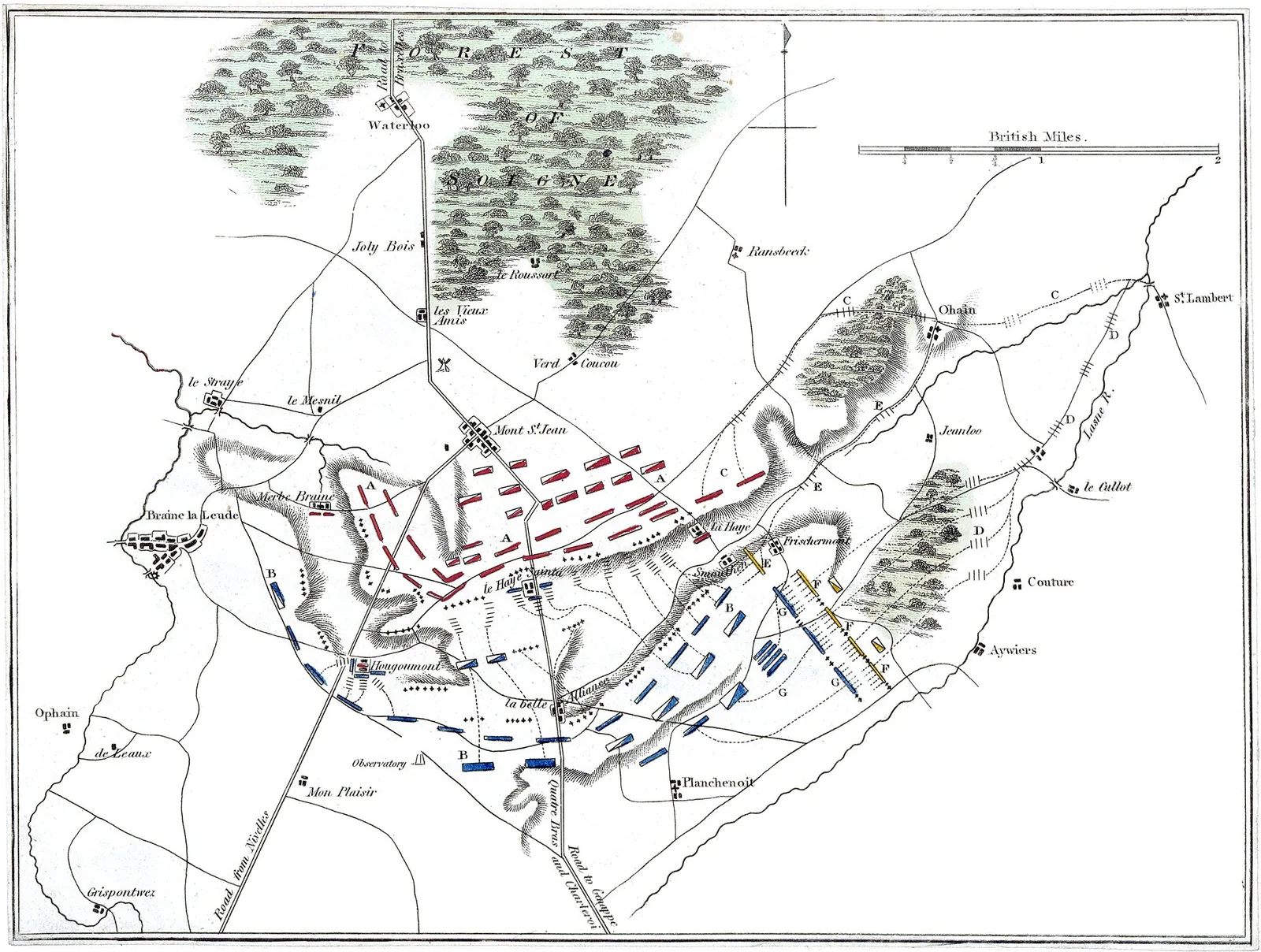
The battlefield lies in today's municipalities of Braine-l'Alleud and Lasne, about fifteen kilometres south of Brussels. Wellington's position was a long ridge running east to west, cut at right angles by the Charleroi–Brussels road. Along the crest ran the Ohain road, sunken in places. Near its junction with the main road stood an elm tree that served as Wellington's command post for much of the day.
True to his method, Wellington placed his infantry just behind the crest, on the reverse slope. The French could see only his skirmishers and artillery; the bulk of his battalions was sheltered from roundshot and from view. The front was short, about four kilometres, which allowed him to draw up his troops in depth in the centre and on the right while waiting for the Prussians to reinforce his left.
Three forward strongpoints locked the position. On the right, the château-farm of Hougoumont, with its walled garden, orchard and wood. In the centre, just west of the main road, the farm of La Haye Sainte, held by 400 men of the 2nd Light Battalion of the King's German Legion under Major Baring, with a sandpit occupied by the skirmishers of the 95th Rifles. On the left, the farms of Papelotte and La Haie, the hamlet of Smohain and the château of Frichermont, in country of sunken lanes and hedges that commanded the road by which the Prussians would come.
The French army deployed on another ridge about a kilometre to the south, on both sides of the main road, around the inn of La Belle Alliance. Unable to see the enemy's dispositions, Napoleon drew up his forces symmetrically: Reille's II Corps to the west, d'Erlon's I Corps to the east, the reserve cavalry behind them, Lobau's VI Corps and the Guard in the centre. Further back, on the French right, lay the village of Plancenoit and beyond it the Bois de Paris. A telling detail: Wellington had recent surveys of the ground, Napoleon the Ferraris–Capitaine maps of 1794.
The morning of 18 June
It had rained all night; the soldiers had slept in the mud, often without food. Wellington, up before dawn, had received Blücher's assurance that the Prussian army would march to his support, and resolved to give battle. At Wavre, Bülow's IV Corps, the only one not engaged at Ligny, led the march. Progress was slow: congested streets, sodden roads, a fire that blocked several of Wavre's streets. The tail of the corps did not leave the town until 10:00.
Napoleon had spent the night at the farm of Le Caillou, on the main road south of the battlefield. At the morning conference Soult suggested recalling Grouchy. The Emperor brushed him aside: according to witnesses, he declared that the English should not be made so much of, that he had ninety chances in a hundred of beating them and that it would be "no more than eating breakfast". He was also told of talk overheard at an inn in Genappe announcing that the Prussians would march over from Wavre; he replied that they needed at least two days to recover and that Grouchy would deal with them.
He delayed the attack. The sodden ground would hamper the cavalry and stop roundshot ricocheting; part of the army had bivouacked well to the south and had yet to come up. At 10:00 he answered a dispatch from Grouchy, directing him to head for Wavre in order to draw nearer. At 11:00 he dictated the general order: a diversionary attack on Hougoumont, then a bombardment of the allied centre by a grand battery, then an assault by d'Erlon's corps on Wellington's left to break through and roll up his line from east to west, separating it from the Prussians.
Hougoumont, the battle within the battle
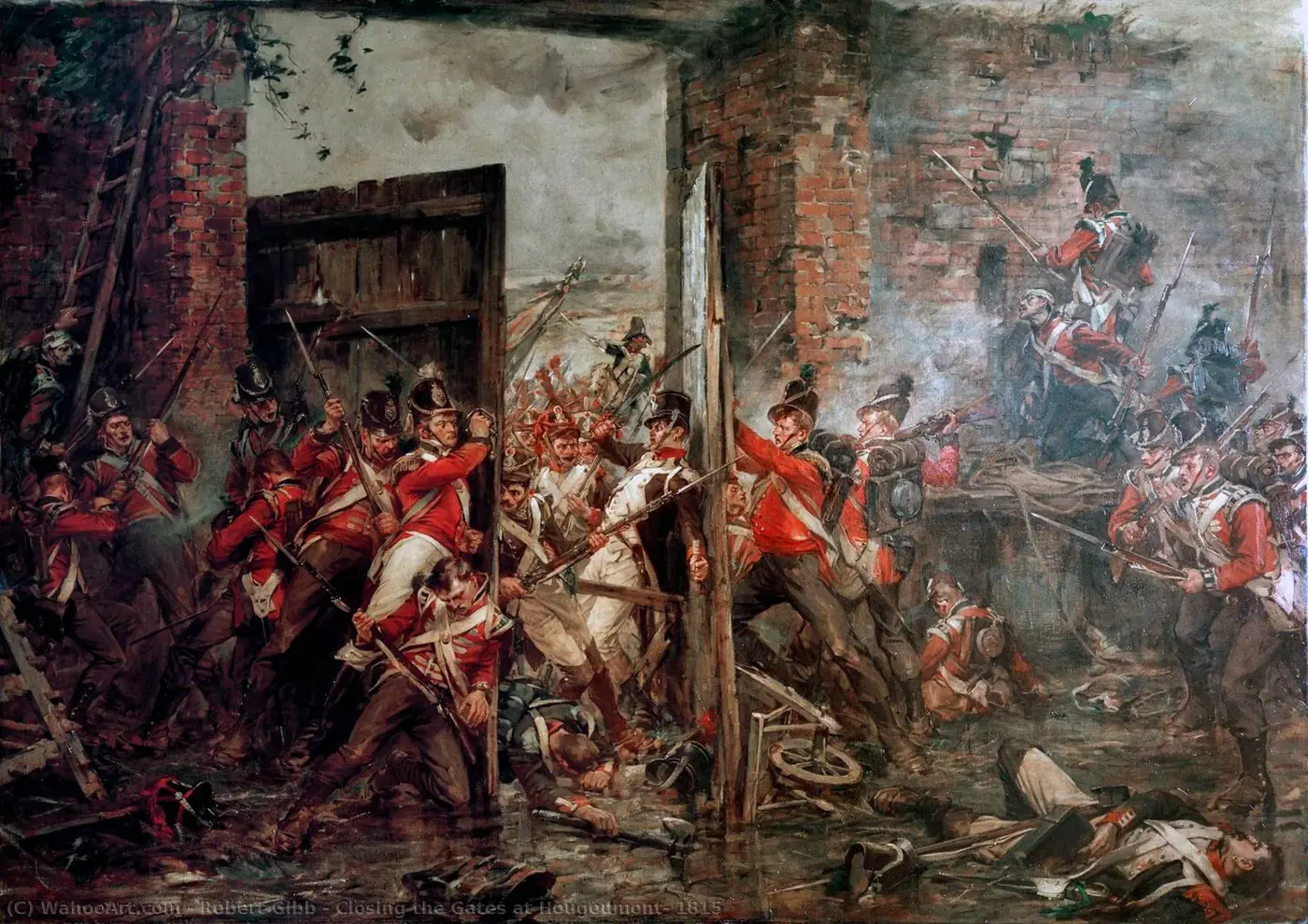
No one knows exactly when the battle began. Wellington wrote in his dispatch that the attack on Hougoumont started at about ten o'clock; most accounts place it around 11:30. Prince Jérôme's division, commanded by the Emperor's brother, attacked the wood and the park, defended by Hanoverian Jäger and a Nassau battalion; the château itself was held by four light companies of the Foot Guards under Lieutenant-Colonel Macdonell.
Bauduin's brigade cleared the defenders from the wood but broke under British artillery fire, and its general was killed. A second wave, led by Soye's brigade, reached the north gate of the farm. Sous-lieutenant Legros smashed it open with an axe and a handful of Frenchmen got into the courtyard. The guardsmen managed to close the gate behind them; the trapped attackers were killed. Wellington would later say that the success of the battle had turned upon closing the gates at Hougoumont.
The fighting never stopped all day. In the afternoon Napoleon had the buildings shelled to set them on fire: everything burned except the chapel. What was meant to be a diversion became a sinkhole. The French committed 33 battalions in all, about 14,000 men; Wellington devoted 21 battalions, about 12,000 men, to keeping open the hollow way that supplied the farm. Historians still debate who pinned down whose reserves; what is certain is that Hougoumont never fell.
The grand battery and d'Erlon's attack
In the centre, some 80 guns came into battery. They opened fire between 11:50 and 13:30 depending on the source. They caused significant losses, but the battery was too far back, the soft ground smothered the roundshot, and the reverse slope hid most targets: the French could see little more than skirmishers and a Dutch brigade posted forward.
At about 13:15 Napoleon saw in the distance, towards Chapelle-Saint-Lambert, six to eight kilometres off his right, the first Prussian columns. He had Grouchy ordered to draw near and fall upon them, and detached Lobau's corps to bar their way. But Grouchy was already engaged at Wavre against Thielmann's Prussian rearguard. His subordinate Gérard had urged him to march to the sound of the guns; he kept to his orders. Soult's letter would not reach him until after 20:00.
At about 13:30 d'Erlon's I Corps moved off: four divisions, those of Quiot, Donzelot, Marcognet and Durutte, some 14,000 men on a front of one kilometre. They advanced in deep masses, each division formed of its battalions deployed one behind another at five paces' interval — a formation the strategist Jomini would later call inconceivable. On the left, one brigade isolated La Haye Sainte; cuirassiers cut to pieces a Hanoverian battalion sent to relieve it.
Facing the other three divisions stood some 6,000 men: Bylandt's Dutch brigade in the front line, and the British brigades of Kempt and Pack lying behind the crest, under Picton's command. Bylandt's brigade, exposed out in front, gave way. The French reached the Ohain road, pushed through the hedge and drove back the Scottish regiments. Picton was killed shortly after ordering a counter-attack. For a few minutes, early in the afternoon, the battle seemed to be turning in Napoleon's favour.
The charge of the British heavy cavalry
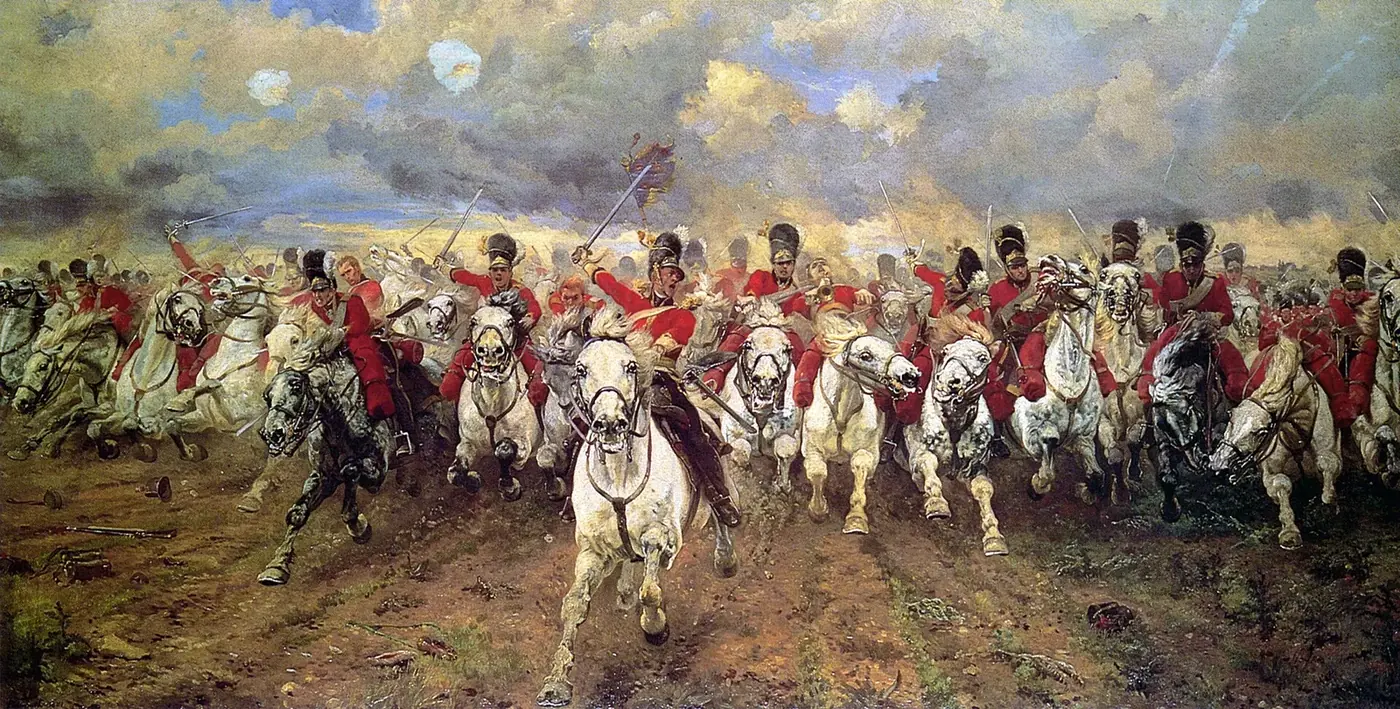
This was the moment Lord Uxbridge, commander of Wellington's cavalry, chose to launch his two heavy cavalry brigades, massed out of sight behind the ridge. West of the main road, General Somerset's Household Brigade — Life Guards, Royal Horse Guards, King's Dragoon Guards; east of it, General Ponsonby's Union Brigade, so called because it combined an English, a Scottish and an Irish regiment: the Royal Dragoons, the Scots Greys and the Inniskillings. Some 2,000 horsemen in all, on better horses than those of any army on the continent.
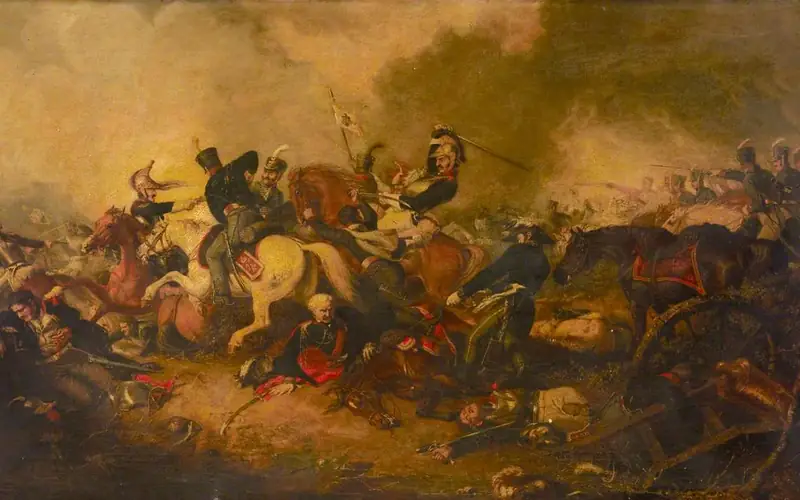
The shock was devastating. The cuirassiers covering the French left were swept away; d'Erlon's masses, caught while deploying, could not form square and broke. The Royal Dragoons took the eagle of the 105th of the Line, the Scots Greys that of the 45th: they would be the only two eagles captured by the British during the battle. I Corps streamed back across the valley in disorder, leaving behind some 3,000 men, including more than 2,000 prisoners.
But the troopers, carried away, did not stop. They rode on to the guns of the grand battery, on blown horses, without order and without reserves. Napoleon launched Milhaud's cuirassiers and Jacquinot's lancers against them. The counter-charge was deadly. Ponsonby, caught by a lancer, was killed; so was Colonel Hamilton, commanding the Scots Greys. The two brigades officially lost 1,205 men and 1,303 horses over the day. Uxbridge would admit that he had made a great mistake in leading the charge himself instead of organising its support. Even so, it took until 16:00 for d'Erlon's corps to be fit to fight again.
Ney's cavalry charges
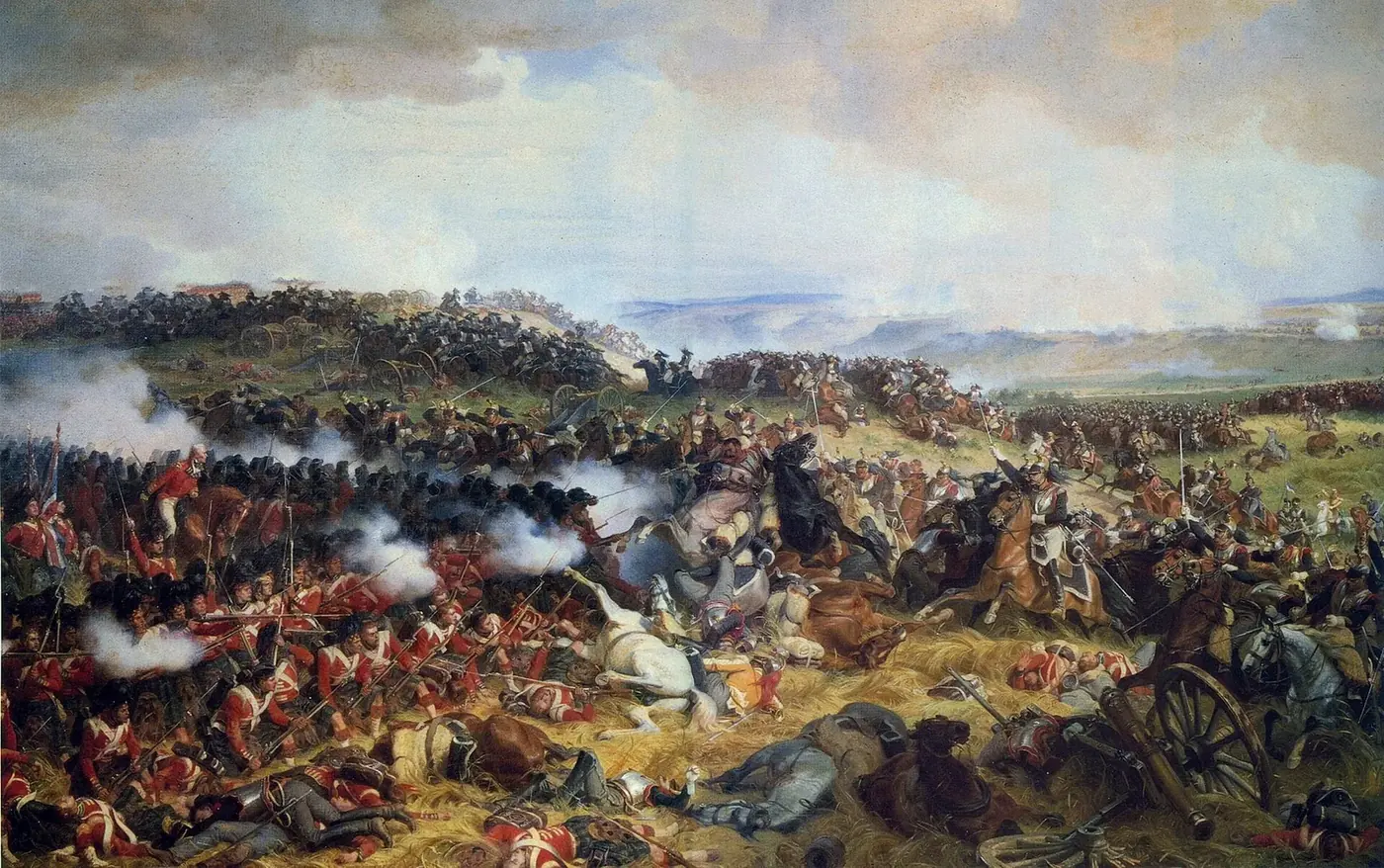
A little before 16:00, Ney thought he saw a withdrawal in the allied centre; it was in fact the flow of wounded and wagons to the rear. He had little infantry left to hand, the rest being engaged at Hougoumont or detached against the Prussians. He therefore tried to break Wellington's centre with cavalry alone: first Milhaud's cuirassiers and Lefebvre-Desnouettes' Guard light cavalry, some 4,800 sabres; then, when they were repulsed, Kellermann's heavy cavalry and Guyot's Guard heavy cavalry. In all, around 9,000 horsemen in 67 squadrons charged between Hougoumont and La Haye Sainte. Seeing the charge, Napoleon judged that it had come an hour too soon, but that what had been started must be supported.
The allied infantry formed squares, four ranks deep. They were far smaller than in paintings: a battalion of 500 men made a square less than twenty metres a side. The gunners fired until the last moment, took shelter inside the squares as the horsemen closed, then ran back to their guns to fire into the retiring squadrons. The French, strangely, did not spike the guns they overran between waves. British witnesses would count a dozen assaults. Captain Mercer, judging the Brunswickers around him unsteady, kept his battery in action through every charge.
A horse will not throw itself onto a hedge of bayonets, and cavalry alone can do nothing against a square that holds. The charges broke one after another. They cost the elite of the French cavalry dearly: the Guard heavy cavalry division lost 47 per cent of its strength, and the Grenadiers à Cheval fell from 796 men on 15 June to 462 on the 19th. Ney finally organised a combined attack with Bachelu's infantry and a regiment from Foy's division, some 6,500 men; it came too late and fell back under fire. The episode inspired Victor Hugo's "sunken road" in Les Misérables, into which the cuirassiers tumble; in reality the lane was sunken for only about 150 metres, and no contemporary account reports any such slaughter.
Plancenoit: the Prussians enter the battle
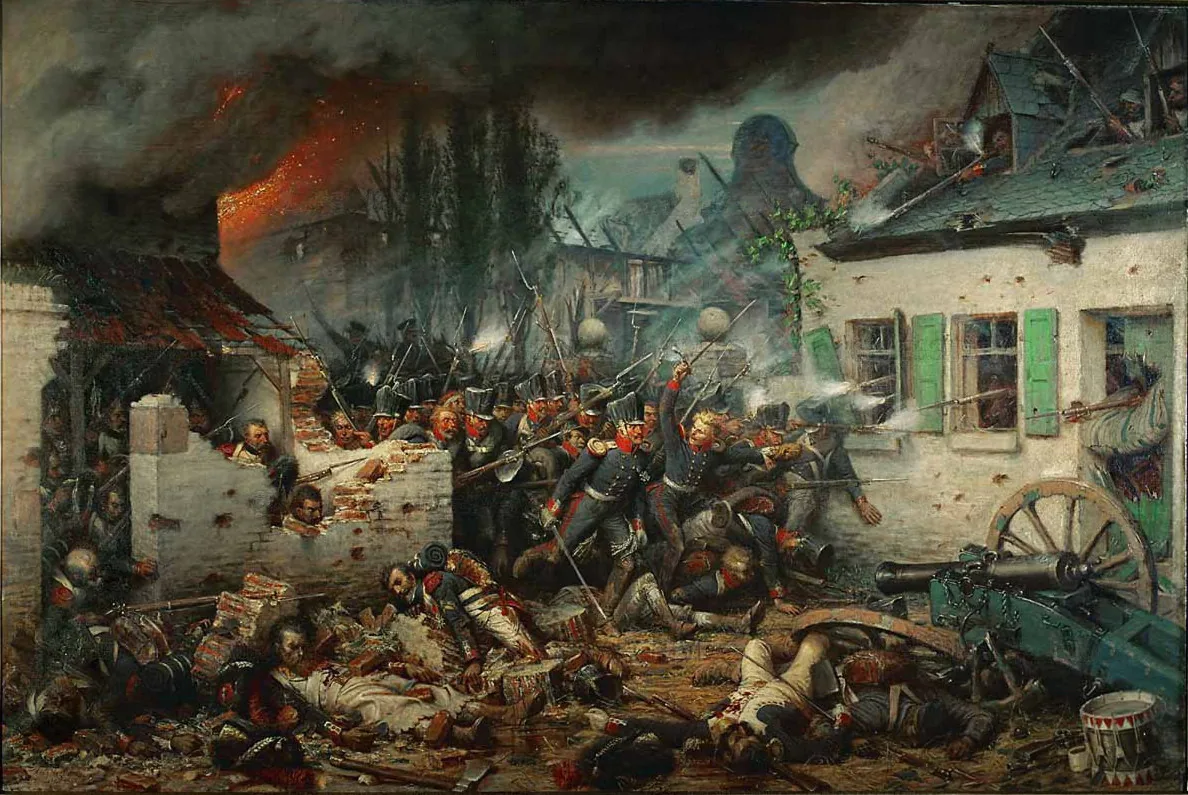
At 16:30 Bülow observed that the road to Plancenoit lay open. The village, in the rear of the French right, commanded the Charleroi road, the Army of the North's only line of retreat. The Prussian 15th Brigade drove Lobau's troops out of the château of Frichermont with the bayonet and linked up with the Nassauers on Wellington's left, while the 16th Brigade advanced on Plancenoit with six battalions. Lobau, heavily outnumbered, fell back on the village.
Napoleon had to send in the Young Guard, eight battalions under General Duhesme. It retook Plancenoit after bitter fighting, then was driven out in its turn. The Emperor then committed two battalions of the Old and Middle Guard, which recaptured the village with the bayonet without firing a shot. Plancenoit would change hands five times that evening: around the burning church and the churchyard turned into a redoubt, the fighting went from house to house, with no quarter given.
The Prussian intervention cannot be measured only by the troops it committed. It forced Napoleon to withdraw part of his reserves, the Young Guard among them, from the battle against Wellington at the very moment the Anglo-allied centre was beginning to give. Wellington acknowledged it in his dispatch: Bülow's operation on the enemy's flank was "a most decisive one".
The fall of La Haye Sainte
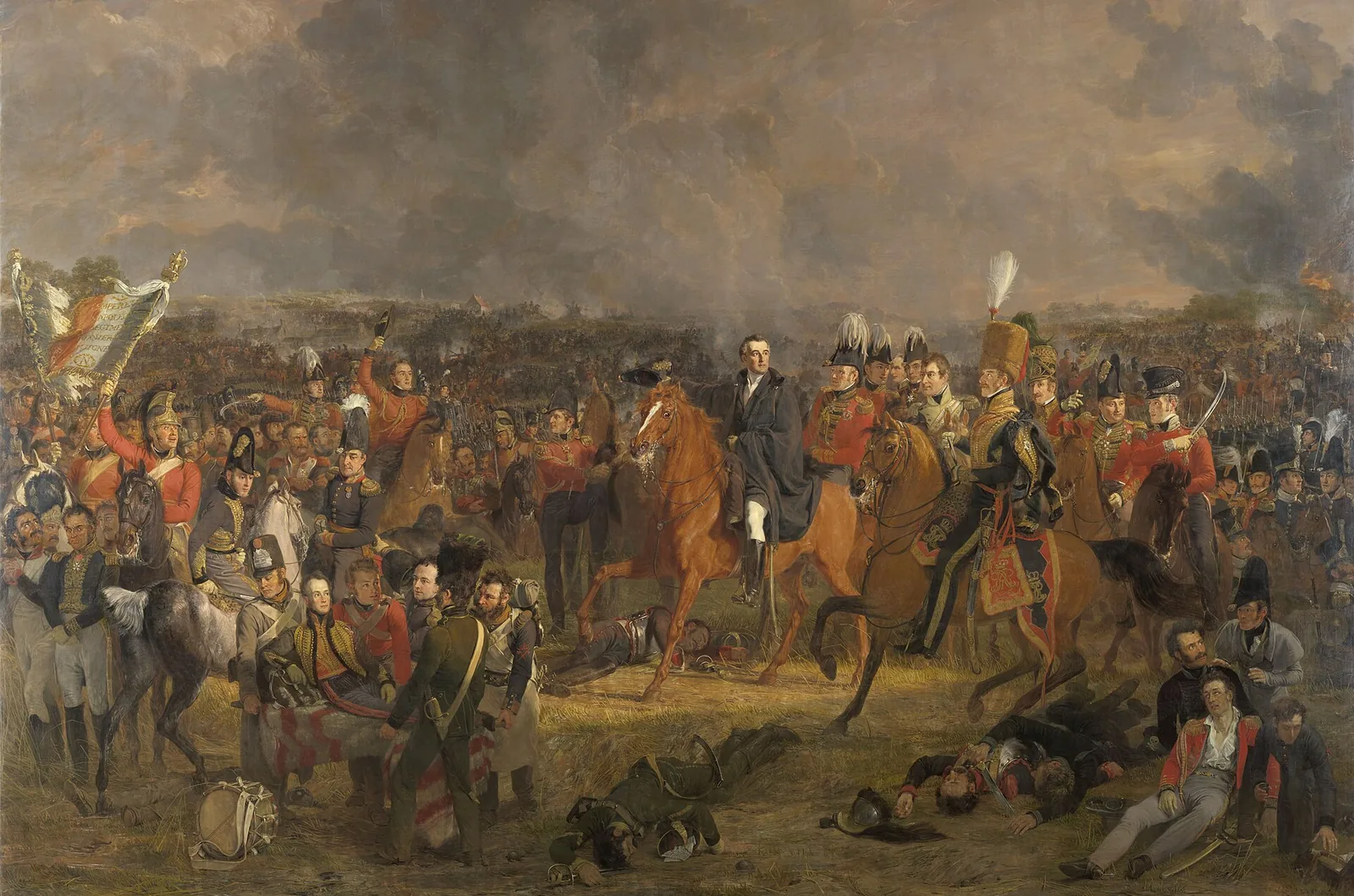
At around 18:30, as Ney launched his combined attack, rallied elements of d'Erlon's corps led by the 13th Light Infantry at last took La Haye Sainte. The King's German Legion had held the centre of the battlefield for almost the whole day; they had run out of ammunition. The survivors fell back to the ridge.
The loss of the farm laid bare the very centre of Wellington's army. Ney pushed skirmishers and horse artillery forward, firing canister into the squares at a few dozen metres. The 30th and 73rd Regiments, cut to pieces, had to merge into a single square; the 27th Inniskillings lost two thirds of their strength without being able to leave their formation, pinned by the threat of cavalry. The colours of Halkett's brigade were sent to the rear, a measure without precedent. Sent to retake the farm with one Legion battalion, Colonel Ompteda was killed and his battalion destroyed by cuirassiers.
Around Wellington, officers were falling: his military secretary FitzRoy Somerset, his aide-de-camp Canning, his quartermaster-general De Lancey and Generals Alten and Cooke were killed or wounded. This was the moment of greatest danger for the Anglo-allied army. Wellington would write that the time the Prussians took to arrive seemed interminable: "both they and my watch seemed to have stuck fast".
Zieten on the Anglo-allied left
Meanwhile Zieten's Prussian I Corps was arriving on Wellington's extreme left, near La Haie and Papelotte. The junction nearly failed. Seeing wounded men and Nassau stragglers streaming back, and having received an order from Blücher to support Bülow, Zieten began to swing towards Plancenoit. General Müffling, the Prussian liaison officer with Wellington, caught up with him and convinced him that the battle was lost unless his corps came at once to support the English army.
Zieten resumed his march. His arrival allowed Wellington to thin out his left and bring Vivian's and Vandeleur's light cavalry brigades, still intact, to the centre. For the French the moral effect was terrible: they had been expecting Grouchy, and it was Prussians who appeared. By about 19:30 the French line was bent into a horseshoe, anchored on Hougoumont on the left, Plancenoit on the right and La Haie in the centre.
The attack of the Guard
With La Haye Sainte taken and the Plancenoit front stabilised for the moment, Napoleon committed his last reserve at about 19:30: the infantry of the Imperial Guard, never yet defeated. The attack was made by five battalions of the Middle Guard, formed in squares of about 550 men each, with horse artillery between them; three battalions of the Old Guard followed in a second line without reaching the crest. Ney, riding his fifth horse of the day, led the assault, but angled towards the allied centre-right instead of attacking straight at the centre.
On the right, the grenadiers under Friant and Poret de Morvan overthrew Halkett's British brigade, whose general was badly wounded in the face; the Prince of Orange, leading a counter-attack, was wounded in turn. At this point the Dutch general Chassé, on his own initiative, brought his division forward: Captain Krahmer de Bichin's horse battery took the grenadiers in the flank, and Detmers' brigade charged with the bayonet. The grenadiers gave way.
Further left, the chasseurs of the Guard climbed a crest that seemed deserted. Behind it lay 1,500 Foot Guards under General Maitland, lying down to escape the artillery. They rose and fired at point-blank range: some 300 chasseurs fell at the first volley, General Michel among them. The 4th Chasseurs, 800 strong, drove back the British guardsmen for a moment, until the 52nd Light Infantry under Colonel Colborne wheeled onto their flank, crushed them with fire and then charged.
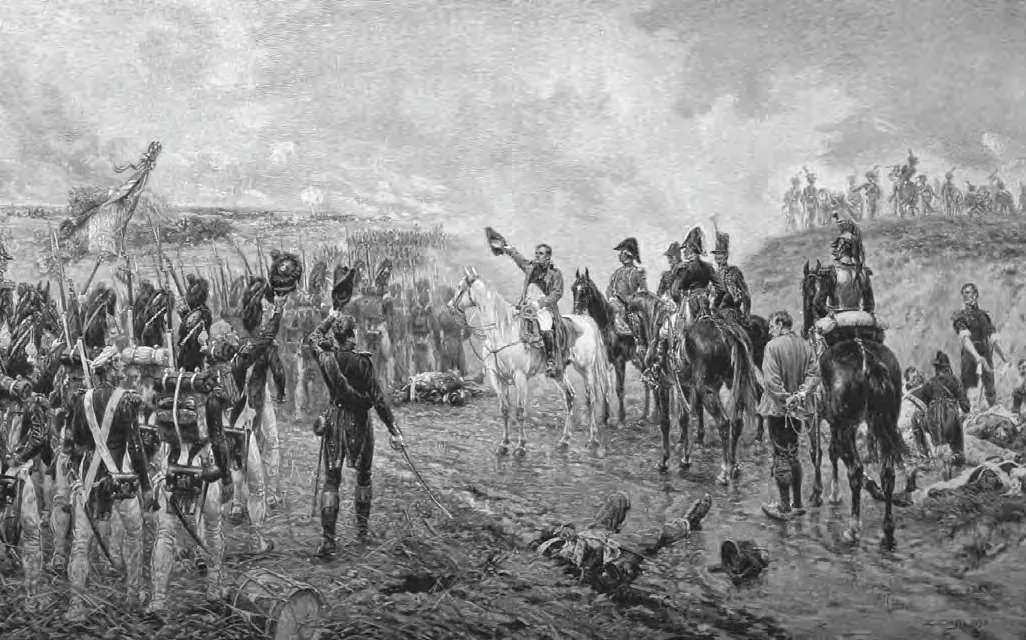
The Guard fell back. The news ran through the French army like a shock wave: "La Garde recule! Sauve qui peut!" — "The Guard is retreating! Every man for himself!" Wellington rose in his stirrups and waved his hat to signal a general advance. The whole Anglo-allied line came down from the ridge.
The rout and the meeting at La Belle Alliance
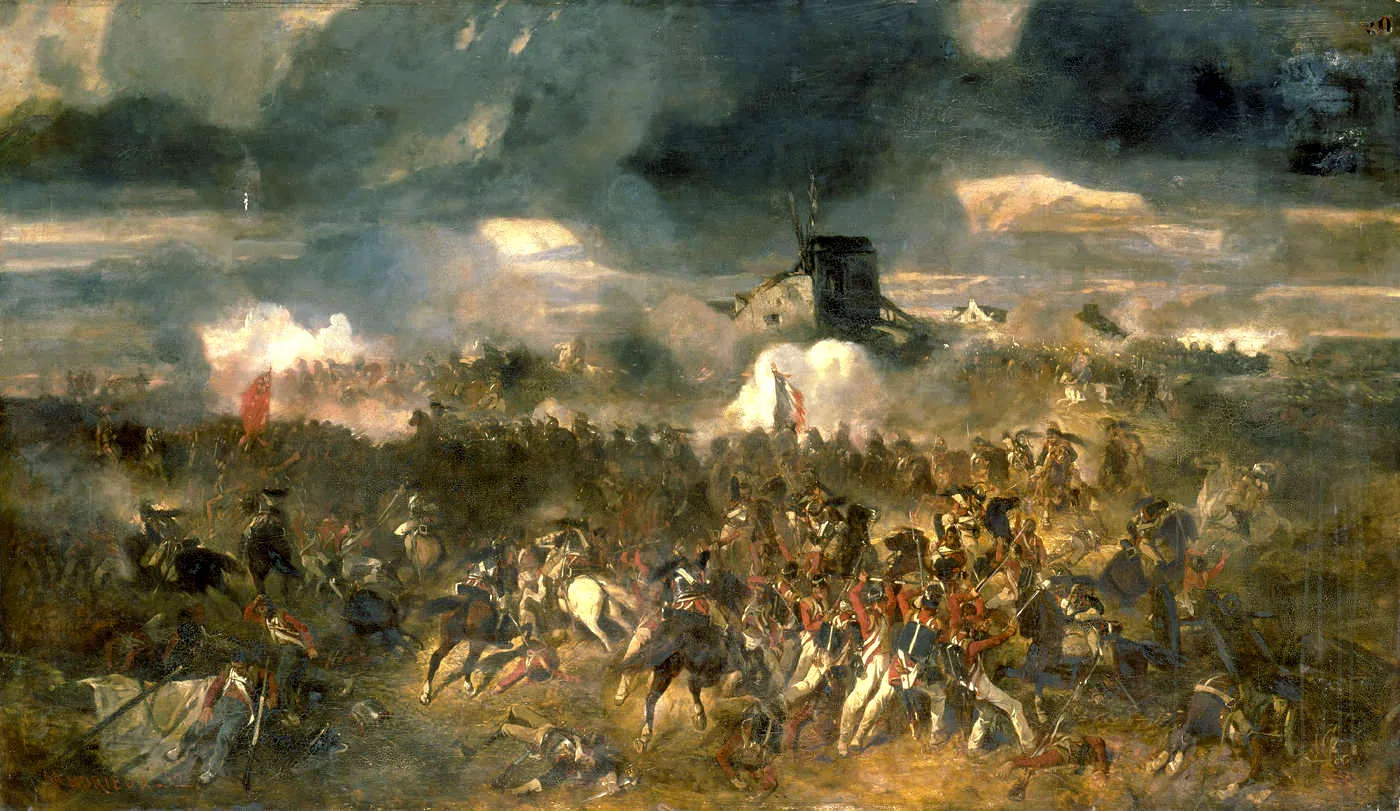
The remnants of the Guard rallied on the reserve battalions south of La Haye Sainte for a last stand. Adam's British brigade, the Hanoverian Osnabrück Landwehr and the cavalry of Vivian and Vandeleur broke them apart. It was during this retreat that squares of the Guard, summoned to surrender, are said to have answered: "The Guard dies, it does not surrender!" The phrase, attributed to General Cambronne, is probably apocryphal; legend also credits him with a shorter word. Cambronne, badly wounded, was taken prisoner.
At the same moment the Prussian brigades of Pirch and Bülow took Plancenoit for the last time, turning the village through the Chantelet wood. The Guard withdrew in order, crying "Let us save our eagles!", before being swept up in the tide of fugitives. The Young Guard division would report 96 per cent casualties; two thirds of Lobau's corps had ceased to exist. Two battalions of the Old Guard still stood in square on either side of La Belle Alliance to cover the retreat; Napoleon stayed in the left-hand square until he was persuaded to leave.
At about 21:00 Wellington and Blücher met. Tradition places the scene in front of the inn of La Belle Alliance, whose name seemed predestined; it more probably took place a little further south, on the Genappe road. The Prussians would call the battle "La Belle Alliance"; the French at first called it the battle of Mont-Saint-Jean. Wellington, writing his dispatch from his headquarters in the village of Waterloo, gave it the name that stuck.
The exhausted Anglo-allied army halted. The pursuit was left to the Prussian cavalry, which Gneisenau drove on as far as Genappe at about 23:00. There, in the jam at the bridge over the Dyle, the Prussians captured Napoleon's carriage and his diamonds. Some 78 guns and 2,000 prisoners were taken during the night. The Army of the North no longer existed.
The human cost
After Borodino, Waterloo was the bloodiest single-day battle of the Napoleonic Wars. Wellington lost some 17,000 killed and wounded, Blücher about 7,000 — 810 of them in the Prussian 18th Regiment alone, engaged first at Frichermont and then at Plancenoit. French losses came to 24,000 or 26,000 killed and wounded, including 6,000 to 7,000 prisoners, to which must be added some 15,000 men who deserted in the following days.
Witnesses who walked the field in the days that followed described thousands of wounded lying without help among the corpses of men and horses. The dead were hastily buried in mass graves, a task that took at least ten days. Yet none of those graves has ever been found: according to research by the historians Bernard Wilkin and Robin Schäfer, local farmers later dug up human and animal bones to sell to a nearby sugar factory, which turned them into bone char for refining.
"The nearest-run thing you ever saw in your life": so Wellington summed up the day. The phrase conveys both the victory and the narrow margin that separated it from defeat.
Grouchy and the causes of defeat
While Waterloo was being fought, Grouchy was engaging General Thielmann's Prussian rearguard at Wavre. He defeated it on the morning of 19 June, then withdrew in good order towards France on learning of the disaster. His 33,000 men never appeared on the battlefield. From Saint Helena, Napoleon laid a large share of the blame on him. Historians are more divided: the orders Grouchy received were late and ambiguous, the first message calling him towards Waterloo reached him only in the evening, and nothing proves he could have arrived in time, even had he marched to the guns at midday.
The strategist Jomini, a contemporary, identified four causes: Blücher's skilfully combined arrival; the admirable firmness of the British infantry and the composure of its commanders; the dreadful weather, which had softened the ground and delayed until one o'clock an attack that should have been made in the morning; and the inconceivable formation of I Corps in masses far too deep. Clausewitz, chief of staff of Thielmann's corps during the campaign, rejected the idea of a victory lost to bad luck or treachery: he saw instead the effect of grave errors and of an ambition that outran its means.
Modern historiography stresses the interplay of the two coalition armies. Without Wellington's resistance, the Prussian intervention would have come too late; without Blücher, Wellington, his centre almost shattered and his reserves committed, could hardly have held against an intact Guard. Historians also point to the delegation of tactical command to Ney, cavalry charges launched without infantry, slowness in gauging the Prussian threat, and a day's delay lost on 17 June.
Consequences: the end of the Empire
Napoleon left the battlefield and reached Paris on the morning of 21 June. He still thought of raising an army, but the Chamber of Representatives, at Lafayette's urging, declared itself in permanent session to forestall any dissolution. Deprived of political support, the Emperor abdicated on 22 June in favour of his son; the Chambers ignored that clause. The coalition armies entered Paris on 7 July, and Louis XVIII regained his throne.
Having taken refuge at Rochefort, Napoleon gave up the idea of reaching America and surrendered on 15 July to Captain Maitland aboard HMS Bellerophon. The British government deported him to Saint Helena, where he died in 1821. The second Treaty of Paris, signed on 20 November 1815, made France pay for the Hundred Days: loss of the territories returned in 1814, an indemnity of 700 million francs and several years of occupation.
In the longer run, Waterloo closed twenty-three years of almost uninterrupted war born of the Revolution. The Europe of the Congress of Vienna would see no further major conflict between great powers until the Crimean War, nearly forty years later. The United Kingdom emerged as the dominant power at sea and Prussia strengthened in Germany. In English, "meeting one's Waterloo" has come to mean a final, crushing defeat.
Memory: from the Lion's Mound to Les Misérables
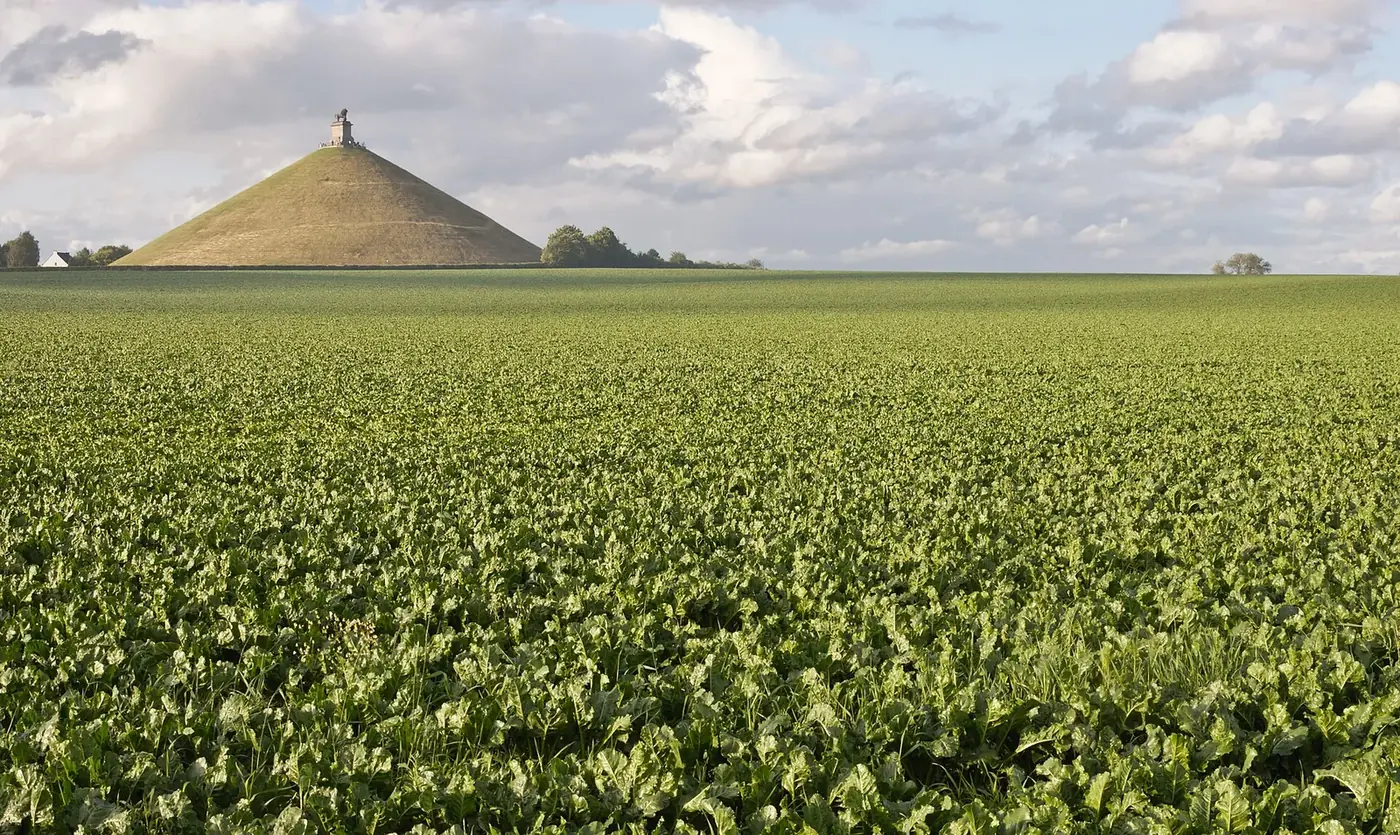
Tourism began the day after the battle: on 19 June Mercer already saw a carriage from Brussels set down sightseers on the field. King William I of the Netherlands had an artificial hill topped by a lion raised in the centre of the Anglo-allied line, where his son the Prince of Orange had been wounded: the Lion's Mound. Some 300,000 cubic metres of earth were taken from the ridge itself, removing the bank of the Ohain road. Hougoumont, La Haye Sainte and La Belle Alliance, on the other hand, still stand, as do the fields east of the main road.
At the crossroads of the main road and the Ohain road, several monuments mark the graves of British, Dutch, Hanoverian and King's German Legion soldiers. A monument to the French dead, the Wounded Eagle, stands where one of the last squares of the Guard is believed to have formed; a Prussian monument stands at Plancenoit. In Britain, the 1st Foot Guards, thought to have defeated the grenadiers of the Old Guard, were given the title of Grenadier Guards and adopted their bearskin.
In France the defeat became a literary myth. Victor Hugo made it the cry of "L'Expiation" in Les Châtiments — "Waterloo! Waterloo! Waterloo! dismal plain!" — then devoted a whole book of Les Misérables to the battle, where the sunken road and Cambronne's word passed into legend. Two centuries later, memory remains sensitive: in 2015 France protested against a Belgian two-euro coin marking the bicentenary, and Belgium had it melted down and reissued it at a non-standard face value.
Discover other battles
 Victory
 Read the account
Ligny
16 June 1815
Ligny, Belgium
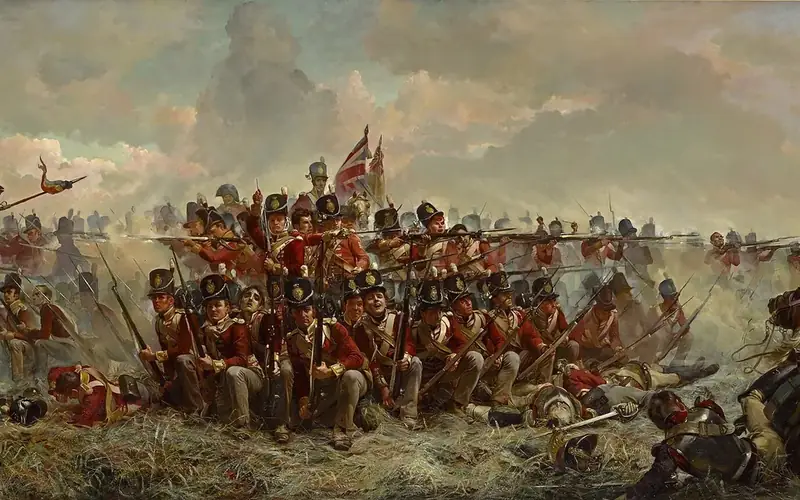 Inconclusive
 Read the account
Quatre Bras
16 June 1815
Quatre Bras, Belgium
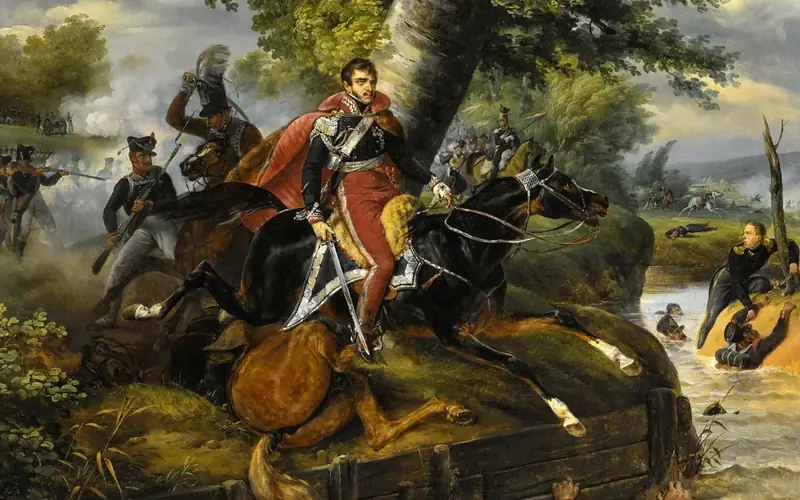 Defeat
 Read the account
Leipzig
16-19 October 1813
Leipzig, Saxony (Germany)
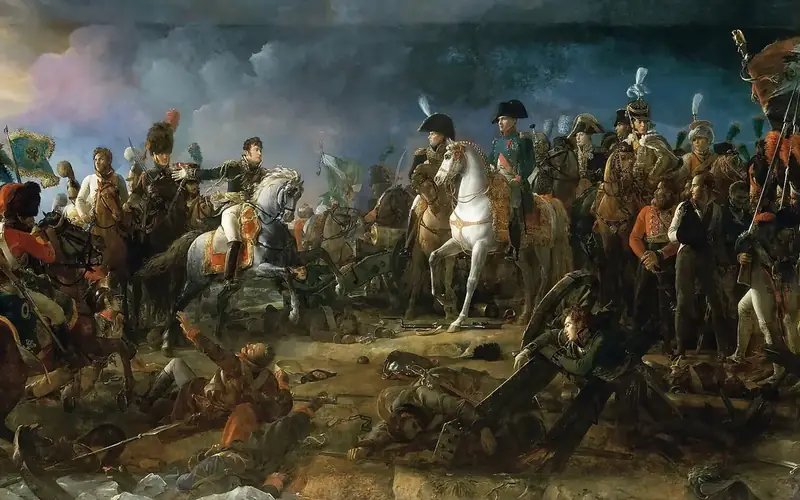 Victory
 Read the account
Austerlitz
2 December 1805
Pratzen plateau, Moravia (Czech Republic)
Go further
Recommended books to dig deeper (affiliate links)

Napoleon the Great
Andrew Roberts · 2014
A monumental biography drawing on Napoleon’s 33,000 surviving letters, admiring but rigorous.
See on Amazon
Napoléon ou le mythe du sauveur
Jean Tulard · 1977
The book that reshaped how the man is read: how France gave itself a saviour, and what it cost.
See on Amazon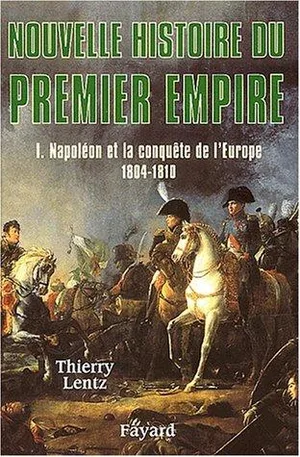
Nouvelle histoire du Premier Empire
Thierry Lentz · 2002-2010
Four reference volumes on institutions, diplomacy and collapse: the scholarly synthesis of the subject.
See on AmazonAs an Amazon Associate, this site earns from qualifying purchases.
Support the encyclopedia
Napoleon Empire is an independent project. Your contribution helps grow the content and keep the site running.
DonateSecure payment on the platform you choose.