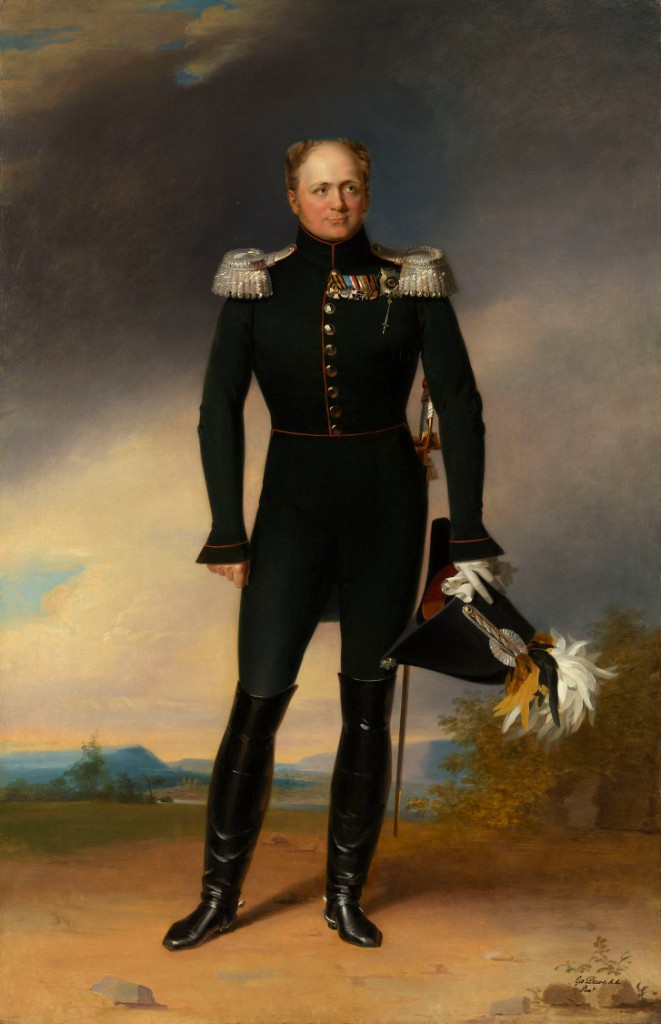
Alexander I Pavlovich (23 December 1777 Saint Petersburg-19 November 1825 Taganrog, Julian calendar then in use) came to the throne in 1801 after his father Paul I’s deposition and death in a palace coup of which he was both beneficiary and traumatised witness. Raised between Enlightenment rationalism and Orthodox mysticism, Grand Duke Alexander first embodied hope of a « regenerated » monarchy: he spoke of constitutions, tolerance, a Europe of rights; coalition geopolitics and clash of armies soon imposed another schooling. From the Third Coalition to Austerlitz, from Prussian and Polish campaigns to Friedland, he learned French tactical superiority and the need to buy time. The Tilsit meetings on the Niemen in July 1807 sealed a Franco-Russian alliance and a division of spheres that fascinated courts and alarmed London; they did not resolve the structural clash between a Russian economy dependent on maritime exports and the Continental Blockade Napoleon sought to impose on all Europe. The following years mixed diplomatic complicity — Congress of Erfurt, mediation impulses — and growing friction over neutral ports, Poland’s fate, Finland wrested from Sweden in the war of 1808-1809. In 1812 the Grand Army’s invasion put Russian strategic patience centre stage: successive retreats, bloody Battle of the Moskva (Borodino), abandonment then burning of Moscow, wearing the enemy by space and climate. Alexander did not claim cavalry genius: he played the sovereign who arbitrated military factions, who sanctified national resistance without controlling each skirmish. The Russian retreat changed the European balance; in 1813-1814 Russia bore the weight of a rebuilt coalition, and the emperor entered Paris as a theatrical liberator, mixing personal charisma and treaty calculus. At the Congress of Vienna then in the Holy Alliance he embodied monarchical conservatism against the ideas of 1789, at the price of an ambivalent reputation among liberals. His death at Taganrog in 1825, in murky circumstances, opened a dynastic crisis the Decembrists would highlight. For Empire Napoléon Alexander I remains the most durable continental adversary: the one who survived the greatest military concentration of the modern era and imposed on Europe a counter-model of empire built on territorial depth, coalition diplomacy and the religious memory of the patriotic war.
Grand Duke at Catherine’s Court, Heir under Paul I
Born in Saint Petersburg in 1777, Alexander grew up under grandmother Catherine II as much as under the conflicted authority of parents Grand Duke Paul and Maria Feodorovna. Education mixed foreign tutors, languages, mathematics, history and early sensitivity to Enlightenment ideas — Voltaire read in secret, reform projects whispered in antechambers. The young grand duke learned early that the Russian throne passes not only by birth: it is won by regiments, guards, palace coups whose winter palace walls kept memory of putsches.
Paul I, who came to the throne in 1796 after Catherine’s long death, embodied a wilful, nervous monarchy obsessed with Prussian uniform and the least court gestures. Son Alexander, married in 1793 to Louise of Baden (future Elizabeth Alexeievna), lived in constant tension between filial piety and political worry: the father alienated the military elite, relit quarrels with London, displeased the guards. Conspiracies formed; in March 1801 officers murdered Paul at Saint Michael’s Castle. Alexander, informed or tolerant by interpretation, took the throne promising a « reign of justice » erasing parental arbitrariness.
The bloody accession long marked the tsar: he presented himself as liberator of subjects from paternal excess, but bore guilt of a son who survived his father’s fall. That moral wound fed both his philanthropic speeches and mistrust of plots — a paradox the 1820s would illustrate. For Napoleonic historians young Alexander of 1801 was already double: idealist of state projects and heir trained in bayonet reality.
Early reign years swung between symbolic measures — partial amnesties, consultations on constitutions for Poland or Baltic lands — and consolidation of personal power. Revolutionary then consular Europe watched this monarch with a gentle face and intense gaze: Napoleon Bonaparte, First Consul then emperor, read him as a possible interlocutor as much as an unavoidable geographic foe.
When the Third Coalition erupted Alexander was not yet twenty-eight: he entered war with the enthusiasm of a sovereign who believed he carried a crusade against « French militarism », without fully measuring the gap between chancellery rhetoric and the brutality of pitched battles. Austerlitz on 2 December 1805 taught the lesson: the Russo-Austrian army broken on Moravia’s frozen lakes, Francis II forced to capitulate, the image of a continental Europe reorganised under Napoleon’s baton.
Eylau, Friedland and the Niemen Theatre: Tilsit
The 1806-1807 campaign placed Alexander at the heart of the Fourth Coalition: after Jena and Auerstedt the Prussian army collapsed; Russians became the eastern pillar of resistance. At Eylau in February 1807 the battle in snow opposed gigantic masses; neither Napoleon nor Bennigsen won a clear victory, but the tsar grasped the cost of attrition war against the French machine. The following months mixed manoeuvres in East Prussia and Poland until Friedland, where on 14 June 1807 Russian crushing opened the way to peace.
On the Niemen banks in July 1807 Alexander and Napoleon met in a setting of rafts and floating pavilions — staging worthy of opera, but brutally concrete stakes: partition of Prussia, creation of the Duchy of Warsaw, influence in northern Germany, promise of cooperation against London. The Treaties of Tilsit froze a Franco-Russian alliance dividing Europe into two great systems: the continent under French hegemony with Russia as privileged associate, and British maritime power isolated but unbeaten.
For Alexander Tilsit was both strategic relief and dangerous commitment: he saved the army, avoided occupation of the capital, but tied dynastic prestige to the fortune of a Corsican emperor who did not long tolerate partners’ economic independence. Russian diplomats, Caulaincourt as ambassador at Saint Petersburg, watched day after day the gap between fraternal banquets and trade figures: the Continental Blockade strangled exports of timber, hemp, grain to neutral markets.
The Saint Petersburg court lived Tilsit as shameful truce or chance of modernisation, by clans. Alexander himself alternated personal fascination with the Emperor of the French — talks, gifts, joint projects to « reorganise » Europe — and growing lucidity on the impossibility of equal sharing between two messianic empires. That ambivalence prepared the break of 1810-1812 directly.
In strictly Napoleonic terms Tilsit represents continental apogee: Napoleon believed he had tamed the tsar by combining military prestige and personal charisma; he underestimated depth of Russian mercantile interests and Alexander’s ability to break an alliance when dynastic honour and fiscal survival of the regime demanded. Historians often stress the peace of 1807 bought Russia years to rebuild reserves, reform the army and consolidate the Baltic fleet — time Napoleon spent elsewhere, notably Spain.
Erfurt, Blockade and Tensions: End of the Entente
The years 1808-1810 saw Alexander try to play several boards: Congress of Erfurt in 1808, where meeting Napoleon before the German court displayed monarchical solidarity against « ideas »; secret talks with London intermediaries to test an exit from conflict; limited internal reforms — army, finances, administration of western provinces. The tsar sought to preserve the façade of the Tilsit alliance while restoring commercial room for manoeuvre.
The Continental Blockade, pillar of Napoleonic strategy against the United Kingdom, collided head-on with interests of merchants in Saint Petersburg, Riga, Arkhangelsk and nascent Odesa. Charters and ukases forbidding or authorising neutral flags became legal battlefields: in December 1810 the ukase authorising neutral shipping was, from the French viewpoint, disguised rupture. Napoleon read the measure as personal betrayal; Alexander presented it as economic necessity.
On the Nordic stage the Russo-Swedish war of 1808-1809 enlarged the empire at Stockholm’s expense: Finland became a grand duchy under the Russian crown, an operation the tsar framed as stabilisation of Baltic borders but French strategists read as consolidation of a power already disobedient on maritime trade. The Polish question, with neighbouring Duchy of Warsaw, fed mutual mistrust: Napoleon feared resurrection of the kingdom under Russian influence; Alexander dreaded permanent extension of the Napoleonic model in Central Europe.
Embassies exchanged increasingly acid memoranda; Caulaincourt, pivot of conversations, struggled to keep common language. Memoirs and correspondence show Alexander swinging between hopes of European mediation — dream of a « saviour » role for thrones — and discreet preparation for defensive war. Diplomatic manoeuvres around marriage to an Austrian archduchess or failed matrimonial alliances with the Bonaparte house fed court chronicles without stopping conflict logic.
By summer 1811 the French invasion decision sharpened; on the Russian side western fortresses were strengthened, supplies stockpiled, deep-retreat strategy weighed. Alexander, in talks with generals, insisted Russia was not a plain to occupy in a few weeks: it was a space to defend by time, enemy logistics and moral mobilisation. That doctrine, foreshadowing the 1812 campaign, opposed head-on the Napoleonic vision of the decisive battle.
1812: Borodino, Moscow and Strategic Fire
In June 1812 the Grand Army crossed the Niemen; Alexander first entrusted operations to Barclay de Tolly, advocate of orderly retreat preserving the bulk of forces, while Bagration pushed for harder engagements on the southern wing. Staff frictions reflected the empire’s geographic diversity: Balts, Ukrainian nobles, old Petrograd guard did not read the war the same way. The tsar arbitrated, visited the army, celebrated liturgies, sanctified defence of the « Orthodox fatherland » against « Latin » invasion — powerful rhetoric for public opinion even if tactical reality stayed with marshals.
The Battle of the Moskva, called Borodino, on 7 September 1812 opposed colossal masses near Moscow. Napoleon sought a clear victory; Kutuzov, named unified commander-in-chief in August, accepted shock to slow the enemy without risking annihilation of the army. The bloody day — redoubts, cavalry charges, counter-attacks — decided little strategically: the French held the field, the Russians withdrew in good order eastward. Alexander, informed of losses, had to compose with the image of a « null » battle that was in fact calculated sacrifice.
French entry into Moscow emptied of much of its population opened the most ambiguous phase of the campaign: Napoleon believed he held a political lever; Alexander refused any negotiated capitulation legitimising occupation. Fires that devastated the city — attribution mixing municipal authorities, accidents, saboteurs and legend — deprived the Emperor of the French of an administrative centre and stable victory symbol. Smirnov’s canvas of the fire fixed for posterity the image of a capital in flames under an autumn sky.
Alexander left Moscow for Saint Petersburg to coordinate strategic pursuit: he did not ride every skirmish but kept political cohesion of the camp, blocking premature talks some magnates would judge opportune. Small war, Cossacks, detachments harrying French lines completed climate and distances: the Napoleonic machine consumed men and fodder at an unsustainable pace.
For Empire Napoléon 1812 embodies the expeditionary model’s limit: Alexander appears as the sovereign who accepted « losing » his capital to win the war — intolerable gesture for tactical thought founded on taking cities and decisive battle. Russian then Soviet memory raised the tsar as tutelary figure of resistance; recent research nuances personal role in favour of collegial decision-making, without denying the emperor had last word on refusing peace at the price of occupied Moscow.
From the Berezina to Paris: The Coalition Revived
The Grand Army’s retreat, marked by combat, frost and forced crossings of which the Berezina crossing remains symbol, turned Alexander into moral paymaster of the coalition. The tsar demanded pursuit until complete exhaustion of surviving French corps while negotiating with Prussian and Austrian generals the shape of a Europe without Napoleon. His entourage mixed Germanophile aristocrats, Tatar officers, Francophone diplomats: the Russian war machine became the eastern axis of a system he dreamed of steering without suffering it.
In 1813 the Saxon campaign saw Russians fight alongside Prussians and Austrians back in the field after successive declarations of war. Leipzig in October crowned crushing of the Napoleonic army on several rivers; Alexander was not on the field like a Murat, but his presence in allied deliberations weighed on decisions to pursue toward the Rhine then Paris. The Russian emperor embodied continuity of total engagement against the « tyrant » — official manifesto vocabulary.
Coalition entry into Paris in spring 1814 marked the apogee of his personal prestige: he paraded, received homage, talked with Talleyrand and French notables around balance between Bourbon restoration and European guarantees. Alexander presented himself as liberator, sometimes with solemnity Parisians noted with mixed admiration and irony. Napoleon abdicated at Fontainebleau; the tsar, who had briefly considered more complex solutions for France’s future, finally accepted the Bourbon scheme to preserve cabinet peace.
The Treaties of Chaumont and diplomatic frame preparing Vienna crystallised primacy of the four great powers — Russia, Austria, Prussia, United Kingdom — over continental affairs. Alexander saw confirmation of the arbitral role he assigned Russia: conservative gendarme of legitimist Europe, protector of thrones against revolutions. That vision already clashed with German and Italian liberals but matched the mood of an aristocracy exhausted by twenty-five years of war.
For the Napoleonic historian phase 1813-1814 completed Alexander’s transformation: from hesitant prince of Austerlitz to triumphant monarch of the Champs-Élysées, he learned to wield allied armies, subsidies and sacred rhetoric. Napoleon, in abdicating, implicitly recognised no battle alone could recompose the continent while Russia held the eastern flank.
Congress of Vienna, Holy Alliance and Shadow of the Decembrists
The Congress of Vienna gathered princes, diplomats and musicians in protocolar dance redrawing borders, trade routes and dynastic balances. Alexander figured as feared arbiter: he defended projects of a « European charter » sometimes utopian, obtained the largest Polish share as Congress Kingdom in personal union, but had to compose with Metternich and Castlereagh, less inclined to mystical slogans. Negotiations on slavery at sea, Rhine navigation, tariff rights revealed an emperor both visionary and pragmatic.
In 1815 after the Hundred Days the Holy Alliance — text signed with Francis I of Austria and Frederick William III of Prussia — wrapped Christian language around monarchical solidarity against any future revolution. European liberals saw a throne conspiracy; sovereigns read mutual assurance. Alexander made himself its most zealous promoter, at the price of a reactionary image in nascent public opinion. Yet in Baltic or Finnish provinces some administrative reforms survived, ambiguous legacy of Jacobin and Napoleonic years.
Last reign years mixed personal mystique, travel, projects of pious secret societies and harsher repression of liberal student or officer circles. Alexander withdrew at times from daily political show, delegating thankless tasks to Arakcheyev or other favourites. The army returned from Paris and Vienna brought contradictory ideas: empire glory but also contact with Enlightenment ideas that could no longer be locked away.
In November 1825 Alexander died at Taganrog on a journey in the empire’s south; exact circumstances — fever, diagnosis, isolation — immediately fed rumours of substitution, monastic withdrawal under the name Fyodor Kuzmich, or moral suicide. Ill-prepared succession opposed Constantinians and Nicholaevites; the following month Senate Square saw the Decembrist rising fail, first great fracture between autocracy and Russian modernity.
For Empire Napoléon Alexander I closes the Napoleonic era from the eastern viewpoint: he survived the myth of French invincibility, imposed Russia as first-rank power, but left an empire inwardly more fragile than he believed. His name remains indissolubly tied to 1812, Tilsit and Vienna — three dates summoning three faces of one sovereign: constrained ally, total adversary, then gendarme of Europe of kings.
Discover other characters
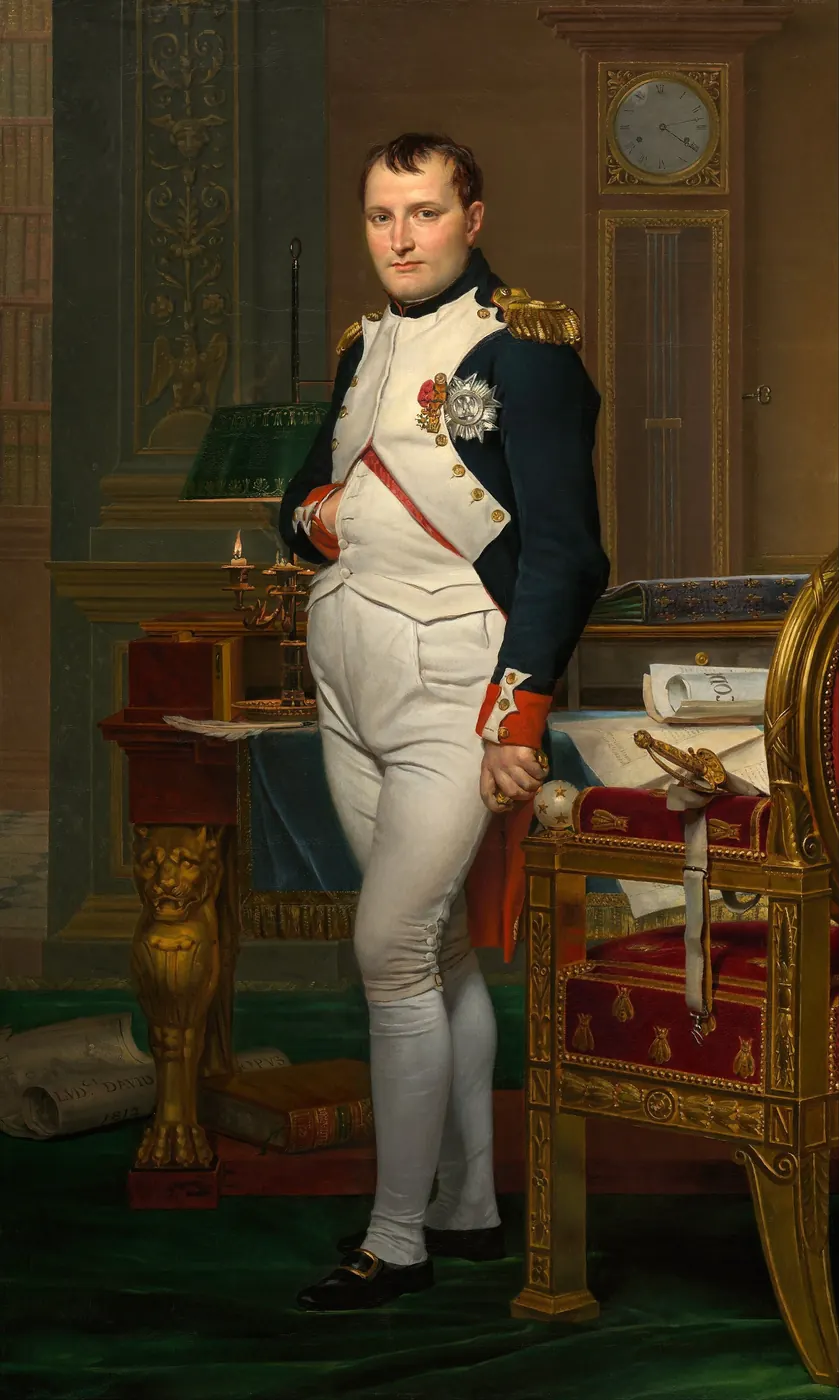
Napoleon Bonaparte
Emperor of the French
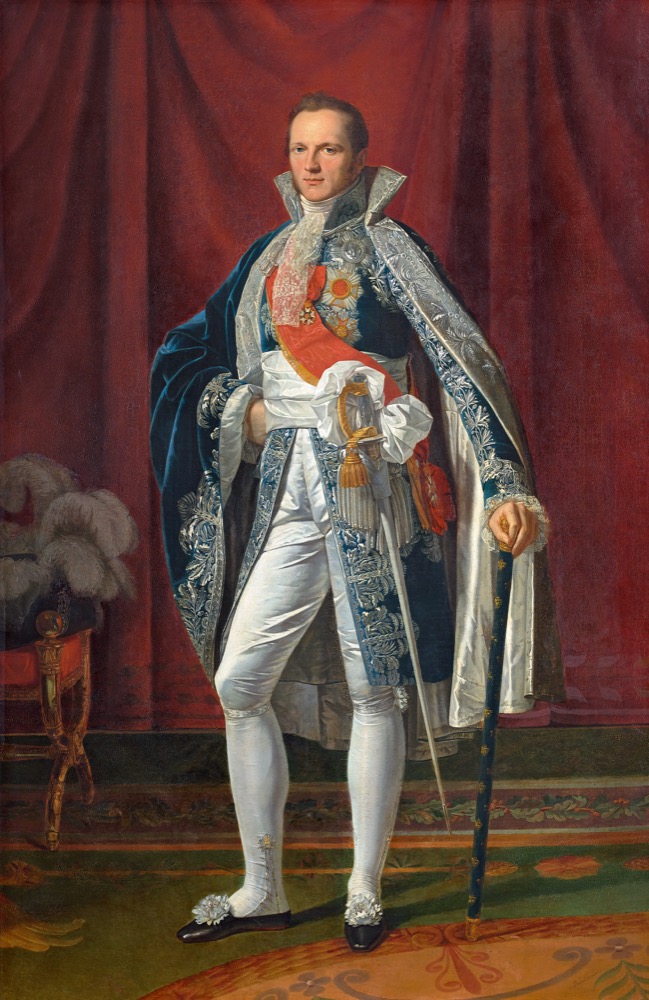
Armand-Augustin-Louis de Caulaincourt
Master of the Horse, ambassador to Saint Petersburg, Minister for Foreign Affairs
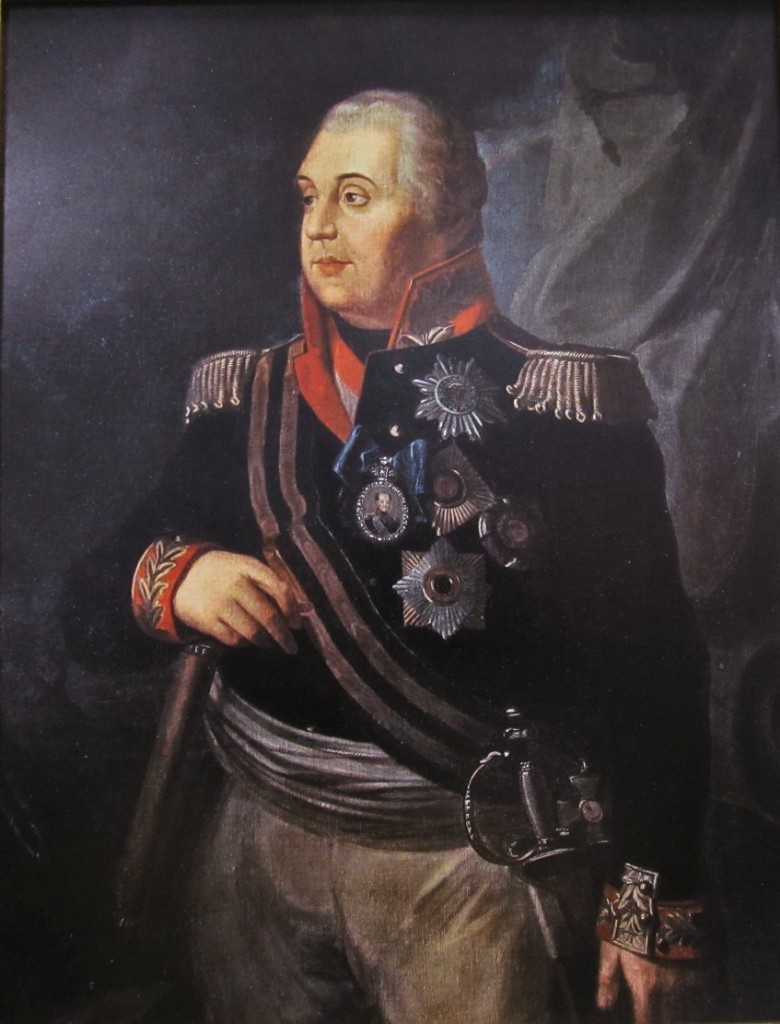
Mikhail Illarionovich Golenishchev-Kutuzov
Russian field marshal (Generalfeldmarschall), commander-in-chief in 1812
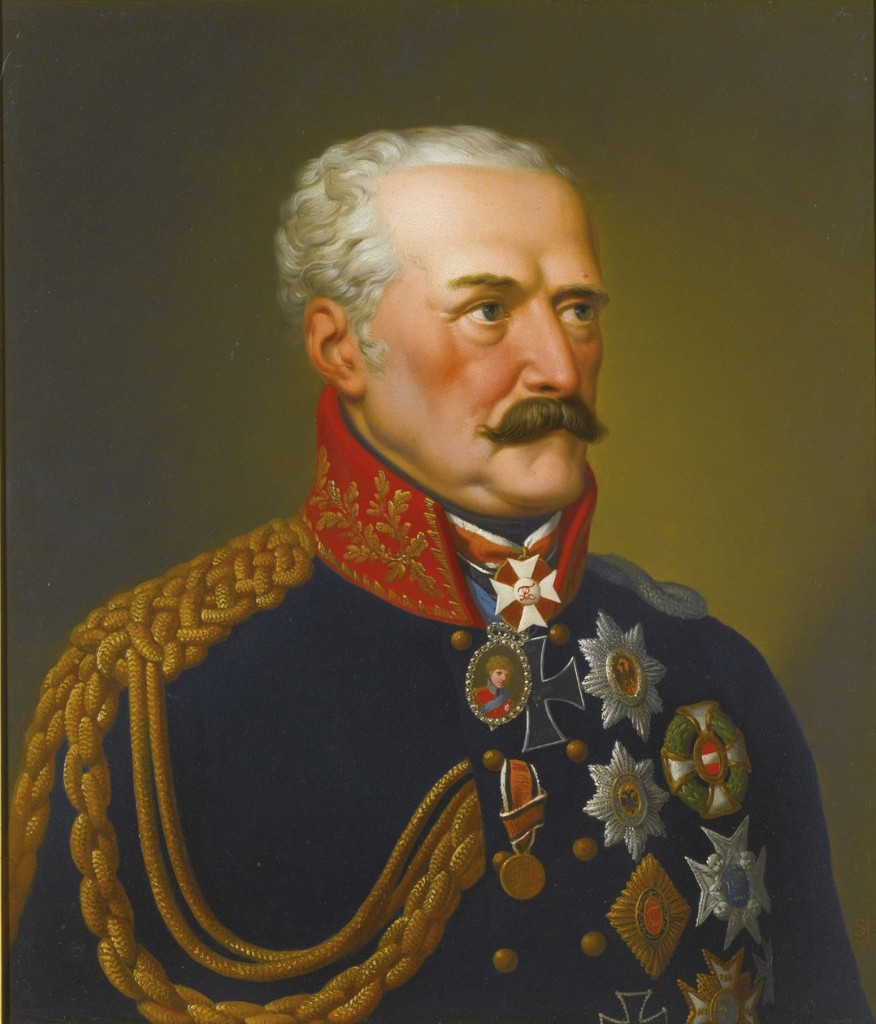
Gebhard Leberecht von Blücher, Prince of Wahlstatt
Prussian general, field marshal on coalition battlefields
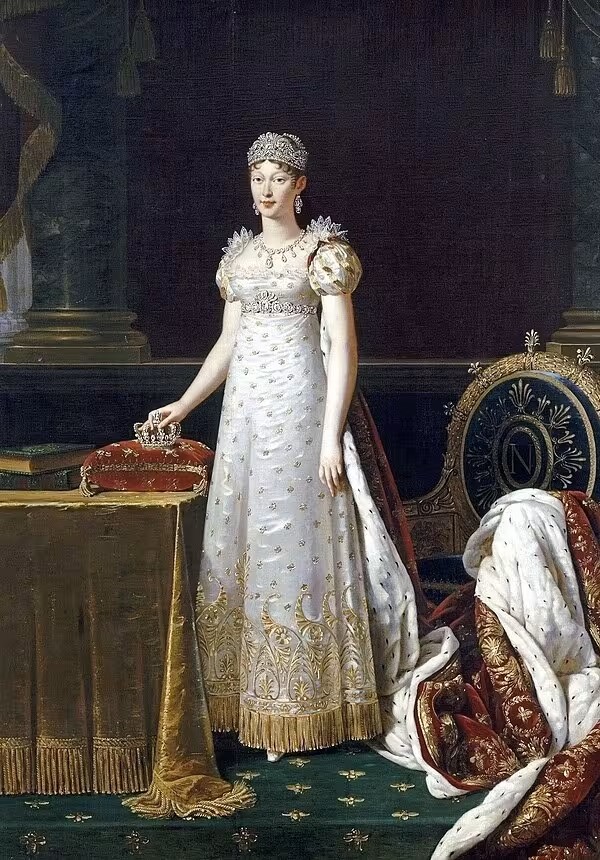
Marie Louise of Austria
Empress of the French
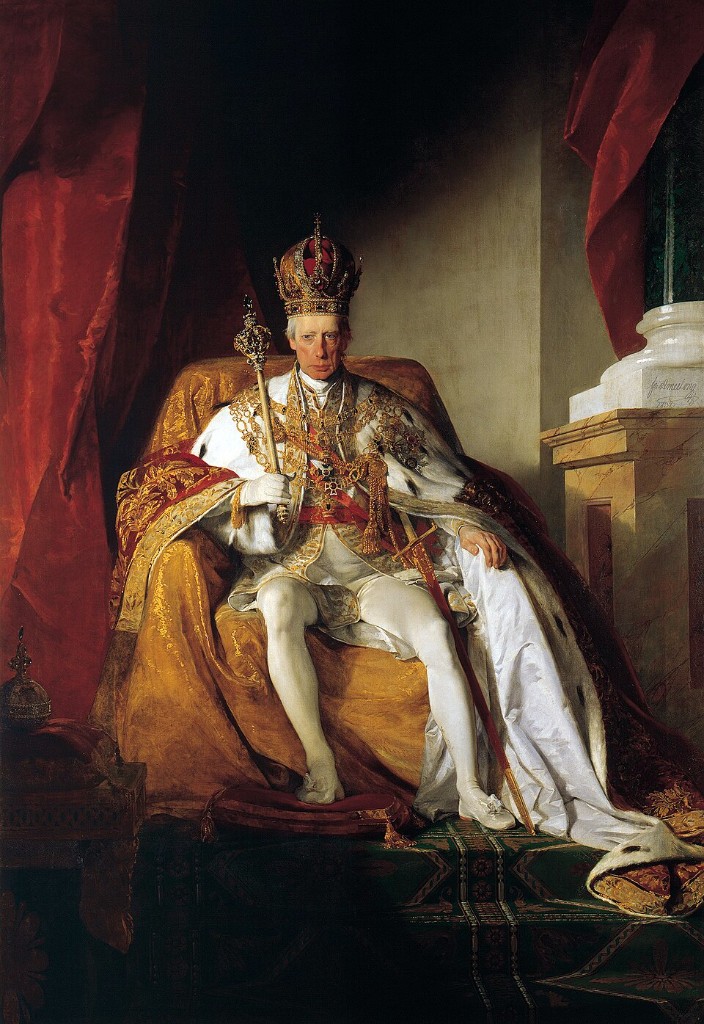
Francis II / Francis I, Emperor of Austria
Last Emperor of the Holy Roman Empire (1792–1806), Emperor of Austria (1804–1835)
Go further
Recommended books to dig deeper (affiliate links)
Napoleon the Great
Andrew Roberts · 2014
A monumental biography drawing on Napoleon’s 33,000 surviving letters, admiring but rigorous.
See on Amazon
Napoléon ou le mythe du sauveur
Jean Tulard · 1977
The book that reshaped how the man is read: how France gave itself a saviour, and what it cost.
See on Amazon
Nouvelle histoire du Premier Empire
Thierry Lentz · 2002-2010
Four reference volumes on institutions, diplomacy and collapse: the scholarly synthesis of the subject.
See on AmazonAs an Amazon Associate, this site earns from qualifying purchases.
Support the encyclopedia
Napoleon Empire is an independent project. Your contribution helps grow the content and keep the site running.
DonateSecure payment on the platform you choose.