Saint-Domingue, the richest colony
In 1789 Saint-Domingue, the western part of the island of Hispaniola, was the most lucrative colony in the Atlantic world. Its sugar and coffee plantations supplied, by the usual estimates, some 40 per cent of the sugar imported by France and Britain and nearly 60 per cent of the world's coffee. The ports of Nantes and Bordeaux, the refineries, a considerable share of France's foreign trade: all of it rested on the forced labour of around 450,000 enslaved people, set against some 40,000 white colonists and more than 28,000 free people of colour, many of them slaveholders in their own right and denied the civil equality that the Revolution was slow to grant them.
The brutality of the system was described by contemporaries themselves. Mortality was so high that the enslaved population could only be sustained through the slave trade: a large proportion of the island's slaves had been born in Africa. On the night of 21 August 1791 the plantations of the North went up in flames. The insurrection would never again be extinguished, and it changed the nature of the problem facing Paris: this was no longer a colonial order in need of reform, but a society at war with itself, which the Spanish to the east and the British, soon established on the coast, sought to exploit.
The abolition of 1794: a freedom unevenly applied
The civil commissioners sent out by the Republic, Léger-Félicité Sonthonax and then Étienne Polverel, did not wait for the metropole. On 29 August 1793 Sonthonax proclaimed the freedom of the slaves in the North; emancipation was extended to the West and South in the weeks that followed, partly in order to win the insurgents over against foreign invasion. On 4 February 1794 (16 Pluviôse Year II) the Convention made the measure general: it abolished slavery in all the colonies and declared all men domiciled there to be French citizens, without distinction of colour. The Constitution of Year III, in 1795, made the colonies integral parts of the Republic.
The decree was applied very unevenly. It was genuinely put into effect in Guadeloupe, French Guiana and Saint-Domingue. In Martinique, occupied by the British from 1794 until 1802, slavery was never interrupted. In the Mascarene Islands the colonial assemblies refused to apply the text and in 1796 expelled the agents sent to enforce it. On the eve of the Consulate, then, the abolition of 1794 was no uniform reality: it was a fragile and very recent gain, one that many planters had never accepted and that the metropole, absorbed by war, scarcely monitored any longer.
Toussaint Louverture, master of the colony
Born around 1743 on a plantation near Le Cap (Cap-Français), Toussaint, who had been freed before the Revolution, took part in the insurrection of 1791 and then served Spain. On 18 May 1794, following the decree of abolition, he rallied to the Republic. He was appointed lieutenant governor of the colony on 31 March 1796 and commander-in-chief of the army on 3 May 1797. He drove out the British, sidelined the commissioners sent from Paris and then, in 1800, defeated the general of colour André Rigaud, who held the South. Early in 1801 he occupied the Spanish part of the island, ceded to France by the Treaty of Basel in 1795, and proclaimed the abolition of slavery there.
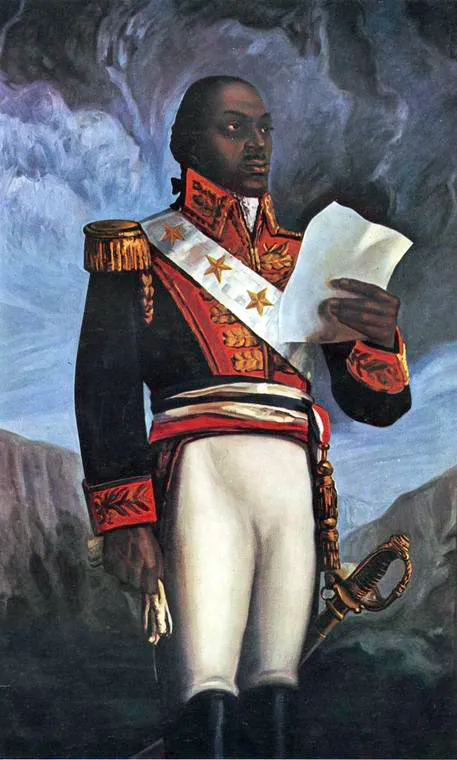
In July 1801 an assembly convened under his direction adopted a Constitution for Saint-Domingue. It declared slavery abolished “for ever” and the colony part of the French Empire, but it named Toussaint governor for life, with the right to designate his successor, and made no provision for approval by the metropole. For Bonaparte, who had written into the Constitution of Year VIII (Article 91) that the colonies would be governed by special laws, this was as much a provocation as a seizure of power. For the former slaves, it was the guarantee that they would not be sent back to the plantations.
Toussaint was more than a war leader. He sought to revive the economy by imposing on the cultivators, now free and paid a share of the revenues, a very strict labour regime on the large estates, some of them run by their former masters: legal freedom came with a military discipline that did not please everyone. This contradiction, between abolition in principle and the preservation of the export plantations, goes some way to explaining why several of his own generals went over to Leclerc.
Bonaparte and the colonial question
Historians still debate what exactly Bonaparte intended. At the end of 1799 the Consuls had assured the Black population of Saint-Domingue that their freedom would not be called into question. Yet the First Consul was surrounded by advocates of reasserting control: the former proprietors, many of whom had found refuge in France, and Admiral Decrès, the Minister of the Navy. The influence attributed to Josephine, a Creole from Martinique, belongs to this debate, though its precise weight cannot be measured. The Abbé Grégoire and a few others spoke out against any step backwards, but went unheard.
Peace with Britain, whose preliminaries were signed in London on 1 October 1801 and which led to the Treaty of Amiens in March 1802, freed up the fleet and the troops. It also restored Martinique, Saint Lucia and Tobago to France. Bonaparte cherished, moreover, a broader ambition: to rebuild a French domain in the Americas, with Louisiana, recovered from Spain, and Saint-Domingue as its economic pivot. Retaking the island was the precondition for everything else.
As far as Saint-Domingue was concerned, the decision to restore slavery was not set down in any written order during the months of the expedition. Philippe Girard stresses Bonaparte's hesitations, and no written order for restoration was sent to Saint-Domingue while the expedition was under way. One thing is certain: the expedition was prepared amid ambiguity. The proclamation addressed to the inhabitants in the First Consul's name affirmed that all were free and equal, whatever their colour; but the general entrusted with carrying it out was Bonaparte's brother-in-law, and his mission was to bring the island back under the authority of the metropole, including that of a man who behaved like a sovereign.
The Leclerc expedition
Charles Victor Emmanuel Leclerc, born in 1772, had married Pauline Bonaparte in 1797; he had served as an officer in the Italian campaign and on 18 Brumaire. On 14 December 1801 squadrons set sail from Brest, Lorient and Rochefort under the command of Admiral Villaret de Joyeuse. The squadrons from Toulon and Cádiz followed in February 1802. Counting these and the reinforcements of 1802, the total exceeded 40,000 men, to whom were added Polish contingents dispatched from the spring onwards.
In early February 1802 the fleet appeared off Le Cap. Henri Christophe, who commanded there, refused to hand over the town without orders from Toussaint and set it ablaze rather than surrender it. Leclerc landed, settled into the ruins and opened a campaign that was, on paper, meant to be swift. In practice it soon turned into a war of sieges and attrition. At Crête-à-Pierrot, a fort in the Artibonite defended by Dessalines, the French troops launched assaults in March and suffered heavy losses before the defenders evacuated the position.
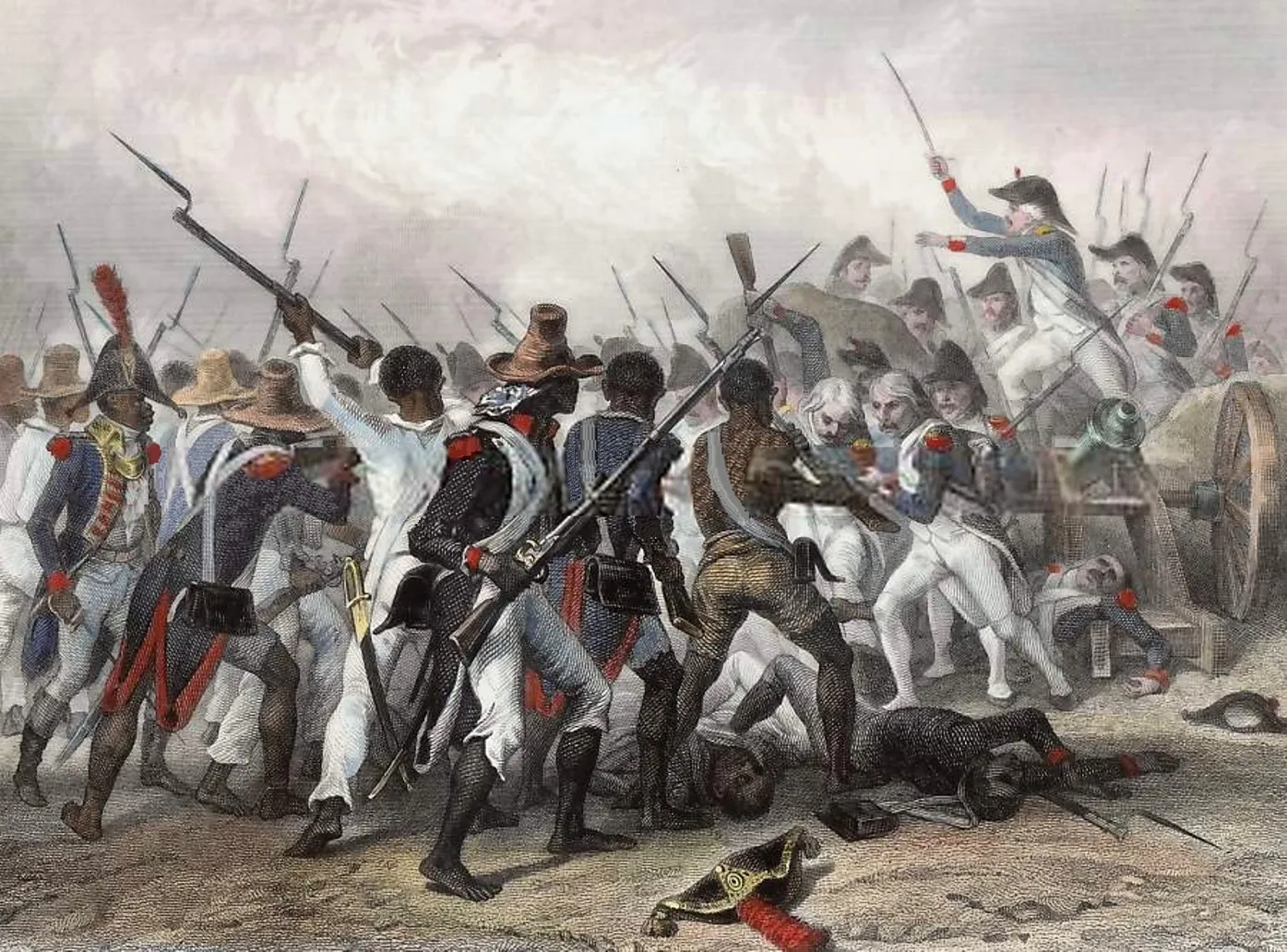
Yellow fever, which struck the newly landed troops first, would weigh more heavily still. It carried off thousands of men within a few weeks, and the historian Renaud Piarroux has demonstrated its role; Bernard Gainot and Mayeul Macé nonetheless point out that it was the insurgents who defeated the French, not disease alone. The Black generals, for their part, wavered. Christophe and then Dessalines went over to Leclerc in the spring, after months of fighting. On 6 May 1802 Toussaint in turn agreed to lay down his arms; he was allowed to retire to his estates, keeping his rank and receiving a promise that his liberty would be respected.
The law of 20 May 1802
Fourteen days later, on 20 May 1802 (30 Floréal Year X), the government had a law passed in Paris restoring slavery in part of the colonial empire. Its text was brief. The first article provided that, in the colonies returned to France under the Treaty of Amiens, slavery would be maintained in accordance with the laws and regulations in force before 1789. Article II extended this regime to the other French colonies beyond the Cape of Good Hope, that is to say the Mascarenes. Article III restored the slave trade under the rules that had applied before 1789. Article IV, finally, placed the colonial regime under the authority of regulations issued by the government for a period of ten years.
The law named neither Guadeloupe, nor French Guiana, nor Saint-Domingue. To the letter, therefore, it did not restore slavery where it had been abolished; it confirmed it in Martinique, Saint Lucia, Tobago and the Mascarenes, where it had never ceased. But no one, in Paris or in the colonies, was deceived: the text sanctioned a return to the old order, and through Article IV it gave the government almost unlimited latitude for the rest. It passed by a large majority, 54 votes to 27 in the Tribunate and 211 to 63 in the Legislative Body, after debates in which the opposition remained a minority. The Senate, for its part, had observed that such a multi-tier regime might conflict with the Constitution, which led to the text being simplified.
The gap between the letter of the law and its practice deserves emphasis. It allowed the government to proceed by decree, colony by colony, without ever publicly confronting the question of the 1794 abolition. This formal caution does nothing to lessen the significance of the choice: going back on an abolition proclaimed eight years earlier was no trivial matter.
Guadeloupe: Delgrès and Matouba
In Guadeloupe events moved more quickly. General Antoine Richepance arrived on 5 May 1802 with an expeditionary force, in a colony where part of the military leadership consisted of officers of colour, such as Colonel Magloire Pélage and Commandant Louis Delgrès. Born in 1766 at Saint-Pierre in Martinique, Delgrès was a free man of colour, an officer first in the militia and then in the armies of the Republic. Judging the return of slavery to be inevitable, he chose to resist.
On 10 May 1802 he issued a proclamation entitled “To the whole universe, the last cry of innocence and despair”, in which he recalled that resistance to oppression is a natural right. His troops fell back on Matouba, near Basse-Terre, where they were surrounded. On 28 May Delgrès and some 300 companions chose to blow up their position rather than surrender, under the motto “Live free or die”. The repression that followed was very harsh. Richepance, himself struck down by yellow fever, died in September.
What followed was administrative. A consular decree of 16 July 1802 (27 Messidor Year X) placed Guadeloupe under the regime of 1789 without uttering the word slavery, and a second decree, the next day, stripped almost all free people of colour of their citizenship. The first would not be promulgated on the island until May 1803. In French Guiana a decree of 7 December 1802 introduced “district conscription”, which restored slavery in all but name. By these indirect routes the government achieved its aim without ever proclaiming it.
Saint-Domingue: from Toussaint's arrest to Vertières
In Saint-Domingue Leclerc concluded that he could not leave Toussaint at liberty. On 7 June 1802, despite the promise made at his submission, he had him arrested. Shipped aboard the frigate La Créole and then the Héros, Toussaint was transferred to France and confined in the Fort de Joux, near Pontarlier in the upper Doubs, where he died in isolation on 7 April 1803. Tradition holds that as he went aboard he declared: “In overthrowing me, you have cut down in Saint-Domingue only the trunk of the tree of liberty of the Blacks; it will spring up again from the roots, for they are many and deep.” The words, whose source remains uncertain, belong in part to legend, but they capture well what was about to happen.
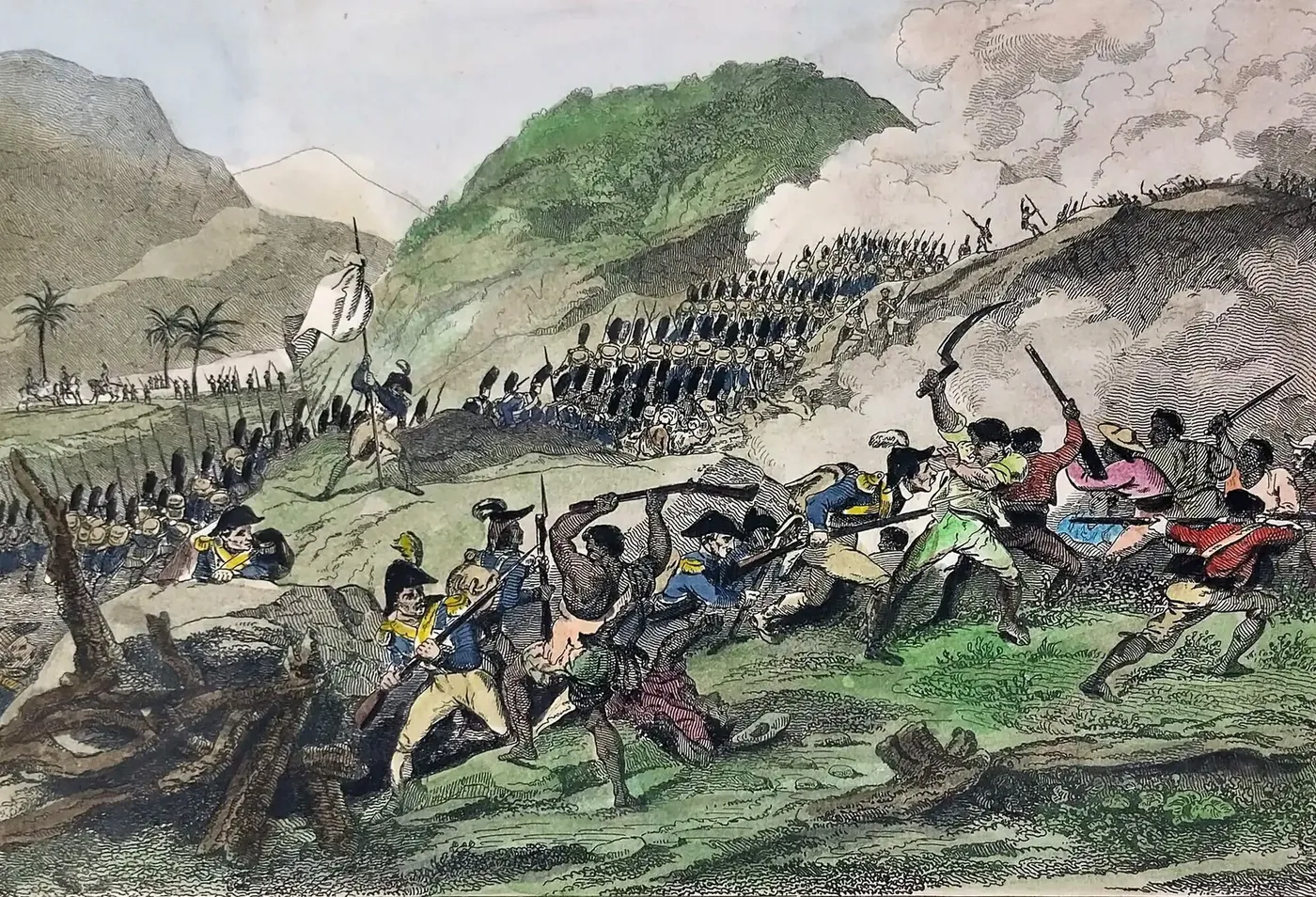
From the summer onwards, news of the restoration of slavery in Guadeloupe, known or feared, finally convinced the cultivators that their freedom was under threat. Dessalines and Christophe, who had come over, changed sides in the autumn and took command of a so-called “indigenous” army that brought together Toussaint's former soldiers, cultivators and deserters, among them a few Poles who had crossed to the other side. Leclerc died of yellow fever in early November 1802. His successor, Donatien de Rochambeau, waged an even more brutal war and came up against what was now a general resistance.
The resumption of war between France and Britain in May 1803 cut the expeditionary force off from its reinforcements and opened the sea to British ships. On 18 November 1803, at Vertières, near Le Cap, Dessalines's troops defeated the French. Rochambeau capitulated the following day and surrendered to a British squadron, which interned him in Britain; the last soldiers left the island on 4 December, from Môle Saint-Nicolas. On 1 January 1804, at Gonaïves, Dessalines proclaimed independence under the name of Haiti, the first state born of a slave revolt.
The loss of Saint-Domingue weighed upon the whole of Bonaparte's American policy. Failure was already in the air when Louisiana was ceded to the United States in the spring of 1803, a few weeks before the break with London: without Saint-Domingue, Bonaparte's American project lost its foundation. The human cost was considerable: tens of thousands of soldiers, most of them carried off by disease, never returned, and twenty-seven of the sixty generals committed are said to have perished. Estimates vary from one source to another, but all agree on the scale of the disaster.
A heavy legacy
In metropolitan France itself, the government took measures that reveal the climate of the moment. A decree of 13 Messidor Year X (2 July 1802) barred Black people and people of colour from entering continental territory without special authorisation, and an ordinance issued by the Prefect of Police, Dubois, in October made it the basis for arrests in Paris. Slavery was certainly not practised in France, but the consular regime now openly embraced distinctions of colour that the Revolution had abolished.
The restoration of 1802 was not the end of the story. During the Hundred Days a decree of 29 March 1815 abolished the slave trade, to no practical effect since the reign ended three months later. France recognised Haiti's independence only in 1825, under Charles X, in return for an indemnity of 150 million francs, reduced to 90 million in 1838. Slavery was definitively abolished in the French colonies by the decree of 27 April 1848, on the initiative of Victor Schœlcher. In 2001 the law of 21 May, known as the Taubira law, recognised the slave trade and slavery as crimes against humanity.
Among historians there is little doubt about the substance of the verdict: the restoration of slavery was one of the gravest decisions of the Consulate. Debate centres rather on its motives, on Bonaparte's own share, on the role of colonial interests and on the idea, sometimes advanced, of an expedition intended first and foremost to restore French authority rather than the old order. Whatever the case, the tragic end of Toussaint Louverture, Delgrès's revolt and the victory at Vertières have made these months of 1802 a founding moment in Caribbean and Haitian memory. For Napoleon's reputation, it remains one of the heaviest charges still levelled against him.
Further reading
- Yves Benot, La Démence coloniale sous Napoléon, La Découverte, 1992.
- Marcel Dorigny (ed.), Les Abolitions de l'esclavage, de L. F. Sonthonax à V. Schœlcher, 1793, 1794, 1848, Presses universitaires de Vincennes / UNESCO, 1995.
- Philippe Girard, The Slaves Who Defeated Napoleon. Toussaint Louverture and the Haitian War of Independence, 1801-1804, University of Alabama Press, 2011.
- Laurent Dubois, Avengers of the New World. The Story of the Haitian Revolution, Harvard University Press, 2004.
- Frédéric Régent, La France et ses esclaves. De la colonisation aux abolitions, 1620-1848, Grasset, 2007.
- Thierry Lentz, Nouvelle histoire du Premier Empire, vol. I, Napoléon et la conquête de l'Europe, 1799-1807, Fayard, 2002.