A war that cannot be won on land
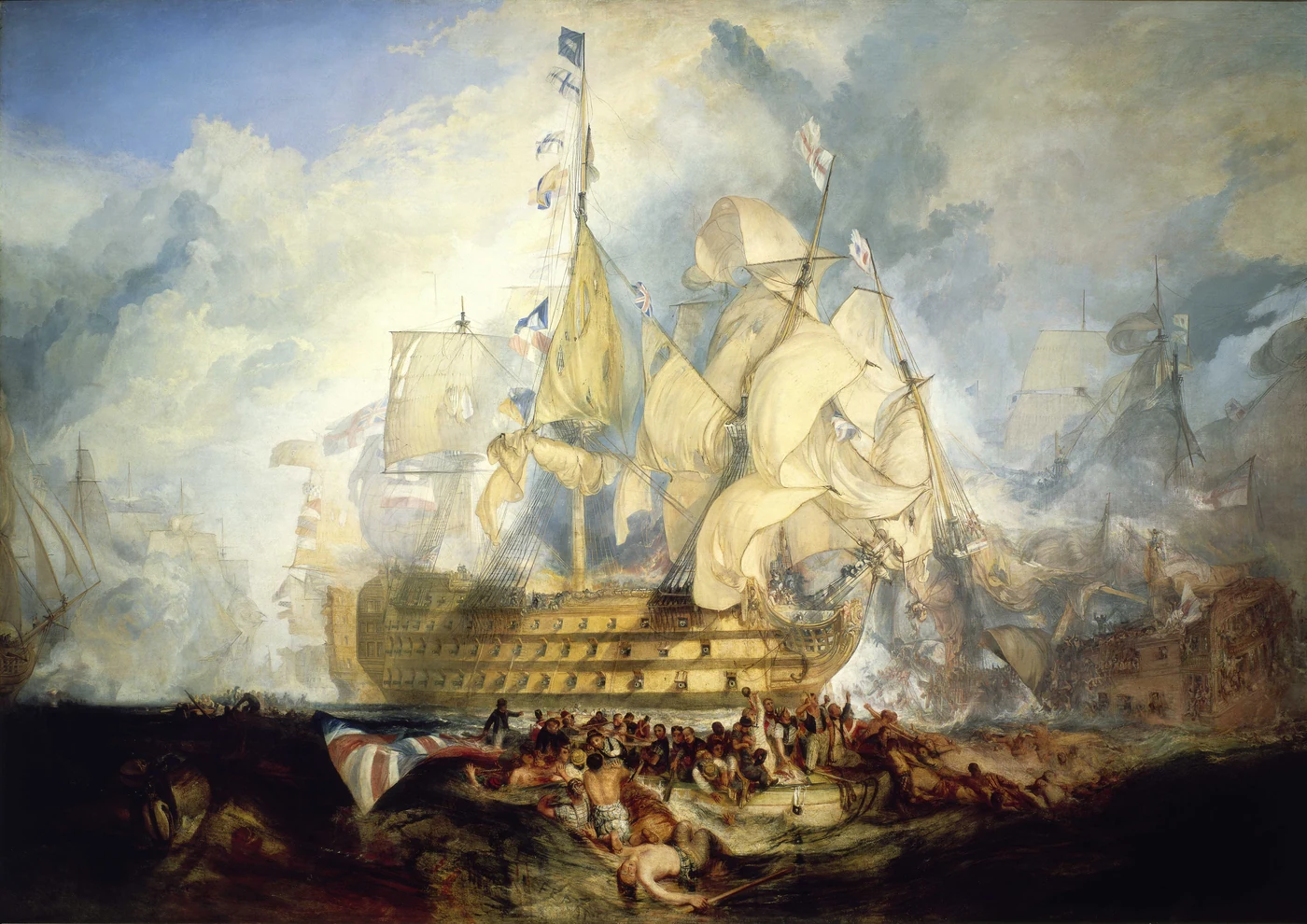
On 21 October 1805, off Cape Trafalgar, Villeneuve's Franco-Spanish fleet was destroyed by Nelson's, and Nelson himself died in the fight. Two months later Napoleon won at Austerlitz and the Third Coalition collapsed. The contrast says everything about the position France now found itself in: on the Continent the Emperor no longer met an adversary able to resist him for long; at sea he had nothing to set against the Royal Navy. The invasion of England, prepared at the camp of Boulogne, had already been abandoned in the summer of 1805, when the Grande Armée took the road to the Danube.
War with the United Kingdom had resumed in May 1803, after the short-lived peace of Amiens. It took an unusual form: a power that ruled the seas faced a power that ruled the Continent, and each seemed out of the other's reach. The British had no army capable of beating the Grande Armée; Napoleon had no fleet capable of crossing the Channel. The successive coalitions, financed from London, settled nothing so long as the British government could pay its allies out of the proceeds of its trade.
This is where Napoleon's reasoning begins. The United Kingdom was a trading nation, with an immense public debt, whose strength rested on exporting its cottons and metals and on re-exporting colonial goods to Europe. Close the Continent to its merchandise and its factories would stand idle, its tax revenue would fall, its credit would collapse, and the cabinet in London would be forced to negotiate. What could not be reached by the fleet would be reached through the customs house. The idea was not new: as early as 31 October 1796 the Directory had banned British goods from France. It had never been applied on the scale of a continent, for want of a France powerful enough to impose it on its neighbours.
The Berlin Decree
The opportunity came with the Prussian campaign. On 14 October 1806 Jena and Auerstedt destroyed the Prussian army; on the 27th Napoleon made his solemn entry into Berlin. Meanwhile the British had answered in their own way. On 16 May 1806 the government headed by Grenville, with Charles James Fox as Foreign Secretary, had proclaimed a blockade of the coast from the Elbe to Brest, that is, of a large part of the shoreline held by France and her allies.
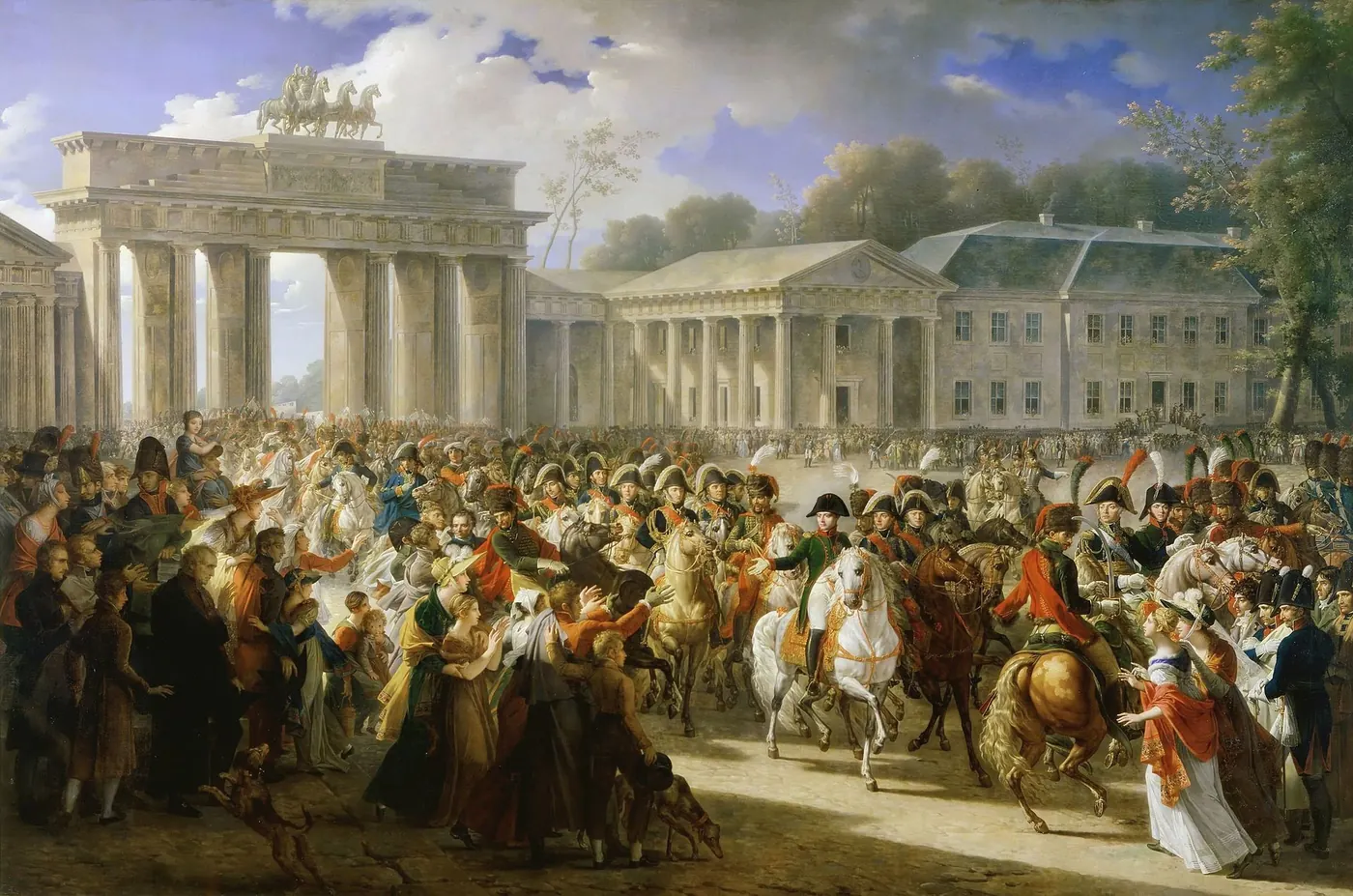
On 21 November 1806, from Berlin, Napoleon signed the decree that gave the system its name. The text opens with an indictment: England does not recognise the law of nations, treats merchant ships as prizes of war, declares blockaded ports that no squadron closes, and thereby claims to forbid the trade of the entire world. By way of reprisal, "the British Isles are declared to be in a state of blockade." All trade and correspondence with them was forbidden. British subjects found in countries occupied by French or allied troops were to be treated as prisoners of war, their goods were declared lawful prize, and no vessel coming directly from England or her colonies would be admitted to any port.
On paper the measure was extravagant: a blockade proclaimed by a power with no fleet to enforce it. Napoleon knew this, and he turned it into a matter for customs officers rather than sailors. The blockade was to be continental, that is, held by the ports, frontiers and administrations of every state that France dominated or whose alliance she demanded. The decree could work only if the whole of Europe complied, and that is what would make it, step by step, the engine of a policy of annexations and conquests.
The British reply and the Milan Decrees
London did not stay silent. The Orders in Council of 7 January 1807 forbade neutral ships to engage in coastal trade between ports under French control; those of 11 November 1807 went much further. All ports from which the British flag was excluded were now treated as blockaded. Neutral ships could reach them only after calling at a British port, where they paid duties: the United Kingdom thus reserved to itself a monopoly of maritime trade with Europe and drew revenue from it.
Napoleon answered with the two Milan Decrees, of 23 November and 17 December 1807. Any ship that had submitted to search by a British vessel, or had called at a port of the United Kingdom, was deemed to have lost its nationality and became lawful prize. Neutrals, above all Americans, were caught between two fires: to obey one side was to risk seizure by the other. Jefferson's government reacted with the Embargo Act of 22 December 1807, which forbade American ships to leave for foreign ports. The measure hurt the American economy more than it hurt its targets, but it also deprived Britain of an important market and supplier.
This duel of texts marked a turning point in the history of maritime law. For the first time two great powers claimed to wage total commercial war on each other, in defiance of the freedom of the seas that neutrals had invoked for a century. Each side accused the other of breaking the law; neither could give way without seeming to yield.
Tilsit and the spread of the system
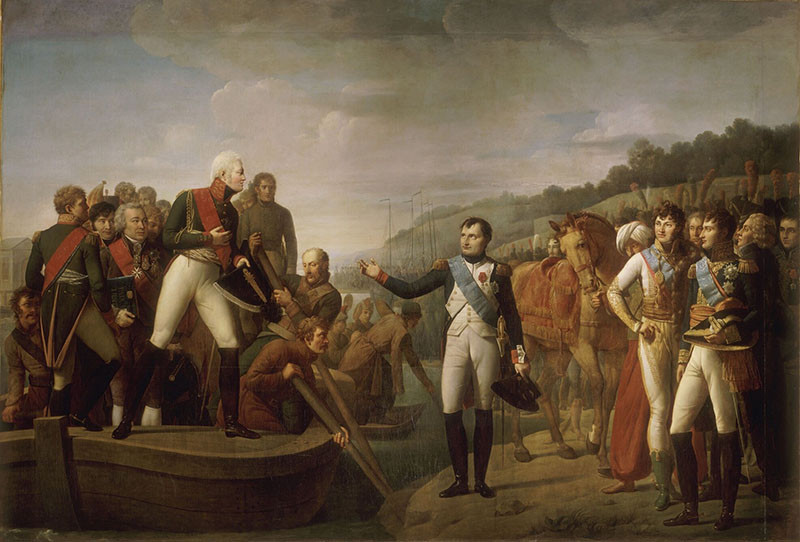
For the blockade to work, the ports of Europe had to close one after another. The great powers of the Continent were led to it by defeat rather than conviction. After Friedland, Napoleon and Alexander I met on the Niemen in June 1807; the peace of Tilsit, signed in July, made Russia France's ally and committed her, by a secret article, to join the system if England refused to negotiate. Prussia, dismembered, closed her ports. Austria, beaten in 1805, rallied to it later and with reluctance.
Denmark was pushed in by force. In September 1807, fearing that the Danish fleet would fall into French hands, the British bombarded Copenhagen and seized the ships; Denmark threw herself into the arms of France. That same year they settled on Heligoland, the Danish islet in the North Sea, which would become one of the great depots of smuggling towards Germany.
There remained the states that refused. Portugal, England's old ally, would not close her ports. By the treaty of Fontainebleau of 27 October 1807, France and Spain agreed to partition her, and Junot entered Lisbon on 30 November, the day after the royal family had left for Brazil. The chain of events did not stop there. The occupation of Portugal served as a pretext for sending troops into Spain, then for ousting the Bourbons at Bayonne in May 1808: the Continental Blockade is thus one of the direct origins of the Peninsular War. In the same spirit, Pope Pius VII, who refused to close his ports to the British and to ally himself with France, saw Rome occupied in February 1808; his states were annexed in 1809.
Smuggling, licences and customs
The system rested on an assumption that the facts soon belied: that a continent could be cut off from its trade. Yet the coasts were long, the customs officers few, and the demand pressing. Sugar, coffee, cotton, indigo and tobacco came from the colonies, and Europe could not do without them. Demand created supply, and smuggling, sometimes organised as a genuine business, flourished on every frontier.
British goods passed through Heligoland, Gothenburg, Malta and Sicily before being slipped onto the Continent by sailors, merchants and customs men who could be bought. Prices, which rose with the risk, made the fortunes of the middlemen. Napoleon replied with more seizures, customs courts and surveillance, and made the customs service one of the largest and harshest administrations of the Empire. Its effectiveness remained uneven: the tighter the control on one side, the more the traffic shifted to the other.
In the end the system contradicted itself. To keep some trade alive, and above all to make sure customs revenue came in, the imperial government began to issue licences, which allowed certain merchants to import or export goods that were otherwise prohibited. London did the same. While the two governments declared all-out economic war on each other, licensed cargoes kept crossing the Channel. The contrast was striking, and contemporaries were not fooled: the blockade was watertight only for those who lacked the means to get round it.
A Europe under constraint
The effects of the system differed from region to region and trade to trade. France's great Atlantic and Mediterranean ports, Bordeaux, Nantes, Le Havre and Marseille, had lived on colonial trade and long-haul coasting: they declined. Shipowners closed down, warehouses emptied, dockworkers lost their jobs. Conversely, industries that no longer faced British competition at home profited from a protected market. Cotton spinning and weaving advanced in Alsace, Normandy, the North and Belgium, where Ghent became a textile centre thanks to the English machines that Lieven Bauwens had introduced there in the late 1790s. In the states of the Confederation of the Rhine, the Grand Duchy of Berg and Saxony likewise saw industries develop behind the customs barrier.
The scarcity of colonial goods spurred the search for substitutes. Chicory replaced coffee for the less well-off. Above all, people tried to make sugar from beet, whose sugar the German chemist Andreas Marggraf had isolated as early as 1747 and for which Franz Karl Achard had founded the first factory in Silesia in 1801. From 1811 an imperial decree encouraged beet cultivation on some 32,000 hectares, and in 1812 Benjamin Delessert perfected an industrial extraction process at Passy. This industry, born of necessity, would outlast the blockade and become one of the great agricultural products of northern Europe.
The human and political cost was heavier. Europe did not experience the blockade as a weapon aimed at England but as a burden imposed by France. Consumers paid more for sugar and coffee; the populations of the ports, deprived of their livelihood, resented the occupier; allied princes saw their customs revenue fall and their subjects turn away from them. In the subject countries, French customs officers became the symbol of domination.
1810: the flight forward
From 1810, faced with the scale of smuggling, Napoleon chose to tighten the system and extend his direct grip on the coasts. The Kingdom of Holland, entrusted to his brother Louis, was a constant leak; Napoleon reproached Louis for letting British goods in, and Louis, anxious to protect his subjects' interests, resisted. In July 1810 Louis abdicated and Holland was annexed to the Empire. In December a senatus consultum united with France the Valais, the Hanseatic cities of Hamburg, Bremen and Lübeck, the Duchy of Oldenburg and a broad strip of the northern German coast. The Empire then counted 130 departments, from Rome to Hamburg.
Summer and autumn also brought draconian measures. The Trianon tariff of 5 August 1810 struck colonial goods that entered legally with very high duties, while keeping the licences. The Fontainebleau decree of 18 October 1810 ordered the seizure and burning of British manufactured goods found on the Continent. Bonfires of English merchandise were lit in several German towns. The authorities could see in them proof of their determination; the inhabitants saw above all the waste of goods that their needs could have absorbed.
This policy coincided with a serious economic crisis. In 1810-1811 France went through a series of bankruptcies, a credit and employment crisis, a poor harvest and a rise in the price of bread. Across the Channel, British exports, already hit in 1808 by the American embargo, collapsed again in 1811, and the depression fed social unrest, including the Luddite riots of 1811-1812. For a moment Napoleon could believe that his gamble was succeeding. The disaster, however, was merely shared.
The political consequences were heavier for France than for the United Kingdom. In December 1810 Russia reopened her ports to neutral ships and imposed a high tax on certain French imports: the tsar chose his economy over the alliance. For Napoleon, who had made the blockade the key to his strategy, this break was not negotiable. It led him, in June 1812, to cross the Niemen. The Continental Blockade is thus one of the causes of the Russian campaign, which would destroy the Grande Armée.
The end of the system
Meanwhile Great Britain had found other outlets. From 1808 the Spanish uprising opened the markets of Latin America to her, and the Portuguese court, settled in Rio de Janeiro, opened the Brazilian ports to friendly nations in January 1808. British exports to America, the East and, by roundabout routes, the Baltic made up in part for what they lost in Europe. Command of the seas, which had been the origin of the problem, became the means of escaping it. The British government gave way on nothing: the Orders in Council were suspended only on 23 June 1812, five days after the United States had declared war on her, partly because of them.
The system did not survive Napoleon's defeats. The retreat from Russia in 1812, then the German campaign of 1813 and the battle of Leipzig, brought down French domination of the coasts: Holland rose in revolt at the end of 1813, the ports of the North and the Baltic opened, and smuggling became free trade. Napoleon did not need to renounce the system officially: the war made it obsolete. By the abdication of 1814 the blockade had lost all reality.
What should one make of this policy two centuries on? Historians have long been divided. The Swedish economist Eli Heckscher, whose The Continental System (1922) remains a standard reference, saw it chiefly as a costly failure. The Frenchman François Crouzet, in his major study of the British economy and the blockade (1958), showed that the United Kingdom had gone through real crises but had never been strangled: British trade managed to redeploy, and the difficulties of 1808 and 1811, keenly felt, were overcome. The blockade thus hampered London without forcing it to negotiate, and it cost continental Europe, which France claimed to dominate, a great deal more.
There remain, in this balance sheet, gains more lasting than the policy that produced them. A protected textile industry took root in several regions of Europe; the beet sugar industry was born; the customs service established itself as a modern administration. But above all the blockade drew the Empire into a logic of annexations and wars, from Portugal to Russia, whose cost exceeded what France's resources could bear. It remains the finest example of what one might call Napoleon's last illusion: believing that power on land could make up for defeat at sea, and that the economy of a continent could be commanded by decree.