An Eastern design
In the spring of 1798 the Directory was looking for a way to strike at England without meeting its navy in the Channel. A direct invasion of the British Isles, floated a few months earlier, looked out of reach for want of a fleet able to hold the sea against the Royal Navy. Talleyrand and Bonaparte, fresh from the glory of the Italian campaign and the treaty of Campo Formio, put forward another idea: carry the war to Egypt, nominally an Ottoman province but in practice ruled by the Mamluk beys, in order to cut Britain's route to India and plant a French base on the eastern Mediterranean. The ambition reached beyond Egypt itself: some, Bonaparte among them, dreamed of a later march towards India, where princes hostile to the British might be found as allies. The Directory, which also saw in the expedition a chance to remove a young, popular and already inconvenient general, gave its approval in March 1798.
The enterprise was not purely military. Bonaparte took with the army a Commission on Sciences and Arts, some hundred and seventy scholars, engineers, artists and technicians, among them the mathematician Gaspard Monge, the chemist Claude Berthollet, the naturalist Étienne Geoffroy Saint-Hilaire and the draughtsman Vivant Denon. The idea, very much of its time, was to conquer Egypt through knowledge as much as through arms, and to give the expedition a lustre that would set it apart from a mere colonial venture. The destination was closely guarded: until the last moment, most of the officers and soldiers who embarked at Toulon believed they were bound for Ireland or Naples.
From Toulon to Alexandria
The fleet sailed from Toulon on 19 May 1798, joined by convoys from Genoa, Civitavecchia and Corsica: in all, close to forty thousand troops, thirteen ships of the line and hundreds of transports, with Admiral Brueys commanding the naval side. It narrowly missed Nelson's British squadron, sent out to hunt for it, and called at Malta, held by the Knights of St John. After token resistance the island surrendered on 12 June; Bonaparte spent a few days reorganising its administration before sailing on.
The landing took place near Alexandria on the night of 1 to 2 July, in a rough sea that delayed and scattered the troops. Alexandria fell the next day after a brief assault. The march on Cairo then began, across a desert where the army suffered from heat, thirst and short supplies; soldiers used to the campaigns of Italy were stunned to find mud-brick villages, dry wells and exhausting mirages. Discontent spread through the ranks, and several senior officers, Murat among them, let their frustration show in front of Bonaparte himself. On 13 July, at Chobrakit on the Nile, a first clash with Murad Bey's Mamluk cavalry went in the French favour, their artillery sinking the enemy flagship; but everyone knew the decisive fight would come before Cairo.
The Battle of the Pyramids
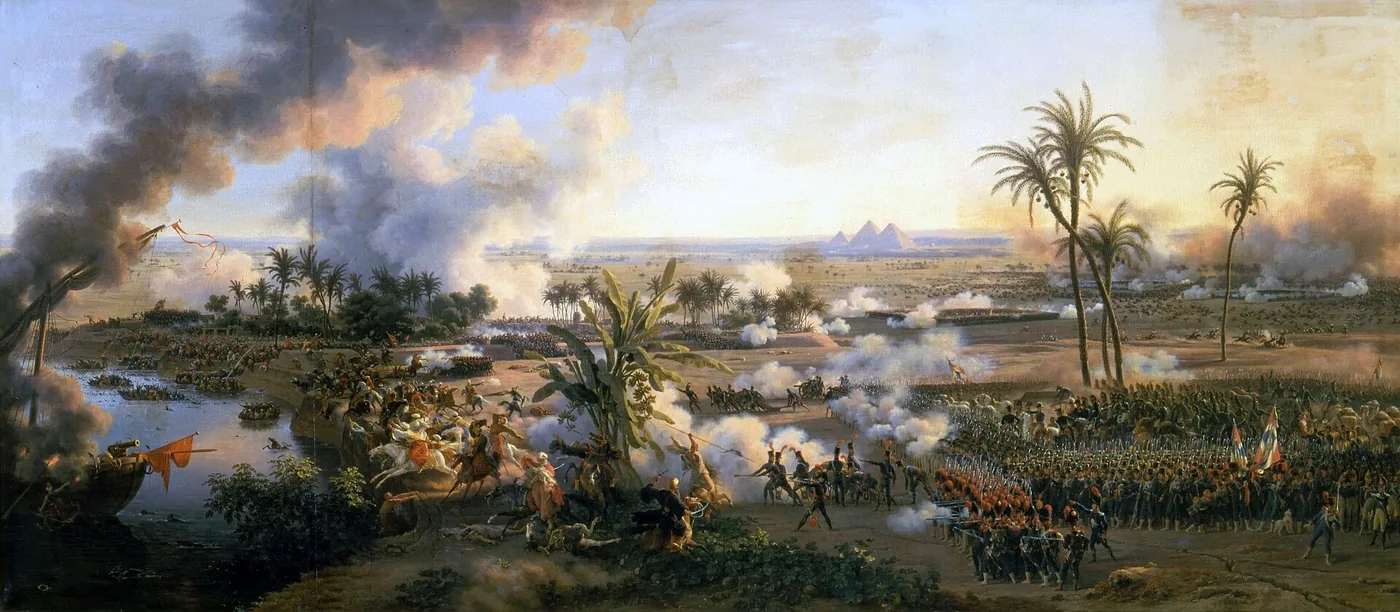
On 21 July 1798 the French army reached Embabeh, on the left bank of the Nile facing Cairo. Murad Bey had gathered there several thousand Mamluk horsemen, a feared heavy cavalry, backed by infantry entrenched in the village. Bonaparte formed his five divisions into squares, with artillery at the corners, to withstand the charges; it was before this formation, so the story goes, that he told his soldiers the now-famous words about the "forty centuries" looking down on them from the pyramids — a line known only from later accounts, whose authenticity remains disputed.
The Mamluk charges broke one after another on the French squares, which held firm. Bon's division then stormed Embabeh at bayonet point; caught between the French and the river, many defenders drowned trying to swim to safety. Murad Bey, wounded, withdrew towards Upper Egypt. French losses stayed light, around thirty killed, against Mamluk losses running into the thousands. Three days later, on 24 July, Bonaparte entered Cairo.
Aboukir, the fleet destroyed
The victory at Cairo lost much of its weight within a few weeks. Nelson had spent weeks hunting the French fleet across the Mediterranean; he found it on 1 August, anchored in line in Aboukir Bay, at the mouth of the Nile. The British squadron, outnumbered but more mobile, attacked in the evening and through the night, catching the French ships from both sides. The battle turned into a disaster: the flagship, L'Orient, blew up after catching fire, Admiral Brueys was killed on his own deck, and only a handful of vessels escaped destruction or capture.
The naval defeat at Aboukir cost the land army nothing directly, but it changed the whole nature of the expedition. Cut off from France, the Army of the Orient could no longer receive reinforcements or supplies by sea; news from Europe reached it only irregularly, carried by the rare ship that slipped through the blockade, and Bonaparte himself would only be able to go home by a stroke of daring. The Ottoman Empire, a bystander until then, declared war on France in September and began preparing a reconquest, by land through Syria and by sea, with the logistical backing of the Royal Navy.
Cairo, the Institute and the revolt
Bonaparte settled into Cairo as a conqueror who also wanted to govern and understand the country. He set up a diwan, a council of local notables attached to the government, tried to keep the religious authorities on side and put on a calculated show of respect for Islam. On 22 August 1798 he founded the Institute of Egypt, chaired by Monge, with Bonaparte himself sitting as a member alongside the expedition's scholars; its sessions ranged from irrigation and bread ovens to ancient languages, astronomy and chemistry, in the belief that science should serve the country's administration directly. It was an engineer from this commission, Pierre-François Bouchard, who would discover the following year, near Rosetta, a stone inscribed in three scripts, bound for a fate nobody yet imagined.
Bonaparte also tried to present the conquest as a liberation: he promised to respect the country's customs and religion, had his proclamations translated into Arabic and surrounded himself with conciliatory sheikhs such as the one from al-Azhar. The effort hardly convinced a population that saw, above all, a Christian army of occupation installed at the heart of a Muslim capital.
The occupation nonetheless remained fragile. New taxes, the presence of foreign, Christian troops in a Muslim capital, and rumours stoked by hostile ulama fed a resentment that broke out on 21 and 22 October 1798: the people of Cairo rose up, killing several dozen isolated Frenchmen, including General Dupuy. Bonaparte had the rebellious districts bombarded and the al-Azhar mosque, where the insurgents had taken refuge, stormed; the repression left several hundred dead, by estimates that vary widely for want of a reliable count. Calm returned, but it stayed precarious until the French finally left.
The Syrian expedition: from Jaffa to Acre
To forestall the Ottoman offensive already being announced from Damascus, Bonaparte decided to carry the war into Ottoman Syria. He left Cairo on 6 February 1799 at the head of a corps of about thirteen thousand men, took the frontier fortress of El-Arish after a few days' siege, then Gaza with little resistance. At Jaffa, where the garrison had had the envoys sent to propose surrender put to death, the assault of 7 March turned into a massacre: the town was sacked, and several thousand prisoners, some of whom had already been released on parole after the fall of El-Arish, were executed on Bonaparte's orders, since there was no way to feed or guard them. The exact number is still debated, estimates ranging from two to four thousand men; the episode remains one of the darkest of the campaign. It was also at Jaffa that plague appeared in the army, an affliction that would dog it for the rest of the expedition.
The army then marched on Acre, defended by the Ottoman governor Ahmad Pasha, known as Djezzar, "the butcher", and supported from the sea by the squadron of the British commodore Sidney Smith. Smith captured en route the convoy carrying the French siege artillery, depriving Bonaparte of his heavy guns; a French royalist engineer in Ottoman service, Antoine Le Picard de Phélippeaux, helped strengthen the town's defences. The siege opened on 20 March 1799. Lacking guns powerful enough to open a wide breach, the French had to make do with field pieces and a few mortars; a breach judged practicable on 28 March turned out to be guarded by a wide, deep ditch, and the assault failed with heavy losses. The following weeks saw a war of mines and countermines, punctuated by sorties from the garrison that repeatedly wrecked the approach works, while the defenders, supplied by Sidney Smith's ships, never lacked for food or ammunition.
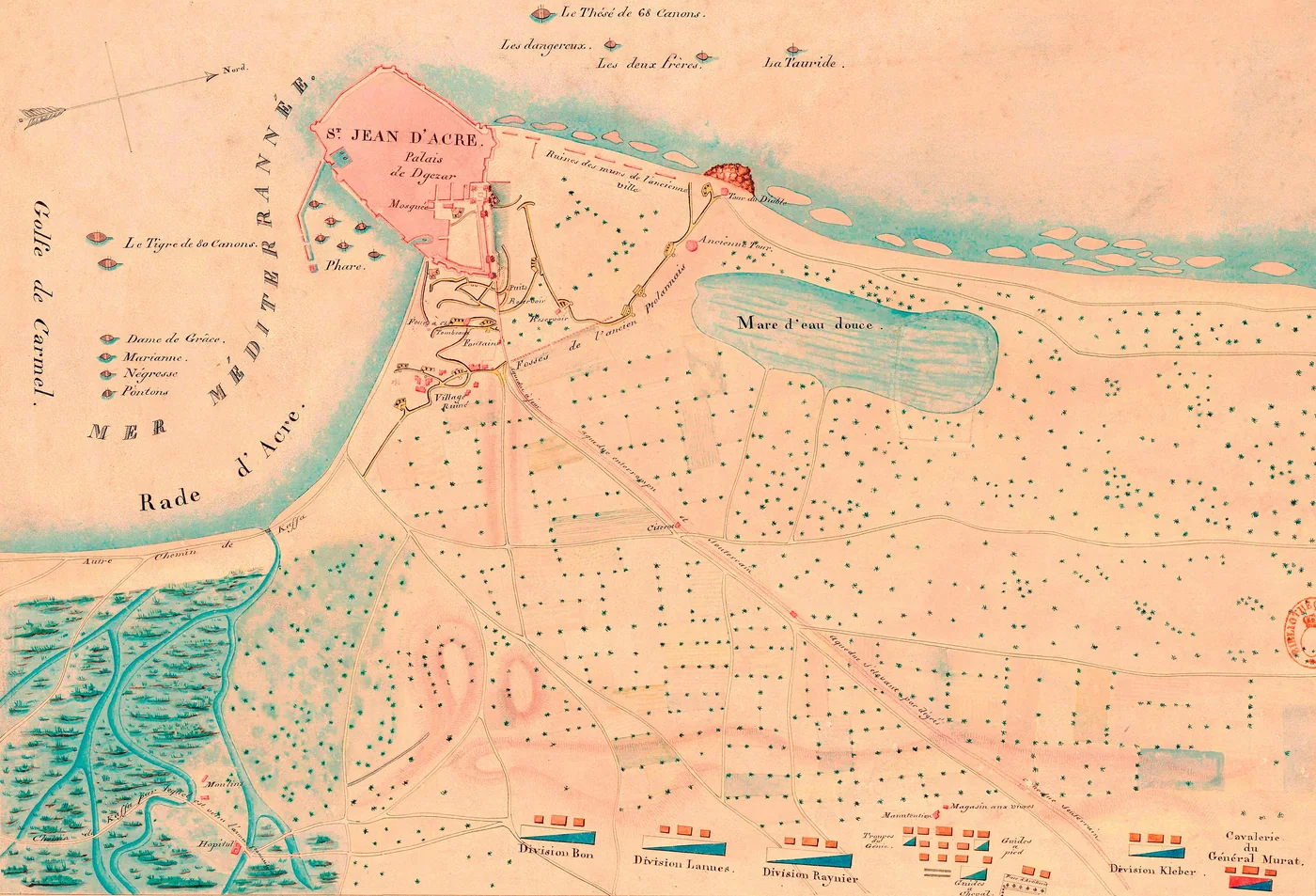
On 16 April a relieving Ottoman army from Damascus came close to surrounding Kléber's division at the foot of Mount Tabor; Bonaparte's arrival with reinforcements turned the situation around and scattered the Ottomans. But the victory changed nothing about the fate of the siege: plague was spreading through the French camp, ammunition was running low, and on 20 May 1799, after one last failed assault, Bonaparte lifted the siege and ordered a retreat to Egypt. The march back, in crushing heat and through hostile country, cost the army further men; later accounts claim that soldiers dying of incurable plague were given opium to shorten their suffering rather than be left to the Ottomans, a claim the chief surgeon Larrey always denied.
Back in Egypt, and Bonaparte's departure
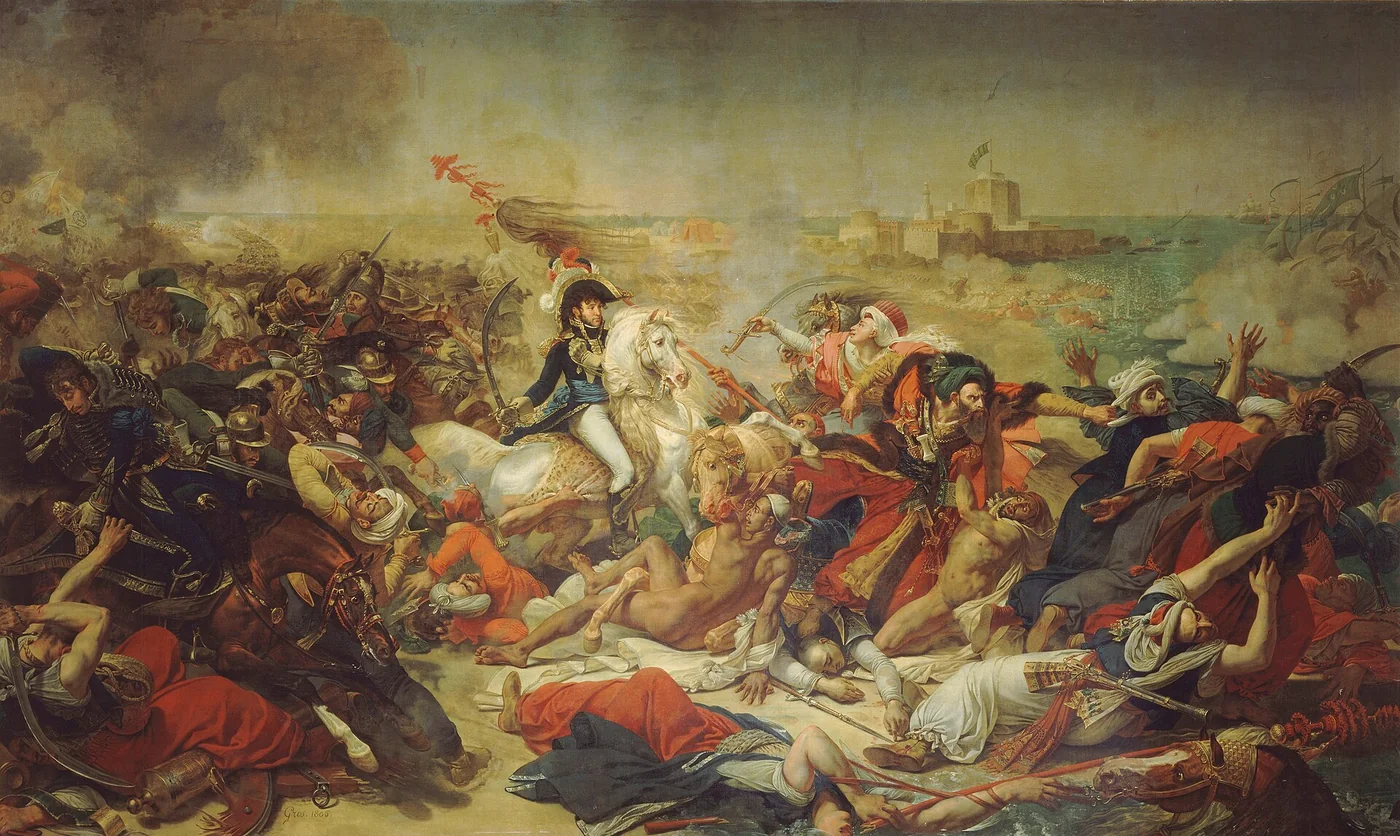
Back in Cairo in June 1799, Bonaparte had almost at once to face an Ottoman landing, backed by Sidney Smith's fleet, in Aboukir Bay, the very place where the French navy had been destroyed the year before. On 25 July 1799 he attacked without delay: the divisions of Lanusse and Lannes broke through the first Ottoman lines, then Murat's cavalry poured through a gap opened by the artillery and charged as far as the enemy camp, where Murat wounded and personally captured the Ottoman commander, Mustafa Pasha. Trapped against the sea, thousands of Ottomans drowned trying to flee; the survivors who took refuge in the fort of Aboukir surrendered a week later. It was one of Bonaparte's cleanest victories in Egypt.
From a captured ship, Bonaparte learned in the following days of France's reverses in Europe and the troubles shaking the Directory. He decided to go home without waiting for authorisation from Paris, leaving Kléber in command of the Army of Egypt. On the night of 22 to 23 August 1799 he secretly boarded the frigate La Muiron with a handful of close companions, among them Berthier, Lannes, Murat, Monge and Berthollet, slipped past the British patrols and landed at Fréjus on 9 October. A month later, on 18 Brumaire, he overthrew the Directory.
Kléber, Menou and the end of the expedition
Kléber, left with a depleted army and no hope of reinforcement, negotiated the Convention of El-Arish as early as January 1800, providing for the French troops to be evacuated to France with their arms and baggage. The British commander-in-chief in the Mediterranean, Admiral Keith, refused to ratify so generous an agreement and demanded unconditional surrender. Kléber took up arms again, crushed an Ottoman army at Heliopolis on 20 March 1800 and put down a second Cairo revolt, before being assassinated on 14 June 1800 by a young Syrian, Suleiman al-Halabi.
Command passed to General Menou, converted to Islam under the name Abdallah and married to an Egyptian woman, a figure less respected by the troops than Kléber had been. He failed to prevent the landing of a British expeditionary force under General Abercromby in March 1801, backed by Ottoman forces from Syria. Beaten near Alexandria, where Abercromby died of his wounds, the French fell back on two fronts, lost Cairo in June, then capitulated at Alexandria itself on 30 August 1801, after holding the besieged city for several weeks. Under the terms of the agreement the survivors were repatriated by the British navy, but had to give up their scientific collections, the Rosetta Stone foremost among them, which passed to the British crown. Vivant Denon, for his part, managed to keep his sketchbooks.
A scientific legacy
In military terms the Egyptian expedition ended in failure: a fleet lost, an army that finally capitulated, no lasting territorial gain. Yet it left a considerable mark. The Commission on Sciences and Arts published, between 1809 and 1829, the monumental Description de l'Égypte, several dozen volumes of text and plates cataloguing ancient monuments, wildlife, plants and contemporary Egyptian society with a precision Europe had not seen before. The work fed a genuine craze for Egypt, in the architecture, furniture and decorative arts of the First Empire and beyond.
The Rosetta Stone, kept at the British Museum since 1802, became the key that let Jean-François Champollion crack the secret of hieroglyphs in 1822, building also on earlier work by the British physicist Thomas Young; the discovery founded Egyptology as a modern scholarly discipline. The taste for ancient Egypt, carried by Denon's engravings and the plates of the Description, endured for decades in the furniture, silverware and architecture of the First Empire, from bronze sphinxes to decorative obelisks.
From the fleeting triumph of the Pyramids to the failure at Acre, the Egyptian and Syrian campaign chiefly served, in the eyes of a French public left for months without reliable news, to build the legend of a general already crowned with glory from Italy. It was that unblemished reputation, of a victor said to have tamed the desert and the pyramids, that Bonaparte came home to collect, a mere few weeks before seizing power on 18 Brumaire.
Further reading
- Henry Laurens, L'Expédition d'Égypte, 1798-1801, Seuil, coll. « Points Histoire », 1997.
- Juan Cole, Napoleon's Egypt. Invading the Middle East, Palgrave Macmillan, 2007.
- Thierry Lentz, Nouvelle histoire du Premier Empire, vol. I, Napoléon et la conquête de l'Europe, 1804-1810, Fayard, 2002 (background chapters on the return from Egypt).
- Patrice Bret, L'Égypte au temps de l'expédition de Bonaparte, 1798-1801, Hachette Littératures, 1998.
- An eyewitness: Vivant Denon, Voyage dans la Basse et la Haute Égypte pendant les campagnes du général Bonaparte, 1802.