On 20 and 21 May 1813, Napoleon attacked the Russo-Prussian army entrenched on the Spree around Bautzen. Having pinned the enemy on the first day, he counted on Ney to outflank it from the north and cut off its retreat; but the manoeuvre lacked bite, and the Allies withdrew in good order. The victory cost each side some 20,000 men.
Forces at play
Outcome: Incomplete French victory

France · Confederation of the Rhine · Italy
- Napoléon
- Ney
- Soult
- Oudinot
- Marmont
- Macdonald
140,000 to 180,000 men according to estimates, only part of them engaged
Casualties: About 20,000 men, up to 25,000 according to some authors

Russia · Prussia
- Wittgenstein
- Blücher
- Barclay de Tolly
- Miloradovitch
- Kleist
About 96,000 to 97,000 men
Casualties: About 20,000 men according to most estimates, 11,000 to 14,000 according to others
Flags: Sodacan, CC BY-SA 3.0; David Liuzzo, Wikimedia Commons
Battle coordinates
Bautzen
Coordonnées 51.1814°, 14.4242°
Battle narrative
After Lützen
Beaten at Lützen on 2 May 1813, the Russians and Prussians withdrew without being pursued: since Russia, Napoleon had almost no cavalry left. They crossed back over the Elbe by way of Dresden and then, after some hesitation on the part of the Prussians, who wanted to cover Berlin, regrouped around Bautzen, in Lusatia, between 10 and 13 May. Meanwhile Miloradovich's rearguard held off Macdonald's corps. On 16 May Barclay de Tolly's troops joined them. Wittgenstein, still in command of the Allied army, decided to give battle in a strong position close to Austria, whose entry into the war they were hoping for.
Napoleon had taken a few days to put his army back in order, set up depots at Dresden and throw bridges across the Elbe. He then divided his forces. Marshal Ney, with several corps, moved north as if to threaten Berlin; the Emperor, with the main army and the Guard, followed the Allies eastwards. When he realised, after a rearguard action on 15 May, that the enemy was waiting for him at Bautzen, he ordered Ney to come back south through Hoyerswerda and fall on the Allied right flank.
The line of the Spree
The Allies had taken up position on the right bank of the Spree, along a front of some fifteen kilometres. To the south lay hills; to the north, a country of ponds and marshes. In the first line, Miloradovich's corps held the heights on either side of the town of Bautzen. Behind it, the main position, strengthened with redoubts, was entrusted to Kleist, Blücher and Yorck; on the far right, on flat ground with nothing to anchor it, stood Barclay. The Russian Guard formed the reserve, and Tsar Alexander and King Frederick William III had their headquarters in the village of Wurschen.
The Allies fielded some 96,000 to 97,000 men. Napoleon gathered many more, between 140,000 and 180,000 according to the estimates if Ney's corps are counted, even though only part of them would fight. On the eve of the battle, 19 May, Barclay and Yorck tried to intercept Ney on the march: at Königswartha Barclay surprised and largely destroyed the Italian division of General Peyri, who was taken prisoner, but Yorck ran into Lauriston's corps, and both had to fall back to their lines.
20 May: crossing the Spree
Napoleon's plan came in two stages. On the first day he would attack frontally to pin the enemy down and force him to commit his reserves; on the second, Ney, arriving from the north, was to outflank the Allied right and cut off its retreat. Around noon the French artillery opened fire. On the right, Oudinot's corps attacked the heights held by the Russians, without decisive success; in the centre, Macdonald at first failed in front of Bautzen. Marmont then crossed the Spree under the cover of sixty guns and drove back the troops of Prince Eugen of Württemberg. His division under Compans entered Bautzen from the rear, and the Russians hurriedly evacuated the town.
Further north, in the centre, which Marshal Soult had been given to command, Bertrand's corps was held in check for hours by Kleist, supported by Blücher. The capture of the village of Burk by Bonnet's division finally forced Kleist to give way, and the whole line of the Spree was crossed. In the afternoon Ney's advance guard seized the crossing at Klix, in the north, without getting over the Spree that day. In the south Oudinot had gained ground, and the Tsar, convinced that the main danger lay on that side, sent reinforcements there.
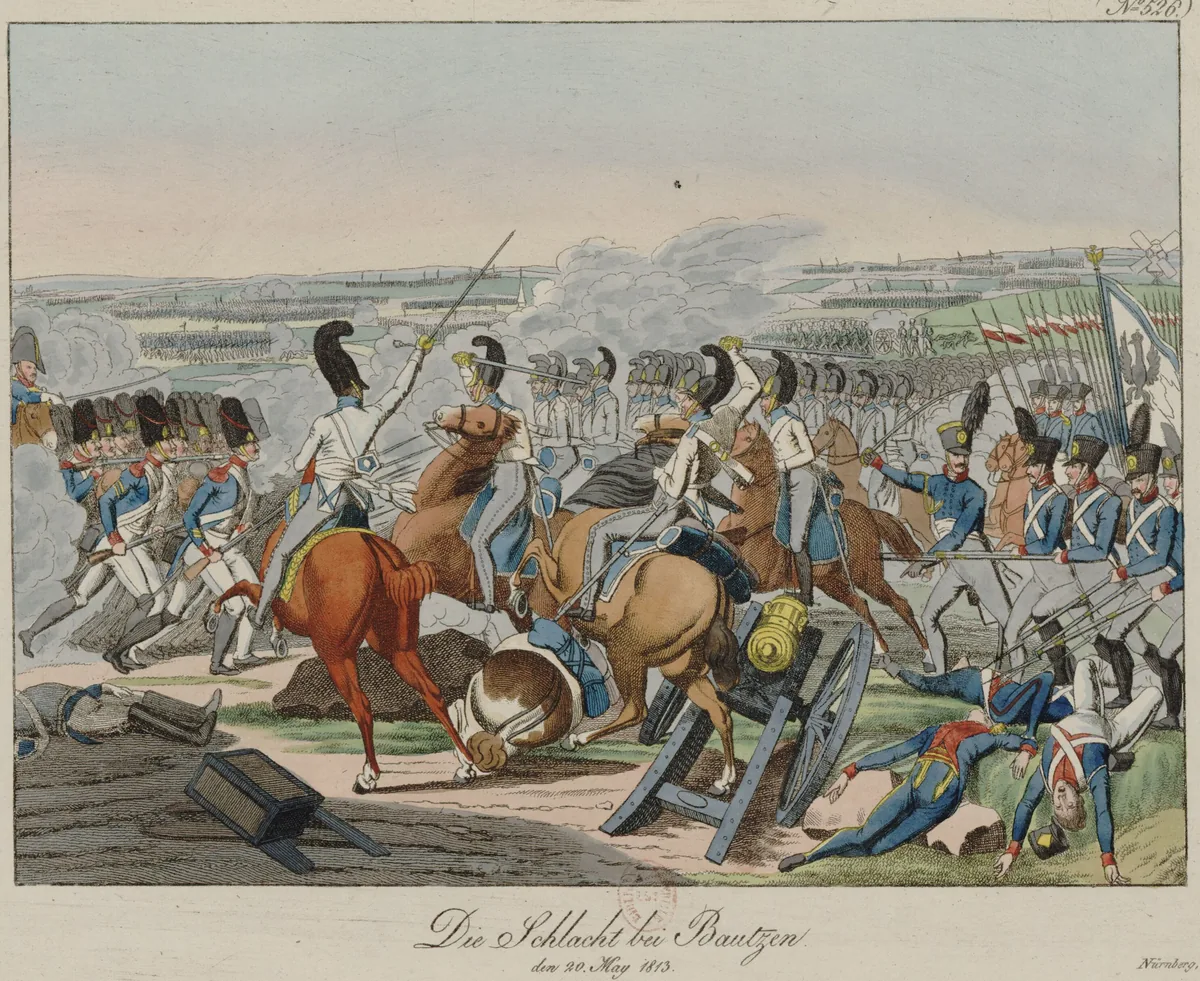
21 May: Ney in the north
Fighting resumed at around six in the morning. In the south Oudinot attacked again. Against the advice of Wittgenstein, who was afraid of stripping his right, the Tsar reinforced Miloradovich once more, and Oudinot was thrown back to the Spree. Napoleon refused to help his marshal: the battle was to be decided in the north. In the centre, both sides largely confined themselves to a violent cannonade.
In the north, Ney pushed Barclay back; Barclay called for reinforcements in vain. As early as ten o'clock Souham's division occupied the village of Preititz, in Blücher's rear. But the rest of Ney's troops advanced cautiously, and Kleist, sent by Blücher, retook Preititz. Instead of driving straight for the Allied rear and their line of retreat, Ney became absorbed in the fight for the village, which he did not recapture until the middle of the afternoon. Many historians would blame him for losing sight of the purpose of the manoeuvre; others point out that the orders from Napoleon and Berthier were very terse for so decisive a mission.
At about two in the afternoon Napoleon at last sent in his centre. Soult had Bertrand's troops storm the Kreckwitz heights, the key to Blücher's position, and they carried them after a bitter fight. Under fire from three sides, Blücher pulled back in time and joined Yorck. At around four o'clock the Tsar ordered a general retreat. The Russians and Prussians withdrew eastwards in good order; Latour-Maubourg's cavalry could make no impression on their squares. Reynier's corps, which Napoleon had not called up in time, only arrived early in the afternoon.
Outcome
Napoleon was left master of the field, but the victory was incomplete and costly. According to the most common estimates, each side lost about 20,000 men, counting the fighting of 19 May; other authors put French losses as high as 25,000 and Allied losses at only 11,000 to 14,000. According to an often-repeated anecdote, the Emperor, struck by the number of wounded among his young soldiers, suspected them of having maimed themselves to escape the fighting and wanted to make examples of them; his surgeon Larrey is said to have talked him out of it.
The next day, 22 May, near Reichenbach, a stray cannonball landed a few metres from Napoleon: it killed General Kirgener and mortally wounded the Grand Marshal of the Palace, Duroc, one of his closest friends, who died the following day. Without cavalry, the pursuit came to nothing. On 25 May Wittgenstein handed over command of the Allied army to Barclay de Tolly. On 4 June Napoleon accepted the Armistice of Pläswitz. He would come to regret it: the truce served his enemies above all, who used it to grow stronger, and Austria went to war against him in August. On the Arc de Triomphe in Paris, the battle is listed under the name of Wurschen, the village where the Allied sovereigns had their headquarters.
Go further
Recommended books to dig deeper (affiliate links)

Napoleon — A magisterial biography
An exhaustive biography of the Emperor, the fruit of rigorous research.
≈ £14.99 Napoleon's Army
Organization, tactics and daily life of the Grande Armée soldiers.
≈ £18.00 Austerlitz 1805
The detailed account of the Battle of the Three Emperors.
≈ £12.99As an Amazon Associate, this site earns from qualifying purchases.
Support the encyclopedia
Napoleon Empire is an independent project. Your contribution helps grow the content and keep the site running.
Donate