On 21 and 22 May 1809 Napoleon crossed the Danube below Vienna by way of Lobau island and ran into Archduke Charles's army around the villages of Aspern and Essling. With his bridges swept away by the flood and by objects sent down the current, he had to fall back to the island: it was his first personal defeat in a major battle, and Marshal Lannes was mortally wounded there.
Forces at play
Outcome: French defeat

France
- Napoléon
- Masséna
- Lannes
- Bessières
66,000 to 80,000 men according to the sources, brought across piecemeal
Casualties: 20,000 to nearly 27,000 men according to the sources, including Marshal Lannes

Austria
- Archiduc Charles
- Hiller
- Rosenberg
- Hohenzollern
95,000 to 98,000 men
Casualties: 20,000 to 23,000 men
Battle coordinates
Aspern-Essling
Coordinates 48.2300° N · 16.4900° E
Battle narrative
Vienna taken, the Austrian army intact
On 10 April 1809 Austria, eager to wipe out Austerlitz and taking advantage of Napoleon's entanglement in Spain, invaded Bavaria. In a few days of fighting, at Abensberg, Landshut, Eckmühl and Ratisbon, the Emperor drove Archduke Charles back north of the Danube. He then marched on Vienna, which he entered on 13 May. But the Austrian army was not destroyed: Charles had regrouped it on the left bank of the river, north-east of the capital, after destroying the bridges. To reach it, Napoleon had to cross the Danube.
Lobau island
A first attempt upstream of Vienna failed. Napoleon then chose Lobau island, downstream: about four kilometres long and wooded, it made it possible to hide troops. The main arm, on the French side, several hundred metres wide, was crossed on the night of 19 to 20 May by pontoon bridges; a shorter bridge was thrown across the small arm towards the left bank. But these bridges were fragile: the Danube was in flood, the current was strong, and the Austrians sent all kinds of floating objects downstream to break them.
On 21 May Masséna's corps crossed to the left bank, into the vast plain of the Marchfeld. The Archduke did not oppose it: he meant to let part of the French army cross and crush it before the rest could join it. He had some 95,000 to 98,000 men; Napoleon, who could bring only part of his army across, could at first oppose him with no more than 30,000 to 40,000.
21 May: Aspern and Essling
The French rested on two villages: Aspern on the left, held by Molitor's division, and Essling on the right, held by Boudet's division, which fortified the village's great granary. Between the two, Bessières's cavalry covered the centre. In the afternoon the Austrian columns attacked. Aspern changed hands several times; Masséna clung on, and at nightfall the Austrians held only part of it. At Essling, Lannes and Boudet threw back three attacks. To relieve the infantry, the cavalry repeatedly charged the Austrian batteries; General d'Espagne, at the head of his cuirassiers, was killed by a cannonball.
The bridges had broken a first time during the day. Once repaired, they allowed Lannes's corps — Saint-Hilaire's division and Oudinot's grenadiers — along with cavalry and artillery, to cross during the night. By morning the French army on the left bank had almost doubled.
22 May: Lannes's attack
At dawn Masséna retook Aspern, and Saint-Hilaire's division helped throw back a fresh attack on Essling. At about 7 a.m. Napoleon launched Lannes against the Austrian centre. The attack made progress under artillery fire; the enemy line wavered, and Archduke Charles had to commit his reserve grenadiers. According to Austrian tradition, he seized a flag himself to rally his soldiers.
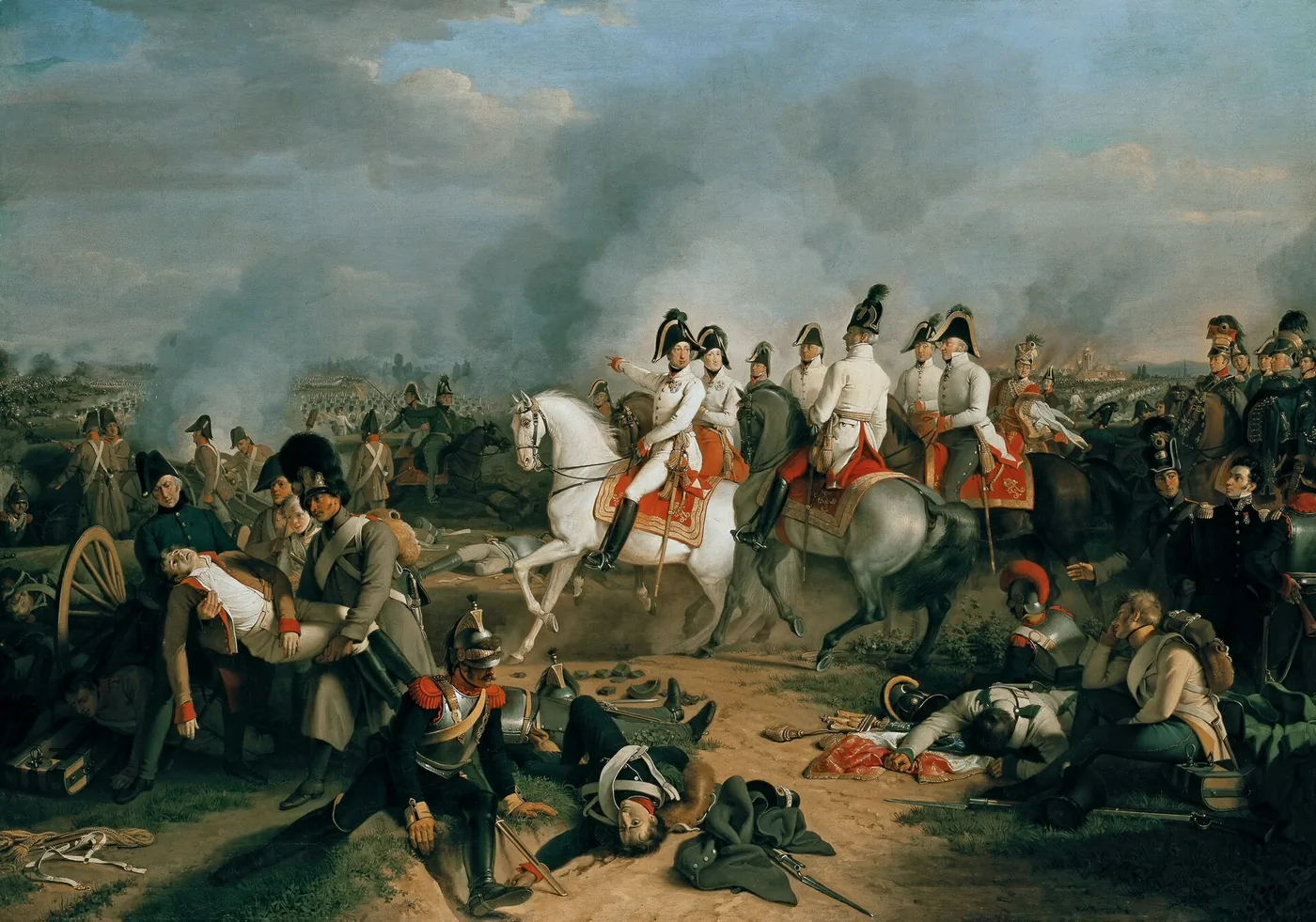
Then came the news: the bridge over the main arm had been carried away again, this time by a floating mill launched by the Austrians. Davout's corps, waiting on the right bank, could no longer cross; ammunition would soon run short. Napoleon had to halt the attack and order a withdrawal to Aspern and Essling. The Archduke, grasping the situation, went back on the offensive. General Saint-Hilaire was mortally wounded. Essling was lost and then retaken by the Young Guard, led by Mouton and Rapp, while nearly 150 Austrian guns pounded the French centre.
The death of Lannes
During this cannonade Marshal Lannes, who had just seen General Pouzet, his former instructor, fall at his side, was struck in the legs by a cannonball. One leg was amputated, and he died on 31 May. He was the first Marshal of the Empire to die of wounds received in battle. "What a loss for France and for me!" Napoleon is said to have exclaimed, losing one of his oldest comrades in arms.
At nightfall the army withdrew in good order to Lobau island. Masséna commanded the rearguard and brought back the wounded who could be moved, most of the equipment and the horses; he was one of the last to cross, on the morning of 23 May.
Outcome
Losses were enormous and roughly equal: from 20,000 to nearly 27,000 men killed, wounded or captured on the French side according to the sources, 20,000 to 23,000 on the Austrian side. For the first time Napoleon had been beaten in person in a major battle. In Vienna and across Europe the Austrians celebrated a victory, and the Emperor's reputation for invincibility was shaken.
A temporary setback
Yet the day after the battle the two armies held roughly the same positions as before, and Charles did not pursue. On the French side it was spoken of as a temporary setback, due above all to the breaking of the bridges. Napoleon established himself on Lobau island; from 1 June General Bertrand had solid bridges built there, protected upstream by palisades. Six weeks later, on the same plain of the Marchfeld, he crossed the Danube again and won at Wagram, on 5 and 6 July, the decisive battle of the campaign. Masséna, for his conduct at Essling, was later made Prince of Essling.
Go further
Recommended books to dig deeper (affiliate links)

Napoleon the Great
Andrew Roberts · 2014
A monumental biography drawing on Napoleon’s 33,000 surviving letters, admiring but rigorous.
See on Amazon
Napoléon ou le mythe du sauveur
Jean Tulard · 1977
The book that reshaped how the man is read: how France gave itself a saviour, and what it cost.
See on Amazon
Nouvelle histoire du Premier Empire
Thierry Lentz · 2002-2010
Four reference volumes on institutions, diplomacy and collapse: the scholarly synthesis of the subject.
See on AmazonAs an Amazon Associate, this site earns from qualifying purchases.
Support the encyclopedia
Napoleon Empire is an independent project. Your contribution helps grow the content and keep the site running.
DonateSecure payment on the platform you choose.