The sovereign of Elba
On 6 April 1814, at Fontainebleau, Napoleon signed an unconditional abdication, after his marshals had made it plain that the army would no longer march. The treaty concluded on 11 April with the Allied powers left him the title of emperor and the sovereignty of the island of Elba, some ten kilometres off the Tuscan coast, together with a small guard and an annual income of two million francs to be paid by France. In the night of 12 to 13 April he had tried to poison himself and survived. On 4 May he landed at Portoferraio.
He did not behave like a man who was simply waiting. He rode round the island, had roads cut, restored the iron mines at Rio, reorganised the finances and found quarters for a small army and a small fleet. His mother, Letizia, and his sister Pauline joined him. But the private life of the lord of Elba was a sequence of bereavements and absences: Josephine died at Malmaison on 29 May 1814, and Marie-Louise, who had returned to Vienna with the King of Rome, never came to join him. Above all he stayed closely informed about France, through newspapers, visitors and the officers who made the journey.
No single motive explains his departure. The promised income was never paid, and his resources were shrinking. At Vienna, where the powers had been redrawing the map of Europe since the autumn, there was talk of moving him to a more distant island, further from Italy and from France. Above all, the reports reaching him described a country disappointed with the new regime. Napoleon concluded that an opportunity had come, and that it would not last.
A France not yet reconciled
The first Restoration was nothing like a tyranny. Louis XVIII, who entered Paris on 3 May 1814, granted on 4 June a constitutional Charter that guaranteed individual liberties, freedom of worship, equality before the law and two chambers, and that kept the Civil Code, the Legion of Honour and the sale of the biens nationaux. The Treaty of Paris of 30 May brought France back to her frontiers of 1792, or very nearly, but without war indemnity or lengthy occupation.
What caused offence was more diffuse. The white cockade replaced the tricolour that soldiers had carried from Valmy to Wagram, and émigrés who made no secret of their grudges were seen again around the king. The army, cut back to peacetime strength, placed thousands of officers trained in the wars of the Revolution and the Empire on half-pay, and saw its Guard reorganised under another name. Prisoners came home from captivity, humiliated, just as their regiments were being broken up. The purchasers of biens nationaux feared that what the Charter guaranteed them might yet be taken back, and the press had no censor but plenty of enemies. The regime was far from unpopular everywhere, and war-weariness was real. But it lacked friends in the barracks, and that was where everything would be decided.
The flight of the Eagle
On the evening of Sunday 26 February 1815, Napoleon embarked at Portoferraio on a small brig, the Inconstant, with about a thousand men spread over seven vessels. The British commissioner assigned to watch him, Neil Campbell, was away from the island, on the Tuscan mainland. The little fleet slipped past the French and British cruisers and anchored in the Golfe-Juan on 1 March. In a proclamation to the army, Napoleon promised that "the eagle, with the national colours, will fly from steeple to steeple to the towers of Notre-Dame".
He avoided the royalist Rhône valley and took the Alpine road through Grasse, Digne and Gap, with an advance guard opening the way and an escort that did not fire. The mountain populations welcomed him. On 7 March, near the lake of Laffrey, some twenty kilometres from Grenoble, he found his way barred by a battalion of the 5th line regiment. Tradition has it that he walked forward alone, opened his greatcoat and invited the soldiers to shoot their emperor. No shot was fired, and the troops fell in behind him. That same evening, at Grenoble, Colonel Charles de La Bédoyère brought over the 7th line and opened the gates of the city.
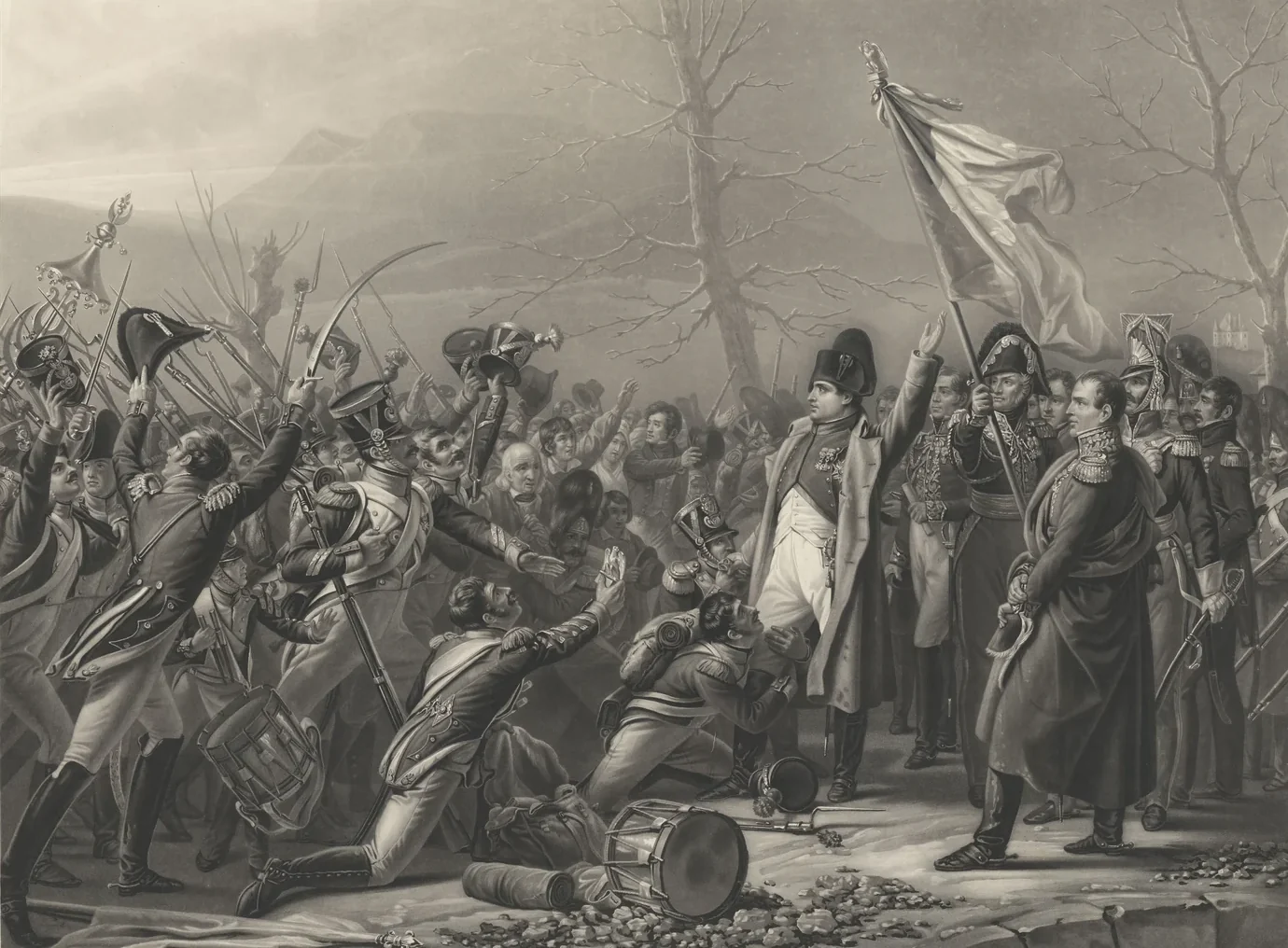
What followed was a triumphal march. At Lyon, on 10 March, the Comte d'Artois, the king's brother, and Marshal Macdonald failed to hold the troops, who went over to the Emperor. Marshal Ney, who had left Paris promising, according to tradition, to bring Napoleon back "in an iron cage", declared for him on 14 March at Lons-le-Saunier, once he saw that his regiments would not follow him; at Auxerre he met his old chief again. Prefects wavered, generals fell into line, peasants and workers cheered. The royal army, on which the king had counted heavily, melted away. In the night of 19 to 20 March, Louis XVIII left the Tuileries for Belgium. On the evening of 20 March Napoleon entered the palace, acclaimed by half-pay officers, twenty days after landing and almost without having fired a shot.
Governing: the liberal Empire
The return had been a military adventure. Now he had to govern, and Napoleon knew he could no longer do so as before. The army had carried him back, but the notables, the middle classes and the former revolutionaries wanted guarantees. He formed a ministry that mixed loyalists and newcomers: Cambacérès at Justice, Caulaincourt at Foreign Affairs, Davout at War, Decrès at the Navy and, more surprisingly, Carnot at the Interior, the old regicide now made a count, and Fouché at the Police, of whom no one doubted that he was playing several hands at once.
The most remarkable episode is the meeting with Benjamin Constant. On 19 March this liberal writer had published a very harsh article against the Emperor in the Journal des débats. A few weeks later Napoleon received him and asked him to draft a constitution. The result was the Additional Act to the Constitutions of the Empire, promulgated on 22 April: a chamber of peers appointed by the Emperor, an elected chamber of representatives, ministerial responsibility, freedom of the press and independence of the judges. The text was put to a plebiscite, which returned more than 1.5 million yes votes against only a few thousand no votes, but in a country where abstention was widespread. Liberals thought the text too timid, Bonapartists thought too much had been conceded. On 1 June the ceremony known as the Champ de Mai, held on the Champ de Mars, proclaimed the new constitution and presented eagles to the regiments; the two chambers opened on 7 June.
In other respects the government made gestures of openness: a decree of 29 March 1815 abolished the slave trade, in a move that was also aimed at British opinion. Still, the country was not united. Part of the south and west remained hostile, the Vendée took up arms again in May, and troops had to be sent there that the Army of the North could have used. The regime had three months before it, and it did not get them.
Europe forms a league
At Vienna, where the Congress was still sitting, news of the departure from Elba arrived on 7 March. The reaction was swift. On 13 March the eight powers that had signed the Treaty of Paris of 1814 declared Napoleon "outside the pale of civil and social relations" and handed him over to "public vengeance". On 25 March Austria, Prussia, Russia and Great Britain renewed their Chaumont alliance and each undertook to put 150,000 men in the field. This was the Seventh Coalition.
Napoleon nevertheless wrote to the sovereigns promising peace, and he probably hoped that the rivalries which had surfaced at the Congress over Poland and Saxony would prevent their union. They did not. For the Allies, the problem was no longer Napoleon alone, but the possibility that a man could return to power through the army and reopen the war. His father-in-law, Francis I of Austria, kept Marie-Louise and the little King of Rome at his side. As for Murat, King of Naples, who had taken up arms against Austria in the spring to support his brother-in-law, he was beaten at Tolentino on 2 and 3 May and signed the convention of Casalanza on 20 May.
Preparations were therefore needed. Davout, at the War Ministry, recalled the old soldiers, reopened the arsenals and organised the National Guards. In three months he produced a force of about 125,000 men for the campaign, the Army of the North. Napoleon decided not to wait for the invasion. The bulk of the Allied forces was still far away, on the Rhine or on the march, but two armies were already in Belgium close to the frontier: Wellington's, made up of British, Dutch, Belgians, Hanoverians and Brunswickers, and Marshal Blücher's Prussian army. If he could beat them one after the other before they joined, he might hope to open negotiations from a position of strength.
The Belgian campaign
On the morning of 15 June the Army of the North crossed the Sambre at Charleroi. The concentration, carried out in great secrecy, had taken the Allies by surprise. Napoleon divided his forces into two wings, entrusted to Ney and Grouchy, and kept the centre under his own command. The next day, 16 June, he crushed part of the Prussian army at Ligny, but things went less well on his left. At Quatre Bras, Ney, who was to hold the crossroads against Wellington's troops, failed to do so, and d'Erlon's corps, which could have decided the outcome of either battle, spent the day marching from one to the other without fighting.
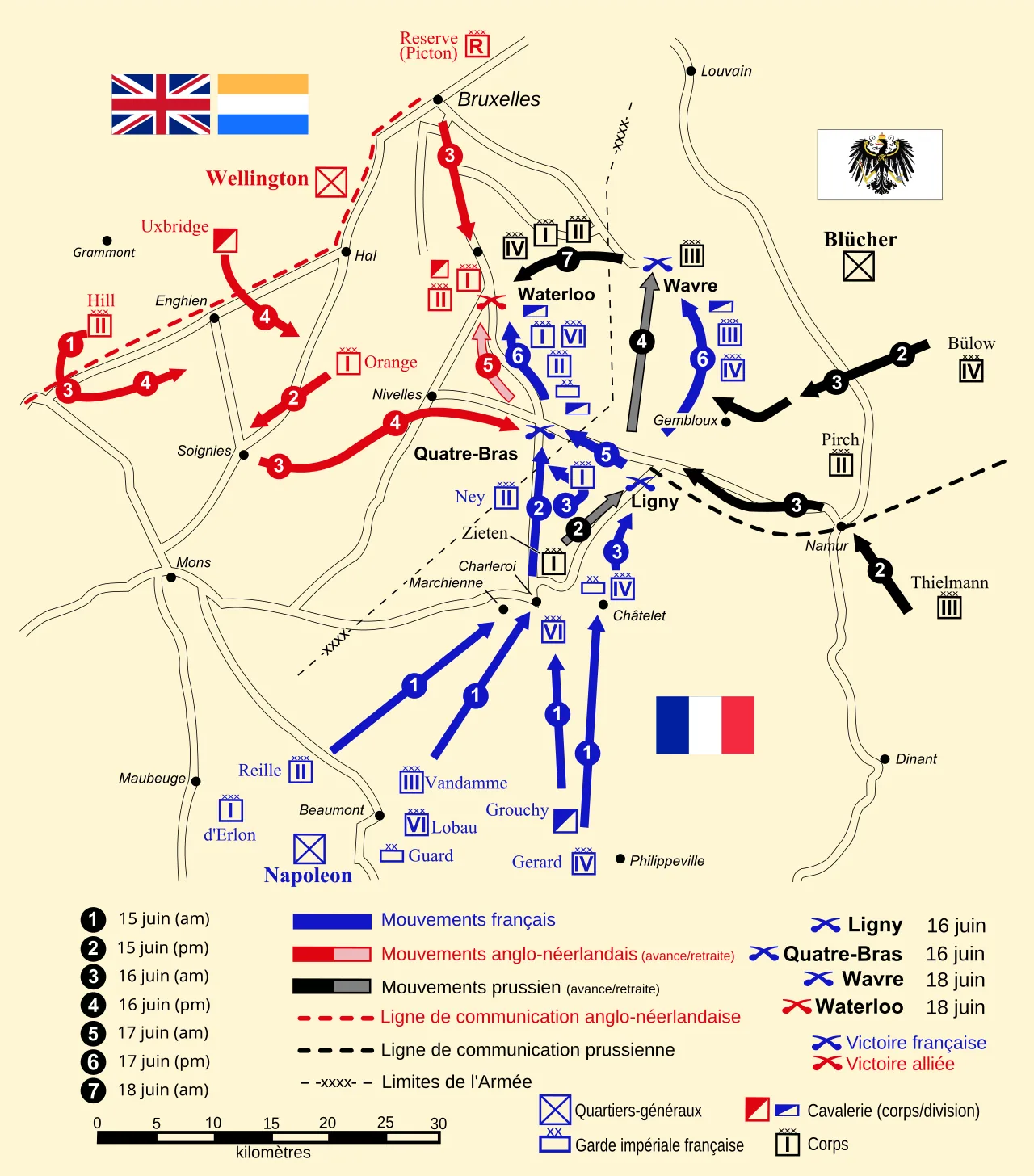
Ligny was not the decisive victory he had hoped for. The Prussians retreated in good order, not eastwards as Napoleon imagined, but northwards to Wavre, from where they could join Wellington's army. On 17 June Napoleon sent Grouchy, with about 33,000 men, to pursue the Prussians, and marched himself against Wellington, who had fallen back to the ridge of Mont-Saint-Jean, in front of the forest of Soignes. The night brought violent rain that soaked the ground.
Waterloo
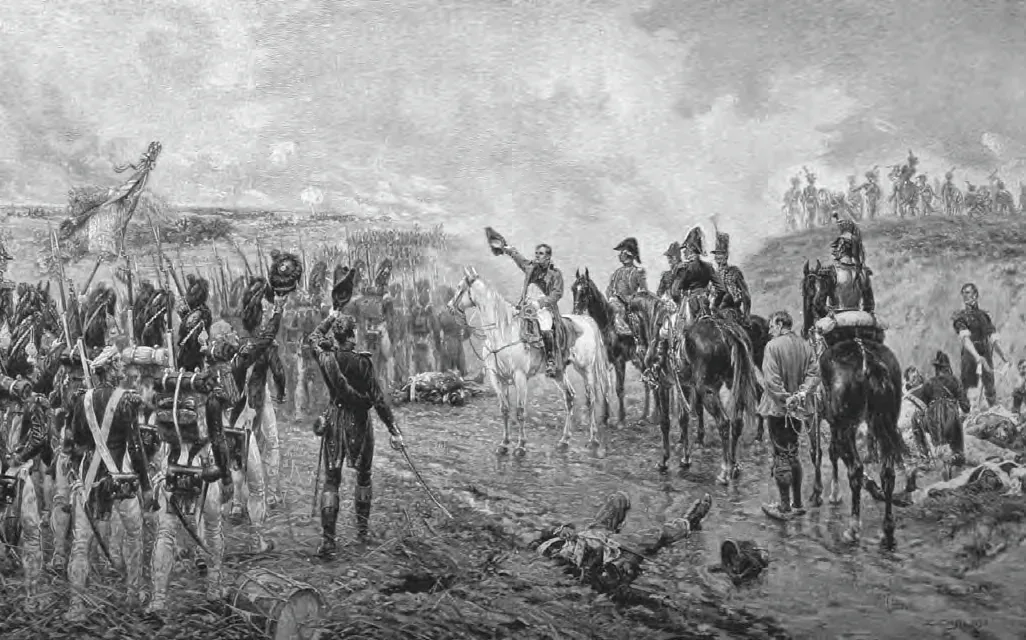
The battle opened on 18 June at about half past eleven, later than planned because Napoleon wanted the ground to dry so that his artillery could manoeuvre. He had some 72,000 men, Wellington a little under 70,000, of whom the British were only a minority. The attack on the fortified farm of Hougoumont absorbed for hours far greater forces than the objective deserved. In the early afternoon a great assault by d'Erlon's corps on the Anglo-Allied left failed. Around four o'clock Ney launched the cavalry charges against the centre, without infantry or artillery support, and the British squares held. Soon afterwards the leading columns of Bülow's Prussians appeared on the French right flank, and Napoleon had to divert part of his reserves to defend Plancenoit.
The farm of La Haye Sainte, at the heart of Wellington's line, finally fell at about six o'clock, but Napoleon did not exploit the success quickly enough. At about half past seven he sent the Guard in a last assault on the Allied centre. The battalions of the Middle Guard climbed under fire, were halted and then driven back, and the cry "The Guard is falling back!" ran through the French lines. At the same moment Zieten's corps arrived on Wellington's left. The army broke. Only a few battalions of the Old Guard, formed in squares, covered the retreat.
Grouchy, for his part, had met the Prussian rearguard at Wavre and fought there all day, inconclusively. He heard the guns, and some of his subordinates urged him to march towards them, but he kept to the order he had received. Whether he should have disobeyed has fuelled decades of controversy. Historians now regard the question as less decisive than was once thought: Napoleon's plan rested on assumptions about the Prussian retreat that Ligny had not confirmed, and the way he fought the battle, the late start, the dispersal of effort, invites far heavier criticism. Losses were enormous on both sides: about 25,000 killed and wounded for the French, not counting prisoners, and more than 20,000 among the Anglo-Dutch and the Prussians.
The second abdication
Napoleon left the field and reached Paris on 21 June, where he learned that the chambers, which Lafayette had urged to declare themselves in permanent session, were only waiting for him to go. On 22 June he abdicated in favour of his son, whom the chambers proclaimed as Napoleon II without ever giving him real power. A provisional government was formed under Fouché's presidency. On 25 June the Emperor withdrew to Malmaison, Josephine's house, and on the 29th left for Rochefort, hoping to reach the United States. The British cruisers made the crossing almost impossible. On 15 July he surrendered to Captain Frederick Maitland aboard the Bellerophon, hoping for an asylum that would not be granted.
Paris capitulated on 3 July. Louis XVIII was back on the 8th, and it was on that day, according to tradition, that the prefect of the Seine, Gaspard de Chabrol de Volvic, speaking to the king of the period just ended, used the expression "Hundred Days". The count is symbolic: there were 94 days from the return to the Tuileries to the second abdication, 110 to the king's return. The Bellerophon carried Napoleon to England, and the Northumberland then took him to Saint Helena, where he arrived on 15 October 1815. He died there on 5 May 1821.
What the Hundred Days cost
France paid heavily for the adventure. The second Treaty of Paris, of 20 November 1815, brought her back to her frontiers of 1790, imposed an indemnity of 700 million francs and an occupation by Allied troops that could last up to five years and in the event ended in 1818. The restored regime hardened. In the south a "White Terror" struck suspected Bonapartists and Protestants, and Marshal Brune was murdered at Avignon in August. La Bédoyère was shot on 19 August. Ney, tried by the Chamber of Peers, was sentenced to death and shot on 7 December, while Murat, who had returned to Italy, was executed at Pizzo on 13 October.
Politically, the Hundred Days cost the restored monarchy the hope of an easy reconciliation, and gave its opponents, liberal and Bonapartist alike, a lasting argument: the king had held on only through foreigners. For Napoleon himself, the episode changed the image. The man who had abdicated in 1814 as a defeated warlord became, with the return from Elba, a figure of legend, and on Saint Helena he would readily present himself as a sovereign converted to liberal ideas. Historians are doubtful: the Additional Act was a compromise imposed by circumstances, and those who wrote it, Constant first among them, made no secret of their reservations about the sovereign's sincerity.
What strikes one, beyond the defeat, is how quickly a regime can collapse without a fight, and then be reborn in the same way. Twenty days were enough to go from the Golfe-Juan to the Tuileries; less than four months separated the landing from the defeat at Waterloo, and that defeat ended the Napoleonic question in Europe for good.
Further reading
- Henry Houssaye, 1815, 3 vols (La Première Restauration, Waterloo, La Seconde Abdication), Perrin, 1893-1905.
- Jean Tulard, Napoléon ou le mythe du sauveur, Fayard, 1977.
- Andrew Roberts, Napoleon. A Life, Viking, 2014.
- Munro Price, Napoleon. The End of Glory, Oxford University Press, 2014.
- Alessandro Barbero, The Battle. A New History of Waterloo, Walker & Company, 2005.
- A witness and participant: Benjamin Constant, Mémoires sur les Cent-Jours, 1820-1822.