Why Austria took up arms again
Four years after Austerlitz, Vienna had forgotten nothing. The peace of Pressburg, signed on 26 December 1805, had cost the monarchy the Tyrol and Vorarlberg, given to Bavaria, as well as Venetia, Istria and Dalmatia, attached to the Kingdom of Italy. In August 1806 Francis II had given up the crown of the Holy Roman Empire, which Napoleon had hollowed out by creating the Confederation of the Rhine, and he was now only emperor of Austria, under the name of Francis I. For a dynasty that had ruled in Germany for centuries, the humiliation ran deep.
Austria had nonetheless made good use of those years. Archduke Charles, the emperor's brother, had reorganised the army: the infantry was grouped into army corps on the French model, the artillery was strengthened, and a militia, the Landwehr, was created in 1808 to supply reserves. Charles himself doubted that the instrument was ready. The foreign minister, Count Stadion, thought on the contrary that the opportunity would not come again.
It did seem to be arriving from the summer of 1808. The capitulation at Bailén had shown that the imperial armies could be beaten, and the war in Spain kept troops, and the Emperor himself, in the Peninsula. At Erfurt, in October, Alexander I had proved more reserved than Napoleon had hoped. England promised subsidies. Vienna also counted on a German awakening: the appeal to the "German nation" issued at the start of the campaign shows that it meant to make this war something more than a dynastic revenge. In early 1809 the decision was taken, and Napoleon, who left Spain in mid-January to return to Paris, already knew he would have to face Austria.
On 10 April 1809, without a declaration of war, the Archduke's army crossed the Inn and entered Bavaria, France's ally. Historians call it the war of the Fifth Coalition, although on the Continent the coalition amounted to Austria alone.
Five days in Bavaria
The campaign began badly for the French. Napoleon was in Paris and had entrusted the conduct of operations to Berthier, an excellent chief of staff but a poor commander-in-chief. The marshal scattered his corps over a wide front between Ratisbon and Augsburg and left Davout isolated. German contingents, Bavarian and Württemberg above all, made up a good part of the army, and many of its French soldiers were young conscripts. The Emperor reached Donauwörth on 17 April and restored the situation within a few days.
On 20 April, at Abensberg, he attacked the Austrian centre with the Bavarians and Württembergers and cut Charles's army in two. The next day Lannes took Landshut. Napoleon then believed that the bulk of the enemy was fleeing towards the Isar and sent most of his forces there, leaving only Davout and a Bavarian corps, about 36,000 men, facing north. But the Archduke, who had taken Ratisbon and its bridge over the Danube, was bringing his corps back to the south bank and marching on Davout. Informed on the morning of the 22nd, Napoleon turned his army round. Lannes covered nearly thirty kilometres in the morning, the Württembergers carried Eckmühl at the third assault, Davout attacked in the neighbouring woods, and the Archduke, seeing the trap close, gave up the field.
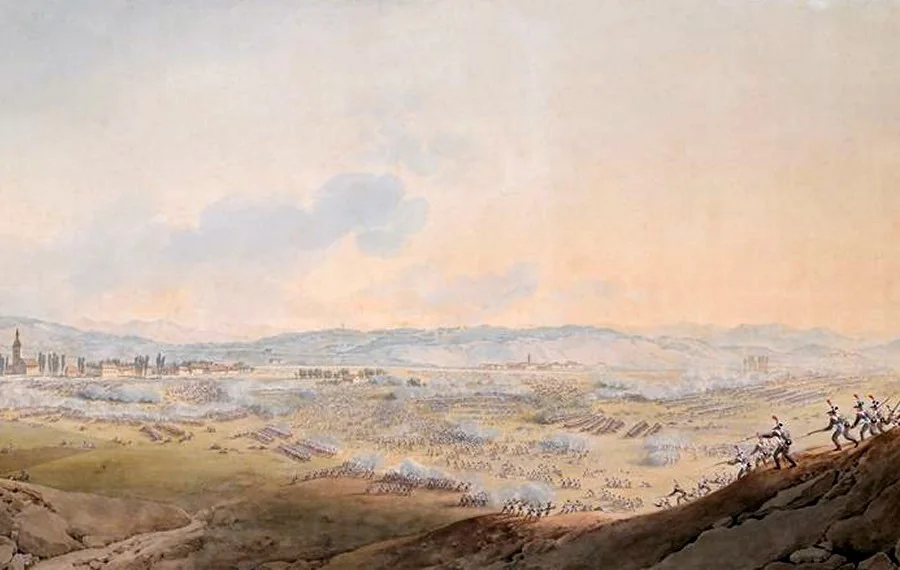
On the 23rd Napoleon stormed Ratisbon, where Lannes led the attack on the ramparts and where the Emperor himself was lightly wounded in the foot. The town was taken, but the Austrian army had had time to cross the Danube and take refuge in Bohemia. In April the Austrians lost more than 30,000 men, yet they were not destroyed. Napoleon is said to have judged later that these manoeuvres were among the finest of his career; the result, for its part, remained incomplete.
Vienna, the Danube and Essling
The road to Vienna was now open. Napoleon reached the capital on 10 May; it was bombarded, capitulated on the 12th, and French troops entered on the 13th. He settled at Schönbrunn, where he had already lodged in 1805. The Viennese were spared a long siege, but what mattered lay elsewhere: Archduke Charles had fallen back to the left bank of the Danube, north-east of the city, and had blown up the bridges. As long as his army was not destroyed, the capital was not worth a victory.
To reach it, Napoleon chose to cross the river downstream from Vienna, using the island of Lobau, about four kilometres long and covered with woods. On the night of 19 to 20 May his pontoneers threw bridges of boats across the main arm, several hundred metres wide. But the Danube was in flood, the current fierce, and the Austrians released barges and floating objects upstream to break the bridges. On 21 May Masséna and his men gained a footing on the plain of the Marchfeld, where they occupied two villages, Aspern on the left and Essling on the right. The Archduke, who had 95,000 to 98,000 men, let them come: he meant to crush the part of the French army that had crossed before the rest could join it. At first Napoleon had only 30,000 to 40,000 men on the left bank.
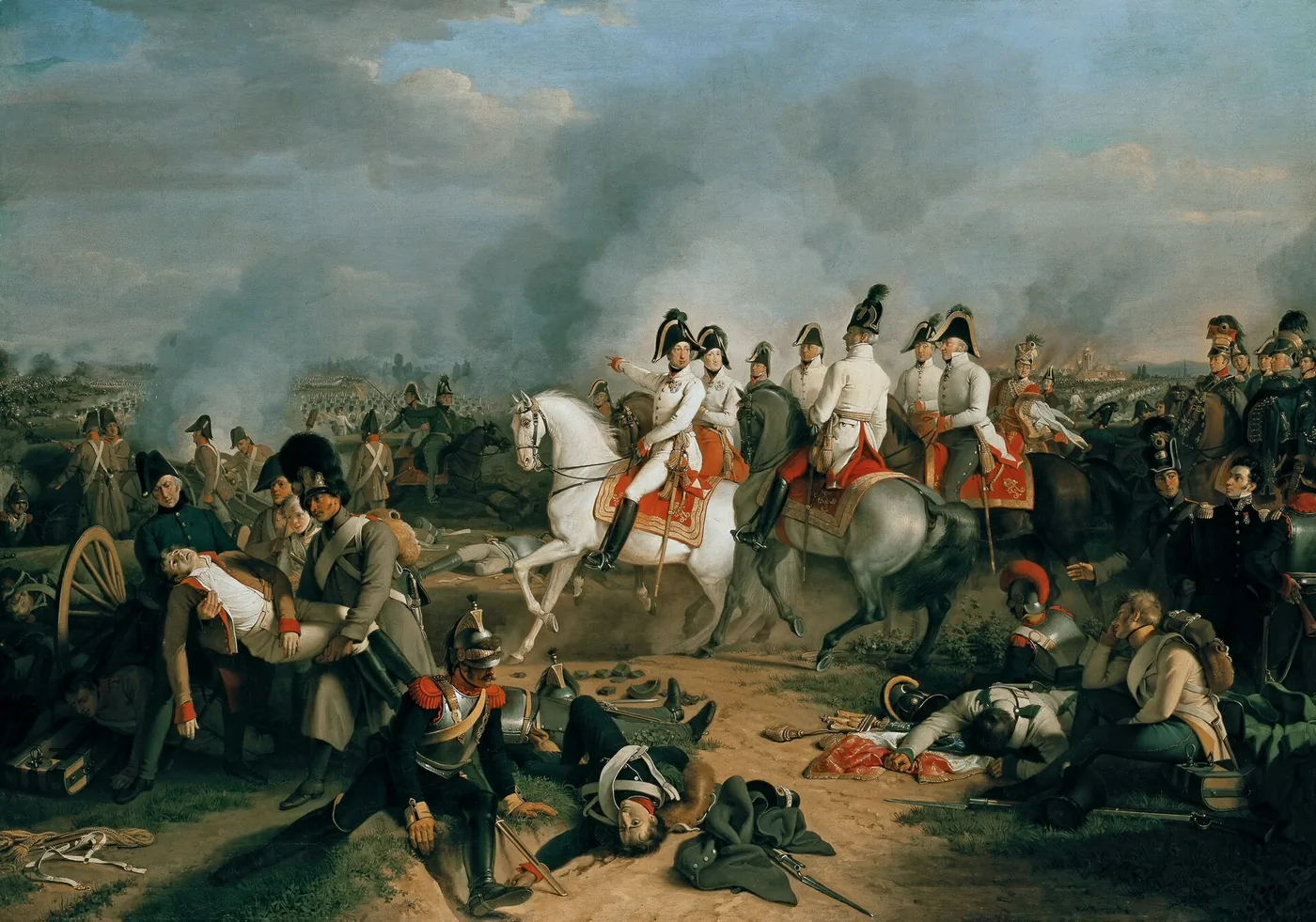
On 21 and 22 May the fighting was fierce. Aspern changed hands several times, and Lannes and Boudet beat off three attacks at Essling from the fortified granary of the village. On the 22nd Napoleon launched Lannes against the Austrian centre, and the enemy line wavered. Then word came that the bridge over the main arm had been swept away again. Ammunition was running short, Davout's corps could no longer cross, and the Emperor had to halt the offensive and pull his army back to the Lobau. Lannes was struck in the legs by a cannonball; amputated, he died on 31 May. Saint-Hilaire and General d'Espagne were also killed. Losses were heavy and roughly equal on both sides: 20,000 to 27,000 men on the French side depending on the source, 20,000 to 23,000 on the Austrian.
For the first time, Napoleon had been beaten in person in a great battle. The setback was not a rout, and the French army withdrew in good order, but the effect was considerable. All over Europe the Archduke's victory was celebrated, and the idea that the Emperor was not invincible gained ground.
Six weeks on Lobau island
Napoleon remained at first for thirty-six hours in an inaction quite unlike him, then pulled himself together. He turned the Lobau into a base: hospitals for the wounded, depots, barracks, and a powerful artillery, including a battery of 124 guns installed under Songis and then Lariboisière. From 1 June General Bertrand directed the building of solid bridges, protected upstream by palisades against the barges the Austrians might send down. By the end of June the French held almost the whole Danube, and the bulletin of 2 July could write that the river no longer existed for the army.
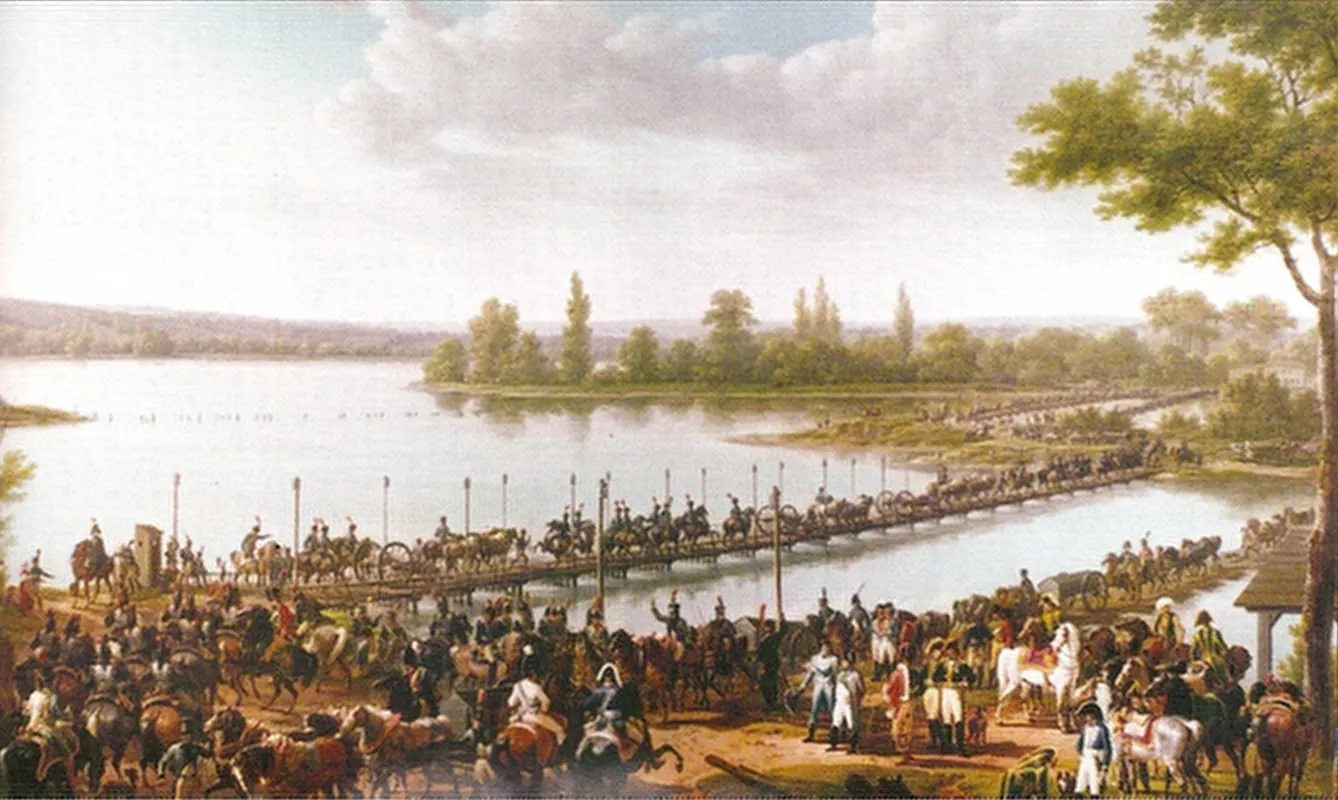
Reinforcements flowed in: Prince Eugène's Army of Italy, Marmont's corps from Dalmatia, Wrede's Bavarian division. On the Austrian side, the victory at Essling had not dispelled the Archduke's doubts. He knew he had not exploited his numerical superiority, that no general uprising had broken out in Germany, that Prussia was not moving and that the expected British landing was slow in coming. He would have liked to negotiate; Emperor Francis refused. So Charles fortified the bank facing the Lobau, then on 3 July withdrew his army from it to the heights overlooking the Marchfeld, behind the Russbach stream. There he waited for Napoleon, and waited too for his brother Archduke John, whose army stood near Pressburg.
Wagram, 5 and 6 July
Napoleon did not repeat the May crossing. On the night of 4 to 5 July, under a storm that blinded the Austrian observers, he brought his army out east of the Lobau, bypassing the fortified villages. Oudinot crossed first in boats, Masséna and Davout followed on bridges prepared in advance, and by morning the bridgehead was secure. On the evening of the 5th a first attack on the plateau of Wagram failed: the Austrians held, and night fell without a decision.
On the 6th the battle began at dawn. Charles attacked the French left wing, near Aspern and Essling, where Masséna, injured in the foot in a fall from his horse, directed his corps from a carriage. The Emperor let him. Davout, at the other end of the line, turned the Austrian left, while Oudinot and the Army of Italy worked their way up the Russbach and Napoleon prepared the central effort: a battery of about a hundred guns, then Macdonald's infantry column, which advanced against the Austrian centre at very heavy cost. By about four in the afternoon Charles's whole army was in retreat. It carried it out by echelons, in good order, and the French, worn out by more than forty hours of marching and fighting, followed without being able to pursue. Archduke John, delayed, arrived too late and turned back.
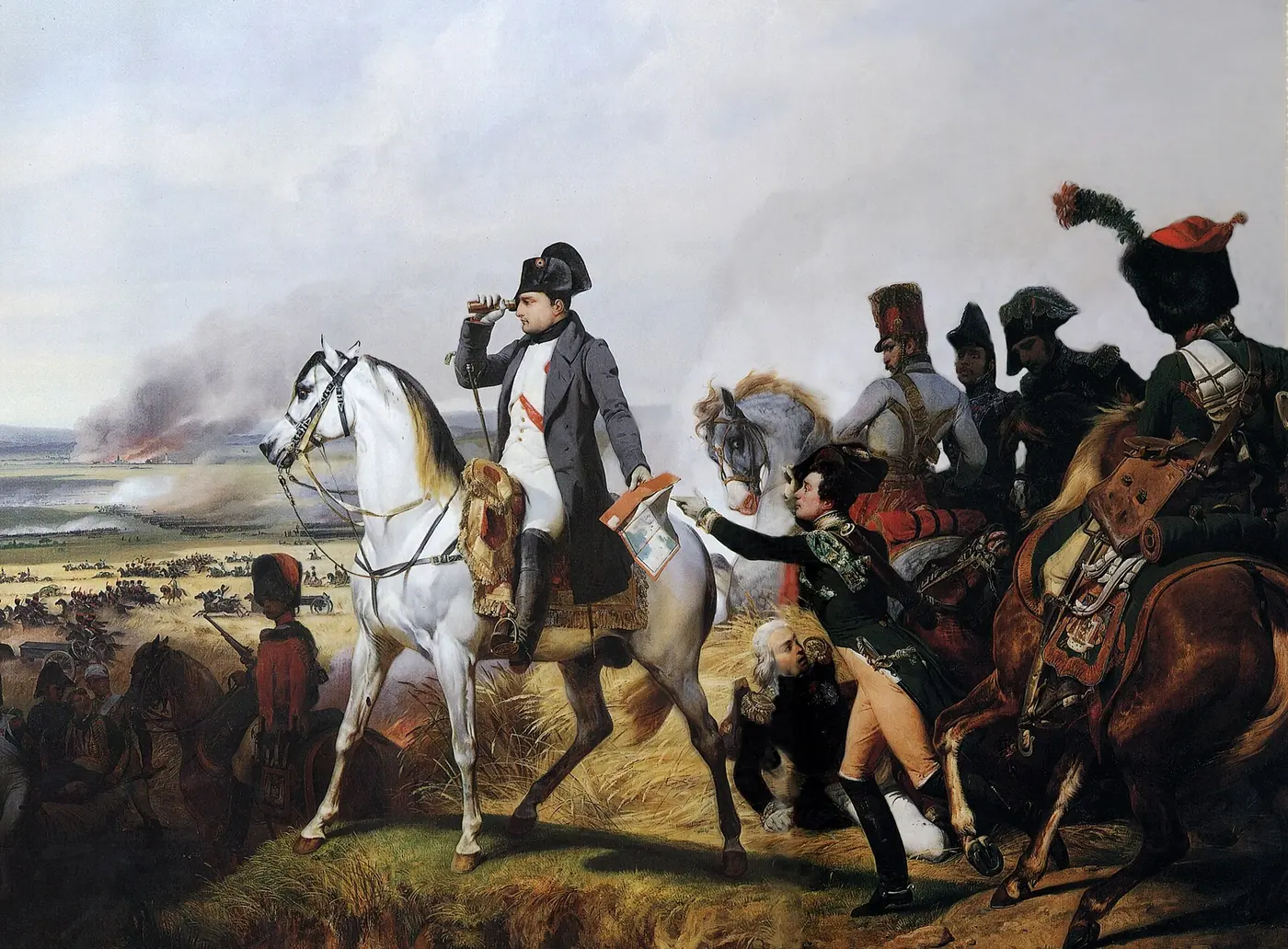
More than 300,000 men had clashed, and at least 72,000 were killed or wounded: no European battle had yet been so vast. The exact figures are still debated. Official French returns show nearly 34,000 killed and wounded, whereas the bulletin of the Grande Armée admitted far fewer; the historian Ian Castle puts Austrian losses at about 41,000 men and French losses at 37,500. Five French generals were killed, among them Lasalle. On 7 July Napoleon made Macdonald a marshal on the battlefield, which is unique in the history of the Empire; Oudinot and Marmont received their batons a few days later. Bernadotte, whose order of the day had credited his Saxons with the victory, was removed from the army.
The secondary fronts
The war of 1809 was not decided on the Danube alone. In Italy Archduke John beat Prince Eugène at Sacile on 16 April, but had to fall back when the situation in Bavaria deteriorated; Eugène beat him in turn on the Piave on 8 May, then at Raab on 14 June, before joining Napoleon before Vienna. In Poland Prince Poniatowski, commander of the troops of the Grand Duchy of Warsaw, stopped Archduke Ferdinand's army at Raszyn on 19 April, then carried the war into Galicia: he took Sandomierz, Lublin and Zamość among other places, and Kraków in July. Russia had sent a corps into Galicia, but it remained largely passive, which says a good deal about the state of the Franco-Russian alliance.
In Germany Vienna's hopes were disappointed. Dörnberg's rising in Hesse in April failed within days; the Prussian major Ferdinand von Schill, who had left Berlin with his hussars without his king's consent, was killed at Stralsund on 31 May; the Duke of Brunswick-Oels, with his "Black Legion", crossed northern Germany and embarked on British ships. These episodes had no military weight, but they foreshadowed the German national feeling of 1813.
The Tyrol, for its part, truly fought. Under Bavarian administration since 1805, it rose in April 1809 under Andreas Hofer, an innkeeper and trader from the Passeier valley. The Tyrolean peasants drove the Bavarians out of Innsbruck, and on 13 August, on the Bergisel above the town, they beat Marshal Lefebvre's corps. After the peace of Schönbrunn Austria abandoned its allies. Hofer, captured at the end of January 1810, was shot at Mantua on 20 February. Finally, at the end of July, a British expedition of nearly 40,000 men landed on Walcheren, in the Scheldt estuary, to attack Antwerp. It bogged down before Flushing, fever decimated the soldiers, and the expeditionary force was withdrawn in December.
Znaim, Schönbrunn and the peace
After Wagram Archduke Charles fell back towards Znaim, in Moravia, where the French army caught up with him on 10 and 11 July. Charles then asked for an armistice, without the authorisation of Emperor Francis; Napoleon accepted it, against the advice of Berthier and several of his lieutenants, and the armistice was signed on the 12th. The French army was indeed at the end of its strength. Charles was afterwards relieved of his post as commander-in-chief and never again led an army in the field.
The talks lasted three months. Austria was represented by Prince Johann of Liechtenstein, France by Champagny, her minister of Foreign Relations. Napoleon, installed at Schönbrunn, waited, and tension mounted: on 12 October, at the daily parade before the palace, a seventeen-year-old German, Friedrich Staps, was arrested by Rapp with a knife on him. Napoleon questioned him himself; Staps confessed that he meant to kill him and refused to ask for mercy. He was shot four days later.
The treaty of Schönbrunn was signed on 14 October 1809. The terms were harsh. Austria ceded Salzburg to Bavaria, western Galicia to the Grand Duchy of Warsaw, the district of Tarnopol to Russia, and to France the territories that would form the Illyrian Provinces, which cut her off from the sea. She lost more than three million subjects, paid a heavy indemnity and undertook to reduce her army to 150,000 men, a promise that would not be kept. The same month Stadion left the ministry, replaced by Klemens von Metternich. The new minister's policy would be to handle Napoleon with care and to gain time.
An empire at its height, already weakened
On paper, 1809 was a triumph. The Empire had never been so extensive, and Austria, defeated for the fourth time since 1796, accepted an alliance: in 1810 Francis I gave his daughter Marie-Louise to Napoleon, who had had his divorce from Joséphine pronounced in December 1809. The marriage tied the Emperor to an ancient dynasty and gave him, in 1811, the heir he had waited for. Berthier received the title of prince of Wagram, Masséna that of prince of Essling, Davout that of prince of Eckmühl.
But the balance sheet is more nuanced. Napoleon had won, but without crushing his enemy. Aspern-Essling showed that the army could no longer rely on the speed of its manoeuvres alone. At Wagram victory had to be won by fire: hundreds of guns on a plain, massive columns, losses comparable to the enemy's. The veterans of Austerlitz and Jena were growing scarce, and the army counted a rising share of conscripts and foreign contingents. Archduke Charles, for his part, had shown that resistance was possible, provided it was done in good order.
The war also had consequences away from the battlefields. While the Emperor was before Vienna he decreed at Schönbrunn, on 17 May, the union of the Papal States with the Empire; Pope Pius VII answered with a bull of excommunication aimed at those responsible for the annexation, and was arrested in Rome on the night of 5 to 6 July, the night of Wagram. The enlargement of the Grand Duchy of Warsaw at Austria's expense worried Saint Petersburg. And in Spain the war went on without him: Wellesley won at Talavera at the end of July a victory that earned him the title of Viscount Wellington. Three years later it would be the Peninsula and Russia, far more than Austria, that decided the fate of the Empire.
Further reading
- Thierry Lentz, Nouvelle histoire du Premier Empire, vol. II, L'Effondrement du système napoléonien, 1810-1814, Fayard, 2004.
- John H. Gill, 1809: Thunder on the Danube. Napoleon's Defeat of the Habsburgs, 3 vols, Frontline Books, 2008-2010.
- Gunther E. Rothenberg, Napoleon's Great Adversary. Archduke Charles and the Austrian Army, 1792-1814, Batsford, 1982.
- James R. Arnold, Napoleon Conquers Austria. The 1809 Campaign for Vienna, Praeger, 1995.