The Battle of Wagram, fought on 5 and 6 July 1809 on the Marchfeld plain north-east of Vienna, pitted Napoleon against Archduke Charles's Austrian army. Six weeks after the setback at Aspern-Essling, the Grande Armée crossed the Danube by surprise from Lobau island. Its evening attacks were repulsed, but on 6 July Napoleon held the Austrian offensive on his left with a grand battery while Davout took Markgrafneusiedl and turned the enemy left, and the archduke ordered a retreat. The largest battle yet fought in Europe, with more than 300,000 combatants, this costly victory led to the Armistice of Znaim and the Peace of Schönbrunn.
Forces at play
Outcome: Costly but decisive French victory

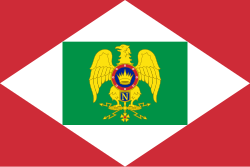


France · Italy · Saxony · Bavaria · Confederation of the Rhine
- Napoléon
- Davout
- Masséna
- Eugène de Beauharnais
- Macdonald
- Oudinot
- Bernadotte
Over 150,000 men; on 6 July, 140,500 infantry, 28,000 cavalry and 488 guns
Casualties: 6,901 killed and 26,757 wounded according to official returns; 37,500 men according to I. Castle

Austria
- Charles d'Autriche
- Bellegarde
- Hohenzollern
- Rosenberg
- Kollowrat
- Klenau
- Liechtenstein
Over 130,000 men; on 6 July, 113,500 infantry, 14,600 cavalry and 414 guns
Casualties: 41,250 men, including 7,500 prisoners, according to I. Castle
Flags: Sodacan, CC BY-SA 3.0, Wikimedia Commons
Battle coordinates
Wagram
Coordinates 48.2956° N · 16.5579° E
Interactive tactical map
Follow the battle hour by hour — hover over or tap a unit for its details.
Crossing in the storm
At nightfall, under a violent thunderstorm that blinds the Austrian observers, the French army emerges from the east side of Lobau, far from the redoubts at Aspern and Essling. Between 9 and 10 p.m., Conroux’s assault troops from Oudinot’s corps cross by boat and overrun the outposts, covered by the island’s batteries. Masséna reaches the bank around 11 p.m.; Davout will follow shortly after 2 a.m.
Archduke Charles, who expected a crossing north of Lobau as in May, only seriously considers another possibility late on 4 July.
Positions reconstructed from accounts of the battle and placed on the actual locations of the Marchfeld villages. Timings, on which sources do not always agree, are indicative. The Austrian V Corps, which stayed on the Bisamberg, and Archduke John’s army, which never reached the battlefield, are not shown.
Battle narrative
The Fifth Coalition
In 1809 the French Empire dominated the continent, but two fronts were wearing it down. In Spain, replacing the Bourbons with Joseph Bonaparte had set off a bitter war, and the capitulation at Bailén in July 1808 had shown that imperial armies could be beaten. Napoleon had to commit large forces there, forces he now lacked in Germany. Austria, defeated at Ulm and Austerlitz, meant to seize the moment. Spurred on by British subsidies, it had reformed its army and placed it in the hands of its best commander, Archduke Charles, brother of Emperor Francis I. Vienna was counting on national uprisings in Germany and hoped to draw Prussia into the war.
On 10 April 1809, without a declaration of war (the archduke had merely informed Marshal Lefebvre the day before), the Austrian army crossed the Inn and invaded Bavaria, France's ally. Napoleon was in Paris. He had left command to Berthier, an outstanding chief of staff but out of his depth as commander-in-chief, who left two entire corps in isolated positions. Everything changed when the Emperor arrived on 17 April. Within days, at Abensberg, Landshut, Eckmühl and Ratisbon, he defeated the Austrians, but Charles managed to save an army still fit to fight and withdrew it north of the Danube. Napoleon then chose to march on Vienna, which he entered on 12 May. The bridges over the Danube had been blown.
Aspern-Essling, the first defeat
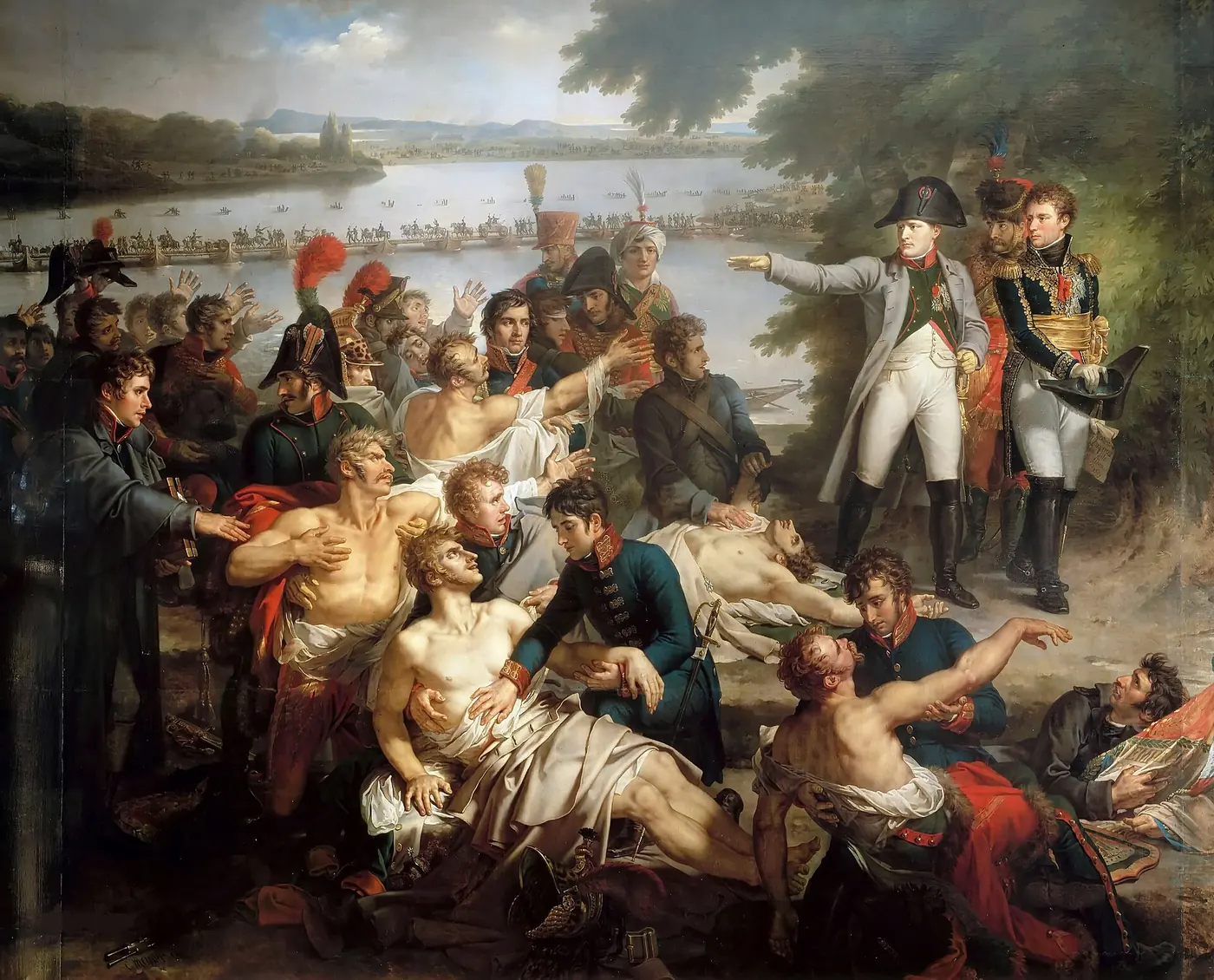
To pursue the archduke, Napoleon had to cross the river. He did so in haste, on flimsy pontoon bridges, using the large island of Lobau downstream from Vienna as a stepping stone. On 21 May Charles attacked the troops already across on the north bank, around the villages of Aspern and Essling. The French held, but on the 22nd, as their counterattack was gaining ground, the main bridge was swept away by the swollen river: neither reinforcements nor ammunition could get across. Napoleon ordered a retreat to Lobau, completed at nightfall after a desperate defence. The battle cost some 53,000 casualties, split almost evenly between the two sides. It was the first serious defeat of his career.
The losses were painful. Marshal Lannes, one of his best commanders and a friend, had been mortally wounded; he died nine days later. General Saint-Hilaire, one of the army's finest divisional commanders, also died of his wounds. General Espagne had been killed at the head of his cuirassiers, and the artillery commander, Songis, fell seriously ill and had to give up his post a few weeks later.
Six weeks on Lobau island
Stunned by the scale of the setback, Napoleon remained unusually inactive for thirty-six hours. Then he turned Lobau into a huge military base: hospitals for his 20,000 wounded, storehouses, barracks. General Songis and then his successor Lariboisière installed a battery of 124 guns on the island and placed further pieces on the islets and banks, as much to cover Vienna as to keep the enemy guessing about the crossing point. From 1 June, General Bertrand directed the building of two solid bridges between the south bank and the island, protected upstream by palisades against any barges the Austrians might float down the river. Pivoting bridges and landing craft were prepared to cross the last arm of the river. Thanks to a captured flotilla and new patrol boats, by the end of June the French controlled the Danube almost completely, and Napoleon could write in the bulletin of 2 July that the river no longer existed for the French army.
The Emperor also gathered reinforcements: Prince Eugène's Army of Italy, Marmont's corps, which had been fighting in Dalmatia, and General Wrede's Bavarian division. Shortly before the crossing, Marshal Masséna fell from his horse and badly injured his foot. Unable to ride, he nevertheless refused to give up his command and resolved to lead his corps from a carriage, much to the Emperor's relief.
Archduke Charles against Napoleon
In the Austrian camp, the victory at Aspern had lifted the troops' morale, but not their commander's. The archduke knew that he had been unable to exploit his numerical superiority, that no general uprising had broken out in Germany, that Prussia was not moving, that the promised British landing in northern Europe had yet to come, and that Russia, France's ally since 1807, was growing ever more aggressive towards the Austrian troops in Galicia. He believed the monarchy's best course was to negotiate and warned his brother that "the first battle lost is a death sentence for the monarchy". Francis refused again and again. The atmosphere in the high command was poisonous: General Hiller, an open critic of Charles's strategy, resigned on 4 July, citing his health. At the end of June the archduke wrote to his uncle, Duke Albert of Saxe-Teschen, that if need be he would strike one more blow against the French, but would risk nothing, or as little as possible.
Charles expected Napoleon to cross at the same place as in May, north of Lobau. There he had a line of sixteen redoubts built, mostly between Aspern and Groß-Enzersdorf, which, strangely, he did not extend southeast along the river, so the line could be outflanked. On 3 July, however, he gave up defending the riverbank and pulled his army back to the heights overlooking the Marchfeld plain: the Wagram plateau behind the Russbach stream, and the Bisamberg heights. These two positions covered his lines of retreat to Moravia and Bohemia, and his staff officers Wimpffen and Grünne had been urging them for weeks. He did not want to fight in the woods and broken ground along the Danube, which favoured the open-order fighting at which the French excelled, nor on the bare plain, ideal ground for the more numerous French cavalry. At 7 a.m. on 4 July he wrote to his brother Archduke John, whose army was near Pressburg, that the coming battle "will decide the fate of our dynasty", and ordered him to draw closer by marching to Marchegg. Delayed by violent thunderstorms, the message reached John only twenty-three hours later.
The opposing forces
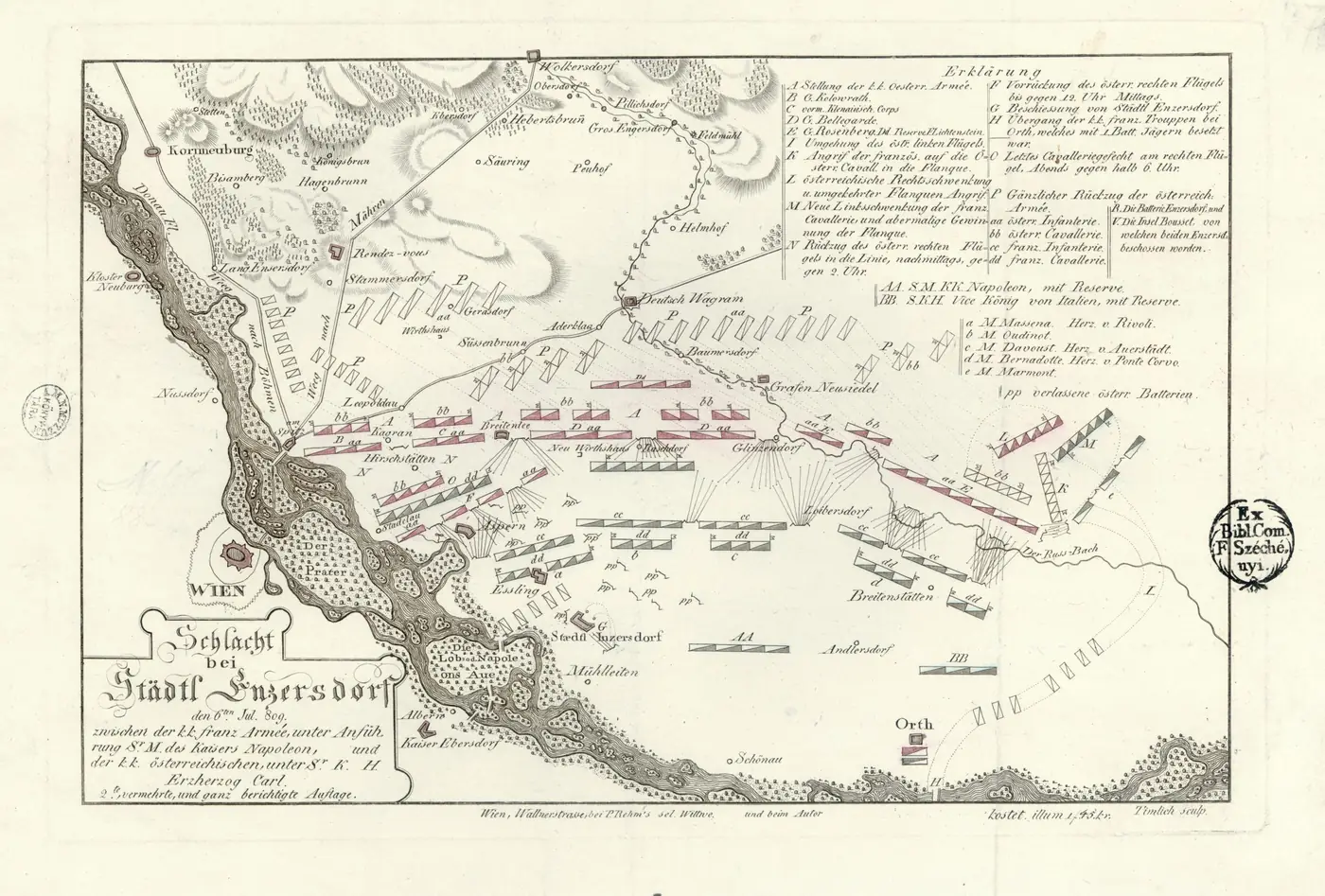
In six weeks Napoleon had assembled around Vienna a French, German and Italian army of more than 150,000 men. With the reinforcements that arrived during the night of 5–6 July, it numbered, by the usual counts, about 140,500 infantry, 28,000 cavalry and 488 guns, not counting 8,500 men and 129 pieces left as a garrison on Lobau. It included Oudinot's II Corps, Davout's III Corps, Masséna's IV Corps, Prince Eugène's Army of Italy with the corps of Macdonald and Grenier, Bernadotte's Saxon IX Corps, Marmont's XI Corps, Wrede's Bavarian division, the Imperial Guard and Marshal Bessières's cavalry reserve.
The Austrian army numbered more than 130,000 men at the start of the battle. For the second day it could field only 113,500 infantry, 14,600 cavalry and 414 guns, without the 13,000 men of Archduke John, who were expected on the left. Its corps were commanded by Bellegarde (I), Hohenzollern (II), Kollowrat (III), Rosenberg (IV), Reuss (V) and Klenau (VI), alongside Nordmann's advance guard and Prince Liechtenstein's reserve of grenadiers and cavalry. More than 300,000 men were about to clash: no European battle had yet brought together so many combatants.
The night of 4 July: crossing the Danube
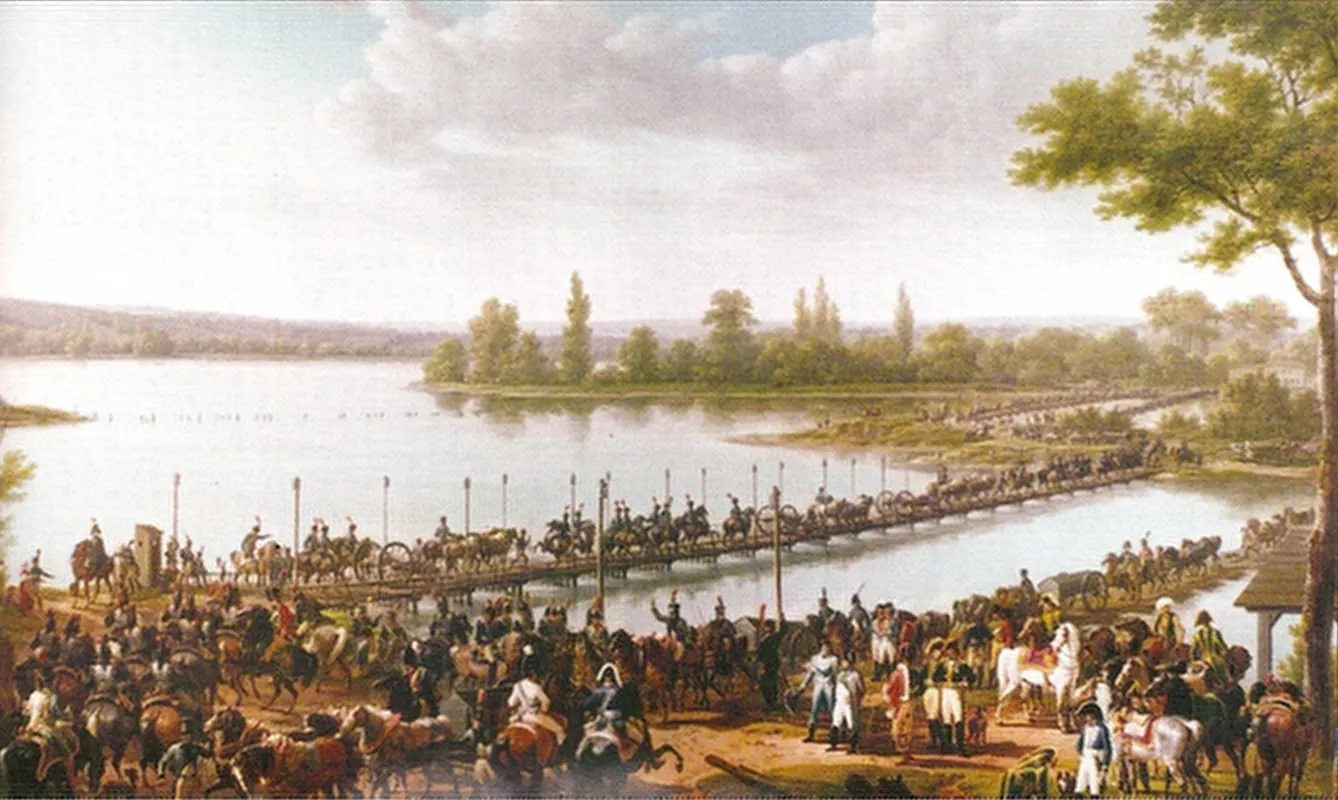
Instead of repeating the May crossing, Napoleon had the bulk of his army emerge from the east side of Lobau, bypassing the redoubts at Aspern, Essling and Enzersdorf. At nightfall on 4 July, under a violent thunderstorm that blinded the Austrian observers, the operation began. Oudinot's II Corps went first: between 9 and 10 p.m., General Conroux's assault troops crossed by boat and overran the Austrian outposts, covered by massive artillery fire from the island. Masséna reached the bank around 11 p.m.; shortly after 2 a.m., Davout's four infantry divisions and three cavalry divisions started over their bridges. The build-up of the bridgehead went according to plan; only the garrison of Mühlleiten castle held out until dawn.
Faced with this onslaught, Nordmann's Austrian advance guard, pounded by the Lobau batteries, fell back north, leaving detachments at Sachsengang castle and Groß-Enzersdorf. Rather than storm the castle, Oudinot had it shelled by his howitzers; its two Austrian battalions surrendered around 8 a.m. Napoleon came forward in person to inspect Groß-Enzersdorf and had the heavy batteries on Lobau fire some one thousand shells into the village, which went up in flames. Klenau tried to relieve the defenders but was checked by Marulaz's cavalry. Colonel Sainte-Croix then stormed the village at the head of the 46th Line and took 400 prisoners, while Boudet's division occupied Essling almost without a fight. By 10 a.m. the bridgehead was firmly established.
5 July: deploying on the Marchfeld
True to his plan, the archduke refused to fight on the plain and ordered Nordmann and Klenau to fall back. The French advanced north in battalion columns, Masséna on the left, Oudinot in the centre and Davout on the right. Nordmann's infantry, drawn up in dense masses that worked well against cavalry but were highly vulnerable to cannon fire, melted away under the artillery: of its 12,000 infantry, barely more than 6,000 were still fit to fight when it reached Markgrafneusiedl. Prince Liechtenstein, sent to its aid with five cavalry regiments, stayed passive.
Around 3:30 p.m., Bernadotte's Saxon IX Corps arrived near the village of Aderklaa. Around 5 p.m., the Austrian cuirassier brigade of General Roussel d'Hurbal, a French émigré, met the reckless charge of 400 Saxon chevaulegers with a pistol volley fired at thirty metres, which sent them fleeing. The rest of the Saxon cavalry then charged, broke the cuirassiers and pursued them until another brigade came to their rescue. Liechtenstein afterwards pulled most of his cavalry back behind the Wagram–Gerasdorf line.
By evening the two armies faced each other. The Austrian army stretched along an arc some nineteen kilometres long: Klenau on the far right, Kollowrat in the right centre, Bellegarde and Hohenzollern behind the Russbach in the centre, and Rosenberg on the left around Markgrafneusiedl, with the grenadiers and the reserve cavalry in second line near Wagram. By around 6 p.m. the French army was fully deployed: Masséna on the left between the Danube and Süßenbrunn, Bernadotte's leading elements near Aderklaa, the Army of Italy in the centre, Oudinot facing the village of Baumersdorf, Davout beyond Glinzendorf, and the Guard and the cavalry reserve in second line. Napoleon held the central position, on a much shorter line than his opponent's.
The evening attacks
Napoleon wanted to exploit the apparent weakness of the Austrian centre before it could be reinforced, to prevent Charles from slipping away overnight, and to split his wings before Archduke John arrived. At 6 p.m. he ordered an immediate attack. After a bombardment between 7 and 7:30 p.m., Oudinot sent part of his corps against Hohenzollern's II Corps, dug in on the plateau with 68 guns. Frère's division crossed the Russbach and reached Baumersdorf, a village of some thirty wooden houses and a bridge, soon ablaze, which Hardegg's brigade went on defending. Oudinot then threw the 57th Line, nicknamed "the Terrible", and the 10th Light forward on the right. Caught by canister and musketry, the 10th Light broke when Hohenzollern personally charged at the head of 500 chevaulegers, and it swept the 57th away in its flight. The two regiments only rallied when they reached the steady ranks of the Guard near Raasdorf.
Further west, General Macdonald, who commanded a corps of the Army of Italy, sent his men against the plateau. Screened by the smoke from burning Baumersdorf, Dupas's small Franco-Saxon division happened to slip between the Austrian I and II Corps and marched on Deutsch-Wagram; Macdonald supported it in person with Lamarque's division, followed by Grenier's divisions. Some Austrian gunners abandoned their pieces and two regiments fell back in disorder, but Bellegarde stepped in personally to refuse his flank, and the smoke slowed the advance. In the confusion, French troops mistook their white-uniformed Saxon allies for Austrians and opened fire on them. Archduke Charles, on the spot, restored order, and a vigorous infantry and cavalry counterattack drove the attackers back across the Russbach. Lightly wounded when he personally took the lead of a regiment, he had, together with Bellegarde, averted a dangerous crisis.
Around 9 p.m., Bernadotte in turn launched his Saxons against Deutsch-Wagram from the west. They entered the village but were stopped near the church. In the smoke-filled streets everyone spoke German and nearly everyone wore white: Saxons fired on other Saxons. Around 10:30 p.m., General Hartitzsch brought up fresh Saxon troops; unaware that friendly units were already in the village, he had his men fire on white-coated soldiers coming out of it, who were in fact Saxons. Believing themselves surrounded, the Saxons in the village fled, and every attempt to rally them at Aderklaa failed. Finally, on the right, Davout attacked Markgrafneusiedl around 9 p.m. with men worn out by a day of marching and fighting; he called the attack off at 10 p.m., for which Napoleon criticised him, perhaps unfairly.
The night of 5–6 July
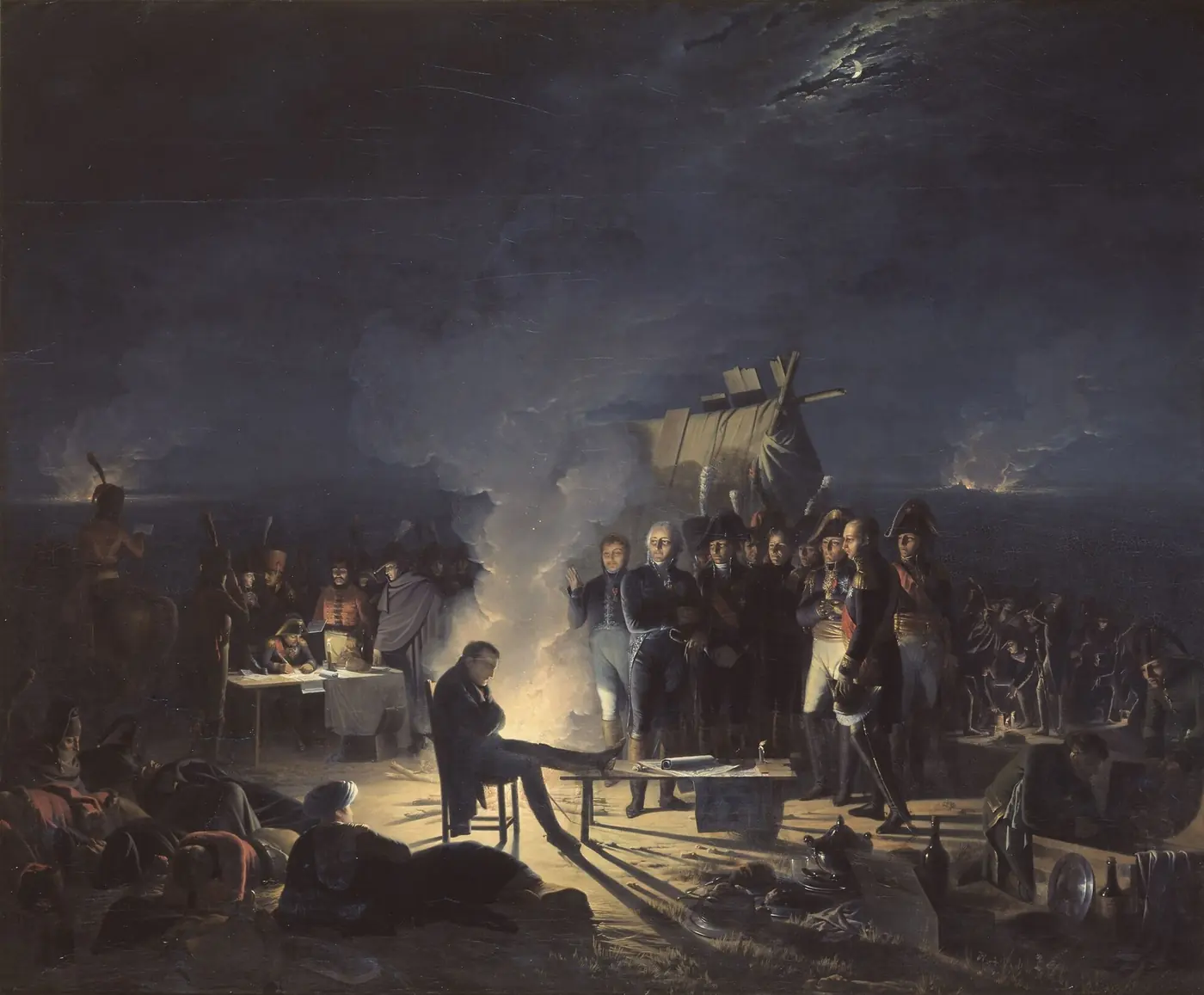
The fighting died down around 11 p.m. The night was bitterly cold; in both armies soldiers lit fires and ate their meagre rations. At headquarters in Raasdorf the corps commanders gathered around the Emperor; only Bernadotte was missing, busy rallying his fugitives. Napoleon had failed to break the centre, but he had pinned the Austrian army and now knew that the archduke would accept battle. For the next day he planned a main attack against the Austrian left: Davout's III Corps was to take Markgrafneusiedl and then roll up the enemy flank on the plateau, while the other corps pinned the enemy. Masséna was ordered to move closer to Aderklaa, leaving only Boudet's division at Aspern to guard communications with Lobau. Marmont, two divisions of the Army of Italy and Wrede's Bavarians arrived during the night.
At Deutsch-Wagram, the exhausted Archduke Charles was probably satisfied: apart from Nordmann's advance guard, his corps were almost intact and had fought well. He decided to take the initiative and, as he later wrote, to fall on the enemy by surprise on all sides as day broke. Around midnight he ordered a general attack for 4 a.m., aiming to envelop both wings of a French army deployed over some ten kilometres, facing an Austrian line of about eighteen. Klenau was to march on Aspern, Kollowrat on Breitenlee and the grenadiers on Süßenbrunn; Rosenberg was to attack Davout with Archduke John's support. But the corps farthest away only received their orders around 3 a.m., two hours late, and Archduke John did not leave Pressburg, forty kilometres away, until 1 a.m.
Dawn on 6 July: Rosenberg's attack
On the left, Rosenberg set off on time. Around 4 a.m. his IV Corps, 18,140 men and 60 guns, reinforced by what was left of the advance guard and by Nostitz's 3,120 horsemen, advanced in three columns; despite orders to keep absolute silence, the troops moved in some disorder and with a great deal of noise. Around 5 a.m. they drove the French outposts out of Großhofen and attacked Glinzendorf. Davout, who had been preparing his own offensive, had his 31,600 infantry, 6,200 cavalry and 120 guns ready for action, and counterattacked at once. The gunfire interrupted Napoleon's breakfast. He thought Archduke John had arrived, and French intelligence put John's army at 30,000 men rather than 13,000, so he sent Nansouty's and Arrighi's cuirassiers towards Davout, followed by the Guard.
Seeing Rosenberg isolated, with no news of John and no sign of the corps on his right wing, Archduke Charles ordered him back to his positions at Markgrafneusiedl. By 6 a.m. he was back, at a cost of 1,100 men. Napoleon, now with Davout, saw that Archduke John was nowhere in sight. He sent his reserves back to Raasdorf, leaving Davout only Arrighi's cuirassiers and a battery of 12-pounders, and changed the plan: instead of a frontal assault, Davout would send part of his troops against the village and another part around it from the east, where the plateau sloped gently. Shifting the divisions and bridging the Russbach for the artillery took time.
The crisis at Aderklaa
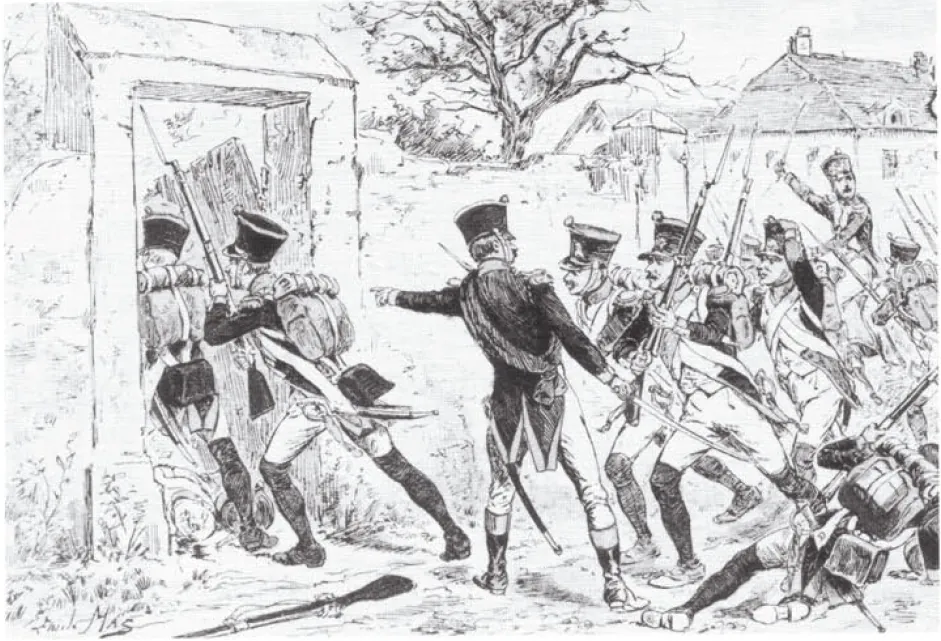
In the centre, things were more serious. During the night Bernadotte had abandoned the village of Aderklaa, the pivot of the French line, without permission and without informing the Emperor, falling back a kilometre to the southeast. Bellegarde's Austrian I Corps set out shortly after 3 a.m. expecting stiff resistance, found the village empty and occupied it with its advance guard; the twelve battalions of Fresnel's division took up position behind it. The 26-gun Saxon battery shelling the village lost fifteen pieces in three hours to the heavy artillery at Wagram. Bellegarde, whose orders told him to wait for the grenadiers, did not press his advantage.
Around 7:30 a.m. Masséna arrived in his conspicuous white carriage with two of his divisions. Napoleon climbed in beside him to discuss the situation, then ordered Aderklaa retaken. Led by the 24th Light and the 4th Line, followed by the Hessian Guard brigade, Carra Saint-Cyr's division stormed the village, but fire from Bellegarde's second line stopped it from pushing beyond. The Austrians now enjoyed a temporary superiority in this sector, 44,000 men against 35,000, which Bellegarde, sticking to his orders, did not exploit. Archduke Charles, who had watched the scene from his observation post at Baumersdorf, rode over, personally organised a counterattack of infantry, grenadiers and chevaulegers, and drove the French out; they streamed back along with the routed Saxons, covered by Lasalle's and Marulaz's cavalry. Masséna then sent in Molitor's division; to get through the crowd of fleeing Saxons, he had to order his men to fire on them. Molitor retook Aderklaa around 9:45 a.m. and defended it fiercely: it took the Austrians two hours to drive him out.
Near Raasdorf, the fugitives and Bernadotte, riding at their head without trying to rally them, ran into Napoleon. After a brief exchange, the Emperor relieved him of his command on the spot. The disorganised Saxon infantry played no further part in the battle; only its cavalry and ten guns remained fit for action.
Klenau in the French rear
On the far Austrian right, the two corps tasked with the envelopment finally arrived, three hours late. Klenau left Leopoldau around 7:30 a.m. and deployed his 14,000 men between Breitenlee and Hirschstetten, facing the 4,600 men of Boudet's division. Austrian hussars captured a ten-gun battery Boudet had pushed forward; the division abandoned Aspern, then Essling around 10 a.m., and fell back towards Groß-Enzersdorf to cover the Lobau bridges. Klenau was now only five kilometres from the rear of the French army and within reach of the vital bridges. But he chose caution: some of his 14,000 men were under fire from the heavy batteries on the island, his orders told him to keep in line with Kollowrat, and he settled for shelling the supply trains, spreading panic among the civilian contractors. Kollowrat, for his part, only completed his deployment between Süßenbrunn and Breitenlee around 9:30 a.m. and, lacking orders, did not attack the very weak French left.
Bessières's charge and the grand battery
Napoleon held the central position on an increasingly curved front. He urged Davout to speed up his attack, but the priority was to stabilise his left, and he did not yet want to commit his precious infantry reserves. He ordered Masséna to break off at Aderklaa and march south against Klenau, moving along the enemy front, and decided to fill the resulting gap with a huge battery. To gain the time needed, he sent in Bessières's cavalry.
Around 11 a.m. Bessières charged with Nansouty's sixteen squadrons, some 2,800 carabiniers and cuirassiers, at the seam between the Austrian III Corps and the grenadier reserve. A first charge failed near Süßenbrunn; the second broke a Grenz battalion, then wheeled onto the Austrian artillery near Aderklaa. Almost in front of Napoleon, a cannonball grazed Bessières's thigh; he was unhorsed and carried off unconscious. A countercharge by Liechtenstein's fresh cavalry threw the French horsemen back, and a belated charge by the Guard light cavalry was repulsed in turn. Over the whole day, Nansouty's division alone lost 1,200 horses killed or wounded. But Masséna had been able to disengage, and the grand battery had had time to deploy.
General Lauriston had assembled this grand battery while the charge went in. The Grande Armée bulletin speaks of a hundred guns, and some authors of a hundred and twelve; Masséna, an eyewitness, counted 84: the 60 pieces of the Guard artillery and 24 from the Army of Italy. Colonel d'Aboville's Guard horse artillery went into action around 11 a.m., followed by the 12-pounders of the Guard foot artillery under Antoine Drouot, then by the guns of the Army of Italy. Deployed over nearly two kilometres and firing at 350 to 550 metres over flat, sodden ground where roundshot ricocheted a long way, the battery wrought havoc: a single ball could sometimes carry away whole files of men. It advanced while keeping up its fire and forced Kollowrat to fall back. Yet the Austrian batteries at Wagram enfiladed it, and so many gunners fell that Napoleon called for volunteers from the Guard infantry to replace them. Discarded slow matches set the ripe wheat alight, and wounded men unable to crawl away burned to death.
Masséna, meanwhile, carried out his flank march with his usual skill. Screened by his cavalry and partly hidden by the tall crops, some of his columns had to cover eight kilometres along the enemy front under Austrian cannon fire. An enemy cavalry charge came so close to his carriage that his aides had to draw their swords. Around noon, after covering six and a half kilometres in ninety minutes, Marulaz's cavalry and Legrand's division were within sight of Essling.
Davout takes Markgrafneusiedl
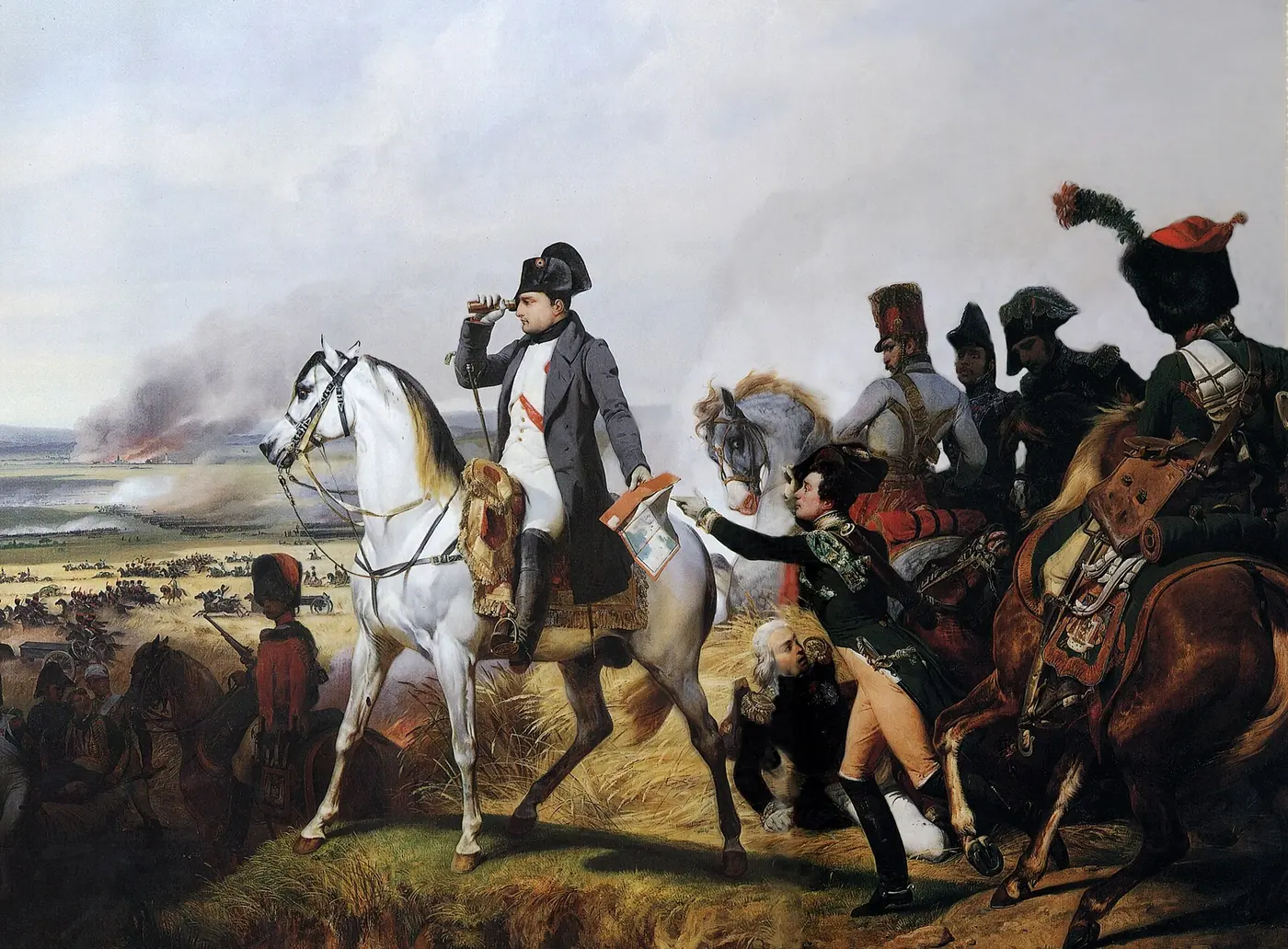
Ten kilometres to the east, the manoeuvre meant to decide the day was under way. Markgrafneusiedl, at the foot of the escarpment, was a strong position: stone houses, a mill, a monastery and a disused church whose tower dominated the plain. After two hours of artillery duel, the French guns, heavier and better concentrated thanks to the crossfire of III and II Corps, silenced most of the Austrian pieces and set the village on fire. Between 9:30 and 10 a.m., under cover of the smoke, Davout moved off: Gudin's and Puthod's divisions head-on against the village, Friant's and Morand's around it from the east, supported by Grouchy's dragoons and Montbrun's light cavalry.
Gudin's and Puthod's first attack was stopped by fire. To the east, an Austrian counterattack put Morand's division in difficulty until Friant sent a brigade against the attackers' flank. General Nordmann, who came up to restore the situation, was mortally wounded. Friant then committed his whole division and gained a foothold on the escarpment, pushing towards the tower. In the burning village the fighting went from house to house; Davout's horse was shot under him and Gudin was badly wounded. Around noon the tower fell, and Rosenberg re-formed his line further back on the plateau. Davout then threw in his last reserve, Arrighi's cuirassiers, but among the enemy barricades they could not, by Arrighi's own account, deploy a single squadron, and they pulled back after several fruitless charges with 300 men out of action.
Archduke Charles personally brought reinforcements to his left wing and sent in his cavalry. Wartensleben's chevaulegers and hussars overran Montbrun's first line and captured ten horse artillery pieces; Montbrun counterattacked, Grouchy committed his dragoons, and the mêlée turned in favour of the French, who retook the guns. The Austrian generals Nostitz and Rothkirch were wounded. This was the main cavalry action of the battle. Around 1 p.m. Rosenberg began a fighting retreat towards Bockfließ, some ten kilometres to the northwest.
Macdonald's column
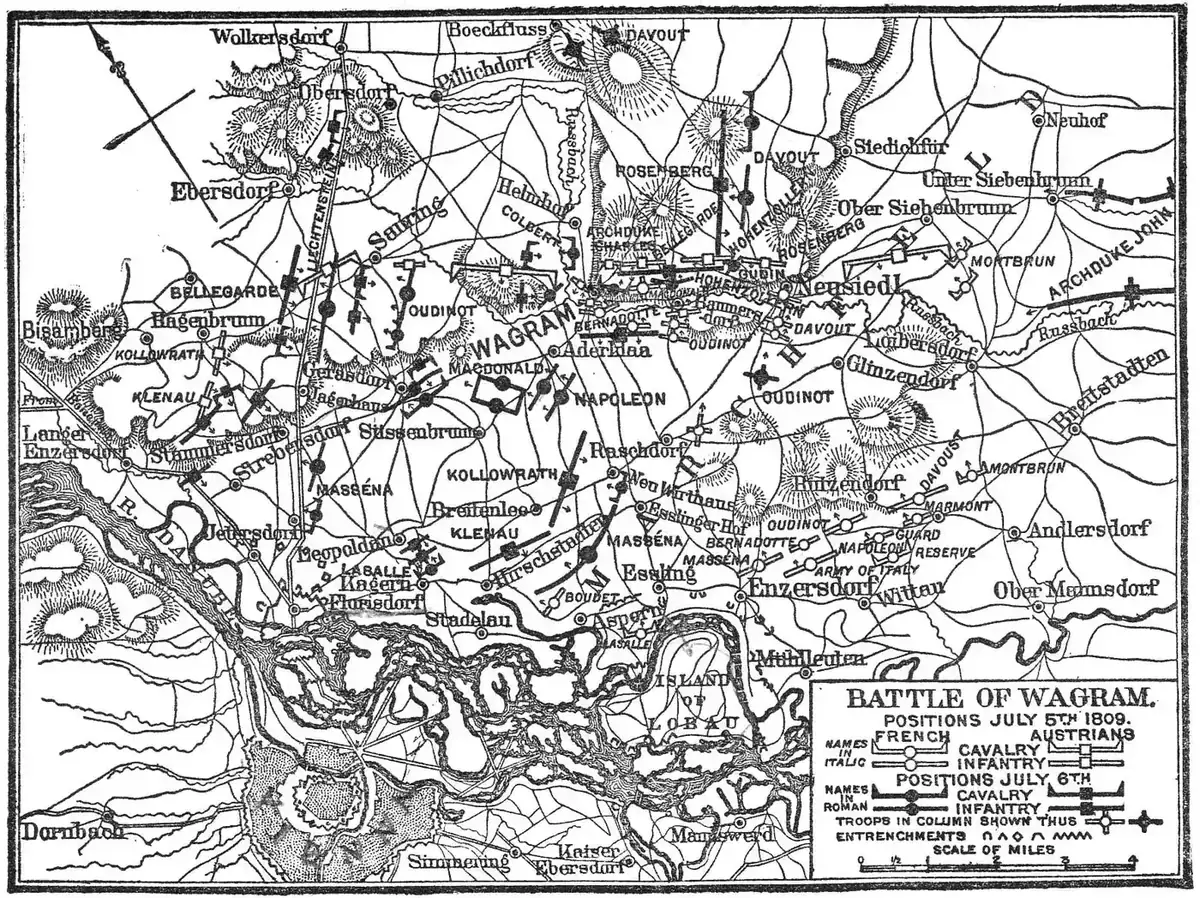
Around 1 p.m. Napoleon saw through his spyglass that the smoke of battle had moved beyond the tower of Markgrafneusiedl: Davout was rolling up the Austrian left. He ordered a general attack. Macdonald was told to move towards Aderklaa, onto the ground held by the grand battery, and take Süßenbrunn, at the seam between the grenadier reserve and the Austrian III Corps. He had about 8,000 men, twenty-three battalions worn down by the previous day's fighting, which he drew up in an unusual formation roughly 800 metres by 550: eight battalions deployed in line at the front, the other fifteen in columns so they could face cavalry. The remains of the grand battery, Seras's division, General Walther's Guard cavalry on the right and Nansouty's cuirassiers on the left were to support it.
The Austrian artillery knocked out fifteen of the accompanying guns before they could even fire, then concentrated on this dense mass, while two Austrian brigades raked its flanks with volleys. Reduced to little more than half its strength and forced to form squares against three cavalry charges, the column came to a halt a few hundred metres short of Süßenbrunn. Macdonald called on the cavalry to charge an enemy line he believed to be in complete disarray. Nansouty, who had stayed too far back, arrived when the Austrians had already formed masses and their guns had withdrawn. Walther, with the fresh Guard cavalry, did not move: he had received no orders either from Napoleon, who was too far away, or from Bessières, who was wounded. By 2 p.m. the attack had run out of steam; Napoleon remarked bitterly that it was the first time his cavalry had let him down. Still, the assault had achieved its main purpose: pinning the Austrians in the centre and preventing Charles from helping his left. Napoleon sent Wrede's 5,500 Bavarians and the Young Guard fusiliers in support; backed by the Guard, the Bavarians took Süßenbrunn, by which time the Austrians were already in full retreat.
Masséna's "infernal column"
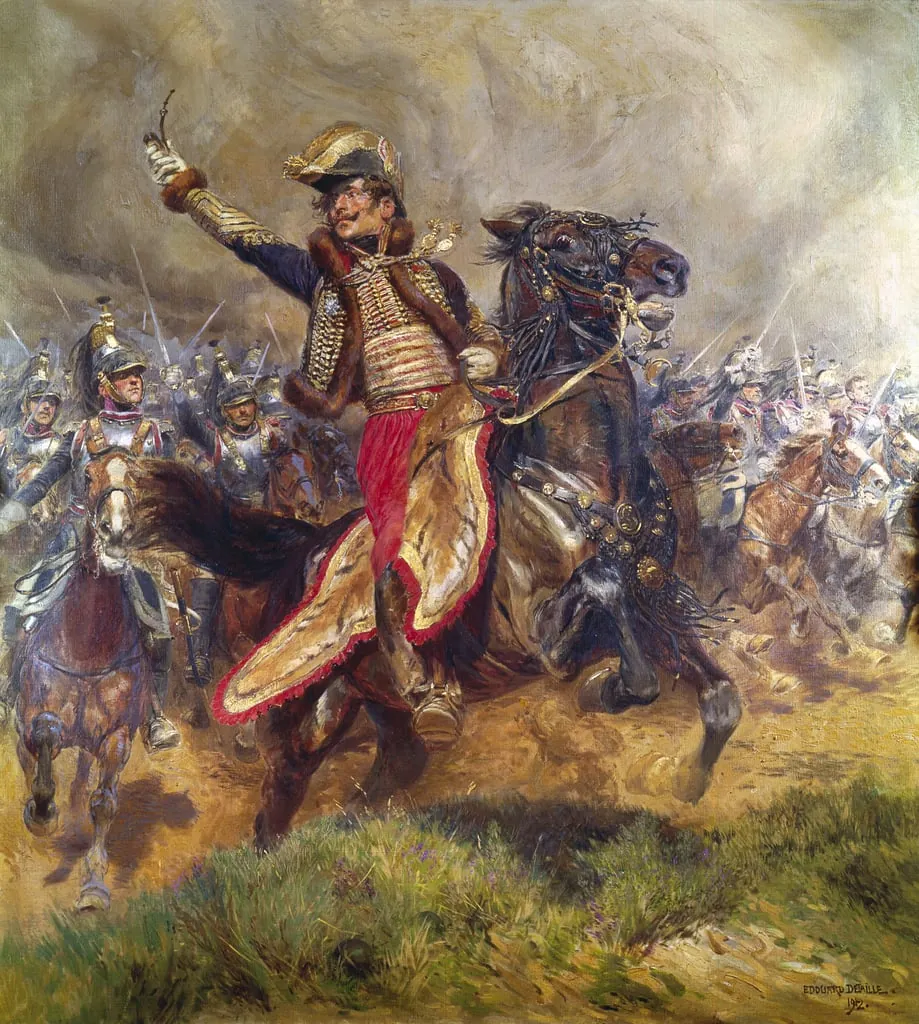
On the left, Klenau saw what he would call in his report an "infernal column" bearing down on him. Around 12:30 p.m. Masséna's leading elements reached Essling, and the marshal learned of Davout's success. Marulaz's cavalry captured the Austrian battery that had been shelling the Danube bridges; Austrian hussars took it back before being charged in turn by Lasalle's cavalry. Six weeks earlier the French had defended Essling against Austrian assaults; now they had to retake it, above all its stone granary. Ledru des Essarts's brigade carried it around 2 p.m. Masséna retook Aspern and sent Molitor's division towards Breitenlee, which Durutte's division of the Army of Italy had just occupied. Then, without orders but hearing the guns on his right, he pressed on towards Kagran and Leopoldau.
Near Leopoldau, Lasalle's cavalry ran into two Austrian battalions formed in masses. Shortly before 5 p.m., while charging the second of them, General Lasalle, one of the finest cavalrymen of his time, was killed by a bullet to the head. A saying was attributed to him: "Any hussar who isn't dead by thirty is a good-for-nothing." Marulaz, trying to avenge him at the head of the 8th Hussars, was wounded in turn. Under fire from the Austrian artillery on the Bisamberg, Masséna halted the pursuit. By around 5 p.m. Klenau had managed to extricate his corps and shelter it behind the Austrian V Corps on the Bisamberg.
The Austrian retreat
While Klenau was being driven out of Essling, Archduke Charles finally received news of his brother: Archduke John would not arrive before 5 p.m., far too late. The corps on the Wagram plateau had been fighting for some ten hours, his right was falling back, and he had no reserves left. To go on was to risk the destruction of the army and, in his eyes, of the monarchy with it. He ordered an orderly retreat.
Around 1 p.m. Oudinot, who had been waiting all morning for the order to attack, went forward against Hohenzollern's II Corps without having received it. Threatened on his flank by Davout, Hohenzollern fell back; Oudinot took Baumersdorf, bravely defended by Hardegg's brigade. Further west, Pacthod's division of the Army of Italy, supported by the Italian Royal Guard, moved up the Russbach unseen as far as Deutsch-Wagram and surprised the flank of d'Aspré's grenadiers; with the help of Tharreau's division, Wagram and Aderklaa fell. Napoleon also committed Marmont's fresh XI Corps.
By 4 p.m. the whole Austrian army was in retreat. It carried it out admirably, in echelon, each corps covering its neighbour, protected by General Smola's artillery. The French, who had been marching and fighting for more than forty hours in the heat with little water or food, followed rather than pursued. Their exhaustion even caused panics: around 4 p.m. at Wagram, infantrymen fled down the escarpment and the Old Guard had to form square around headquarters; an hour later, the appearance of Archduke John's scouts near Glinzendorf spread panic among stragglers and contractors. John, learning that the battle was lost, turned back. Around 6 p.m., elements of Davout's 108th Line were still catching Austrian stragglers at Bockfließ. By 8 p.m. all fighting had stopped.
The toll
With more than 300,000 combatants and at least 72,000 killed and wounded, Wagram was the largest battle yet fought in Europe, and the bloodiest of the Revolutionary and Napoleonic Wars up to that time. The concentration of artillery on an open plain explains the scale of the losses: each army fired at least 90,000 rounds in two days.
The Grande Armée bulletin admitted only 1,500 dead and 3,000 to 4,000 wounded. Official French returns actually recorded 6,901 killed and 26,757 wounded, nearly a quarter of the army; other estimates go as high as 17,000 killed and 25,000 wounded. Five generals were killed, Lasalle among them, along with 238 other officers. The medical services were overwhelmed: most of the wounded had been hit by artillery, whose roundshot caused horrific injuries that often required amputation, and many did not survive. The Guard, treated first, counted 1,200 wounded, half of whom soon returned to the ranks, while 145 died of their wounds. On the Austrian side, an official return showed 51,626 men missing on 11 July compared with the strength on 5 July, a figure that includes the fighting during the retreat and the battle of Znaim; the historian Ian Castle puts Austrian losses at Wagram at 41,250 men, including 7,500 prisoners, and French losses at 37,500. Four Austrian generals were killed or mortally wounded, including Nordmann.
From Znaim to the Peace of Schönbrunn
On the morning of 7 July Napoleon rode over the battlefield. After reading Macdonald's report, he embraced him and raised him to the rank of Marshal of the Empire, the only marshal ever appointed on a battlefield. He reproached Marmont for his slowness and told Oudinot that he deserved to be shot for attacking without orders. Yet Oudinot and Marmont also received their batons a few days later, at Znaim, and a soldiers' song summed it up: "La France a nommé Macdonald, l'armée a nommé Oudinot, l'amitié a nommé Marmont" ("France appointed Macdonald, the army appointed Oudinot, friendship appointed Marmont").
The exhausted French army, its caissons emptied by 90,000 to 100,000 rounds, did not resume the pursuit until around 2 p.m. Archduke Charles withdrew towards Znaim with an army still cohesive, taking with him thousands of French prisoners, a couple of dozen guns and a few eagles. Caught at Znaim on 10 and 11 July, he asked for an armistice on his own responsibility, without Emperor Francis's authorisation. Napoleon accepted it, against the advice of his chief lieutenants, Berthier among them. The Armistice of Znaim, signed on 12 July, ended the fighting. Emperor Francis afterwards removed Charles from supreme command.
The Treaty of Schönbrunn, signed on 14 October 1809, was very harsh on Austria. It ceded Salzburg to Bavaria, West Galicia to the Duchy of Warsaw, the Tarnopol district to Russia, and to France the territories that would form the Illyrian Provinces, losing all access to the sea. It lost more than three million subjects, paid a heavy indemnity and had to promise to reduce its army to 150,000 men, a promise it did not keep. In 1810 Emperor Francis drew Austria closer to France by giving his daughter Marie Louise in marriage to Napoleon. Berthier received the title of Prince of Wagram. Bernadotte, removed from the army, was elected crown prince of Sweden the following year and would one day lead his new country into war against France.
Napoleon was the undisputed victor, yet he had not won a crushing success. As at Eylau, the victory came at a very high price: Austrian losses were only slightly greater than his own, which came on top of the 20,000 men lost at Aspern-Essling. More than thirty generals had been killed or wounded, and many veterans had fallen. His opponents, for their part, had learned from their mistakes.
Remembering Wagram
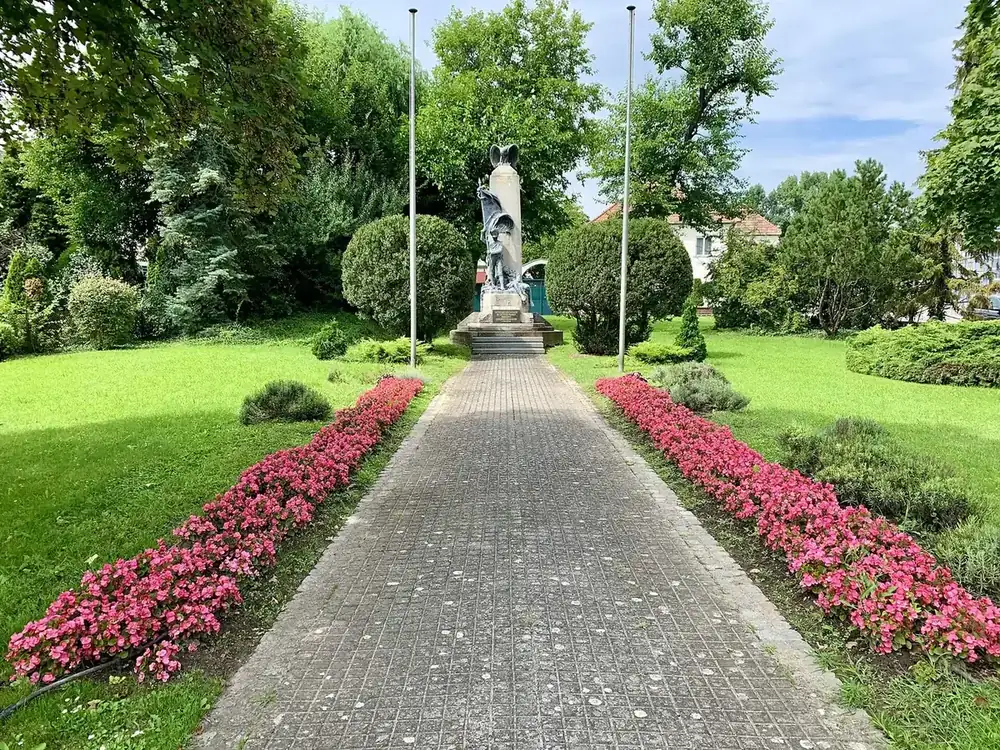
In Paris, the Avenue de Wagram, one of the avenues converging on the Arc de Triomphe at the Étoile, has borne the battle's name since 1864, as do a square and a metro station. In Austria, the memory is written into the landscape. In Deutsch-Wagram a memorial chapel was founded in 1859 for the fiftieth anniversary, followed in 1909 by a monument by the sculptor Franz Seifert. The house where Archduke Charles had his headquarters from 4 June to 6 July 1809 holds a museum opened in 1959, which in 2024 became the Napoleon and Town Museum. On 3 July 1960 the battlefield was marked with twenty memorials at fourteen sites; since combined with those of Aspern, they now number about thirty across fourteen municipalities. In 1835, during a stay in Vienna, Balzac was shown round the battlefield of Wagram by Prince Friedrich of Schwarzenberg: he was gathering details for his Scenes of Military Life.
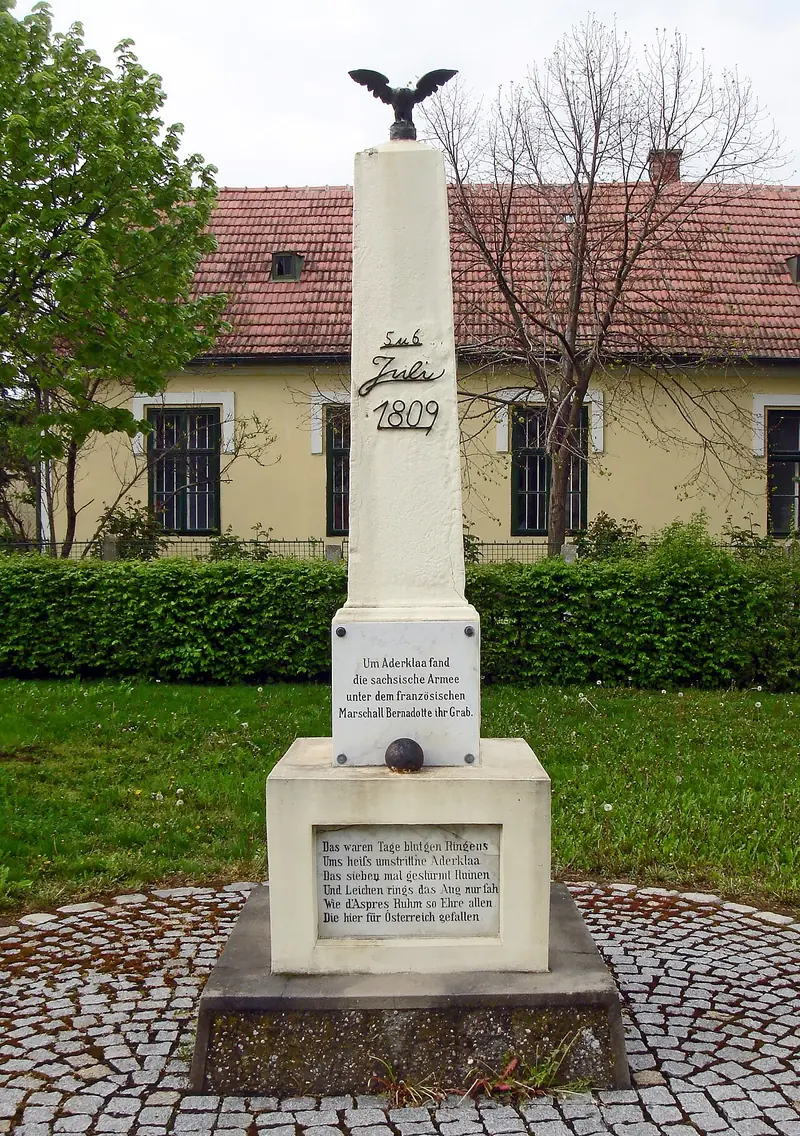
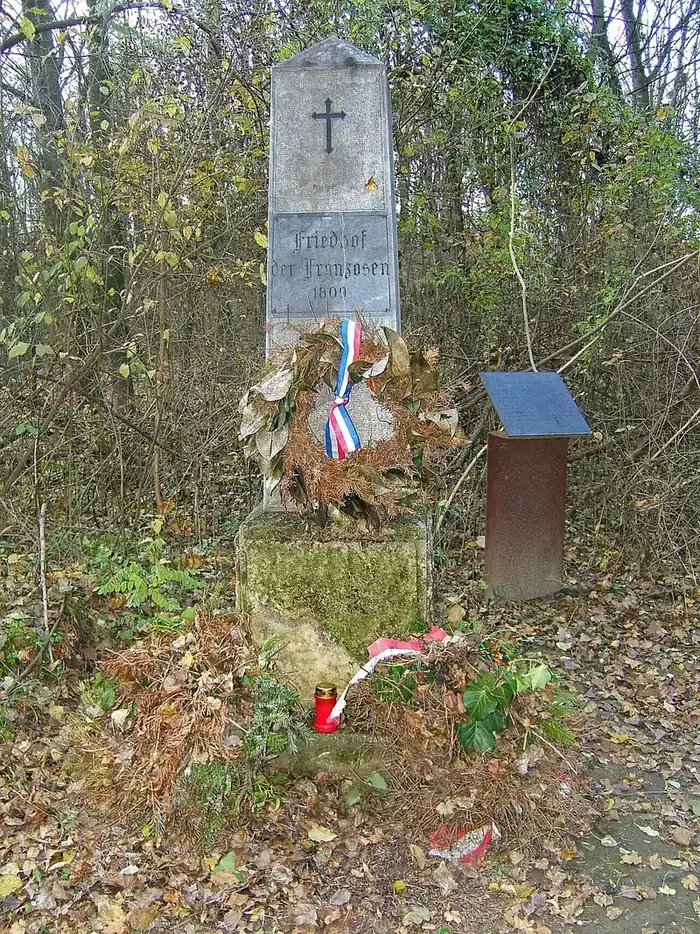
On Lobau, part of the Donau-Auen National Park since 1996, the Napoleonstraße and a series of monuments recall the French army's stay: the site of Napoleon's headquarters, the powder magazine, the French cemetery and, south of Groß-Enzersdorf, the place where the troops crossed.
Discover other battles
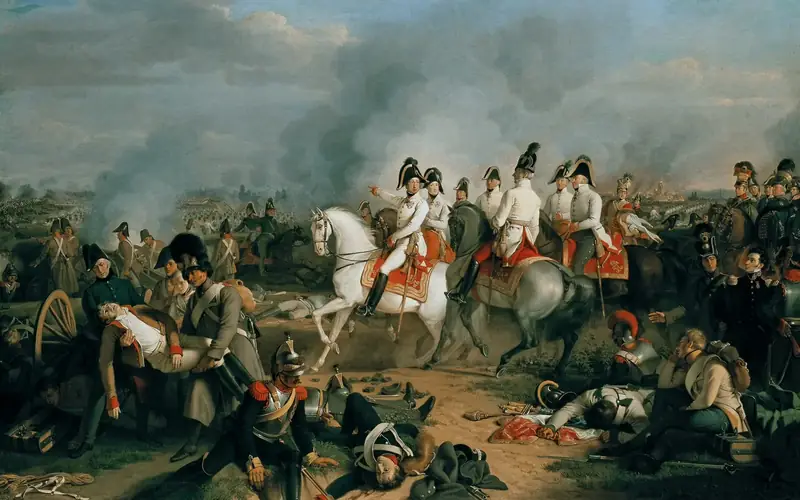 Defeat
 Read the account
Aspern-Essling
21-22 May 1809
Marchfeld, near Vienna
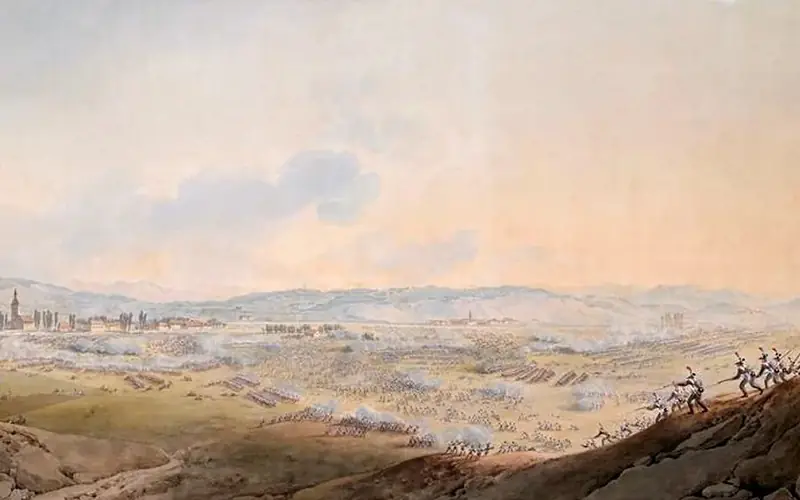 Victory
 Read the account
Eckmühl
21-22 April 1809
Eckmühl, Bavaria
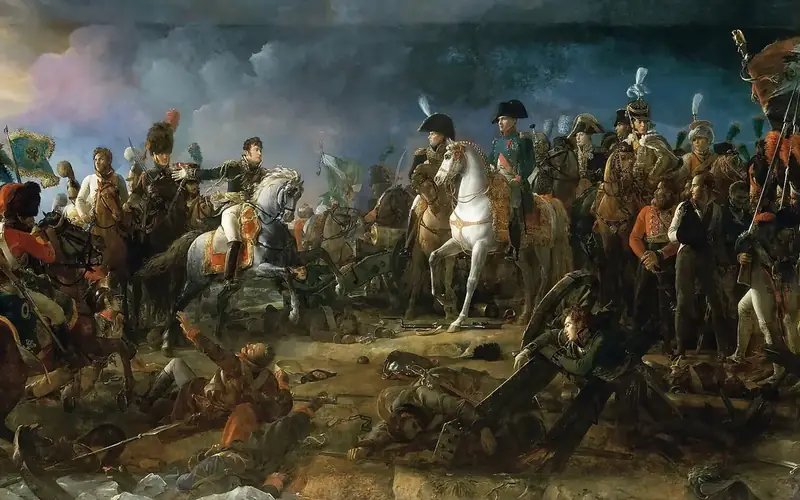 Victory
 Read the account
Austerlitz
2 December 1805
Pratzen plateau, Moravia (Czech Republic)
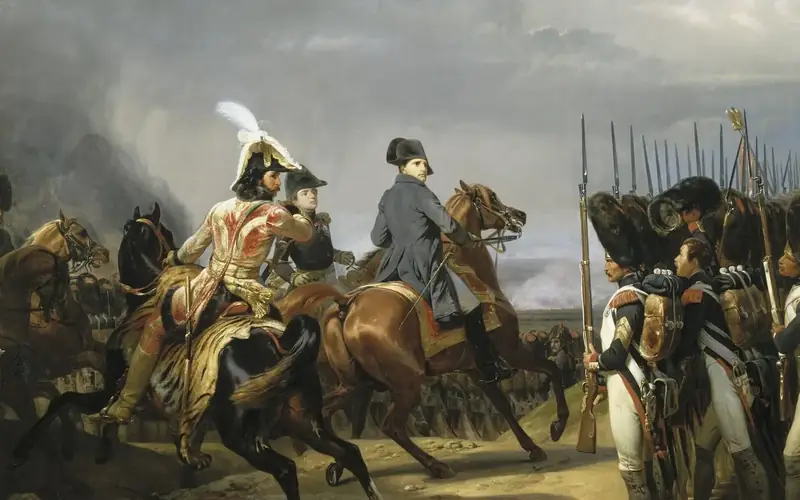 Victory
 Read the account
Jena
14 October 1806
Vierzehnheiligen, near Jena (Thuringia, Germany)
Go further
Recommended books to dig deeper (affiliate links)

Napoleon the Great
Andrew Roberts · 2014
A monumental biography drawing on Napoleon’s 33,000 surviving letters, admiring but rigorous.
See on Amazon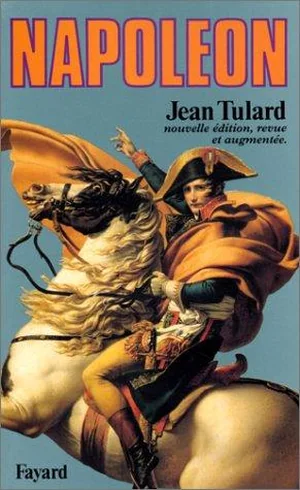
Napoléon ou le mythe du sauveur
Jean Tulard · 1977
The book that reshaped how the man is read: how France gave itself a saviour, and what it cost.
See on Amazon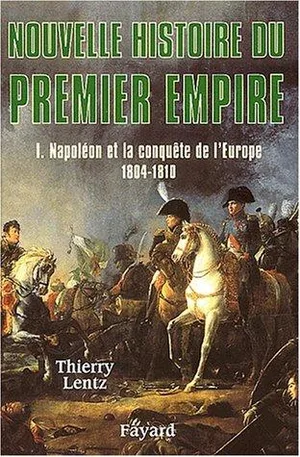
Nouvelle histoire du Premier Empire
Thierry Lentz · 2002-2010
Four reference volumes on institutions, diplomacy and collapse: the scholarly synthesis of the subject.
See on AmazonAs an Amazon Associate, this site earns from qualifying purchases.
Support the encyclopedia
Napoleon Empire is an independent project. Your contribution helps grow the content and keep the site running.
DonateSecure payment on the platform you choose.