By the evening of 10 February 1814 the Russian IX Corps no longer existed, and Napoleon had not slept. The next day, west of Montmirail, he turned on two further corps of the Army of Silesia: the Russian Osten-Sacken, pushing east without knowing what lay ahead of him, and the Prussian Yorck, coming down from the north by Château-Thierry. Between sixteen and twenty thousand Frenchmen — many of them conscripts of the class of 1815, stiffened by the Old Guard — held the crossroads and kept the two apart. The day was fought out around a farm and a hamlet, Marchais and Les Grenaux, taken and retaken until nightfall. It was the second victory of the Six Days, and the one that cost both sides most dearly.
Forces at play
Outcome: French victory: Sacken and Yorck were thrown back on Château-Thierry without having been able to join hands

France
- Napoléon Ier
- Ney
- Mortier
- Lefebvre
- Ricard
- Friant
- Nansouty
16,000 to 20,000 men depending on the account (20,000 at most for Chandler and Petre, 27,153 for Nafziger) and 36 guns: Ricard's division of VI Corps, Friant's 1st Old Guard division, Ney's Young Guard divisions, the Guard cavalry under Nansouty and Guyot; Michel's division and Defrance's guards of honour arriving with Mortier in the afternoon
Casualties: About 2,000 killed and wounded, close to an eighth of those engaged (2,000 according to Chandler and Petre, 2,000 to 2,100 according to Bodart); Nansouty, Michel and Boudin de Roville wounded, Ricard's division reduced by half


Russia · Prussia
- Osten-Sacken
- Yorck von Wartenburg
- Lieven
- Pirch
23,000 to 30,000 men and about a hundred guns: 18,000 Russians and 90 guns under Osten-Sacken according to Chandler (14,000 and 80 according to Nafziger, 20,000 according to Müffling), with a further 9,000 Prussians and 16 guns under Yorck von Wartenburg
Casualties: 3,700 to 4,000 men depending on the account: 2,000 Russians killed and wounded, 800 prisoners, 6 colours and 13 guns according to Petre; about 3,000 Russians including a thousand prisoners in the French account; 877 Prussians in the 1st infantry brigade alone, a quarter of its strength
Flags: David Liuzzo, Wikimedia Commons
Battle coordinates
Montmirail
Coordinates 48.8958° N · 3.4807° E
Battle narrative
The morning after Champaubert
By the evening of 10 February, Olsufiev's IX Corps had ceased to exist, and Napoleon did not wait for the field to be cleared. At seven o'clock he sent Nansouty's cavalry west with orders to hold Montmirail before daybreak. Marmont stayed behind towards Étoges to watch Blücher; the Emperor turned instead against the two corps coming up from the west and down from the north. Ricard's division moved off at three in the morning, Ney's Young Guard at six. Napoleon reached Montmirail around eight o'clock and, against all his habits, did not attack: he waited for his columns to come up.
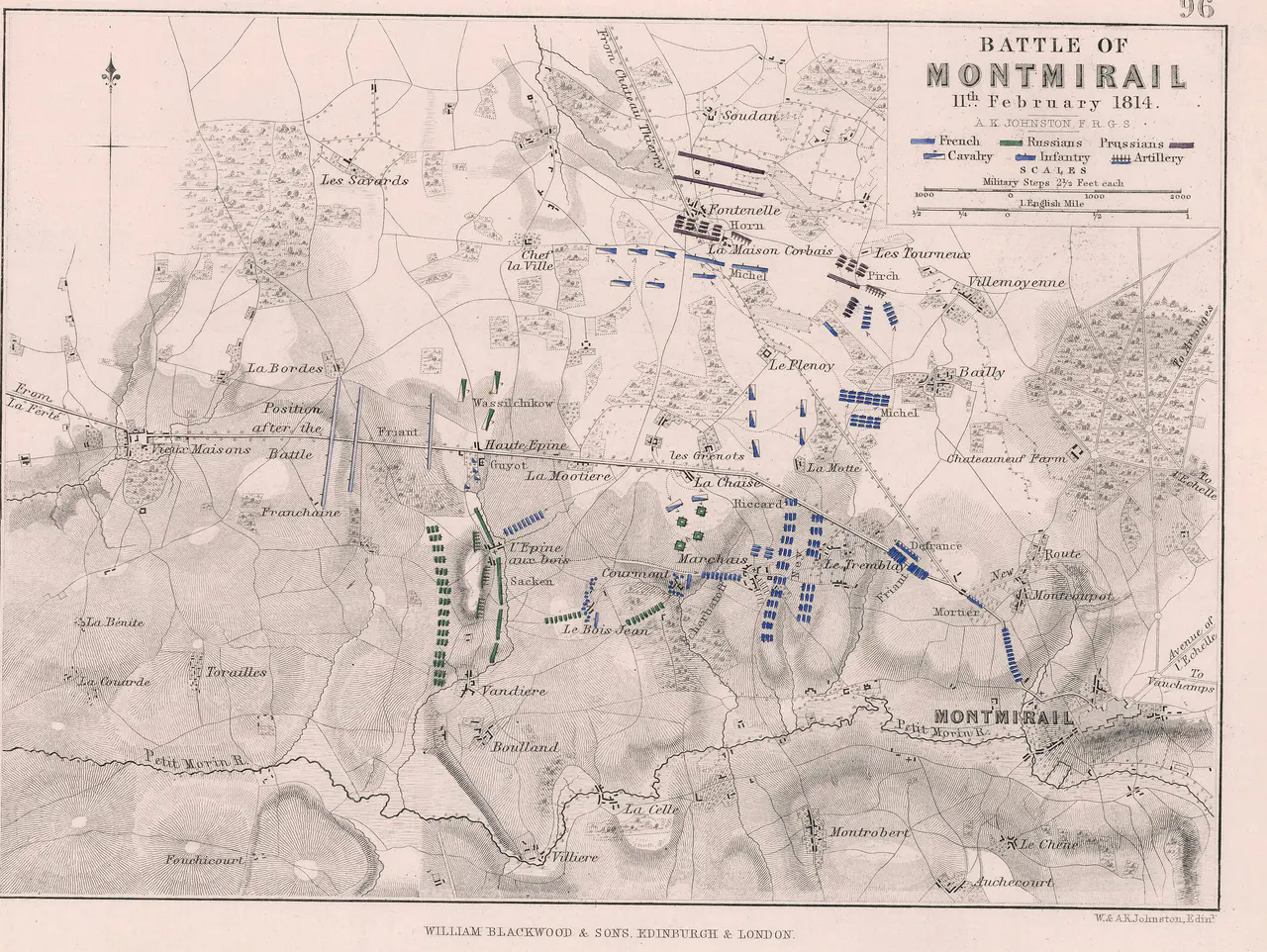
The reason lay on the map. Montmirail is a crossroads: the highway from La Ferté-sous-Jouarre to Vertus cuts the road coming down from Château-Thierry. Osten-Sacken was arriving by the first, Yorck by the second, and neither had yet joined hands with the other. To hold the junction was to keep them apart and beat them one after the next. The whole of 11 February turned on that simple idea — and on whether French conscripts would stand long enough to make it work.
Two armies to be beaten separately
The returns disagree, as they so often do for this campaign. Chandler and Petre credit Napoleon with twenty thousand men at most, the French account keeps to some sixteen thousand and thirty-six guns, Nafziger goes as high as 27,153. Facing him, Sacken fielded eighteen thousand men and ninety guns according to Chandler, fourteen thousand and eighty according to Nafziger, twenty thousand according to Müffling; Yorck added nine thousand Prussians and sixteen guns. What is certain is that the allies were the more numerous and, above all, far the better served by their artillery.
On the French side the day rested on a makeshift assembly: the 1st division of VI Corps, Ricard's, made up largely of young conscripts of the class of 1815 — the "Marie-Louise"; Friant's 1st Old Guard division; the Guard cavalry under Nansouty and Guyot; the two Young Guard divisions brought up by Ney. Mortier would arrive only during the afternoon, with Michel's Old Guard division and Defrance's guards of honour. Sacken, for his part, saw no reason to wait for Yorck. Around nine o'clock patrols clashed east of Viels-Maisons; by ten he had deployed VI Corps south of the highway towards L'Épine-aux-Bois, and Lieven's XI Corps to the north, on the farms of Les Chouteaux, La Chaise and Les Grenaux.
Marchais, taken and retaken
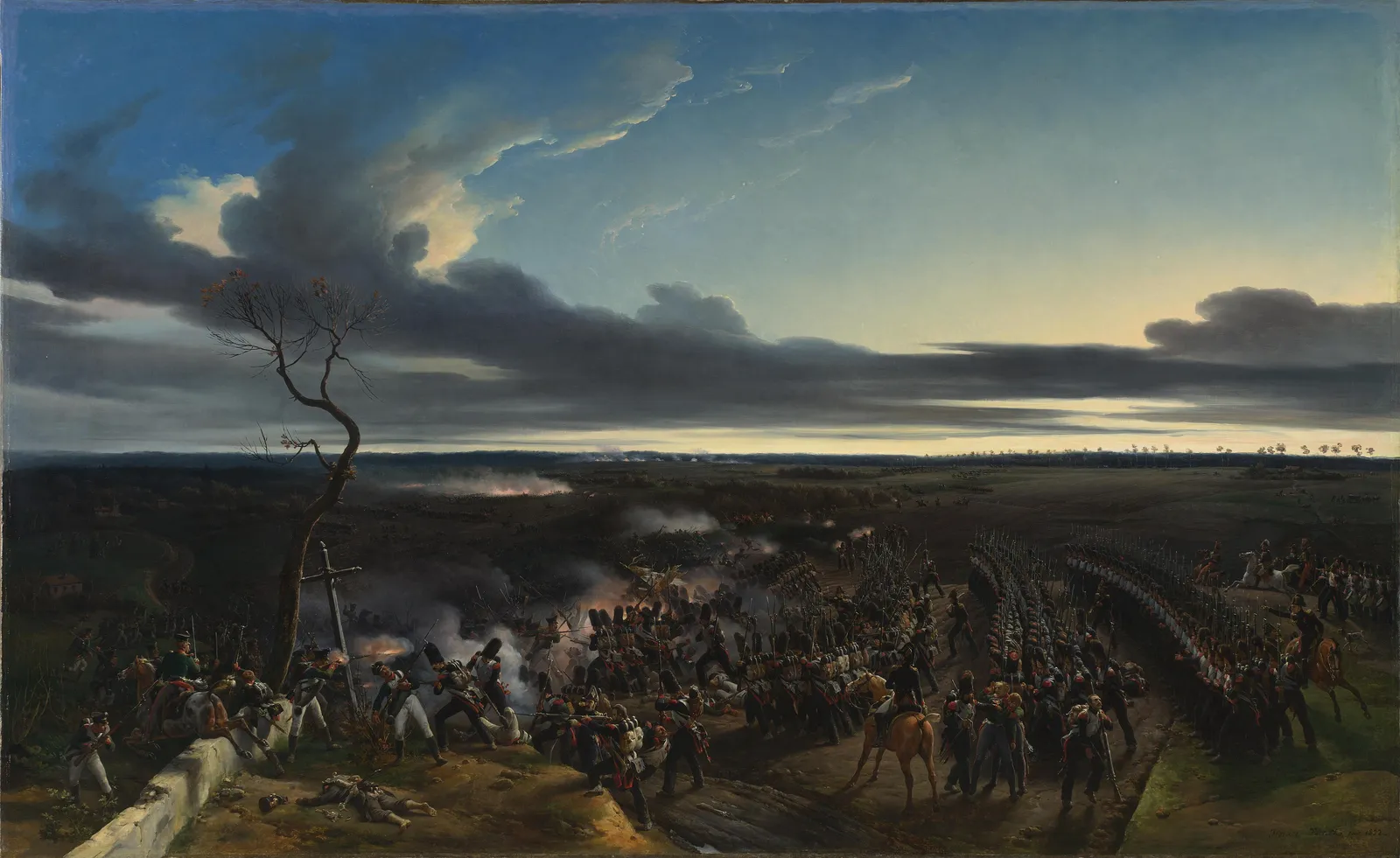
Around eleven o'clock a Russian detachment seized Marchais, a hamlet with a large farm on the slope south of the road. At noon Napoleon sent Ricard against it. What followed was the fiercest fighting of the week: the village changed hands five times, the walls of the Cour d'Airain farm passing from one side to the other at bayonet point, and the historian Jean Colin recorded that more than four hundred bodies were carried out of it. Ricard's division left half its strength there; two days later it would muster only eight hundred men under arms.
Many of them were boys of eighteen or nineteen, poorly equipped, with less than three months' service. They held. Napoleon let them hold and kept the Guard standing idle while the morning ran out: he wanted Mortier before he struck, and he wanted Sacken to commit as much as possible south of the road, where the Russian believed the battle was being decided.
Les Grenaux: the Guard settles it
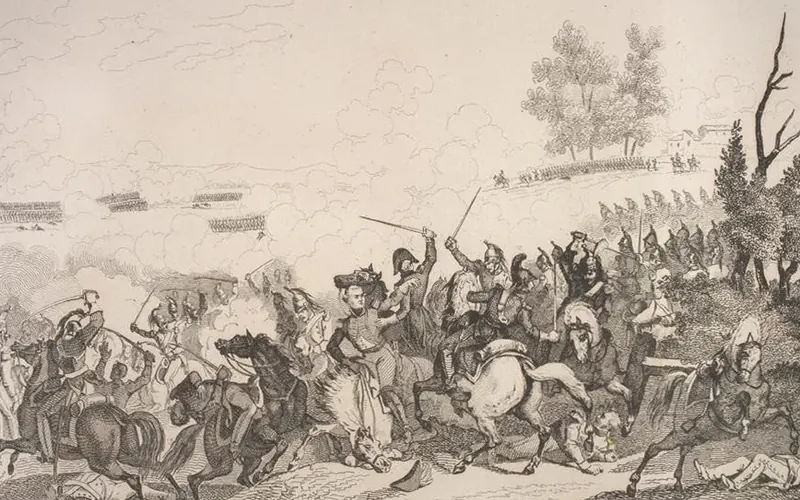
About two o'clock the Emperor judged the moment had come. Sacken had slid the bulk of his force towards Marchais; his left, north of the road, was now held by little more than the farms. Friant attacked with the Old Guard, supported by Guyot's Guard cavalry; Nansouty charged down the causeway, and it took a counter-attack by Vasilchikov's horse to restore the link with Yorck, briefly. Around four o'clock six battalions of the Guard retook the Grenaux farm with the bayonet, while the Guard dragoons of Pierre d'Autancourt and the guards of honour led by Ségur rode down the Russian battery.
Marchais gave way about five. Ricard debouched from Le Tremblay, two Old Guard battalions led by Marshal Lefebvre went into the village, and the Russian brigades were driven back into the ravines and the wood of Courmont, where the dragoons caught them again; Ricard's report speaks of five to six hundred prisoners. Defrance's cavalry closed the day by charging the columns as they pulled away.
Yorck covers the retreat
The Prussians, meanwhile, were coming down, but slowly. At three or half past three the brigades of Pirch and Horn reached Fontenelle-en-Brie. They arrived at the very moment Mortier came onto the field: Michel's Old Guard division went out to meet them and brought them up short. The 1st Prussian infantry brigade pushed on towards La Meulière without being able to break through; Pirch was wounded and Colonel Losthin took his place.
At nightfall Sacken asked Yorck to attack and cover him a line of retreat. It was all the Prussians could still do. The Russians disengaged in the dark by Viffort and made for Château-Thierry; the Polish lancers of the Guard pushed as far as Viels-Maisons. The field stayed French, but the Army of Silesia was not destroyed: it fell back in disorder, and it fell back together.
What the day cost
French losses are put at remarkably consistent figures: two thousand men in Chandler as in Petre, two thousand to two thousand one hundred in Bodart — about an eighth of those engaged. Nansouty, Michel and Boudin de Roville were wounded. On the allied side the spread is wider: Petre counts two thousand Russians killed and wounded, eight hundred prisoners, six colours and thirteen guns; Chandler rounds the whole to four thousand; Nafziger offers a range running from fifteen hundred Russians and nine guns up to three thousand killed and wounded, seven hundred and eight prisoners, twenty-six pieces and two hundred wagons. The French account settles on some three thousand Russians, close to sixteen per cent of the force, a thousand of them taken prisoner.
One figure does not move: the 1st Prussian infantry brigade lost eight hundred and seventy-seven men, a quarter of its strength. Measured against the numbers present, Montmirail was the costliest day of the Six Days for victor and vanquished alike — and the only one on which the Old Guard had to pay in its own blood to carry the decision.
What is left of Montmirail
Napoleon pressed on the next day towards Château-Thierry, then turned one last time against Blücher at Vauchamps on 14 February. In six days he had beaten four allied corps separately. But MacDonald's inaction in the west let what remained of Sacken and Yorck slip away, and the victory of 11 February, clear-cut as it was on the ground, did not bring the strategic result the Emperor hoped for: the Army of Silesia reassembled and went forward again less than a week later. It did leave a lasting mistrust between Russians and Prussians, and that may well have been its most concrete effect.
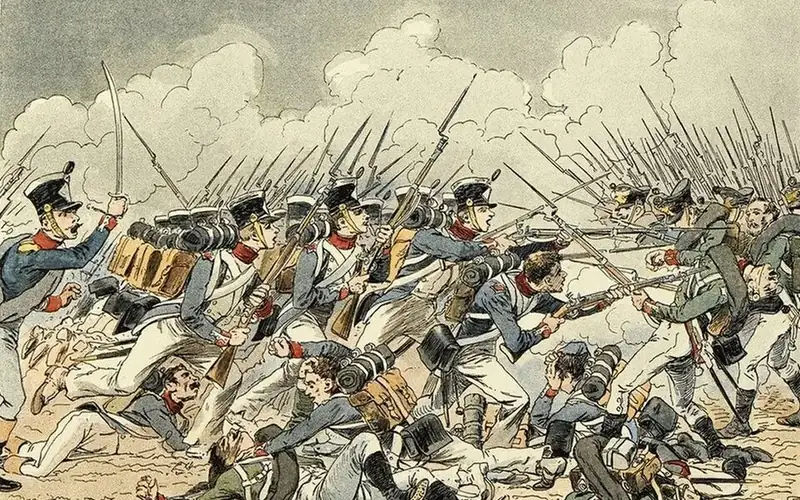
The memory has held better. A commemorative column raised on the Paris road marks the day at the edge of the field, and an orientation table explains it at Marchais-en-Brie. Above all, Horace Vernet drew from it in 1822 one of the great images of the campaign of France — a canvas now in the National Gallery in London, in which the bearskins of the Old Guard advance through a dying light. Eight weeks after Montmirail, on 6 April 1814, Napoleon abdicated at Fontainebleau.
Discover other battles
 Victory
Read the account
Champaubert
10 February 1814
Champaubert, Marne, Champagne
 Victory
Read the account
Vauchamps
14 February 1814
Vauchamps, Marne, Champagne
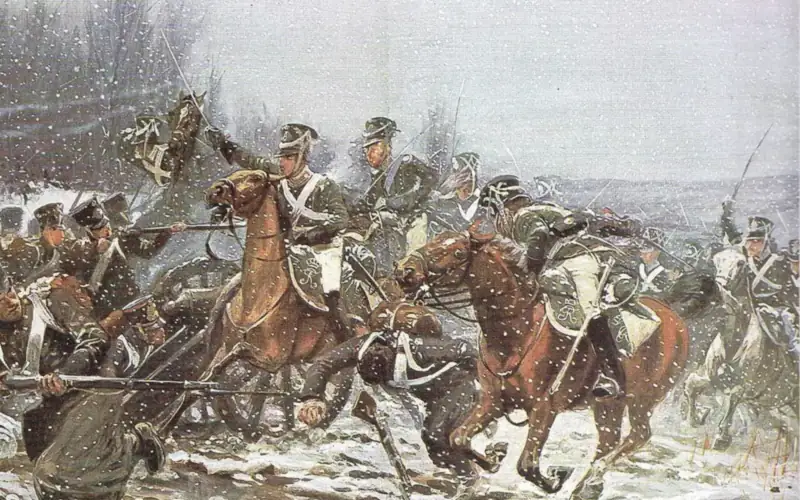 Defeat
Read the account
La Rothière
1 February 1814
La Rothière, Aube, Champagne
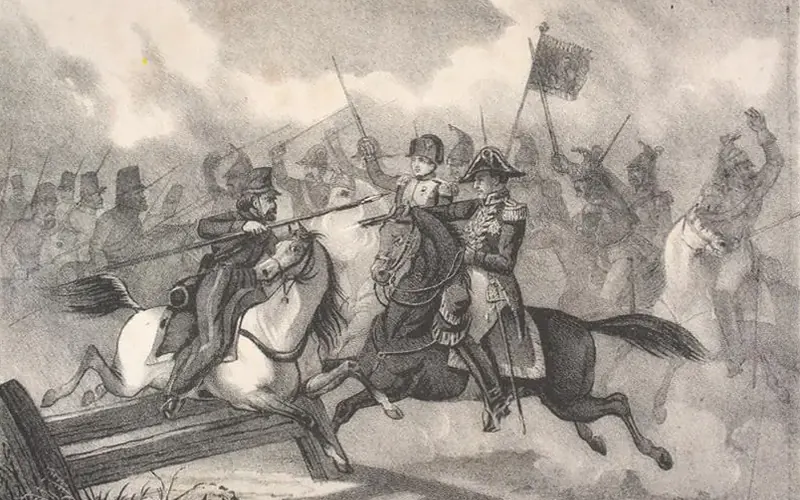 Victory
Read the account
Brienne
29 January 1814
Brienne-le-Château, Aube, Champagne
Go further
Recommended books to dig deeper (affiliate links)

Napoleon the Great
Andrew Roberts · 2014
A monumental biography drawing on Napoleon’s 33,000 surviving letters, admiring but rigorous.
See on Amazon
Napoléon ou le mythe du sauveur
Jean Tulard · 1977
The book that reshaped how the man is read: how France gave itself a saviour, and what it cost.
See on Amazon
Nouvelle histoire du Premier Empire
Thierry Lentz · 2002-2010
Four reference volumes on institutions, diplomacy and collapse: the scholarly synthesis of the subject.
See on AmazonAs an Amazon Associate, this site earns from qualifying purchases.
Support the encyclopedia
Napoleon Empire is an independent project. Your contribution helps grow the content and keep the site running.
DonateSecure payment on the platform you choose.