The Battle of Austerlitz, fought on 2 December 1805 in Moravia, one year to the day after the coronation, is Napoleon's most famous victory. Known as the 'Battle of the Three Emperors', it pitted the Grande Armée, some 73,000 men, against the Austro-Russian army of Alexander I and Francis II, around 85,000 strong. Having feigned weakness and abandoned the Pratzen plateau, Napoleon let the allies wear themselves out against his right, broke their centre as the fog lifted and encircled their left wing. The victory dissolved the Third Coalition and led to the Peace of Pressburg.
Forces at play
Outcome: Decisive French victory

France
- Napoléon
- Soult
- Lannes
- Davout
- Murat
- Bernadotte
- Bessières
72,000 to 75,000 men, 157 guns
Casualties: 1,305 killed, 6,940 wounded, 573 prisoners


Russia · Austria
- Alexandre Ier
- François II
- Koutouzov
- Weyrother
- Buxhöwden
- Bagration
- Liechtenstein
- Grand-duc Constantin
85,000 to 89,000 men, nearly 300 guns
Casualties: 24,000 to 36,000 men depending on the count, including over 11,000 prisoners; 45 colours, ~180 guns
Battle coordinates
Austerlitz
Coordinates 49.1413° N · 16.7652° E
Interactive tactical map
Follow the battle hour by hour — hover over or tap a unit for its details.
Dawn: Kienmayer attacks Telnitz
Thick fog covers the Goldbach valley. The allied columns come down from the Pratzen plateau to outflank the deliberately weak French right, held by Legrand’s division. Behind the Bosenitz stream, invisible from the plateau, two thirds of the French army wait. At about 7:00 Kienmayer’s Austrian advance guard attacks Telnitz.
In the days beforehand Napoleon had told his marshals: “Gentlemen, examine this ground carefully; it is going to be a battlefield, and you will have a part to play upon it.”
Positions reconstructed from accounts of the battle and placed on the actual locations of the villages and heights (Santon, Žuráň, Pratzen, Sokolnitz, Telnitz, Augezd). The Satschan ponds, since drained, are placed approximately. Timings are indicative.
Battle narrative
From Boulogne to the Danube
In the spring of 1805, William Pitt's Britain was financing a Third Coalition against France. Russia signed the alliance in April; Austria, beaten twice in less than ten years and eager for revenge, joined during the summer. The aim was to push France back to less threatening frontiers, in Italy as in Germany.
Napoleon, crowned emperor on 2 December 1804, had spent two years assembling an invasion army of some 150,000 men on the Channel coast. It never crossed, but those years in camp had made it an instrument without equal: seven permanent army corps, each with its own infantry, cavalry, thirty to forty guns and staff, able to fight alone until the others came up. To these were added a cavalry reserve of 22,000 men and the Imperial Guard. This was the Grande Armée.
In August 1805 the Emperor turned his back on England. On 25 September, after a march conducted in the greatest secrecy, some 200,000 men crossed the Rhine on a front of 260 kilometres. The Austrian general Mack, who expected the French through the Black Forest, let himself be enveloped in Ulm: on 20 October, 23,000 Austrians surrendered there, bringing the campaign's prisoners to 60,000. The next day, at Trafalgar, the Franco-Spanish fleet was destroyed; but on the continent the march went on. On 13 November the French entered Vienna without a fight, finding 100,000 muskets, 500 guns and the Danube bridges intact.
A victorious army at the end of its lines
The fall of Vienna did not end the war. Kutuzov's Russian army, arriving too late to save Mack, withdrew north-east, fighting delaying actions at Dürrenstein on 11 November and at Schöngrabern on the 16th, where Bagration held off the French advance guard. On 18 November Kutuzov joined forces near Wischau with Buxhöwden's corps and Prince John of Liechtenstein's Austrians. The allied army gathered at Olmütz, in Moravia, where Tsar Alexander I and Emperor Francis II were present.
The French position was becoming uncomfortable. Lines of communication stretched over hundreds of kilometres and required strong garrisons; Prussia, still neutral, might enter the war; Archduke Charles might come up from Italy with an intact Austrian army. Kutuzov knew it and proposed retreating further, towards the Carpathians, to let winter and distance wear the enemy down.
Napoleon, for his part, needed a battle, and quickly. He did not have the means to pursue indefinitely; he needed the enemy to come to him, on ground of his choosing.
The trap: feigning weakness
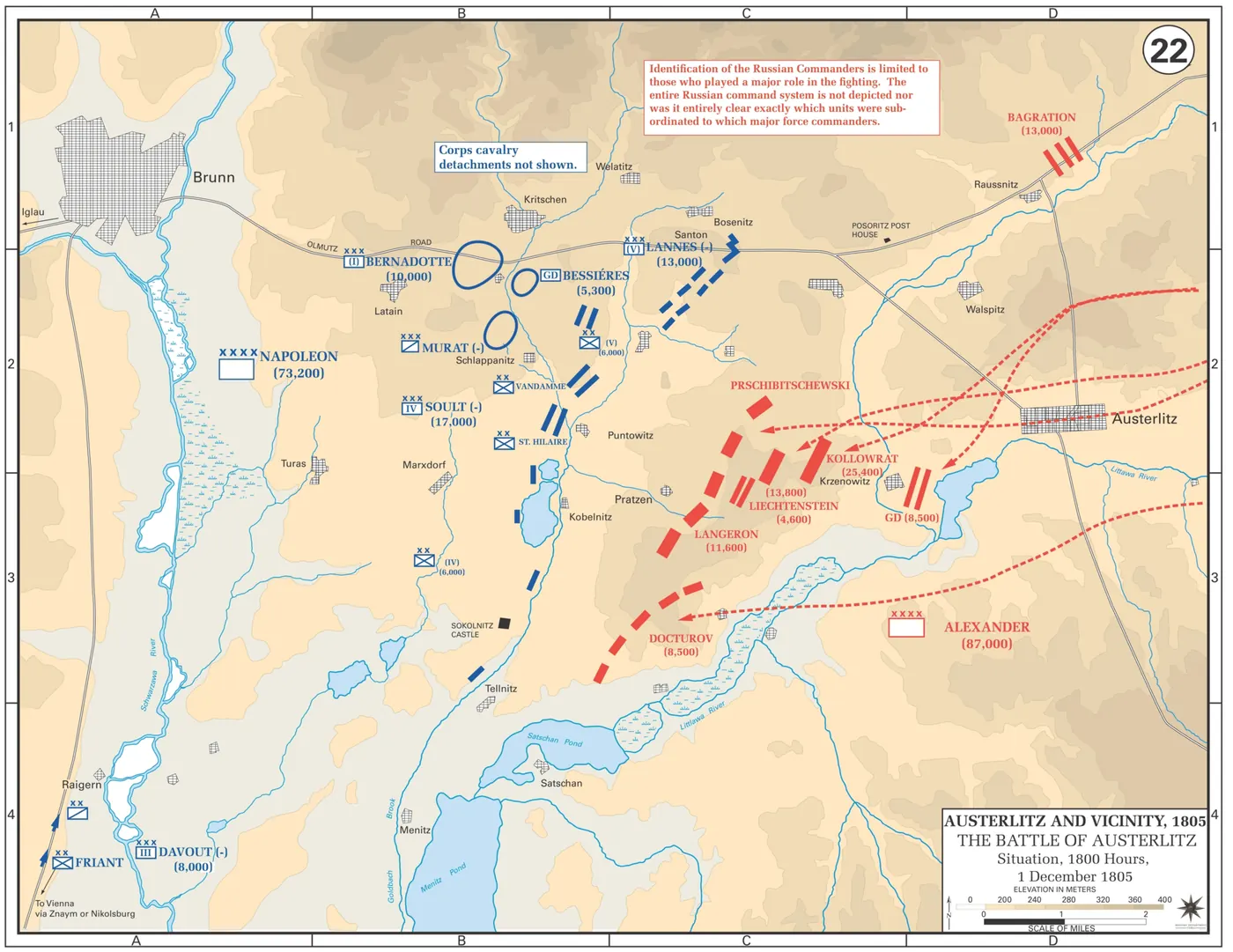
The whole manoeuvre rested on stagecraft. Around Brünn, Napoleon showed only some 53,000 men — the corps of Soult and Lannes and Murat's cavalry — against an allied army of some 85,000 to 89,000. But Bernadotte's corps, from Iglau, and Davout's, from Vienna, could join him by forced marches and bring his strength to around 75,000 on the day.
On 25 November General Savary went to the allied headquarters at Olmütz with a message of peace, and took the opportunity to observe the enemy. On the 27th Francis II proposed an armistice: Napoleon accepted it eagerly. That same day he ordered Soult to abandon Austerlitz and the Pratzen plateau while giving the impression of a disorderly retreat. On the 28th he received Prince Dolgorukov, the Tsar's impetuous aide-de-camp, and played anxiety and hesitation before him. Dolgorukov reported to his master that the French army was at bay.
The trap worked. At allied headquarters, set up at Křenovice, the Tsar's entourage and the Austrian chief of staff Weyrother clamoured for an attack. Francis II counselled caution, and so did Kutuzov; Alexander I decided for battle. Kutuzov kept nominal command, but it was Weyrother's plan that was adopted.
Two armies, two traditions
The French army was an army of manoeuvre. Its permanent corps could march separately and concentrate on the battlefield; its marshals knew one another and knew the Emperor's method; its soldiers were largely veterans of the Revolutionary Wars, trained for two years at Boulogne. On the day of battle Napoleon had some 72,000 to 75,000 men and 157 guns.
The Russian army retained many features of the Ancien Régime: no permanent formation above the regiment, senior officers often drawn from the court, poorly trained junior officers. The Russian soldier, however, was renowned for exceptional steadfastness, and his artillery was solid. The Austrian army had barely emerged from the reforms launched by Archduke Charles in 1801; multinational and multilingual, it had good cavalry and the best artillery in the coalition, but it had lost an entire army at Ulm.
Some 70 per cent of the allied troops were Russian. The coalition army fielded nearly 300 guns, twice as many as the French. Its weakness lay elsewhere: in a command divided between two sovereigns, a bypassed commander-in-chief and a foreign chief of staff, and in columns that had never manoeuvred together.
The battlefield
The ground lies some ten kilometres south-east of Brünn (Brno), between that city and Austerlitz (Slavkov u Brna), in today's Czech Republic. To the north, the Brünn–Olmütz road is overlooked by two heights: the Santon, at 210 metres, and the Žuráň, at 270 metres, from which Napoleon would follow the opening of the battle. To the south, the Goldbach stream flows north to south past Kobelnitz, Sokolnitz and Telnitz, then loses itself in an area of ponds, among them those of Satschan and Menitz.
In the centre rises the Pratzen plateau, a gently sloping height that commands the whole battlefield. In the days beforehand, Napoleon is said to have told his marshals repeatedly: "Gentlemen, examine this ground carefully; it is going to be a battlefield, and you will have a part to play upon it." Abandoning this plateau to the enemy was the heart of the trap.
The French left was firmly held. The Santon was fortified, armed with 18 guns and entrusted to the 17th Light Infantry, with orders to defend it to the last extremity. The right, by contrast, was deliberately thin: along the Goldbach, from Telnitz to Sokolnitz castle, Legrand's division was to hold alone until Davout arrived.
The plans
Weyrother's plan was simple in principle. The French right looked weak and covered the road to Vienna: four columns would come down from the Pratzen plateau to outflank it, cut the French off from their line of retreat and drive them northwards. The 1st column under General Dokhturov (13,600 men), preceded by Kienmayer's Austrian advance guard, would take Telnitz; the 2nd, under Langeron (11,700 men), and the 3rd, under Przybyszewski (10,000 men), would attack Sokolnitz. The whole, under Buxhöwden, numbered more than 40,000 men. The 4th column, under Kollowrath and Miloradovich (23,900 men), with which Kutuzov stood, was to follow from the plateau. In the north, Bagration and his 13,000 men would pin the French left on the Olmütz road, with Liechtenstein's cavalry; Grand Duke Constantine's Russian Imperial Guard, some 10,000 men, stayed in reserve.
Napoleon had guessed this plan. On 1 December the allied campfires showed him a front stretching southwards. He deduced that the enemy would strip the Pratzen to strike his right, and built his battle around that movement. During the day he secretly moved the bulk of his troops behind the Bosenitz stream, into low ground invisible from the plateau, between Puntowitz and Girzikowitz. Some two thirds of his forces were thus concentrated on a front of three kilometres.
The roles were allotted. Davout, with III Corps, was to hold the Goldbach against far superior forces: a few thousand men at first, around twelve thousand later, against Buxhöwden's 40,000 and more. His division under Friant was arriving from Vienna after covering some 110 kilometres in 48 hours. Soult, with the divisions of Vandamme and Saint-Hilaire, about 16,000 men, would attack the plateau once it had emptied. Lannes would hold the north with Murat. Bernadotte, the Guard and Oudinot's grenadiers formed the reserve. The orders, explained verbally to the marshals on the evening of 1 December, were circulated in writing early the next morning.
The eve: the bivouac of 1 December
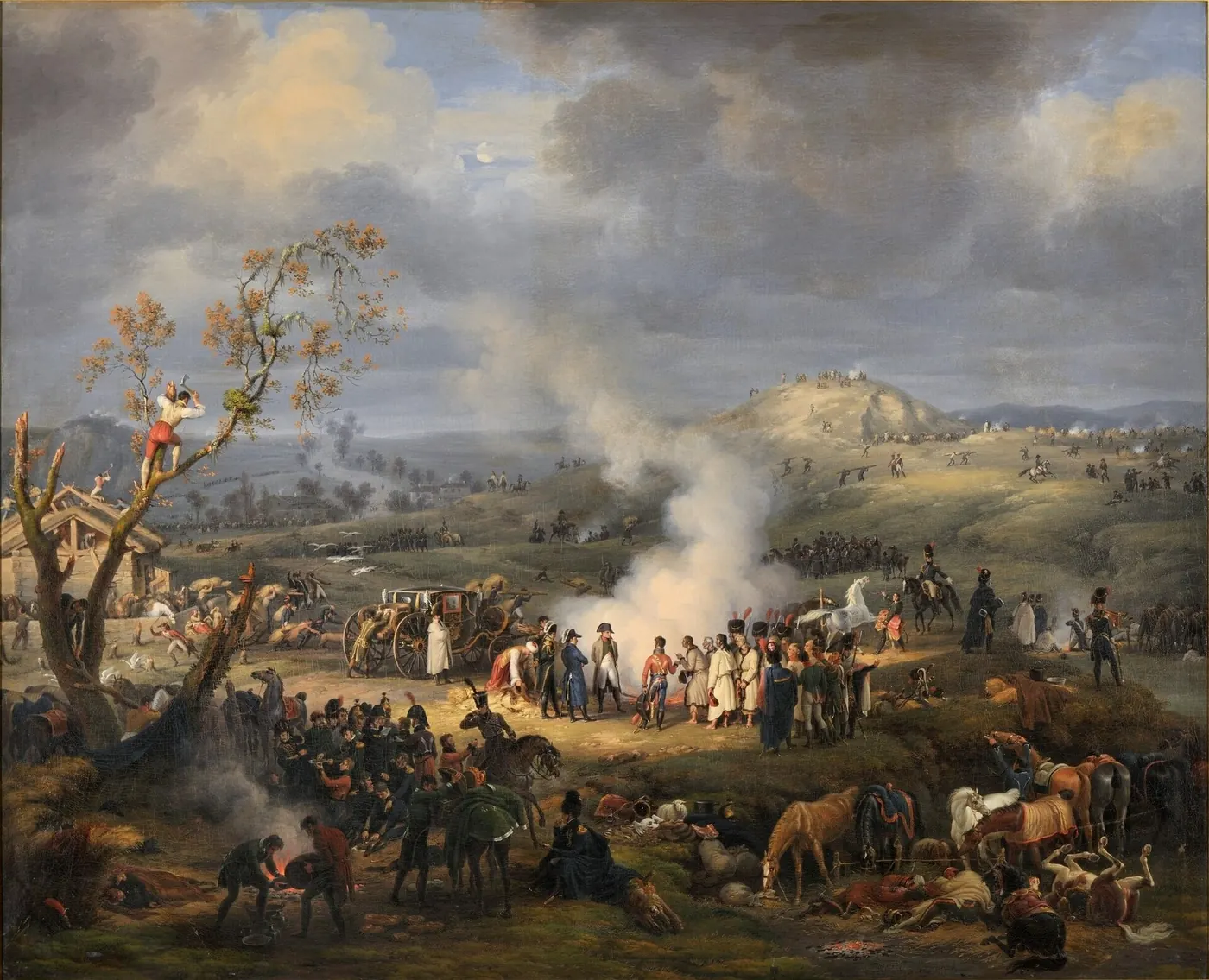
2 December 1805 fell one year to the day after the coronation. The Emperor, less serene than legend would claim, wrote to Talleyrand to say nothing of the coming battle so as not to alarm the Empress Joséphine. According to the historian Frederick Schneid, his chief worry was having to explain a defeat to her.
He spent part of the evening going round the outposts, questioned peasants about the enemy's movements and watched the allied fires on the plateau. The proclamation read to the troops set out the plan without ambiguity: if the enemy left his positions to turn the French right, he would expose his flank.
On the allied side, the council of war of 1 December adopted Weyrother's disposition. Orders reached the columns late, and some units did not know exactly where to take position at daybreak: Liechtenstein's cavalry, in particular, settled on the wrong side of the plateau.
Dawn in the south: Telnitz and Sokolnitz
On 2 December thick fog covered the Goldbach valley. At about 7:00 Kienmayer's advance guard attacked Telnitz, defended by the 3rd of the Line and a battalion of Corsican skirmishers. The French repulsed several assaults; at about 8:00 the arrival of Dokhturov's column forced them to give up the village and fall back across the Goldbach. Kienmayer's Austrian cavalry swept aside General Margaron's light cavalry.
The French right was in danger of being turned. It was then that Davout's first troops arrived: Friant's division, coming from Gross Raigern, counter-attacked, retook Telnitz and lost it again to a charge by Austrian hussars. Further north, Langeron's column attacked Sokolnitz, bombarded the village and drove out the 26th Light; Przybyszewski took the castle. Friant retook the village, lost it and retook it again. Sokolnitz was probably the most contested spot of the day.
The allied advance was slowed by its own confusion. Liechtenstein's cavalry, wrongly placed on the left, crossed through the columns to reach its position in the north and delayed the 2nd column. All morning, some 8,000 French infantry and 2,800 cavalry held off around 35,000 allied troops in a battle of attrition. It was exactly what Napoleon wanted: to feed their attack, the allies went on stripping their centre.
"One sharp blow and the war is over": the assault on the Pratzen
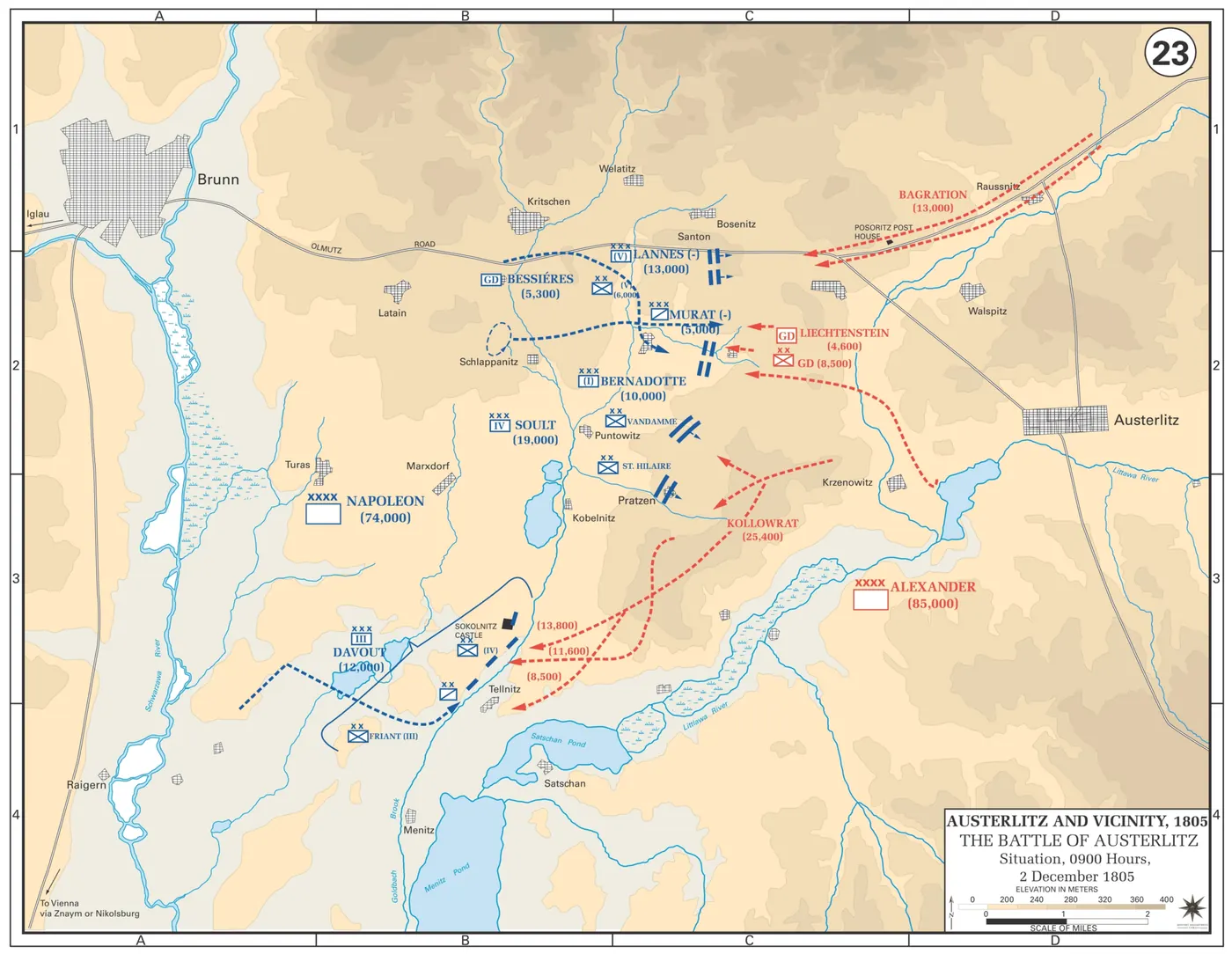
From the Žuráň, Napoleon waited. At about 8:45 the fog began to lift from the heights while still clinging to the low ground. The Emperor saw the allied columns leaving the plateau. He asked Soult how long his men would need to reach the Pratzen heights. "Less than twenty minutes, Sire." Napoleon waited another quarter of an hour, then launched the attack: "One sharp blow and the war is over."
At about 9:00 Soult's divisions emerged from the fog in close columns: Saint-Hilaire to the right of the village of Pratzen, Vandamme to the left. The sun broke through as they climbed the slope — the "sun of Austerlitz" that Napoleon would invoke again on the eve of Borodino. On the plateau, allied officers were stunned to see French masses appear where they had expected no one. The 4th column, which was to follow the others southwards, had begun to move down on the Tsar's orders.
The fight for the Pratzen lasted about two hours. South of the plateau, on the Pratzeberg, the Russian general Kamensky, from Langeron's column, grasped the danger and climbed back on his own initiative with two regiments. Thiébault's brigade of Saint-Hilaire's division held its fire until the advancing Austrian battalions were thirty or forty metres away, then broke them. Kutuzov, present in this sector, ordered several counter-attacks; they failed.
North of the plateau, at about 10:30, Vandamme attacked the heights of Staré Vinohrady, the "Old Vineyards", held by Kollowrath's Austrians. The brigades of Ferey and Schiner struck them in front and flank; after an hour's fighting the Austrian line gave way. By the end of the morning the plateau was in French hands. The allied army was cut in two.
In the north: Lannes, Murat and Bagration
Meanwhile the battle raged along the Olmütz road. At about 9:15 Lannes advanced with the divisions of Suchet and Caffarelli, preceded by Kellermann's light cavalry. Liechtenstein launched his uhlans against it; Kellermann fell back behind the infantry, which opened fire, then counter-charged. At the village of Blaziowitz the chasseurs of the Russian Guard and the French 13th Light fought over houses and gardens; Colonel Castex was killed, and the French finally carried the village at about 11:00.
Murat's cavalry went into action. The cuirassiers of Nansouty and d'Hautpoul charged the Russian cavalry in a long and bitter mêlée and eventually prevailed. At about 11:00 Bagration attempted a diversionary attack on Bosenitz; his chasseurs drove the French detachment back to the Santon, where the fire of the 17th Light and its guns stopped them with heavy losses.
Lannes then pushed Bagration off the battlefield. He wanted to pursue; Murat opposed it, and Napoleon called it off. Bagration withdrew in good order to the north-east: within the following forty hours he put some sixty kilometres between his troops and the battlefield.
The clash of the Guards
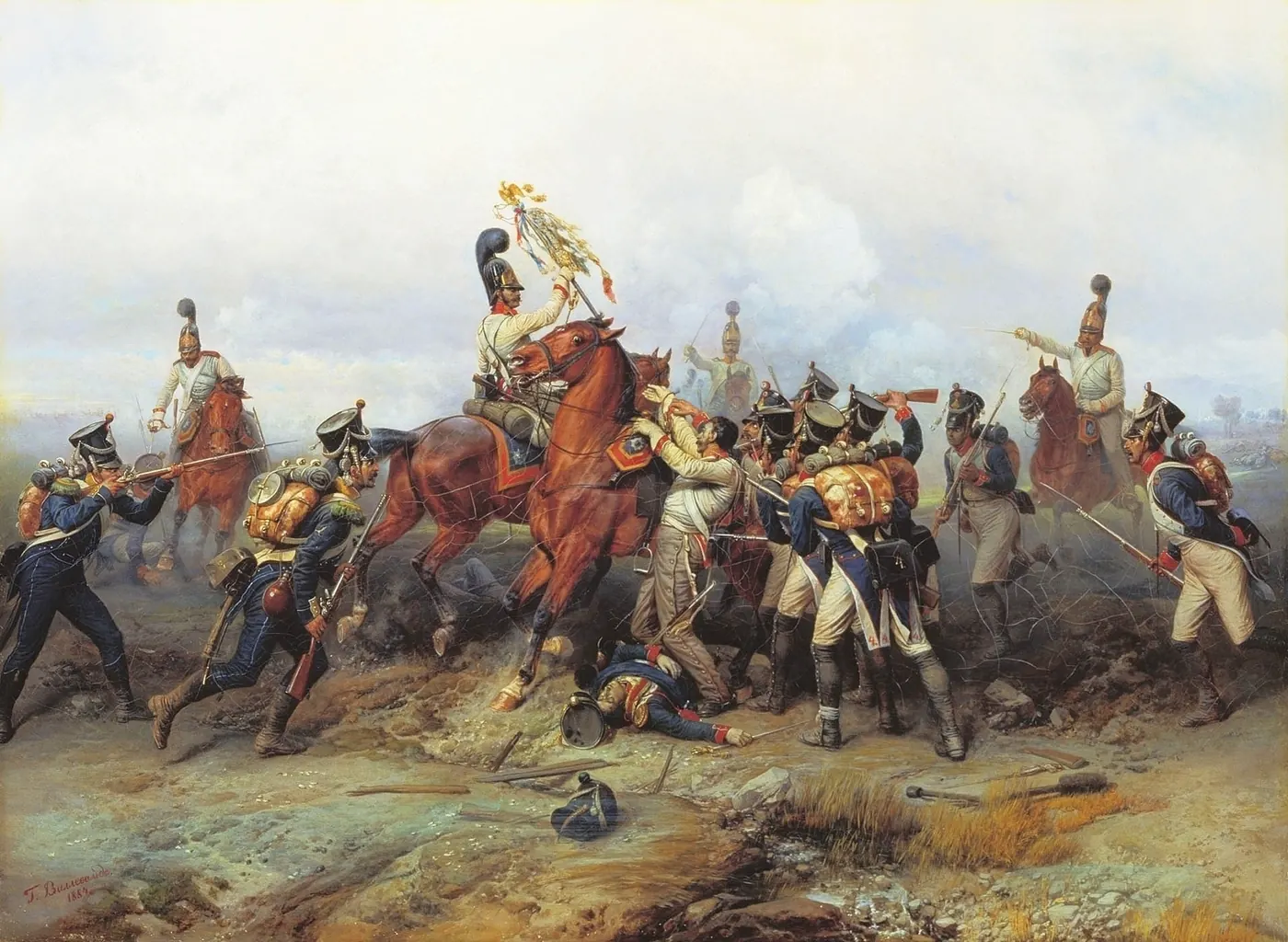
With the plateau taken, Napoleon left the Žuráň and set up his post near St Anthony's chapel on the Pratzen heights. He brought Bernadotte's corps forward to support Vandamme's left. In the allied centre only one intact reserve remained: Grand Duke Constantine's Russian Imperial Guard.
Constantine counter-attacked in Vandamme's sector. The Guard infantry broke through the first French line; the Guard cavalry, the Chevalier Guards among them, caught a battalion of the 4th of the Line in open ground and took its eagle — the only one the French lost in the battle. The French centre wavered.
Napoleon then committed the cavalry of his Guard. General Rapp, at the head of the Mamelukes and the Horse Grenadiers, charged the Chevalier Guards and took their colonel, Prince Repnin, prisoner. The two cavalries engaged in successive masses; Drouet's division, from Bernadotte's corps, deployed on the flank of the mêlée and offered shelter to the French squadrons, while the Guard horse artillery cut down the Russian cavalry. The Russian Guard broke and fell back on Křenovice. The allied centre had ceased to exist. Kutuzov had been seriously wounded, and his son-in-law, Count Tiesenhausen, killed.
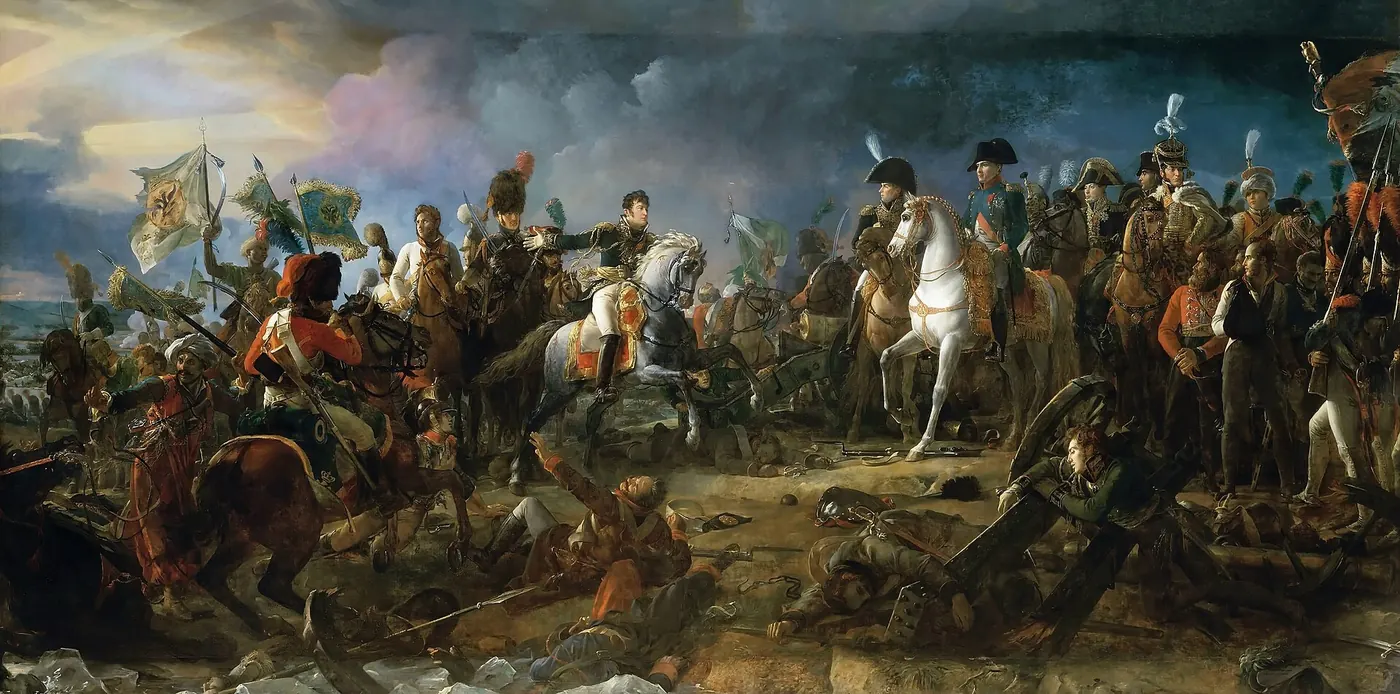
The encirclement of the allied left
At about 13:00 Napoleon swung his battle southwards. Bernadotte held the plateau; Vandamme, Saint-Hilaire, the Guard and Oudinot's grenadiers came down on the rear of Buxhöwden's columns, still fighting on the Goldbach, while Davout pressed them from the front. The allied left, which was to have enveloped the French, found itself caught between two fires.
By about 14:30 Buxhöwden was completely isolated and receiving no orders from either Kutuzov or the Tsar. Vandamme seized Augezd, cutting the line of retreat to the east. At Sokolnitz, the combined assault of Saint-Hilaire and Davout broke the last defenders: Przybyszewski's column and part of Langeron's were captured. Langeron and Kienmayer got away as best they could; the Austrian O'Reilly light horse covered the retreat, charging the French cavalry repeatedly.
Panic spread through the allied army, which abandoned the field in every direction. Only Dokhturov's column kept some cohesion.
The Satschan ponds
To escape encirclement, Dokhturov's troops fell back southwards, along the dikes and across the frozen surface of the Satschan and Menitz ponds. Napoleon had guns brought into battery on the heights of Augezd and fired on the fugitives and on the ice, which gave way. Men, horses and guns sank into the freezing water; many of the drowning were pulled out by the French soldiers themselves.
The episode became one of the images of legend, and its scale is still debated. The bulletin spoke of thousands drowned; historians' estimates range from 200 to 2,000 dead, and the number of guns lost in the ponds varies from 38 to over a hundred depending on the source. Local evidence published later reports that the ponds, drained on Napoleon's orders a few days after the battle, yielded only two or three bodies and some 150 horses.
Dokhturov managed to regroup his troops near Neudorf at nightfall. At about 16:30 the fighting ceased across the whole battlefield. The exhausted French cavalry hardly pursued; during the night of 2 to 3 December the remnants of the allied army gathered at Czeitsch, on the road to Hungary.
A disputed masterpiece
Military historians readily rank Austerlitz alongside Cannae or Gaugamela among the great battles of annihilation. The combination is exemplary: a psychological trap laid over a week, a wing deliberately offered, a hidden reserve, an attack launched at the exact moment the fog lifted from the heights while lingering in the hollows, then a wheel southwards that turned the breakthrough into an encirclement.
Yet the victory had its limits. Napoleon did not destroy the allied army as completely as he had hoped: Bagration withdrew in order, Dokhturov saved part of his column, the Russian Guard re-formed. The collapse owed as much to the enemy's disorganisation — delayed columns, cavalry in the wrong place, confused command — as to the perfection of the plan alone. Several historians also note that so dazzling a victory may have fed in the Emperor an excessive confidence in his ability to force a decision by battle.
On the allied side, the Tsar laid the blame on Kutuzov. Yet it was Kutuzov who had wanted to fall back towards the Carpathians, where logistics would have favoured the allies, where Archduke Charles could have joined them from Italy and where Prussia would have had time to enter the war. At the end of immoderately long supply lines, in a region bare of food, the Grande Armée might have met a very different fate. Austerlitz was also the defeat of a generation of commanders trained by Suvorov: Kutuzov, Bagration, Miloradovich, Kamensky, Buxhöwden.
Legend, finally, has produced its own quotations. The British historian Archibald Alison reported in 1836 that Napoleon, urged by his marshals to attack while the allies were coming down from the plateau, held them back: when the enemy is making a false movement, one must take care not to interrupt him. Reworked over successive accounts, the phrase became the maxim "Never interrupt your enemy when he is making a mistake"; no contemporary source attests it.
The toll
French losses are well documented: 1,305 killed, 6,940 wounded and 573 prisoners, about 9,000 men in all. On the allied side figures vary with the count: the Russians recorded some 11,000 killed and wounded, the Austrians about 600 killed and 1,200 wounded, and more than 11,000 men were taken prisoner. Depending on the count, total allied losses, prisoners included, came to between 24,000 and 36,000 men. The allies also lost 45 colours and some 180 guns.
The disproportion tells the whole story of the battle. With a smaller army and half the artillery, Napoleon imposed on the enemy the ground, the moment and the direction of the battle, and turned an allied offensive into an encirclement.
From armistice to the Peace of Pressburg
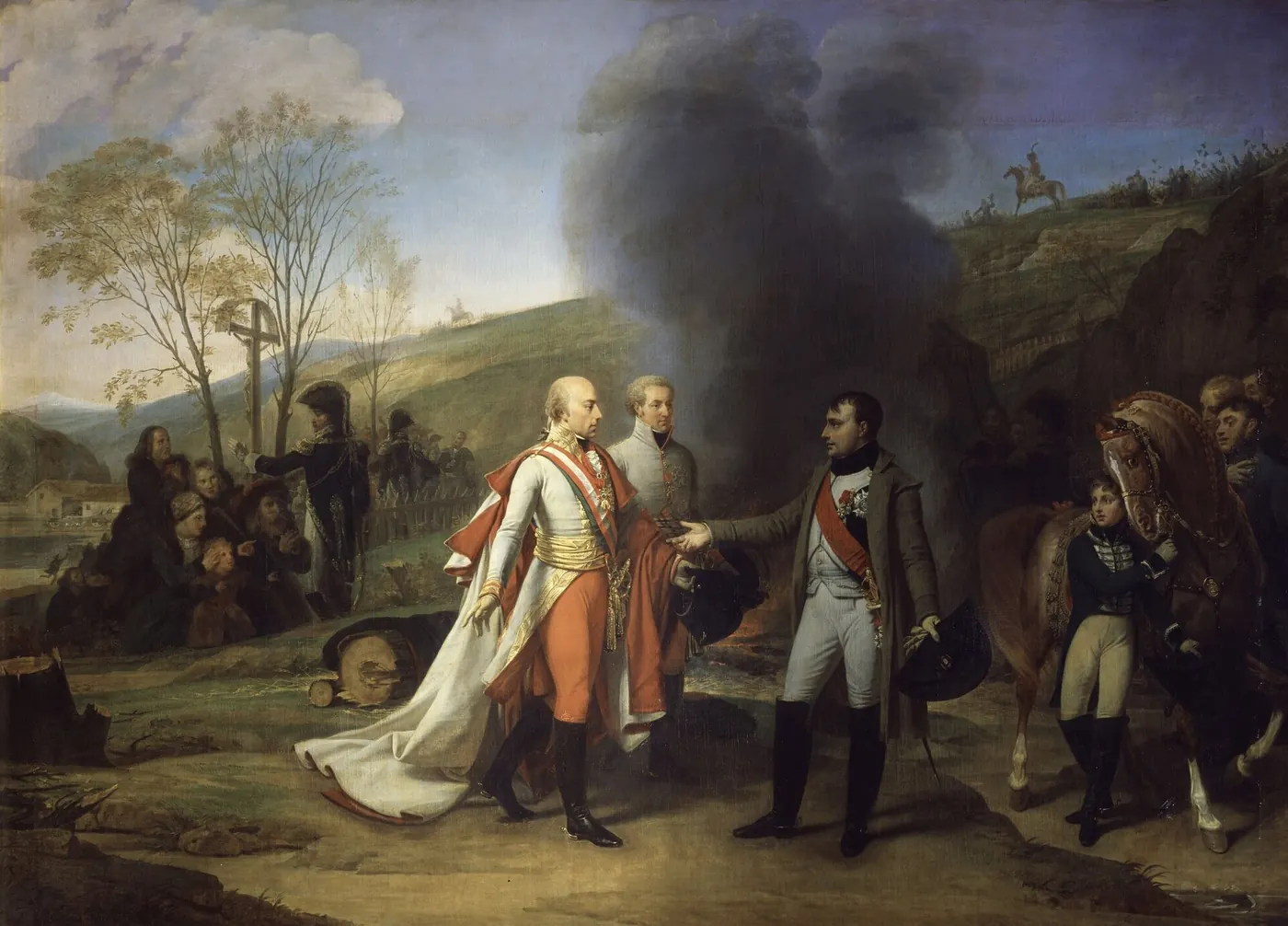
On the morning of 3 December Prince John of Liechtenstein came to French headquarters to request a meeting between the two emperors. On 4 December Napoleon and Francis II met and agreed on an armistice, signed on 6 December at the castle of Austerlitz. The Russian army was allowed to return to its own territory; Alexander I accepted the terms obtained by the Emperor of Austria.
The Treaty of Pressburg, signed on 26 December 1805, took Austria out of the war and out of the coalition. She recognised the French acquisitions of the treaties of Campo Formio and Lunéville, ceded Venetia to the Kingdom of Italy and territories in Germany to Napoleon's allies — Bavaria, Württemberg and Baden — and paid an indemnity of 40 million francs. Bavaria and Württemberg became kingdoms.
The consequences went beyond Austria. In 1806 Napoleon created the Confederation of the Rhine, and Francis II renounced the crown of the Holy Roman Empire, which vanished after a thousand years. Alarmed at French influence in Germany, Prussia went to war the following autumn. In London, William Pitt, hearing the news, is said to have remarked before a map of Europe: "Roll up that map; it will not be wanted these ten years." He died a few weeks later. Alexander I, according to a reported remark, summed up the day: "We are babies in the hands of a giant."
The proclamation and the legend
On 3 December the Emperor addressed a famous proclamation to the army: "Soldiers, I am pleased with you. On the day of Austerlitz you have justified all that I expected of your intrepidity; you have adorned your eagles with immortal glory." It closed with the promise of homecoming: "It will be enough for you to say, 'I was at the battle of Austerlitz', for people to reply, 'There is a brave man.'" To Joséphine he wrote more soberly: "I have beaten the Austro-Russian army commanded by the two emperors. I am a little weary."
The rewards matched the triumph: sums paid to officers and men, pensions for widows, and the adoption by the Emperor of the orphans of fallen soldiers, who were allowed to add Napoléon to their names. In Paris, where the financial situation had been critical only days earlier, government bonds leapt at the news of victory.
Austerlitz entered national memory at once. The Vendôme Column, inaugurated in 1810, is said to have been cast from the bronze of captured guns; the Pont and Gare d'Austerlitz, the Arc de Triomphe du Carrousel and the reliefs of the Arc de Triomphe preserve its memory. Tolstoy made Austerlitz a central moment of War and Peace: Prince Andrei Bolkonsky is badly wounded there on the Pratzen plateau. The officer cadets of Saint-Cyr still celebrate the anniversary of the battle every year. The bicentenary in 2005, by contrast, was low-key in France, amid debate over Napoleon's legacy.
The battlefield today
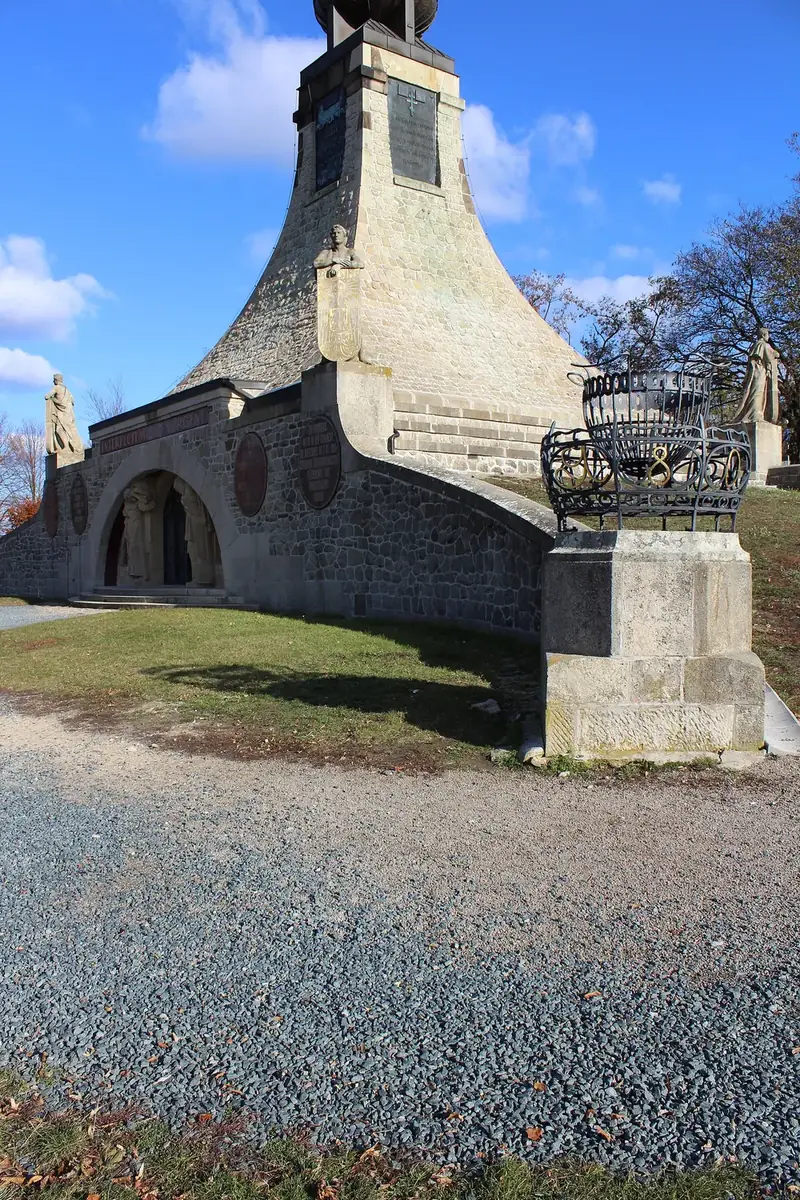
Since 1992 the battlefield has been protected under Czech law as a landscape monument zone covering nineteen present-day municipalities. Its principal monument is the Cairn of Peace near Prace, on the summit of the plateau: designed in Art Nouveau style by the architect Josef Fanta and built from 1910 to 1912, it was not dedicated until 1923, the First World War having delayed its consecration. Twenty-six metres high and decorated with four female statues representing France, Austria, Russia and Moravia, it houses a chapel and an ossuary; a nearby museum is devoted to the battle.
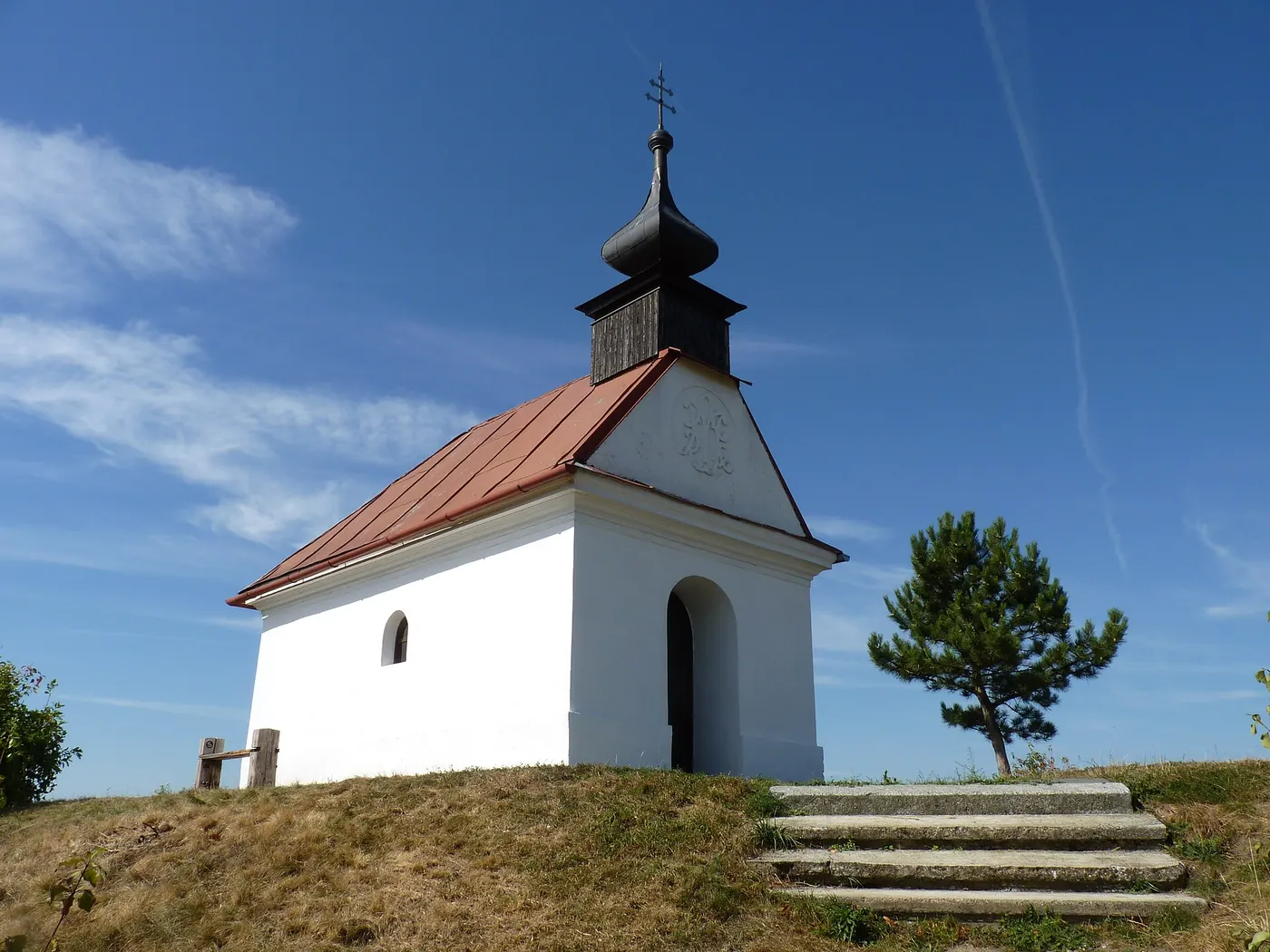
Other sites mark the ground. A white chapel crowns the Santon, at the foot of which re-enactments are held every year. On the Žuráň, from which Napoleon followed the opening of the fighting, a granite monument shows the positions of the armies. On the heights of Staré Vinohrady, where the Guards clashed, a Monument to the Three Emperors was erected in 2005. At Kovalovice the Old Post inn, a building of 1785, served as headquarters for Murat, then for Bagration on the day of the battle, and Napoleon slept there on the night of his victory. At the castle of Austerlitz, where the armistice was signed, a museum presents the battle.
Every year, around 2 December, the villages of the battlefield commemorate the fighting. The Battle of the Three Emperors, which cost thousands of lives in these Moravian fields, has become a European place of memory as much as a French one.
Discover other battles
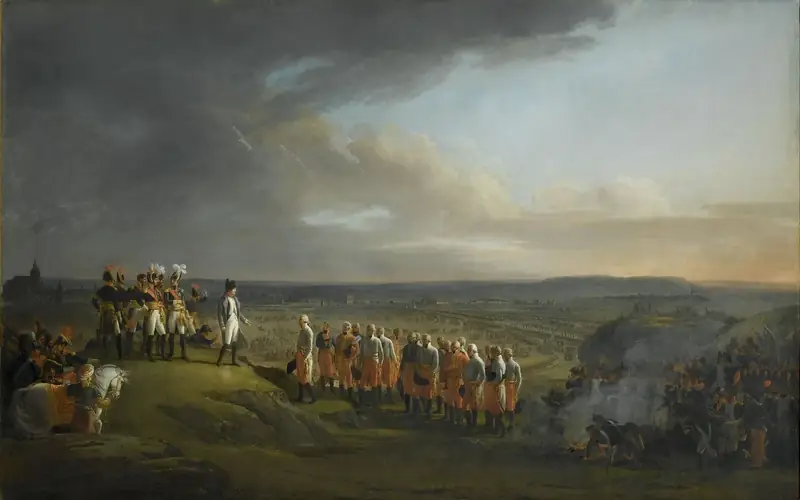 Victory
 Read the account
Ulm
15-20 October 1805
Ulm, on the Danube
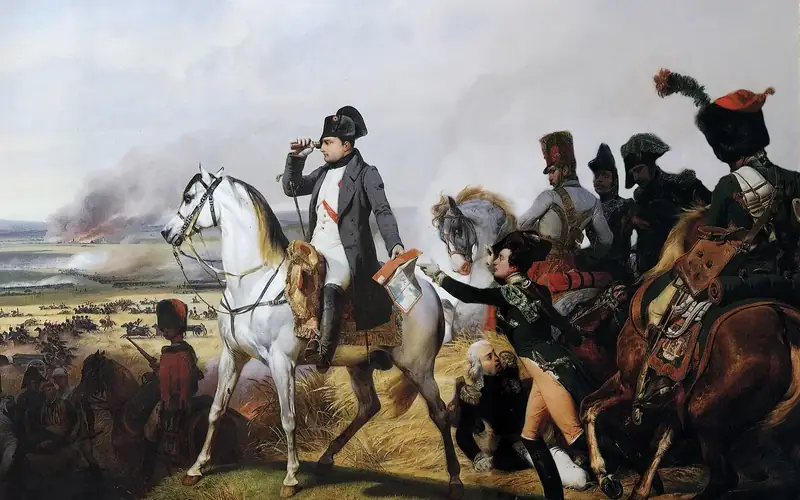 Victory
 Read the account
Wagram
5-6 July 1809
Deutsch-Wagram, north-east of Vienna (Lower Austria)
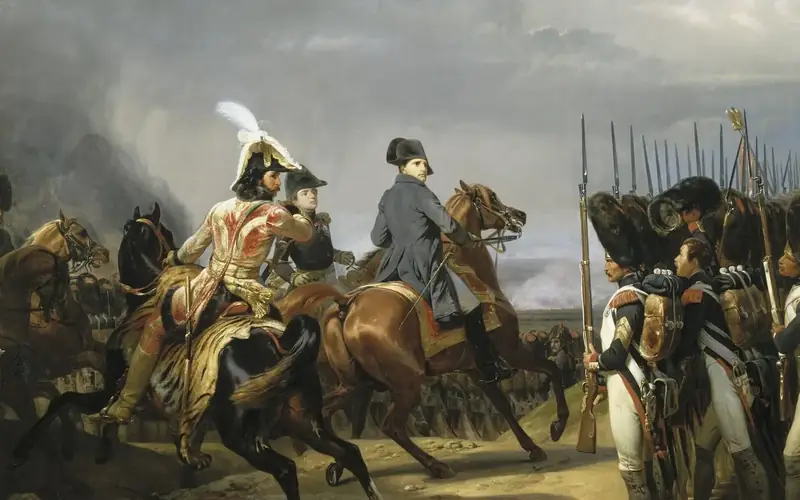 Victory
 Read the account
Jena
14 October 1806
Vierzehnheiligen, near Jena (Thuringia, Germany)
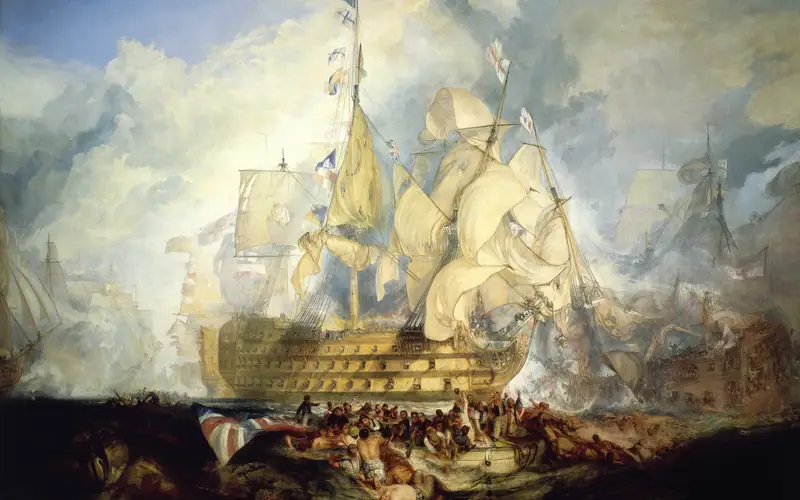 Defeat
 Read the account
Trafalgar
21 October 1805
Off Cape Trafalgar (Andalusia, Spain)
Go further
Recommended books to dig deeper (affiliate links)

Napoleon the Great
Andrew Roberts · 2014
A monumental biography drawing on Napoleon’s 33,000 surviving letters, admiring but rigorous.
See on Amazon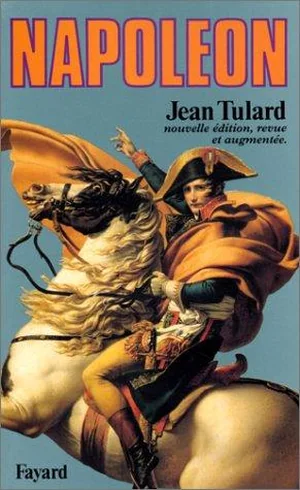
Napoléon ou le mythe du sauveur
Jean Tulard · 1977
The book that reshaped how the man is read: how France gave itself a saviour, and what it cost.
See on Amazon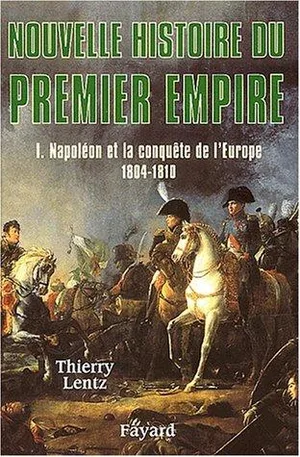
Nouvelle histoire du Premier Empire
Thierry Lentz · 2002-2010
Four reference volumes on institutions, diplomacy and collapse: the scholarly synthesis of the subject.
See on AmazonAs an Amazon Associate, this site earns from qualifying purchases.
Support the encyclopedia
Napoleon Empire is an independent project. Your contribution helps grow the content and keep the site running.
DonateSecure payment on the platform you choose.