In October 1805 the Grande Armée, marching hard from the camp of Boulogne, crossed the Danube behind General Mack's Austrian army and shut it up in Ulm. After a series of actions, including Elchingen, Mack capitulated on 20 October with some 25,000 men: a victory almost without a battle, which opened the road to Vienna and Austerlitz.
Forces at play
Outcome: Decisive French victory

France
- Napoléon
- Ney
- Murat
- Lannes
- Soult
About 80,000 men around Ulm
Casualties: About 500 killed and 1,000 wounded

Austria
- Mack
- Werneck
- Riesch
About 72,000 men at the start of the campaign
Casualties: About 25,000 prisoners at Ulm; some 60,000 men lost over the whole campaign
Battle coordinates
Ulm
Coordonnées 48.3986°, 9.9911°
Battle narrative
The Third Coalition
In 1805 Britain, Austria, Russia and Sweden allied against France: this was the Third Coalition. The Austrians expected the main war to be fought in northern Italy; in Germany they meant only to hold the Alps and wait for the Russians. But when Bavaria sided with France, an Austrian army of some 72,000 men under General Mack prematurely invaded the country, while the first Russian troops were still crossing Poland.
It was long said that this mismatch came from a confusion of calendars, the Russians still following the Julian calendar and the Austrians the Gregorian. The historian Frederick Kagan dismisses this explanation as "a bizarre myth".
From Boulogne to the Danube
The Grande Armée was then assembled at the camp of Boulogne, facing England. At the end of August it set off eastwards; by 24 September its corps were ready to cross the Rhine, from Mannheim to Strasbourg. While Murat's cavalry made repeated demonstrations in the Black Forest to make Mack believe that the attack would come from the west, the bulk of the army carried out a huge wheel to the right, by the north: its corps reached the Danube together, facing south, and crossed it at Neuburg, Donauwörth and Ingolstadt, behind the Austrian army.
Mack trapped
Mack grasped the manoeuvre only on 7 October. He tried to face about, but the fighting went against him. On 8 October, at Wertingen, Auffenberg's division was cut to pieces by Murat's cavalry and Lannes's corps. On the 9th, at Günzburg, a division of Ney's corps beat the Austrians and seized a foothold on the south bank of the Danube. On the 11th, at Haslach-Jungingen, Dupont's division barred the way north to the Austrian army. Meanwhile the corps of Soult, Bernadotte, Davout and Marmont spread out to the east and south in a vast net; at Memmingen, Soult obtained the surrender of 4,600 Austrians.
Elchingen and the Michelsberg
On 14 October, at Elchingen, Ney crushed Riesch's corps and drove its remnants back into Ulm; he would later be made Duke of Elchingen. Murat set off in pursuit of Werneck's corps, which had tried to escape to the north-east: it was overtaken and surrendered on 18 October; only Archduke Ferdinand and about 1,200 horsemen managed to reach Bohemia. On 15 October Ney's troops carried the fortified heights of the Michelsberg, which overlook the city. On the 16th Ulm, where Mack was shut up with the rest of his army, was completely surrounded and bombarded.
The capitulation
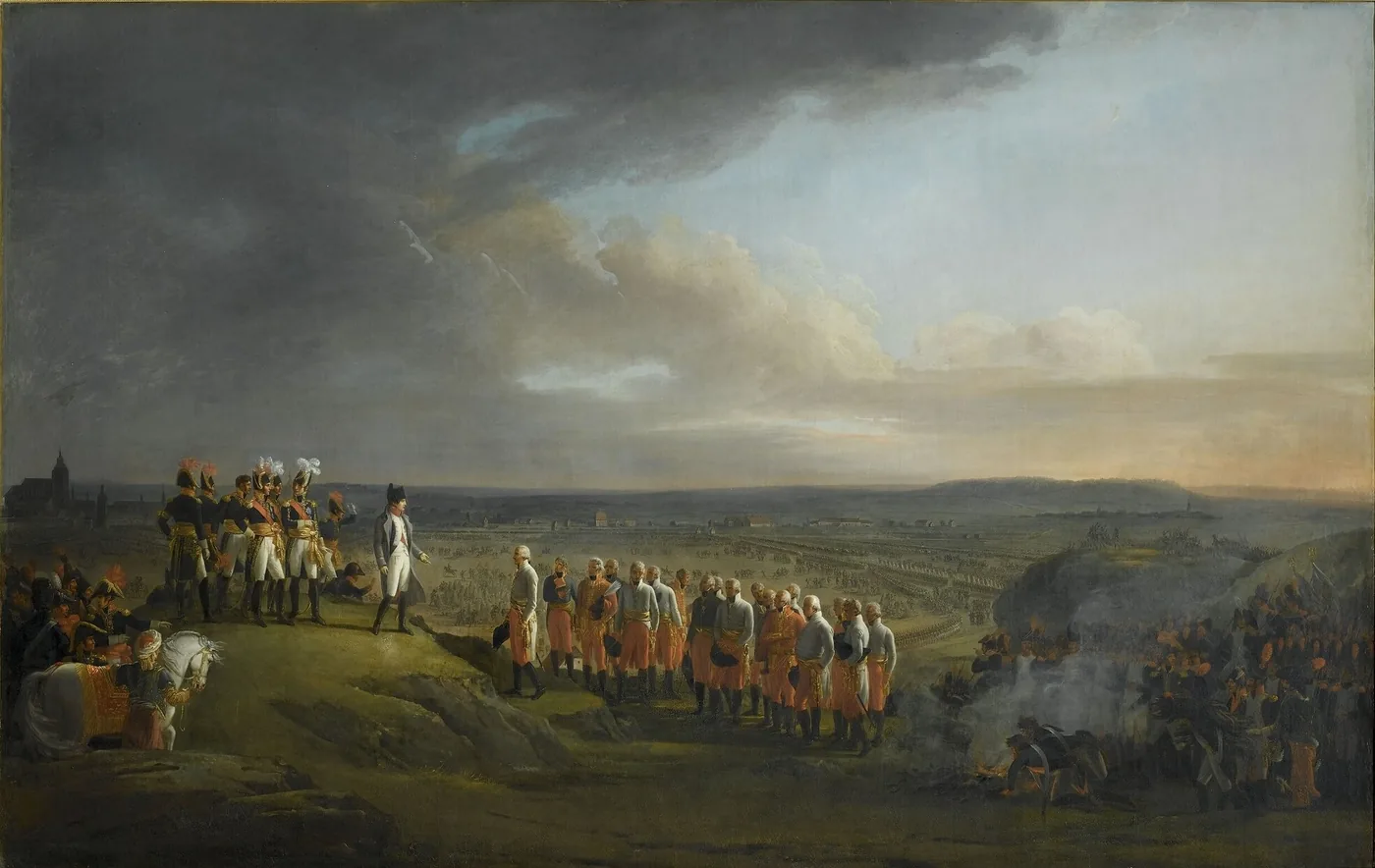
Napoleon preferred not to launch a costly assault: the place would fall of its own accord. On 17 October his envoy, Ségur, signed a convention with Mack: the Austrians would surrender on 25 October if no help had arrived by then. But Mack learned of the capitulations of his other corps and agreed to surrender five days early. On 20 October (the 21st according to some sources) the Austrian army marched out of Ulm and filed for hours past the Emperor and the Grande Armée drawn up in a semicircle; the soldiers laid down their arms. The officers were released on parole, undertaking not to fight France again until exchanged. Mack, it is said, presented himself to Napoleon as "the unfortunate General Mack".
Outcome
About 25,000 men, including 18 generals, surrendered at Ulm, with 60 to 65 guns and some forty colours. The French had lost around 500 killed and 1,000 wounded. Counting the earlier actions and capitulations, the campaign had put some 60,000 Austrians out of action in about a fortnight. In his bulletin of 21 October, Napoleon congratulated his soldiers: "I announced a great battle to you. But thanks to the enemy's bad combinations, I have been able to obtain the same success without running any risk." Mack, court-martialled, was sentenced to two years' imprisonment.
A victory without a battle
Ulm did not end the war. On 21 October, off Cape Trafalgar, the Franco-Spanish fleet was destroyed by Nelson, and Kutuzov's Russian army was approaching. But the road to Vienna lay open: Napoleon entered the city in mid-November, then pursued the Russians and Austrians into Moravia, where he won the victory of Austerlitz on 2 December. Won by manoeuvre rather than by fighting, Ulm has remained, like Austerlitz, a model studied in military schools: a strategic envelopment so complete that the outcome was hardly contested on the battlefield.
Go further
Recommended books to dig deeper (affiliate links)

Napoleon — A magisterial biography
An exhaustive biography of the Emperor, the fruit of rigorous research.
≈ £14.99 Napoleon's Army
Organization, tactics and daily life of the Grande Armée soldiers.
≈ £18.00 Austerlitz 1805
The detailed account of the Battle of the Three Emperors.
≈ £12.99As an Amazon Associate, this site earns from qualifying purchases.
Support the encyclopedia
Napoleon Empire is an independent project. Your contribution helps grow the content and keep the site running.
Donate