On 14 October 1806, while Napoleon was beating Hohenlohe at Jena, Marshal Davout's single corps ran into the main Prussian army, more than twice its size, near Auerstedt. The divisions of Gudin, Friant and Morand held all morning around Hassenhausen, then counter-attacked and routed the enemy; the Duke of Brunswick was mortally wounded there.
Forces at play
Outcome: Decisive French victory

France
- Davout
- Gudin
- Friant
- Morand
About 26,000 men and 44 guns
Casualties: 4,350 to more than 7,000 killed and wounded according to the sources
Prussia
- Frédéric-Guillaume III
- Brunswick
- Schmettau
- Blücher
64,000 to 66,000 men according to the sources
Casualties: About 13,000 killed, wounded and captured, and more than 100 guns
Flags: David Liuzzo, Wikimedia Commons
Battle coordinates
Auerstedt
Coordonnées 51.0994°, 11.5875°
Battle narrative
Two battles on the same day
On 14 October 1806 Prussia fought and lost two battles a few leagues apart. At Jena, Napoleon crushed the Prince of Hohenlohe's army, which he believed to be the bulk of the Prussian forces. Further north, near the village of Auerstedt, Marshal Davout's single corps in fact ran into the main army, with King Frederick William III, the Duke of Brunswick, its commander, and Field Marshals Möllendorf and Kalckreuth. The Battle of Jena is told on its own page; this one follows Davout's day.
Davout's march
Believing that the Prussians were falling back from Weimar towards Leipzig, Napoleon wanted to take them from behind: Davout, posted at Naumburg, was to fall on their rear, and Bernadotte to march by way of Dornburg. On the evening of 13 October Davout held Naumburg and the bridge of Kösen over the Saale. He had only about 26,000 men, in three infantry divisions under Gudin, Friant and Morand, with a little cavalry and 44 guns. Advancing towards him, though he did not yet know it, was an army of 64,000 to 66,000 men according to the sources, with a large cavalry.
Hassenhausen in the fog
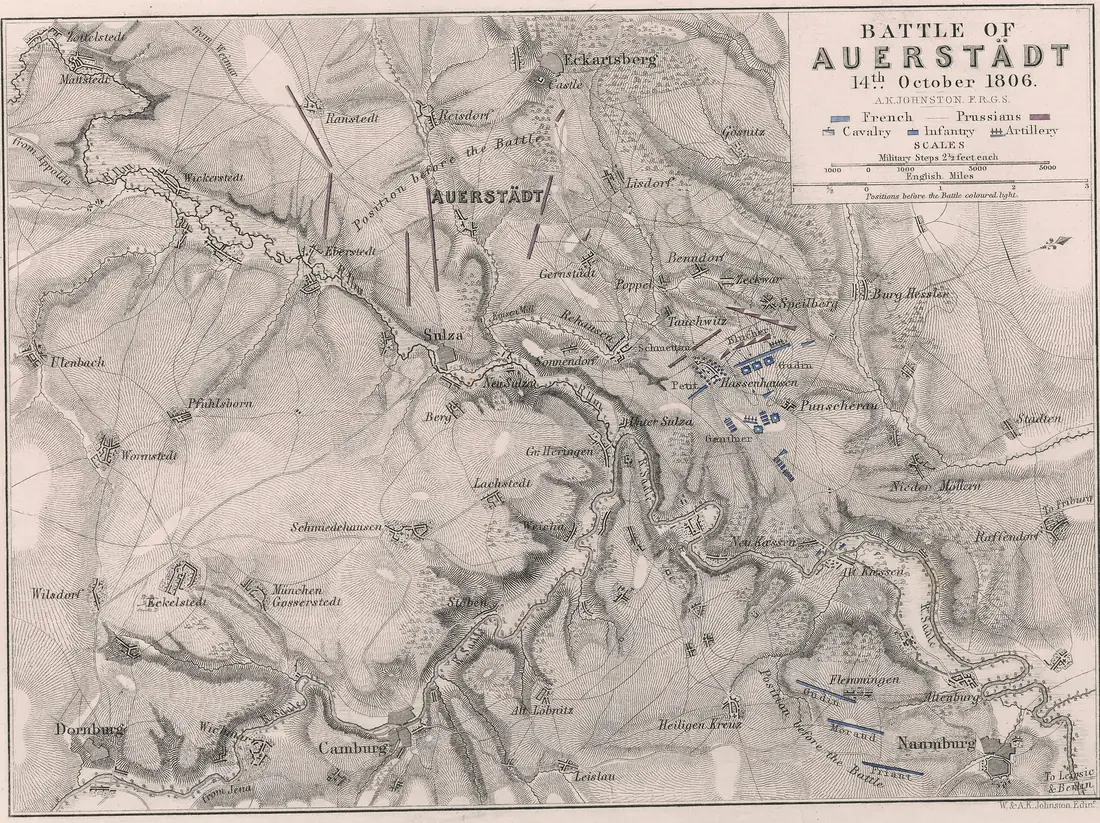
On the 14th, shortly before 6.30 a.m., Gudin's division left Naumburg. In thick fog its scouts ran into Prussian cavalry and artillery at about 7 a.m. near Poppel. Davout realised that he faced substantial forces: he had Gudin deploy around the village of Hassenhausen, which the 25th of the Line occupied after a brief fight. Opposite, Schmettau's division, which was supposed to block the Kösen defile, deployed to attack, and Blücher's cavalry came up on its left. Together they drove Gudin's outposts back to the village.
At about 8.30 a.m. Wartensleben's division arrived in turn with the Duke of Brunswick. Gudin, alone for hours against far superior forces, formed his battalions into squares. At about 9.30 a.m. Friant's division and the 12-pounder artillery reached the field and deployed on his right. The charges of Blücher's cavalry broke against the French squares; according to the accounts, the only words heard in the ranks under the canister were "Close ranks!". Friant drove off a Prussian battery and occupied the village of Spielberg, while Colonel Higonet took Poppel.
The collapse of the Prussian command
Shortly before 10 a.m. Brunswick ordered a general assault on Hassenhausen. He was then mortally wounded; he would die on 10 November. General Schmettau was also badly hit. Deprived of its two commanders, the Prussian army lost its direction: the King tried to lead the attacks himself, but decisions were slow in coming. At about 10.30 a.m. fresh Prussian reinforcements arrived, among them the Prince of Orange's division, which the King split between the two wings.
On the French side, Morand's division came into line at about 11 a.m. and reinforced Gudin's left, which was on the point of giving way. The cavalry charges led by Prince Henry, the King's brother, broke against its battalions.
Davout's counter-attack
At about 11 a.m., seeing the enemy waver, Davout launched his divisions forward. Morand on the left, Friant on the right and Gudin in the centre drove the Prussians back; by about noon Schmettau's centre had been broken and thrown back across the Lissbach stream. The King ordered a retreat. Marshal Kalckreuth's two reserve divisions tried to cover it on the heights of Eckartsberga but, outflanked by Friant's division, abandoned their last position and left several guns behind. The pursuit went on until nightfall; the fugitives from Auerstedt mingled with those from Jena.
Outcome
Davout's corps lost 4,350 to more than 7,000 men killed and wounded according to the sources, between a sixth and more than a quarter of its strength; Brigadier General Debilly and Colonel Higonet were killed. The Prussians lost about 13,000 men killed, wounded or captured and more than a hundred guns. "None of the days of the wars of the Revolution offered so disproportionate a struggle with so brilliant a success," the strategist Jomini would judge.
"Your marshal is seeing double"
That evening Napoleon is said at first to have refused to believe that a single corps had beaten the main Prussian army, telling the officer who brought the news that his marshal, known for his poor eyesight, "was seeing double". He then paid tribute to Davout, whose corps had the honour of entering Berlin first, on 25 October; in 1808 the marshal was made Duke of Auerstedt. Bernadotte's inaction, by contrast — he heard the guns of both battles but intervened at neither Jena nor Auerstedt — remains one of the great controversies of the campaign.
Go further
Recommended books to dig deeper (affiliate links)

Napoleon — A magisterial biography
An exhaustive biography of the Emperor, the fruit of rigorous research.
≈ £14.99 Napoleon's Army
Organization, tactics and daily life of the Grande Armée soldiers.
≈ £18.00 Austerlitz 1805
The detailed account of the Battle of the Three Emperors.
≈ £12.99As an Amazon Associate, this site earns from qualifying purchases.
Support the encyclopedia
Napoleon Empire is an independent project. Your contribution helps grow the content and keep the site running.
Donate