The Battle of Leipzig, fought from 16 to 19 October 1813 and known in Germany as the "Battle of the Nations", pitted Napoleon against the allied armies of Russia, Prussia, Austria and Sweden. More than half a million men took part: it was the largest battle of the Napoleonic Wars. After an indecisive first day and a general assault on 18 October, Napoleon ordered a retreat; the premature blowing of the Elster bridge on the 19th cut off his rearguard, in which Marshal Poniatowski died. The defeat brought down the Confederation of the Rhine and opened the road to France for the allies.
Forces at play
Outcome: Decisive French defeat
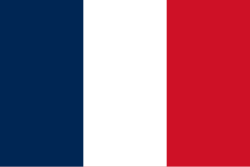

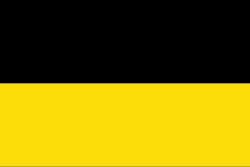
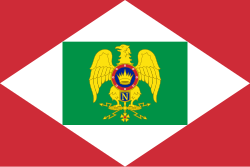
France · Poland · Saxony · Italy · Confederation of the Rhine
- Napoléon
- Murat
- Ney
- Marmont
- Macdonald
- Poniatowski
190,000 to 210,000 men and about 700 guns depending on the source
Casualties: 38,000 to 45,000 killed and wounded, at least 15,000 prisoners, more than 20,000 wounded left behind and some 300 guns
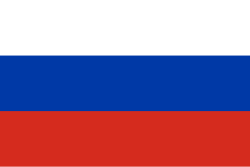

Russia · Prussia · Austria · Sweden
- Schwarzenberg
- Blücher
- Bernadotte
- Bennigsen
- Barclay de Tolly
About 200,000 men on 16 October, over 300,000 and 1,200 to 1,500 guns by the 18th
Casualties: About 54,000 men, including some 20,000 Russians, 16,000 Prussians and 14,000 Austrians
Flags: TRAJAN 117, CC BY-SA 3.0; Sodacan, CC BY-SA 3.0; David Liuzzo, Wikimedia Commons
Battle coordinates
Leipzig
Coordinates 51.3138° N · 12.4071° E
Interactive tactical map
Follow the battle hour by hour — hover over or tap a unit for its details.
Barclay attacks in the south
Barclay de Tolly’s columns set off before dawn and, around 9 a.m., the artillery opens fire from the Pleiße to Liebertwolkwitz. Kleist attacks Markkleeberg, held by Poniatowski and Augereau; Eugen of Württemberg’s Russians and Prussians take Wachau, where Napoleon is in command, but cannot hold it; Gorchakov and Klenau fail before Liebertwolkwitz. Between the rivers, Merveldt’s corps is stuck in front of Connewitz.
Napoleon has set up his command post on the Galgenberg: it will be the southernmost point he reaches during the battle.
Positions reconstructed from accounts of the battle and placed on the actual locations of the villages, most of which are now districts of Leipzig. Timings, on which sources do not always agree, are indicative, and strengths vary widely between authors. Each phase re-centres the map on the sector where the action is taking place.
Battle narrative
From Russia to Germany
At the start of 1813 the Grande Armée had not recovered from the disaster in Russia, where it had lost some 400,000 men and 200,000 horses. General Yorck, commanding the Prussian contingent, signed the Convention of Tauroggen with the Russians as early as 30 December 1812; Prussia allied itself with Russia through the Treaty of Kalisch and declared war on France in March 1813. Before the Russian advance, the French abandoned the Duchy of Warsaw, evacuated Berlin and fell back to the Elbe.
Within a few months Napoleon raised a new army, but it was made up largely of young, inexperienced conscripts, and the cavalry, decimated in Russia, remained its weak point. He beat the Russians and Prussians at Lützen on 2 May and at Bautzen on 20 and 21 May, but lacked the horsemen to exploit these victories. In June he accepted the Armistice of Pläswitz and Austrian mediation. The negotiations failed: on 12 August Austria in turn declared war on France.
The Trachenberg Plan
During the armistice, the sovereigns of Russia and Prussia met the Crown Prince of Sweden, Charles John, at Trachenberg Castle in Silesia; he was none other than the former Marshal Bernadotte. Completed with the Austrians, the resulting plan provided for three armies: Prince Schwarzenberg's Army of Bohemia, the strongest, Blücher's Army of Silesia and Bernadotte's Army of the North, soon joined by Bennigsen's Army of Poland. The principle was simple: avoid battle when Napoleon was in command in person, fall back before him and strike at his isolated marshals.
The method worked. Napoleon won another great victory at Dresden on 26 and 27 August, but Vandamme's corps, sent in pursuit of the defeated allies, was crushed at Kulm on 29 and 30 August. Oudinot was beaten at Großbeeren on 23 August while marching on Berlin, Macdonald on the Katzbach on 26 August by Blücher, and Ney at Dennewitz on 6 September. France's German allies began to waver: Saxon units went over to the enemy, the Westphalians deserted, and on 8 October, through the Treaty of Ried secretly concluded with Austria, Bavaria broke off its alliance with Napoleon.
Concentrating around Leipzig
In early October the allies tightened the noose. Blücher crossed the Elbe at Wartenburg on 3 October and marched south, Bernadotte followed him, while Schwarzenberg emerged from Bohemia. Threatened with being cut off from France, Napoleon left the Dresden area and concentrated his army around Leipzig, a major Saxon city, where he hoped to fight the decisive battle his opponents had been denying him for two months. On 14 October, south of the city, Murat's horsemen and those of Schwarzenberg's advance guard clashed around Liebertwolkwitz, in what is often described as one of the largest cavalry battles in history, with nearly 14,000 horsemen. The outcome was indecisive, but the French cavalry lost more of its precious strength.
The ground shaped the battle. Three rivers, the White Elster and the Pleiße to the west and south and the Parthe to the north, divided the country around Leipzig into separate sectors. By holding the city and its bridges, Napoleon could shift troops from one sector to another faster than his opponents. But behind him only one road led west: the Lindenau causeway, which crossed the marshy meadows of the Elster on an embankment.
The opposing forces
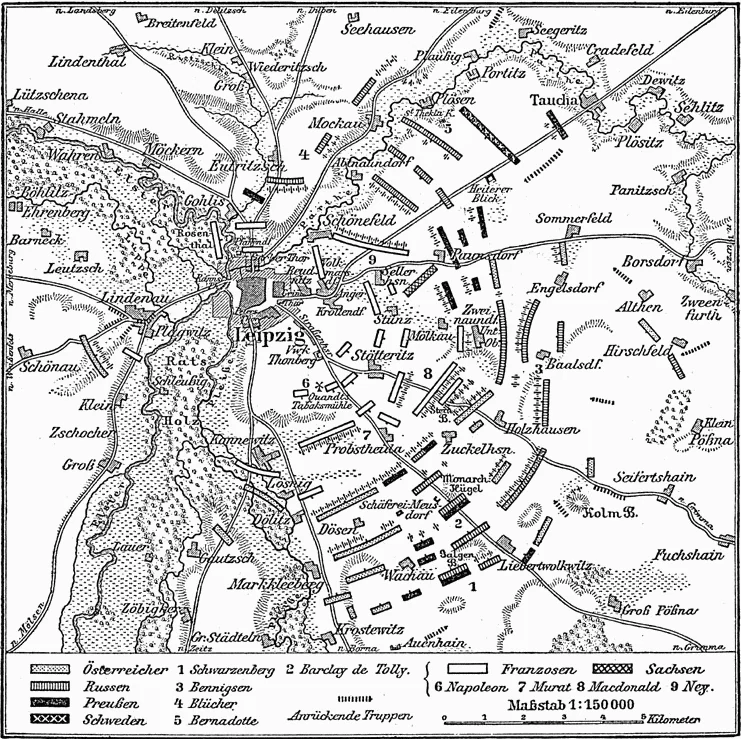
Estimates vary widely from one author to another. Napoleon gathered some 190,000 to 210,000 men around Leipzig, mostly French but also Prince Poniatowski's Poles, Italians and Germans from the Confederation of the Rhine, above all Saxons and Württembergers, with around 700 guns. His corps were commanded by Marshals Ney, Marmont, Macdonald, Augereau, Victor and Poniatowski and by Generals Bertrand, Lauriston, Reynier and Souham; Murat led the cavalry, and the Imperial Guard formed the reserve.
The allies, for their part, were not all present on the first day. On 16 October they fielded about 200,000 men, above all Schwarzenberg's Army of Bohemia; with the arrival of Bernadotte's and Bennigsen's armies they rose to over 300,000 men with 1,200 to 1,500 guns. Russians, Austrians, Prussians and Swedes fought side by side under the eyes of three sovereigns: Tsar Alexander I, Emperor Francis I of Austria, Napoleon's father-in-law, and King Frederick William III of Prussia. More than half a million men were to fight for four days: it was the largest battle of the Napoleonic Wars.
The two sides' plans
Napoleon concentrated his effort in the south. By one estimate he had 138,000 men and 488 guns there, against some 130,000 soldiers of the Army of Bohemia, and he meant to crush that army before the other allied armies closed the ring. In the north, Marmont and Ney were to hold off the Army of Silesia, which the Emperor still believed to be far away; in the west, Bertrand covered Lindenau.
Schwarzenberg's original plan was to attack through the low, marshy ground between the Elster and the Pleiße, turn the French right and march straight on Leipzig. The Tsar judged the terrain impassable and had the plan changed. Only the 35,000 or so Austrians of Merveldt and the Prince of Hesse-Homburg would attack between the rivers; the corps of Kleist, Wittgenstein and Klenau, under Barclay de Tolly, would attack the French positions head-on east of the Pleiße. Gyulay was to threaten Lindenau, and Blücher to advance from the north-west. The Army of Bohemia thus found itself spread over three battlefields separated by rivers and marshes.
16 October: Wachau and Liebertwolkwitz
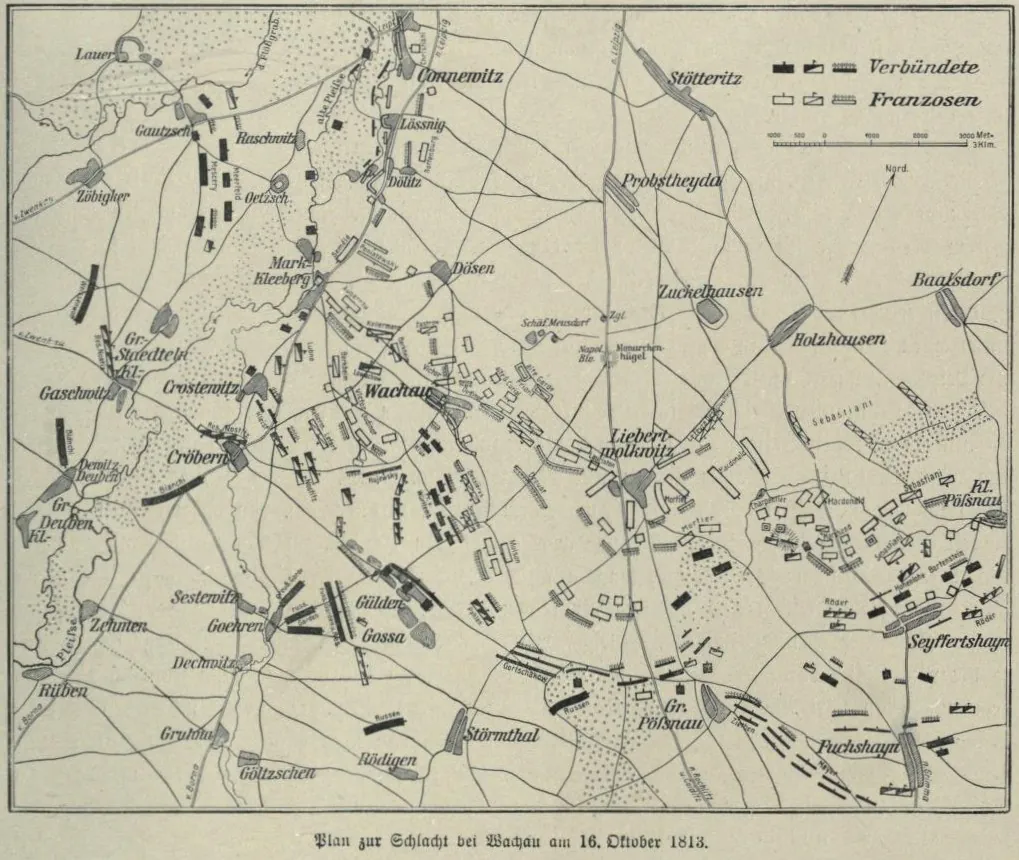
On 16 October the ground was sodden from the previous days' rain. Barclay's columns set off before dawn and, around 9 a.m., the artillery opened fire on the villages held by the French, from the Pleiße to Liebertwolkwitz. Napoleon had set up his command post on the Galgenberg, a low rise between Wachau and Liebertwolkwitz.
On the allied left, Kleist's Prussians attacked Markkleeberg, defended by Poniatowski and Augereau; the village changed hands several times during the day. In the centre, Prince Eugen of Württemberg's Russians and Prussians took Wachau, where Napoleon was in command in person, but had to give it up under the fire of the superior French artillery. On the right, Gorchakov and Klenau's Austrians failed to take Liebertwolkwitz, defended by Macdonald and Lauriston, and lost the Kolmberg. By around noon the allied line was so battered that Schwarzenberg had to send Barclay the Prince of Hesse-Homburg's Austrian reserves.
Yet Napoleon held back his counterattack. He was counting on Marmont's corps, which he had called down from the north; but Marmont was pinned at Möckern by the Army of Silesia, which had arrived earlier than expected. Around 2 p.m. the Emperor ordered a general attack with the troops he had. Drouot massed a grand battery, put by the sources at one hundred to one hundred and fifty guns, which devastated the Russian lines. Macdonald tried to outflank the allied right but was driven back, as the first Russian reinforcements had arrived.
Murat's great charge
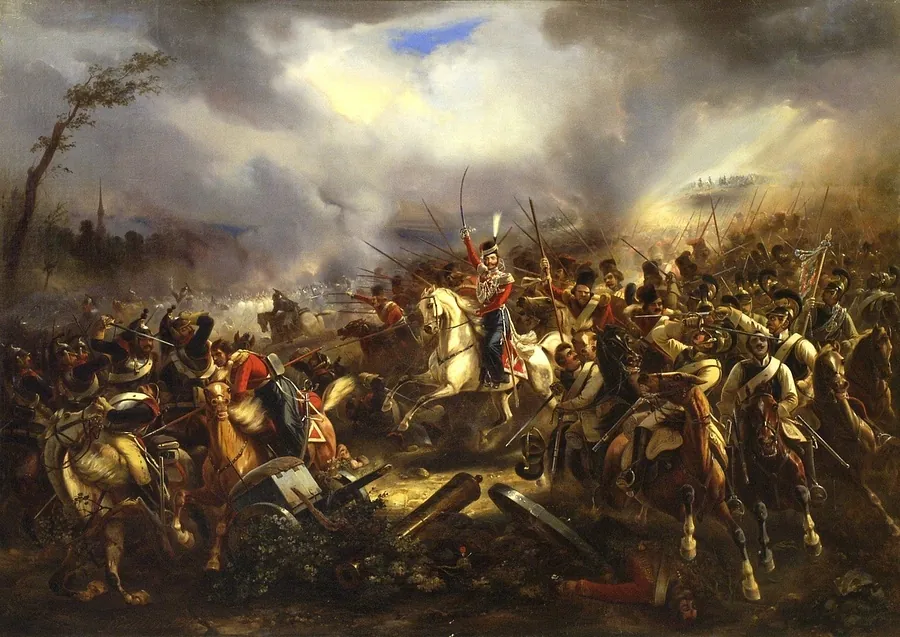
Around 3 p.m. Murat sent a mass of 8,000 to 10,000 French, Italian and Saxon horsemen into the gap opened by the artillery. The charge broke through the allied centre near Wachau and pressed on almost to the rise where the allied sovereigns and Schwarzenberg stood. But Murat had kept no reserve, and his squadrons, launched in massive columns, were taken in the flank by small formations of Russian, Prussian and Austrian cavalry, among them the Tsar's Life Guard Cossack regiment. The Russian infantry, formed in squares, held firm. The French horsemen fell back to their own artillery. An attack by Lauriston's infantry on Güldengossa failed in turn.
By evening the French had gained ground in the south, but no decisive breakthrough had been made. Napoleon had no fresh troops left to commit, and nightfall ended the fighting. That day, for his conduct at the head of VIII Corps, Prince Poniatowski received a Marshal of the Empire's baton: he was the only foreigner ever given that rank.
Connewitz and Dölitz, between the rivers
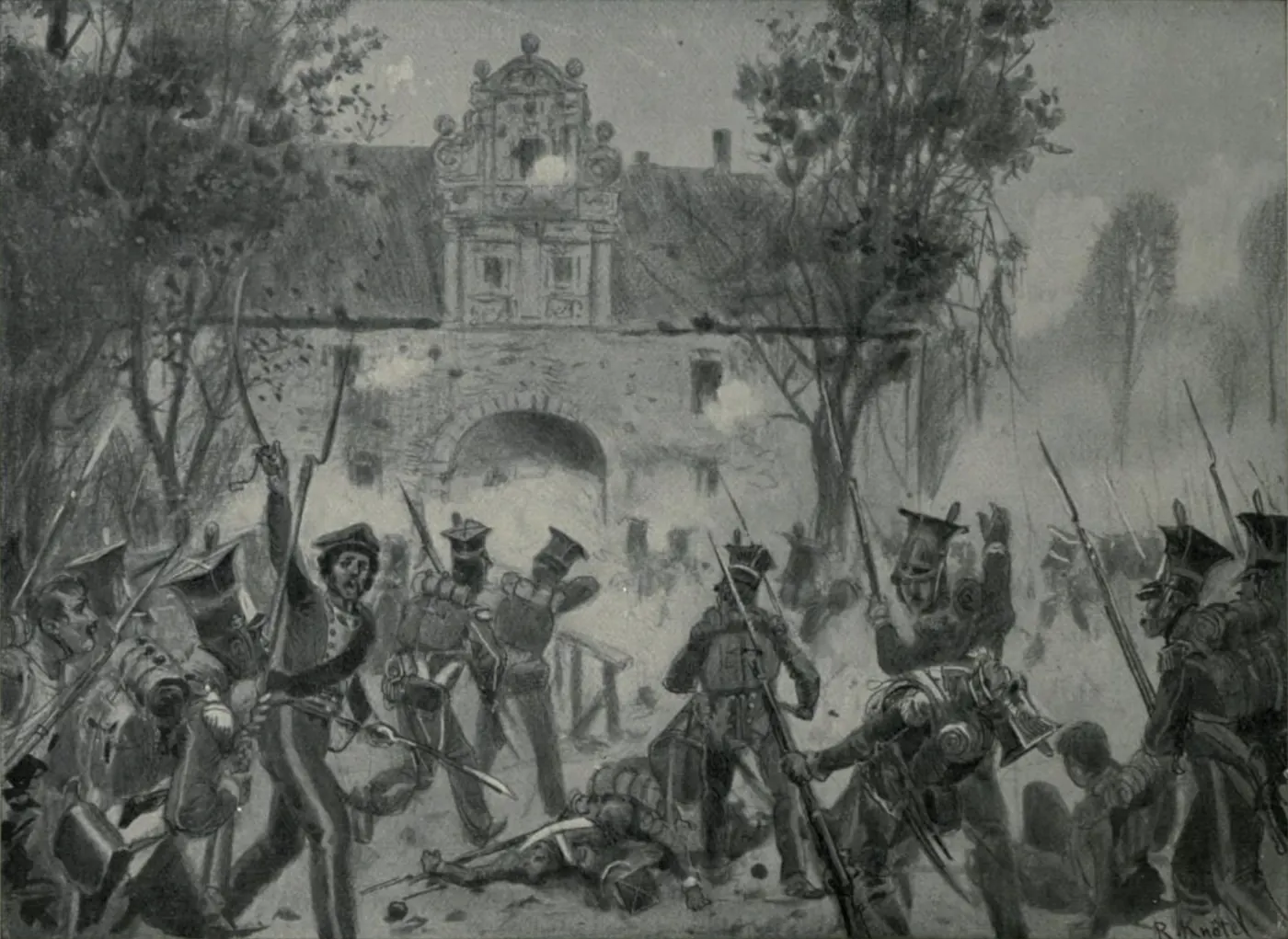
Between the Elster and the Pleiße, the Austrian attack came to little. Setting off from Gaschwitz at 8 a.m., Merveldt's corps could not deploy its artillery on the marshy ground. At Connewitz the first bridge had been destroyed and the second barricaded, and French skirmishers in the houses on the far bank pinned the attackers down. By midday most of the 28,000 Austrians were standing idle west of the Pleiße while their comrades to the east were fighting hard. Merveldt himself had the misfortune to ride into the Saxon and Polish lines, where he was wounded and taken prisoner.
Further south, at Dölitz, the Austrians took the manor facing the village, but the Poles counterattacked and the struggle dragged on across the mill race. Around 3 p.m. the Austrians finally managed to bring up guns, which set fire to the mill held by the Poles. Towards evening the situation became critical for the French in this sector, until the arrival of Souham's III Corps, called down from the north, stabilised the front. At nightfall Dölitz was still in French hands.
Möckern, in the north
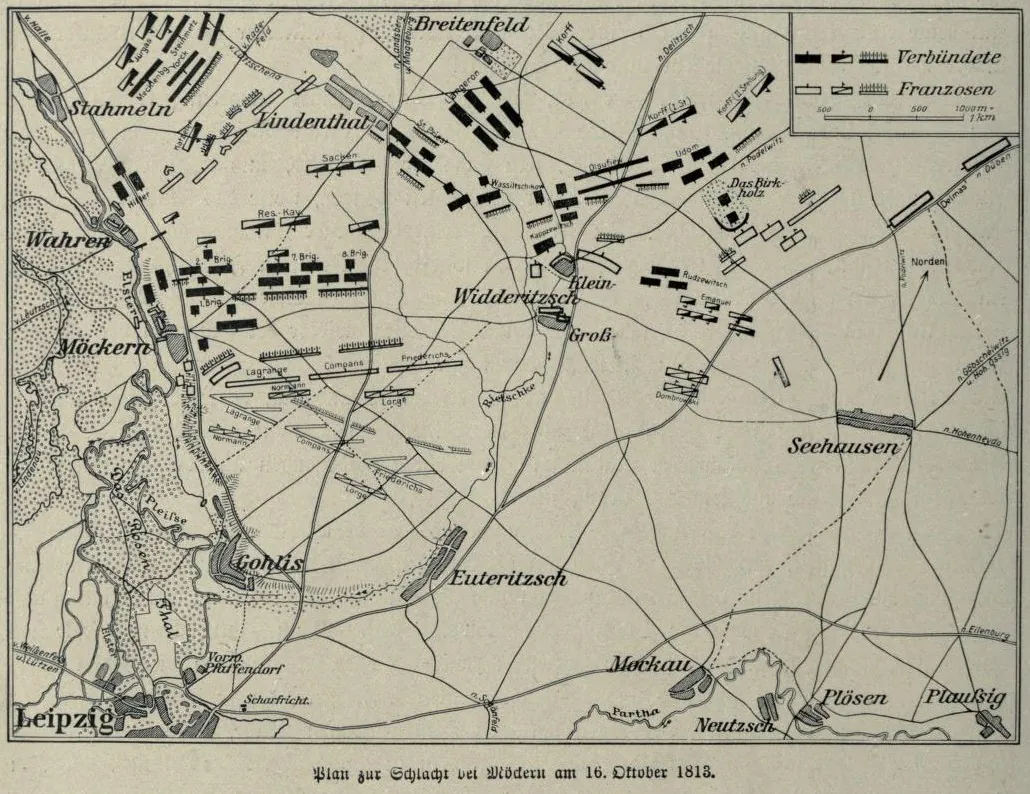
In the north, the day went the allies' way. Without waiting for the Army of the North, Blücher marched on Leipzig. Marmont, who had just been ordered to move to Wachau and had already left a better position further north, decided to await the attack at Möckern with some 17,000 men. The village, with its manor, gardens and loopholed walls, was a veritable fortress, and the French artillery held good positions on the heights to the east.
Yorck's Prussian corps, about 20,000 men, could only attack frontally, since the Elster covered the village's flank. Assault after assault, the Prussians finally carried Möckern late in the day; the fighting went on into the night. The losses were dreadful: some 7,000 men for Yorck's corps alone according to some authors; 9,000 allied and 7,000 French killed and wounded, plus 2,000 prisoners, according to others. Further east, at Wiederitzsch, Dąbrowski's small Polish division long held out against Langeron's Russians, who finally took the village at heavy cost. Ney, who had sent part of his troops to help Marmont before turning them back south, arrived too late to make a difference at Wachau. In the west, Bertrand repulsed Gyulay's attack on Lindenau.
The first day ended without a decision. The French had won minor successes at Wachau and Lindenau and suffered a reverse at Möckern; the allies had lost some 20,000 to 30,000 men, the French around 25,000. But time was working against Napoleon: he was expecting only Reynier's 14,000 men, while Bernadotte and Bennigsen were approaching with some 145,000.
17 October, a Sunday lull
On 17 October, a Sunday, the fighting stopped almost everywhere. Only in the north did Sacken's Russians drive Dąbrowski's Poles out of Gohlis, while Blücher, made a field marshal the day before, pushed up to the gates of Leipzig. The allies were joined by Bennigsen's and Bernadotte's armies and decided to attack the next morning. By one estimate, that evening they had 306,000 men and about 1,200 guns, against 160,000 men and 630 guns for Napoleon.
The Emperor tried a political opening. He released on parole General Merveldt, captured the day before, with proposals for the allied sovereigns: he would hand back the fortresses he held on the Oder and the Vistula if allowed to withdraw behind the Saale, and open peace negotiations. The allies did not take it up. Napoleon then tightened his lines, evacuating Wachau and Liebertwolkwitz, and had the road through Lindenau and Weißenfels secured in case a retreat became necessary.
18 October: the assault from all sides
On 18 October the French army formed a semicircle around Leipzig: Poniatowski held the Pleiße from Connewitz to Dölitz, the centre formed a salient at Probstheida, and the left stretched to the Parthe and curved back north of the city. Napoleon set up his command post near Quandt's tobacco mill, on a rise between Stötteritz and Probstheida. The three allied sovereigns and Schwarzenberg followed the battle from another rise to the south-east, later known as the Monarchenhügel, the "Monarchs' Hill".
The allies attacked in six columns, with their main effort east of Leipzig. The distances were such that their movements could hardly be coordinated. In the south, the Prince of Hesse-Homburg's column briefly took Dösen, Dölitz and Lößnig, where Bianchi's Hungarians distinguished themselves, but the Young and Old Guard drove it back. To support this sector Schwarzenberg called up Gyulay's corps, thereby stripping the west of Leipzig. Bertrand, for his part, finally drove Gyulay's Austrians away from Lindenau: the line of retreat was open.
Probstheida, the heart of the battle
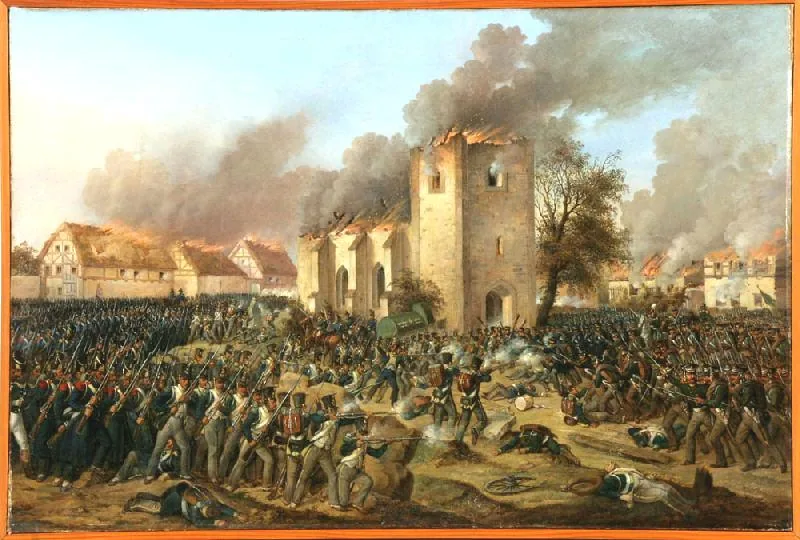
The bloodiest fighting took place at Probstheida, a village south-east of Leipzig and the key to the French position. Barclay threw some 60,000 men at it in two columns under Kleist and Wittgenstein, at the insistence of the sovereigns and despite Kleist's reservations. The French had entrenched themselves behind the high garden walls, backed by numerous guns and strong infantry reserves.
Prussian jägers tried to rush the village, and then the assaults followed one another. The Imperial Guard artillery gradually gained the upper hand, Murat's cuirassiers charged the weakened Prussian lines, and only the countercharges of the Russian cavalry saved the infantry. A third assault, led by General Raevsky's Russians, got into the gardens, but the Imperial Guard arrived in time to throw it back. Probstheida, defended under Napoleon's personal direction, did not fall. Further east, Bennigsen's column, which only attacked in the afternoon, took Zuckelhausen and Holzhausen but failed before Stötteritz.
Schönefeld, Paunsdorf and the defections
To the north-east, Bernadotte's Army of the North, some 95,000 strong according to certain sources, crossed the Parthe at Taucha, reinforced by Langeron's Russian corps, lent by Blücher. At Schönefeld, Marmont's VI Corps defended the village fiercely until it ran out of ammunition; III Corps came up to relieve it. The village was taken and retaken several times and burned to the ground before finally remaining in the hands of Langeron's Russians.
At Paunsdorf, a British company of Congreve rockets attached to the Army of the North fired into the village and threw the defenders into disorder; its commander, Captain Richard Bogue, was killed by a bullet to the head. It was in this sector that the most discussed event of the day took place. That morning at Mockau a brigade of Saxon cavalry had already gone over to the Russians; in the afternoon, near Paunsdorf, a large part of the Saxon infantry of Reynier's corps changed sides in turn, as did some Württemberg horsemen. The figures given range from 3,000 to more than 5,000 Saxons. The military significance of this defection is debated: some historians consider it slight, while other accounts see it as a cause of the French line's withdrawal at Paunsdorf. In any case it struck contemporaries, and in France people long spoke of the Saxons' "betrayal".
By the evening of 18 October the allies had gained little ground, but the French were exhausted. Their artillery reportedly had only 20,000 rounds left. Napoleon judged the battle lost.
The decision to retreat
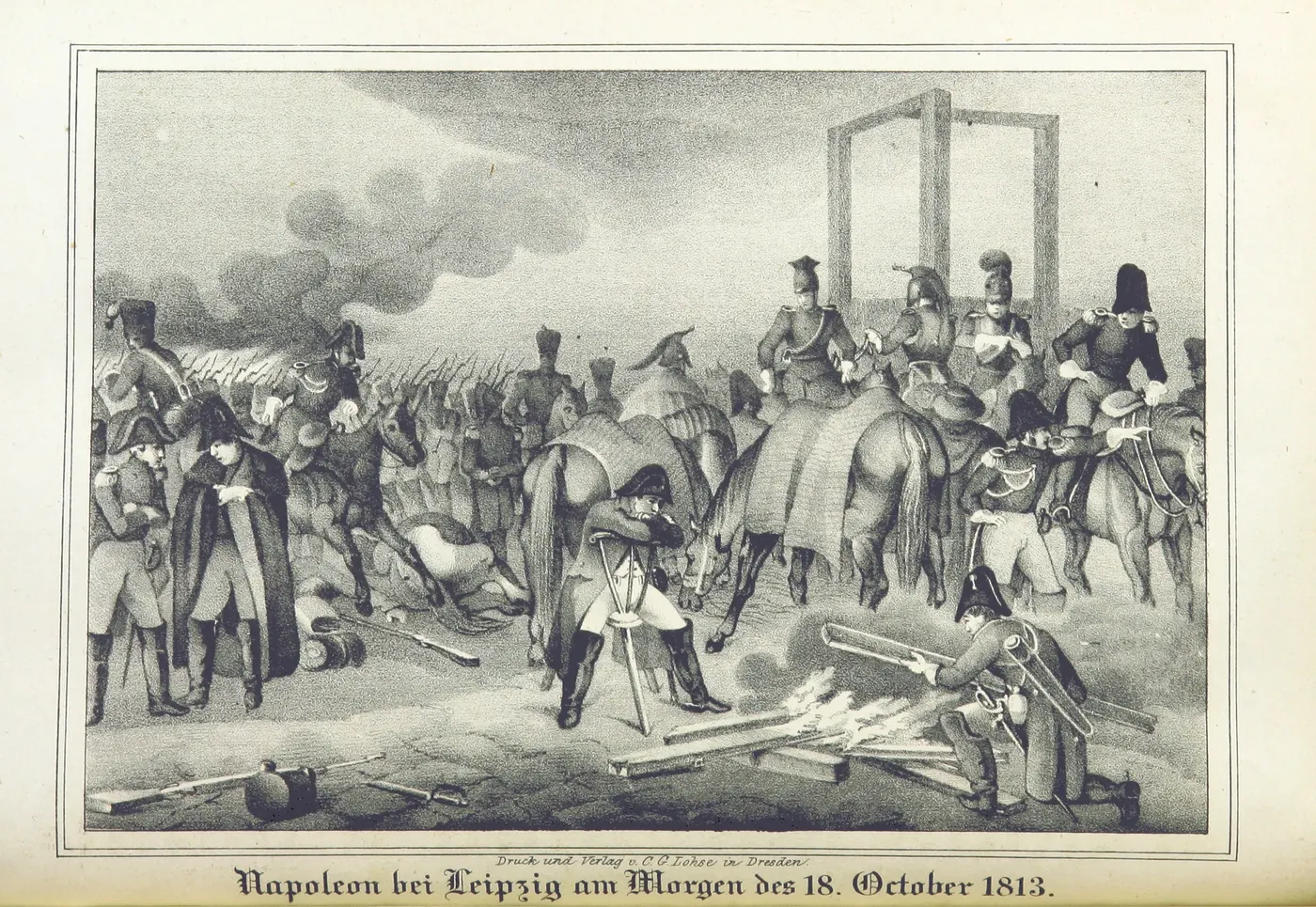
According to local tradition, Napoleon gave the order to retreat in the afternoon at the tobacco mill, then fell asleep on a camp stool before returning to Leipzig after dark. During the night the bulk of the army silently evacuated Connewitz, Probstheida, Stötteritz and Reudnitz, passed through the city and crossed the Elster by the single stone bridge leading onto the Lindenau causeway, towards Weißenfels. Weak rearguards held the villages to conceal the movement; the garden and cemetery walls near the Grimma Gate were pierced with loopholes.
A rearguard of about 30,000 men, including the corps of Macdonald, Poniatowski and Lauriston, was to hold Leipzig long enough to let the rest of the army, its artillery and its baggage get across. The allied outposts failed to notice the retreat during the night.
19 October: fighting in Leipzig
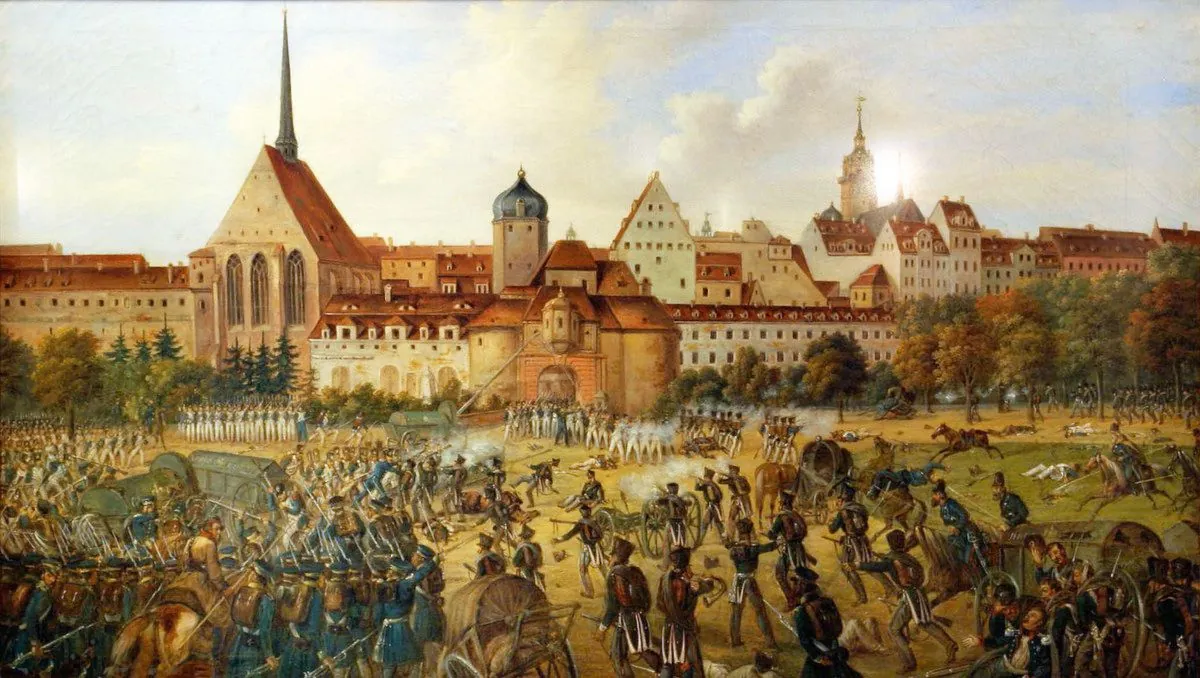
The allies only discovered the evacuation on the morning of 19 October. During the morning they launched a concentric assault on Leipzig. The Russians took the Halle suburb, Bülow's Prussians the Grimma suburb, and Bennigsen the Peter Gate to the south. The French defended themselves house by house, behind barricades, while the inhabitants took cover. Swedish jägers also took part in the final assault.
The Elster bridge
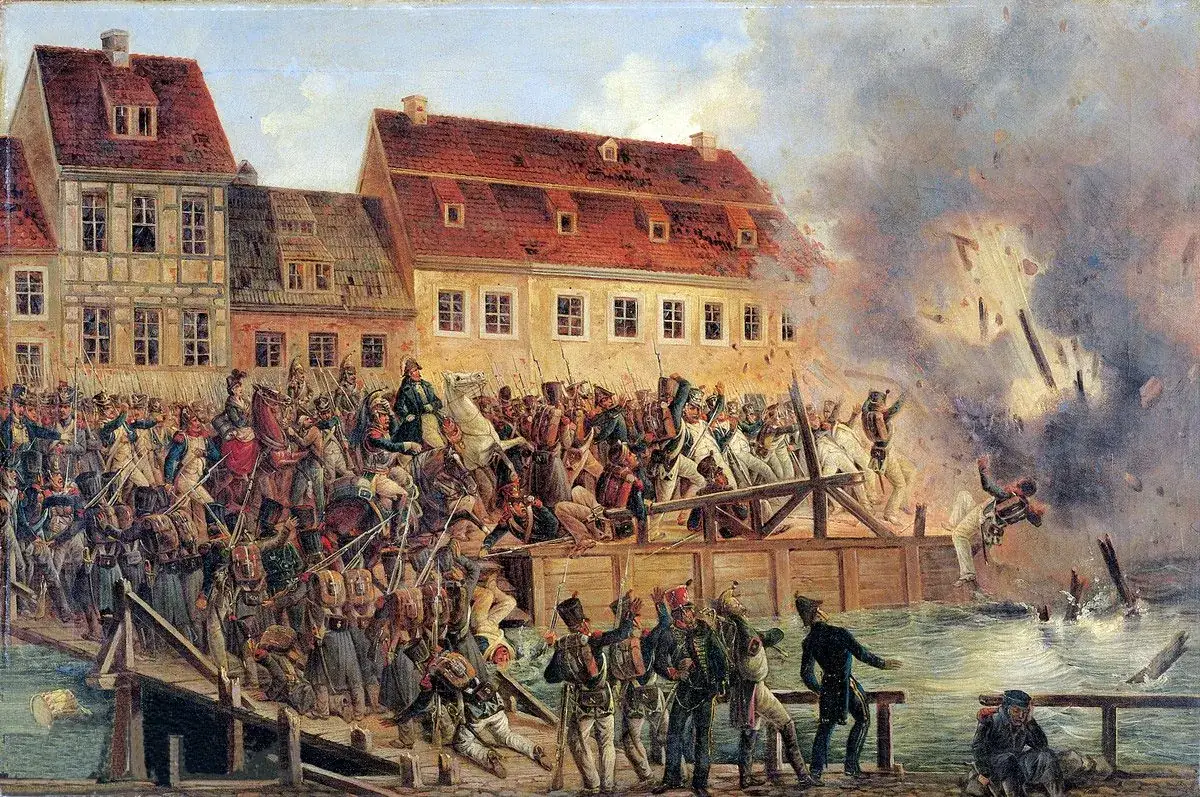
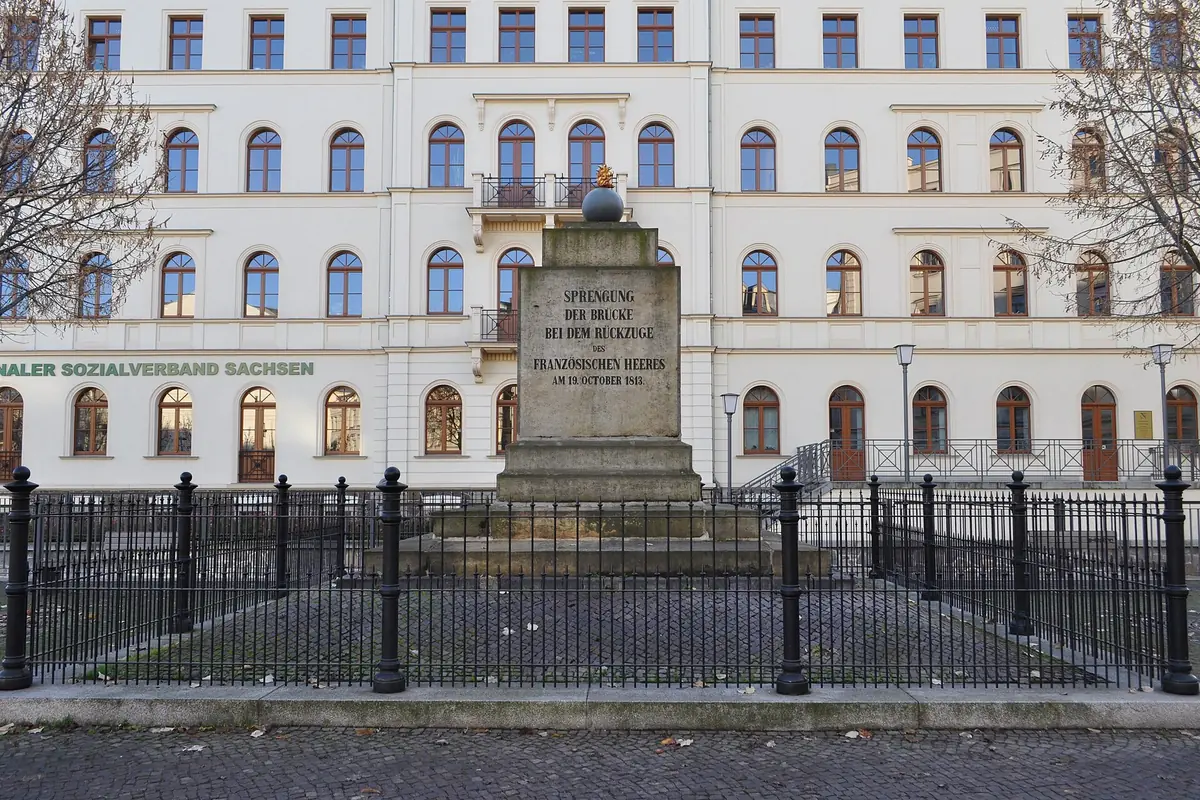
The retreat went on until early afternoon. Napoleon had ordered the Elster bridge near the Ranstädt Gate to be blown once the army was across, to slow the pursuit. According to the monument that commemorates the event, he himself had crossed it half an hour earlier. Around 1 p.m., while the bridge was still crowded with retreating troops and the rearguard was still fighting in the city, the charge went off. According to the most widespread account, General Dulauloy, in charge of the operation, delegated it to Colonel Montfort, who left it to a corporal unaware of the planned timing; the corporal lit the fuse too early. The circumstances are still debated, and the orders given seem to have been contradictory.
Thousands of men were trapped on the east bank. Many tried to swim across the Elster, swollen by the rains, and drowned; the rest were captured. Marshal Macdonald managed to swim across. Generals Lauriston and Reynier were taken prisoner. By early afternoon Leipzig was entirely in allied hands.
The death of Poniatowski
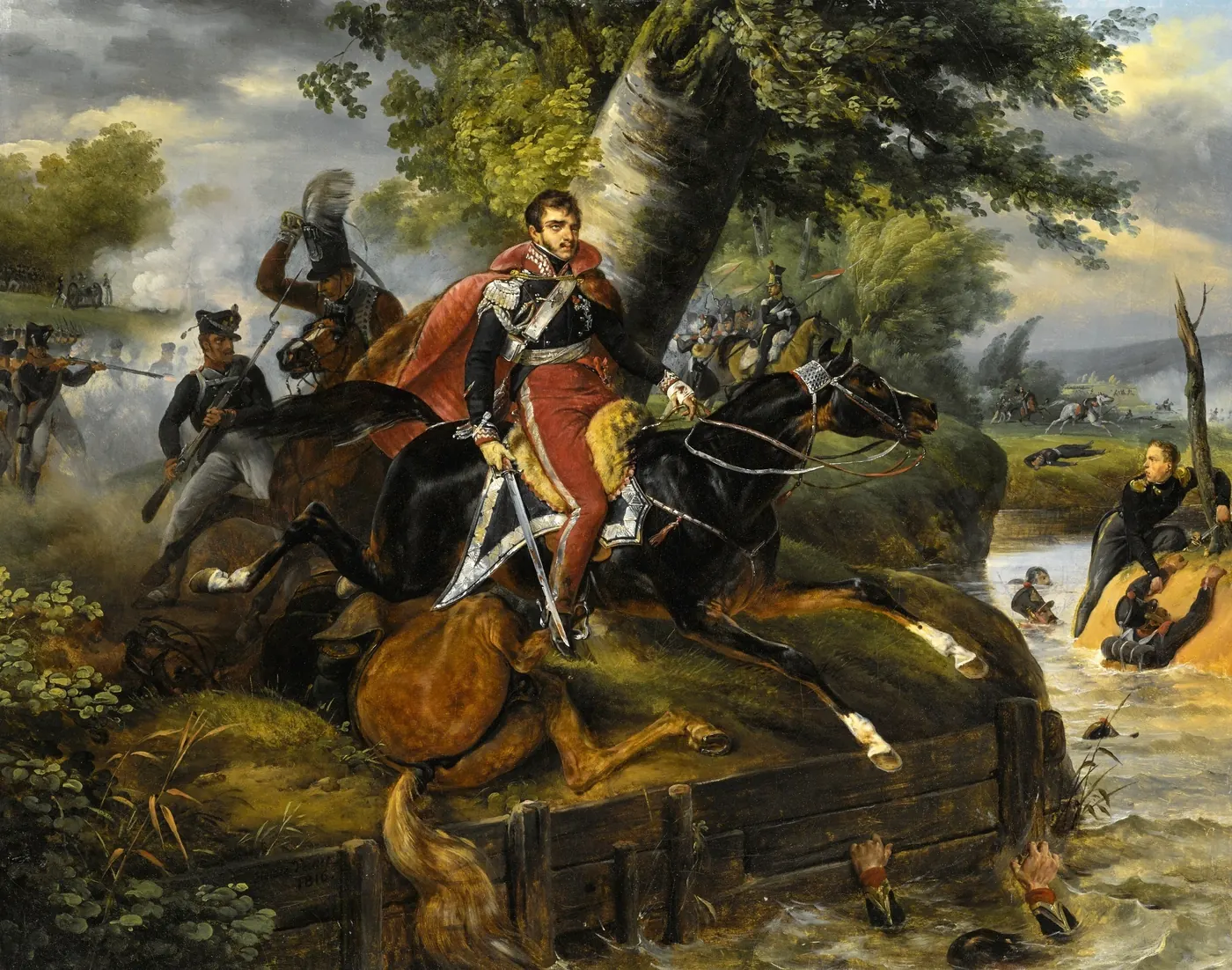
Among those who did not get across was Marshal Poniatowski, nephew of the last king of Poland, whose corps was covering the retreat. Already wounded, he tried to cross the Elster on horseback to avoid capture and drowned. His body was only found on 24 October; later taken back to Poland, it now lies in Wawel Cathedral in Kraków. On learning of his death, Napoleon wrote to his sister that "the loss we have suffered is very great". On Saint Helena he is said to have called him "the true king of Poland".
The toll
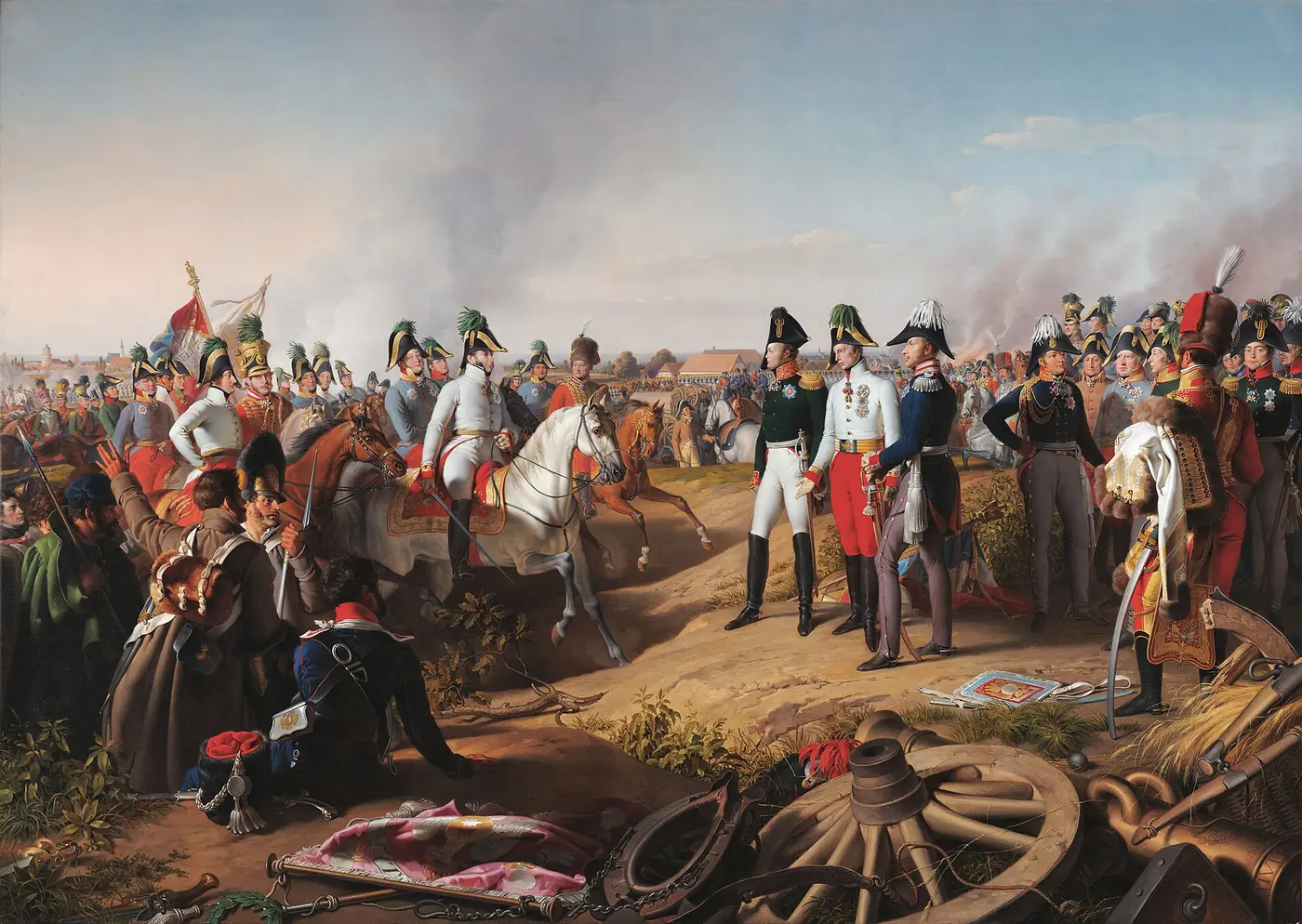
The number of casualties remains uncertain, and the figures vary from source to source. It is most often estimated that around 90,000 men were killed or wounded in four days, and total losses, prisoners included, exceeded 100,000. For the French, estimates range around 38,000 to 45,000 killed and wounded, plus at least 15,000 unwounded prisoners, more than 20,000 wounded and sick left in the Leipzig hospitals, and some 300 guns. The allies are thought to have lost about 54,000 men, including some twenty thousand Russians, 16,000 Prussians and 14,000 Austrians killed or wounded. Several French generals were killed, Poniatowski among them, and several dozen were taken prisoner.
The city was overwhelmed with wounded and sick, many of whom died for lack of care and hygiene, and a typhus epidemic then carried off many soldiers and inhabitants. The corpses were so numerous that the inhabitants struggled to bury them; some were still visible the following year.
From Hanau to the Rhine
The exhausted allies did not vigorously pursue the French army, and Schwarzenberg refused a cavalry pursuit, for which several historians would criticise him. Napoleon made his way back to the Rhine with the remnants of his army. On 30 and 31 October, at Hanau, he ran into General Wrede's Bavarians and Austrians, some 40,000 strong, who tried to bar his way, and forced his way through. But he left behind, shut up in the fortresses of Germany and Poland, more than 100,000 men and two highly capable marshals, Davout at Hamburg and Gouvion-Saint-Cyr at Dresden.
Napoleonic Germany collapsed. Württemberg joined the allies on 2 November, Baden on 20 November, then Nassau and Hesse; the Confederation of the Rhine disappeared. The King of Saxony, who had stayed loyal to Napoleon, was taken prisoner and his kingdom placed under allied administration. On his return to Paris, the Emperor is said to have summed up the situation: "A year ago all Europe marched with us; today all Europe marches against us." In early 1814 the allies invaded France. Paris fell on 31 March, and Napoleon abdicated on 6 April.
Remembering the "Battle of the Nations"
The French of the time spoke of the battle of "Leipsick". In Germany the name Völkerschlacht, the "Battle of the Peoples" or "of the Nations", appeared as early as 22 October 1813 in an article by the writer Achim von Arnim, and it became established around the centenary. For decades 18 October was celebrated in the German states as the anniversary of a national rebirth.
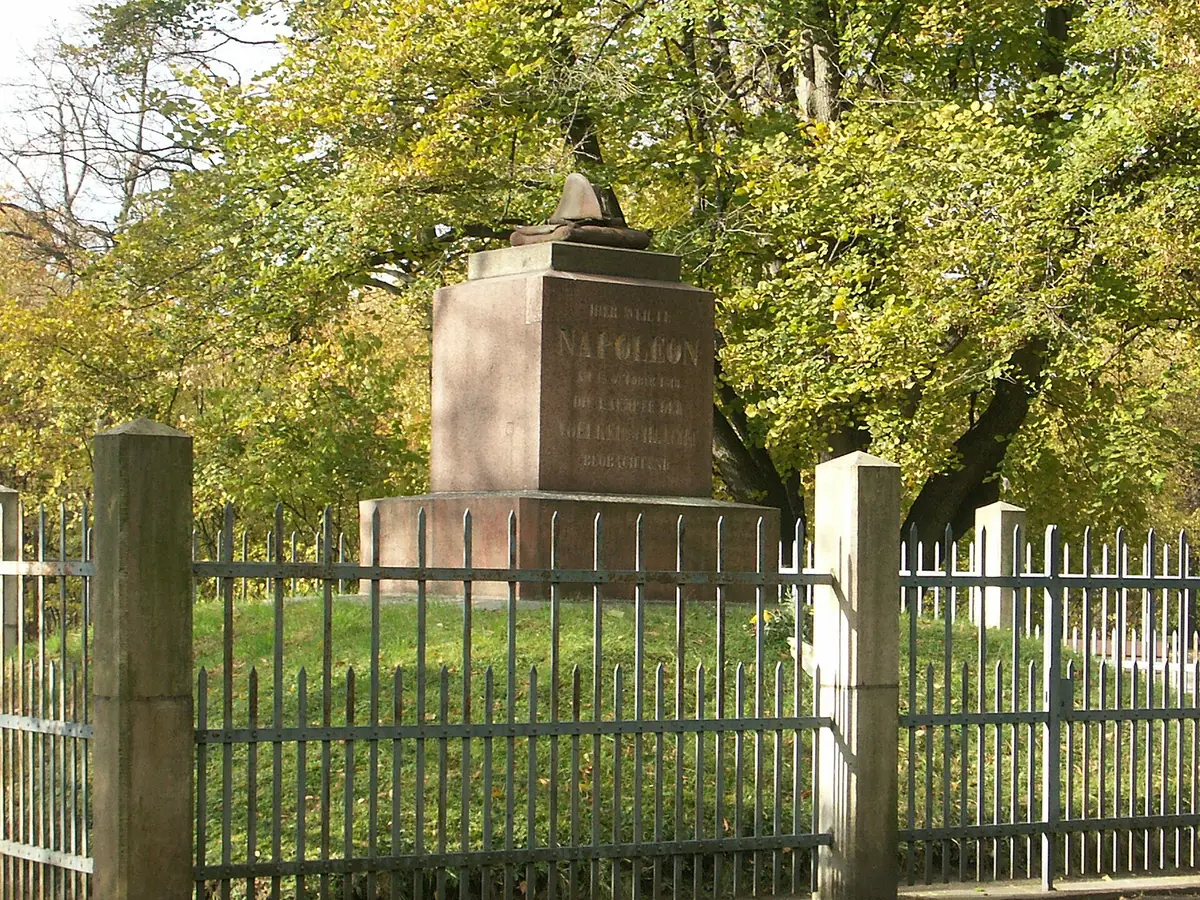
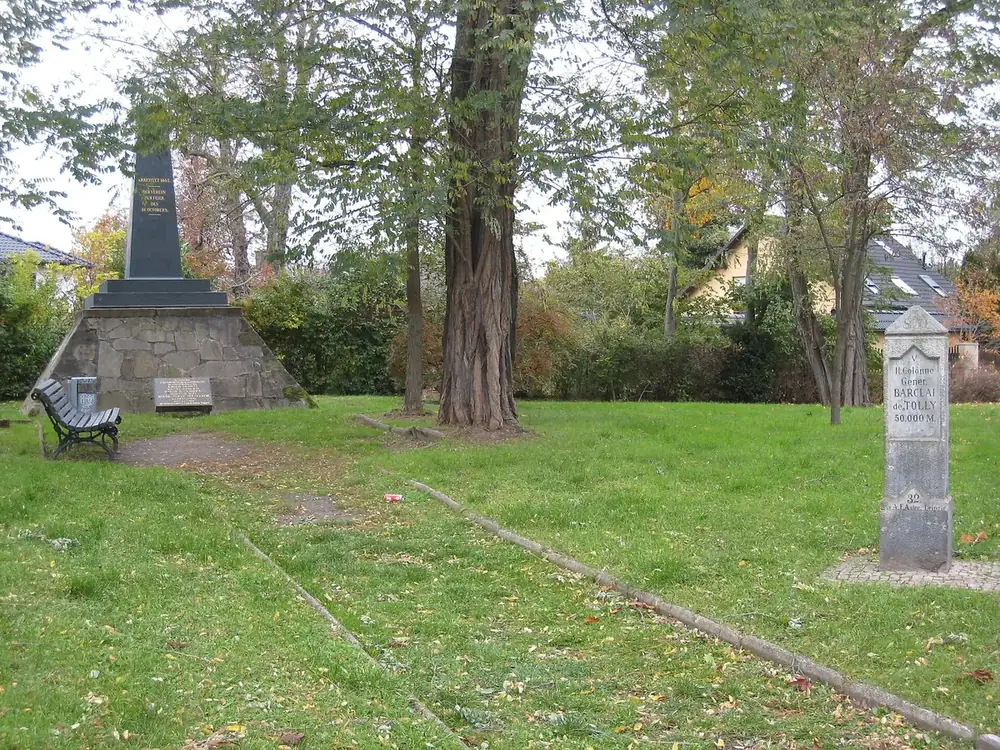
The battlefield, now largely swallowed up by the city, is dotted with monuments. The first major memorial, a cast-iron obelisk, was raised in 1847 on the Monarchenhügel. On the Galgenberg, a stone of 1852 marks Napoleon's command post on 16 October; it bears a reference to the Book of Job: "Hitherto shalt thou come, but no further." The Napoleonstein was inaugurated in 1857 on the site of Quandt's tobacco mill, and the monument to the blowing of the bridge in 1863. Between 1861 and 1864 the writer Theodor Apel had 44 sandstone markers set up at his own expense to show the positions of the armies; there are now 50, marked "N" for Napoleon's troops and "V" for the allies.
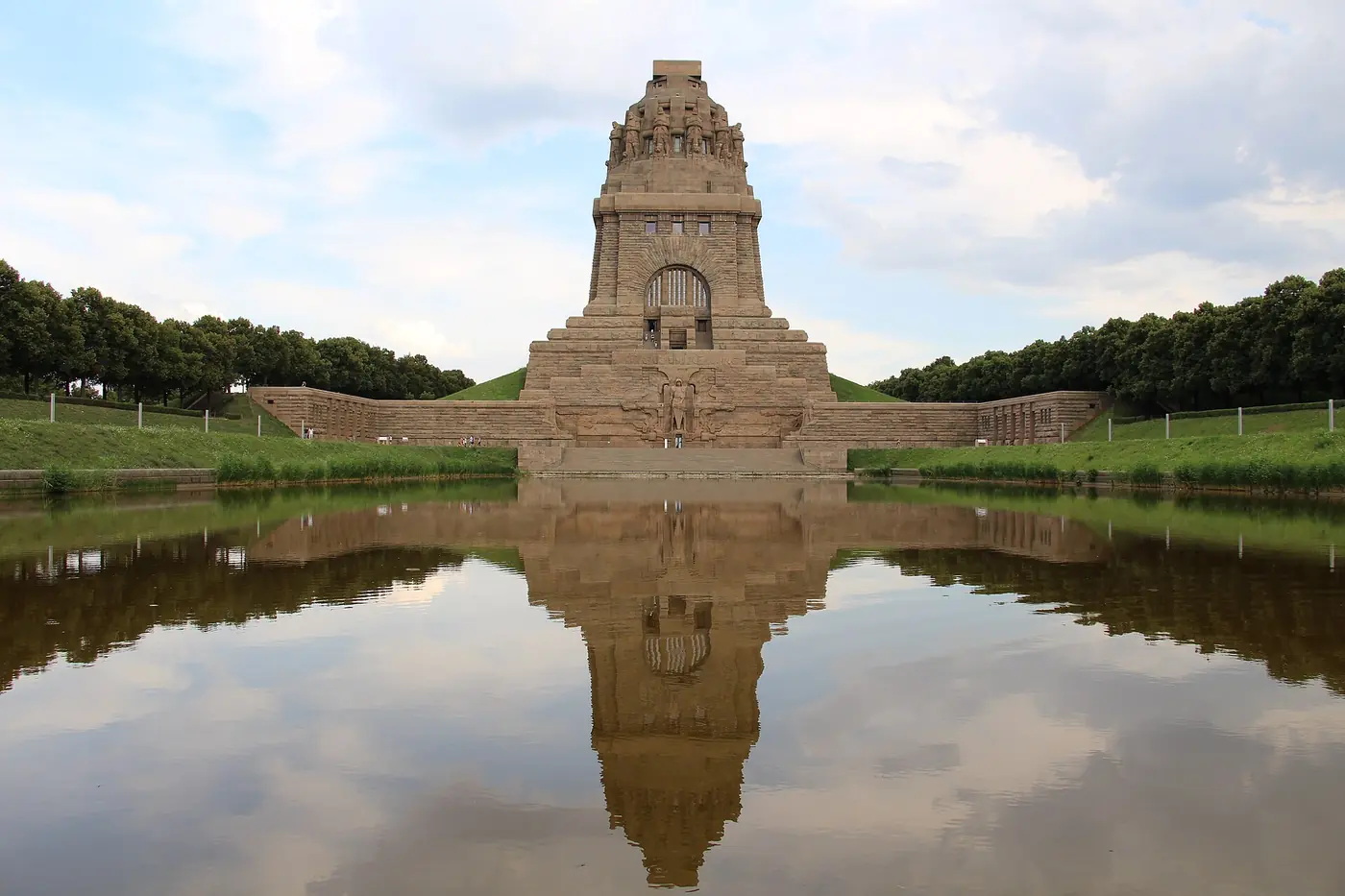
Two buildings were inaugurated for the centenary. The Russian Memorial Church, an Orthodox church built in memory of some 22,000 Russian soldiers who fell at Leipzig, was consecrated on 17 and 18 October 1913. On 18 October 1913, in the presence of Emperor Wilhelm II, the Monument to the Battle of the Nations was inaugurated; it had been begun in 1898 to designs by the architect Bruno Schmitz. At 91 metres, it is one of the largest monuments in Europe; its crypt is meant as the symbolic tomb of those who fell in the battle. A few hundred metres away, near the Napoleonstein, stood the mill from which Napoleon had followed the fighting.
South of the city, the Torhaus at Dölitz, the gatehouse of the manor fought over in 1813, is the last surviving building to have played an important part in the battle; it houses a museum of tin figures. For the bicentenary in October 2013, a re-enactment brought together some 6,000 participants from 28 countries in front of about 35,000 spectators.
Discover other battles
 Victory
 Read the account
Dresden
26-27 August 1813
Dresden, Saxony
 Victory
 Read the account
Lützen
2 May 1813
Lützen and Gross-Görschen, Saxony
 Victory
 Read the account
Bautzen
20-21 May 1813
Bautzen, on the Spree (Lusatia)
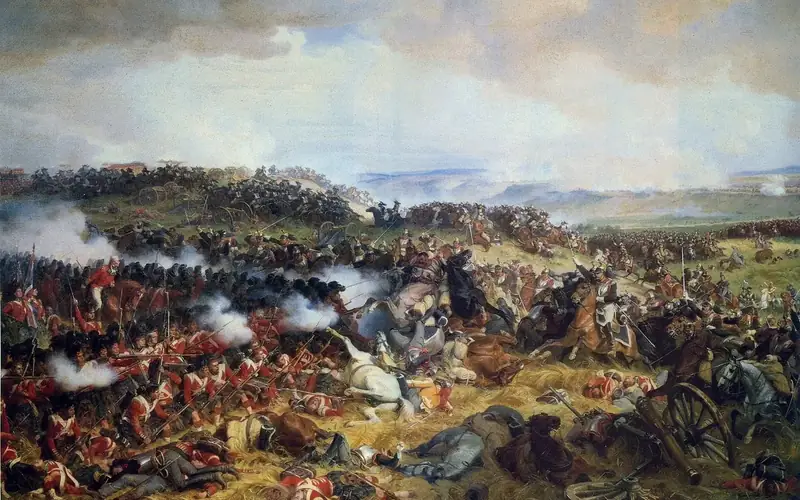 Defeat
 Read the account
Waterloo
18 June 1815
Mont-Saint-Jean, south of Brussels (Belgium)
Go further
Recommended books to dig deeper (affiliate links)

Napoleon the Great
Andrew Roberts · 2014
A monumental biography drawing on Napoleon’s 33,000 surviving letters, admiring but rigorous.
See on Amazon
Napoléon ou le mythe du sauveur
Jean Tulard · 1977
The book that reshaped how the man is read: how France gave itself a saviour, and what it cost.
See on Amazon
Nouvelle histoire du Premier Empire
Thierry Lentz · 2002-2010
Four reference volumes on institutions, diplomacy and collapse: the scholarly synthesis of the subject.
See on AmazonAs an Amazon Associate, this site earns from qualifying purchases.
Support the encyclopedia
Napoleon Empire is an independent project. Your contribution helps grow the content and keep the site running.
DonateSecure payment on the platform you choose.