On 10 February 1814, halfway between Sézanne and Épernay, Napoleon opened the Six Days' Campaign by falling on the isolated corps of Lieutenant General Olsufiev. The allies had just split their armies: Blücher was moving up the Marne, Schwarzenberg following the Seine, and between them lay a corridor the Emperor took by night, along roads Marmont had judged impassable. In a single day four thousand Russians who refused to withdraw were surrounded, cut apart by the cuirassiers and destroyed; their general dined that same evening at the table of the man who had beaten him. It was not a great battle — it was the first blow of a week that would give the French army one last illusion of victory.
Forces at play
Outcome: French victory: the Russian IX Corps was destroyed and its commander taken prisoner

France
- Napoléon Ier
- Marmont
- Ney
- Bordessoulle
- Doumerc
13,300 infantry and 1,700 cavalry engaged according to Digby Smith: Marmont’s VI Corps (Lagrange and Ricard divisions), Bordessoulle’s cuirassiers, Doumerc’s cavalry, Picquet’s lancers, Ney’s Young Guard divisions
Casualties: 600 to 650 killed and wounded according to Smith and Bodart, about 200 according to Chandler; General Lagrange severely wounded in the head

Russia
- Olsoufiev
- Poltoratski
- Kornilov
3,700 to 5,000 men of the IX Corps with 24 guns: Udom’s jägers (10th, 12th, 22nd and 38th regiments), Kornilov’s division, the Apsheron and Nasheburg regiments under Poltoratsky — almost no cavalry
Casualties: 2,400 men and nine guns according to Smith, 1,400 dead and 1,894 captured with 21 guns according to Nafziger; Generals Olsufiev and Poltoratsky taken prisoner
Battle coordinates
Champaubert
Coordinates 48.8753° N · 3.7703° E
Battle narrative
After La Rothière, two armies drifting apart
The defeat at La Rothière on 1 February 1814 did not destroy the French army, but it convinced the allies that they had little left to fear. Napoleon fell back on Troyes on 3 February, then on Nogent-sur-Seine on the 6th and 7th. Meanwhile the victors made the mistake the Emperor had been watching for since the campaign began: they separated. Blücher's Army of Silesia moved up the valley of the Marne towards Paris, Schwarzenberg's Army of Bohemia followed the Seine, and the gap between them widened by the day.
On 7 February Napoleon decided to step into it. He left some thirty thousand men in the south to hold Schwarzenberg and took towards Sézanne about twenty thousand infantry and ten thousand horse: Ney's Young Guard divisions, Marmont's VI Corps, the cavalry of Grouchy and Defrance, with Mortier's Old Guard closing the march. Opposite, Blücher's corps were strung out over more than forty kilometres, each beyond supporting distance of its neighbour.
The most exposed link was the Russian IX Corps of Lieutenant General Zakhar Olsufiev, which halted at Étoges on 8 February, eleven kilometres from Blücher's headquarters at Vertus. On the evening of the 9th, Marmont's scouts spotted it around Baye. The Prussian field marshal was informed at nine o'clock; he saw nothing in it but a reconnaissance and recalled no one.
The road Marmont thought impassable
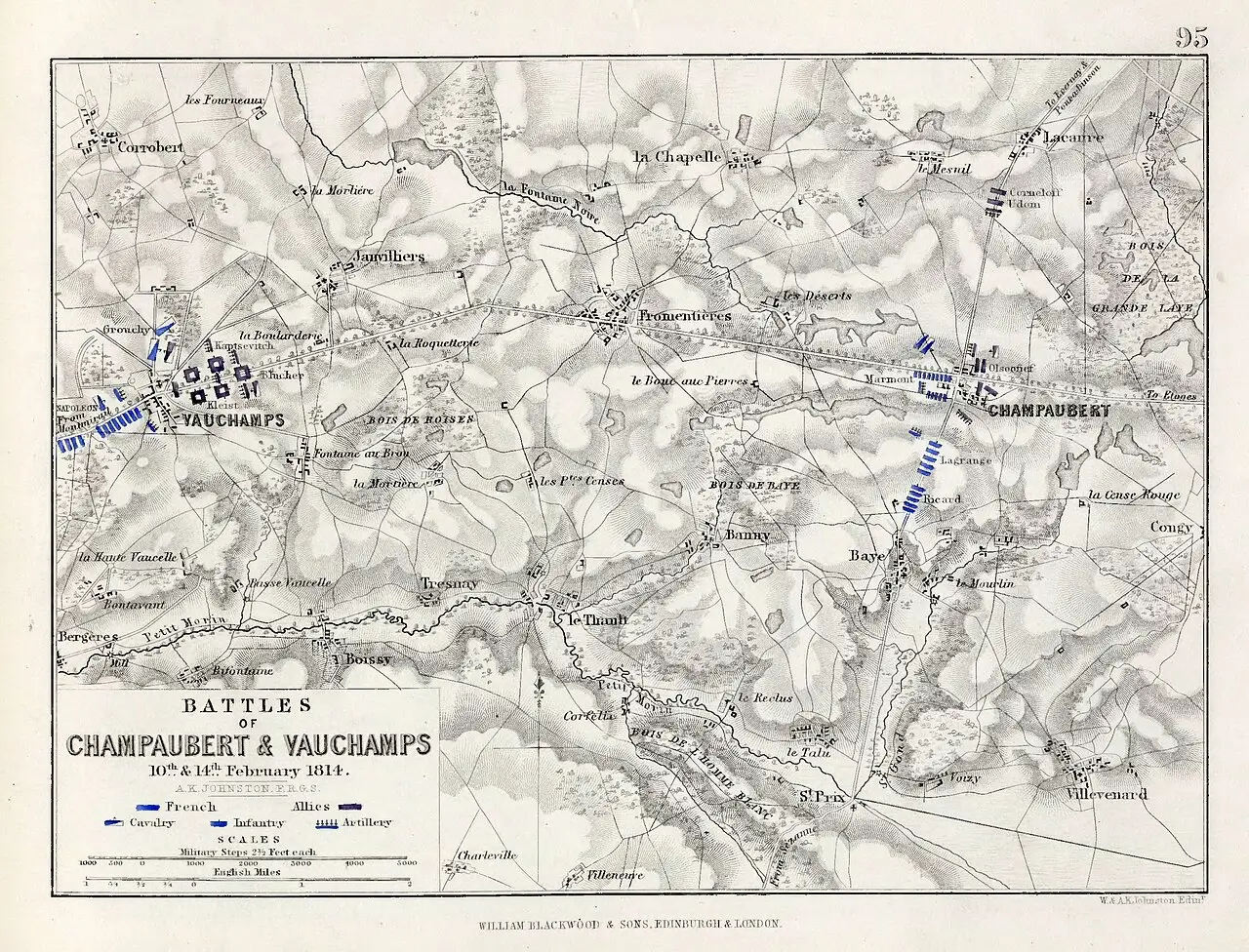
Marmont, leading the march, wrote to the Emperor that the road from Sézanne to Montmirail looked unusable and suggested a detour by Esternay and La Ferté-Gaucher. The thaw had flooded the approaches to the Petit Morin and the marshes of Saint-Gond; the limbers sank to their hubs. Napoleon let the order stand and had every available horse requisitioned from the villages.
At this point a factor entered that the allies had not reckoned with. Champagne had at first taken the invasion without revolt; the Russian and Prussian requisitions of the preceding weeks had turned the countryside around. Peasants came in numbers to hitch their beasts to the guns and put their shoulders to the wheels. During the night of 9–10 February the artillery got through. In the morning the French cavalry found the Saint-Prix bridge over the Petit Morin intact and without a single sentry: Olsufiev had neither destroyed nor watched it. By nine o'clock Napoleon was across with Ricard's division and gave the order to attack.
A council of war and an order taken literally
The two sides were in no way comparable. Olsufiev had, depending on the count, between three thousand seven hundred and five thousand men and twenty-four guns, with almost no cavalry; Digby Smith gives 3,700 infantry, Petre and Bodart four thousand. Facing them deployed thirteen thousand three hundred foot and seventeen hundred horse: Marmont's VI Corps with the Lagrange and Ricard divisions, Bordessoulle's cuirassiers, Doumerc's cavalry, Picquet's lancers, soon joined by the artillery and battalions of Ney's Young Guard.
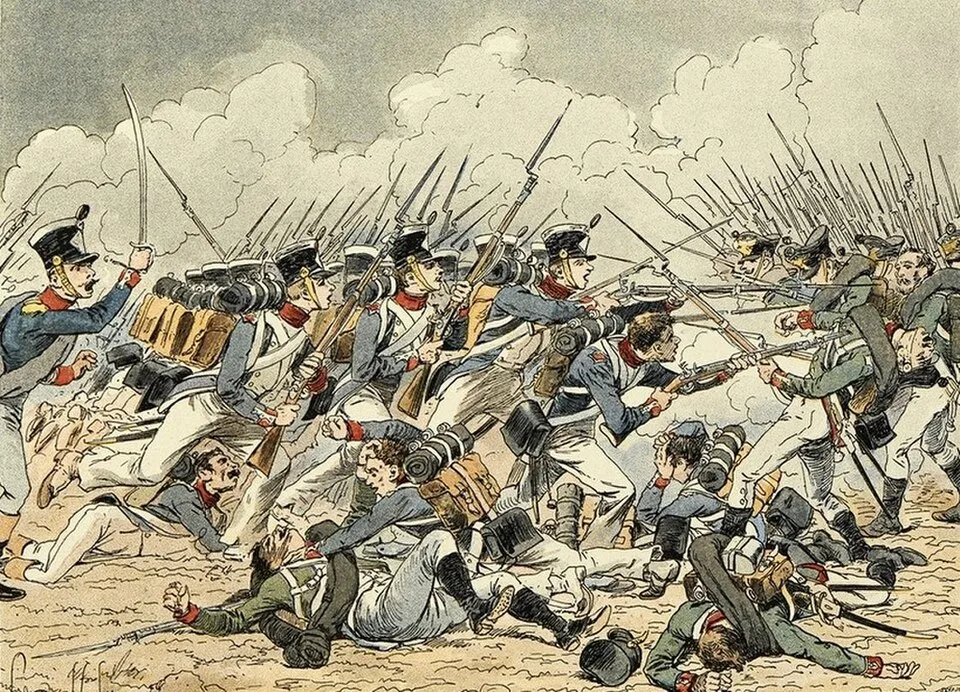
Around eleven o'clock Ricard pushed General Udom's jägers — the 10th, 12th, 22nd and 38th regiments — back into Baye and the woods beside it. At one o'clock Olsufiev called his generals together: all voted for withdrawal on Étoges, where wooded ground would have covered the retreat. He refused. He had been ordered to hold Champaubert, hold it he would, and he still hoped Blücher would send help. No one came. That literal obedience, more than any French manoeuvre, decided the day.
Baye, Bannay, Champaubert
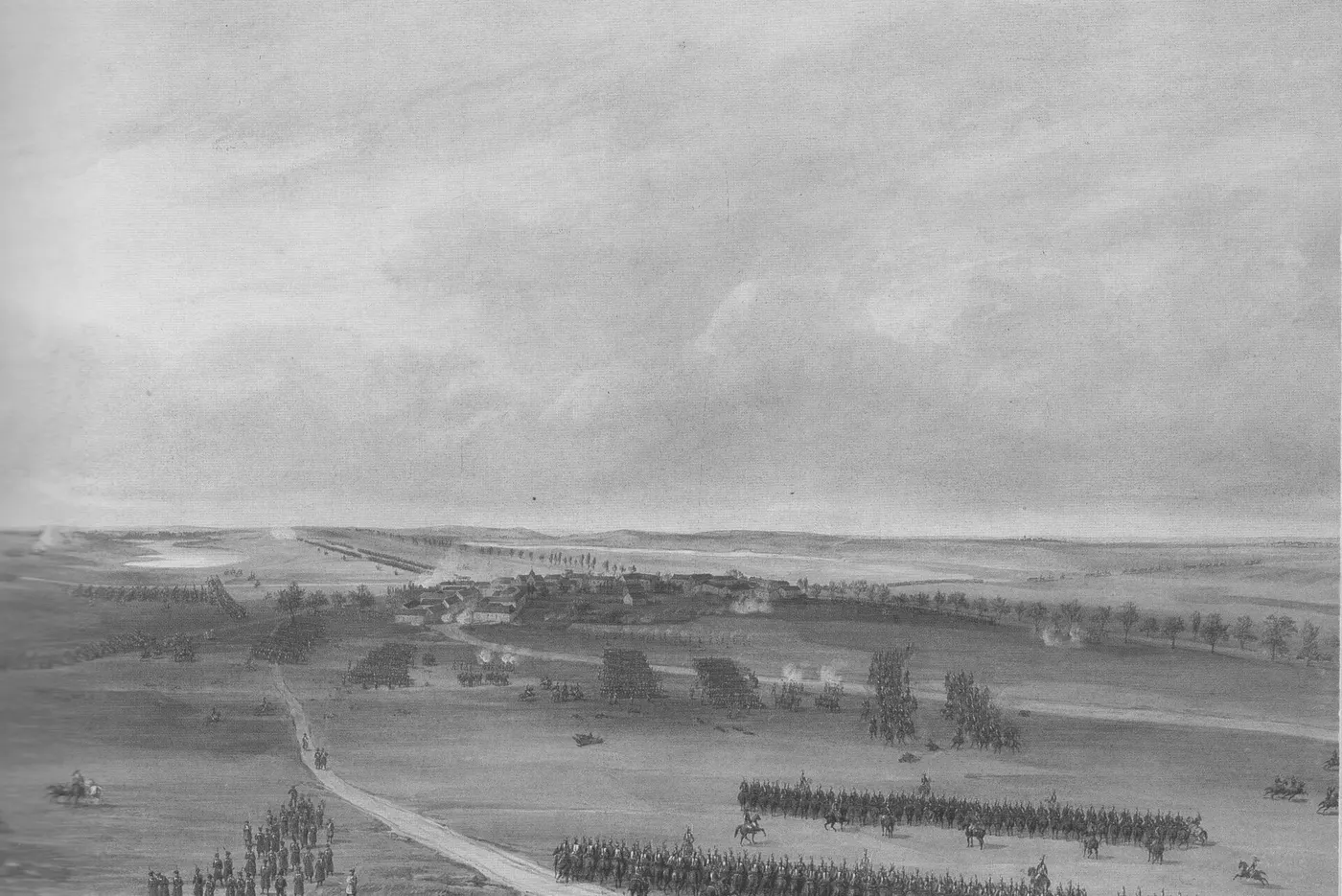
Around two in the afternoon the Russians gave up Baye and Bannay. Ricard took the first village, Pelleport's brigade of Lagrange's division carried the second. Doumerc pushed his cavalry round to the west to cut the Montmirail road while Bordessoulle locked the exits to the east. The Russian corps found itself in a pocket with three sides out of four already closed.
Olsufiev then handed Champaubert to Major General Prince Konstantin Poltoratsky — the Apsheron and Nasheburg infantry regiments with nine guns — and tried to break out towards Étoges with the rest. About three o'clock Ricard entered the village and the fighting went from house to house. Poltoratsky disengaged in square, fell back some three kilometres under French canister, then, out of ammunition, surrendered with both regiments.
The charge at La Grange de Vaux
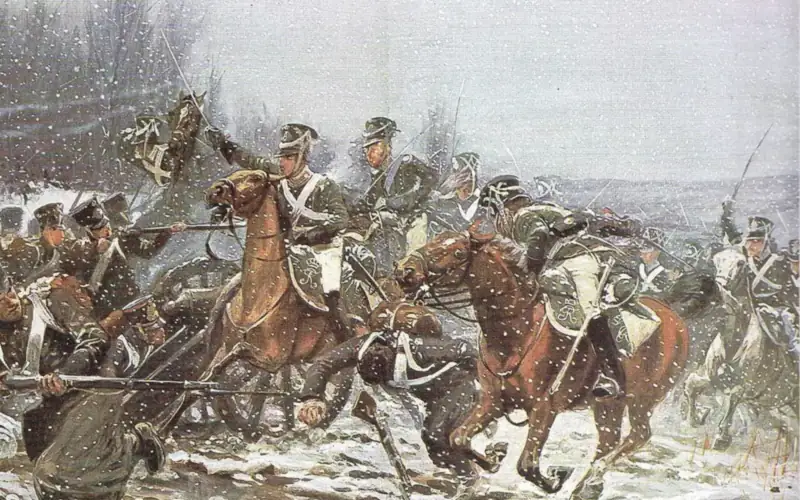
The main body meanwhile struck north. Near the farm of La Grange de Vaux a charge by Bordessoulle's cuirassiers cut it in two: the squares came apart and the infantry scattered across the sodden ploughland. Olsufiev, unhorsed, was taken prisoner; French tradition remembers the name of the chasseur à cheval Pierre-Christophe Christille, decorated with the Legion of Honour on the spot. That same evening the captive general dined at Napoleon's table — the courtesy customary between opponents of such rank, and a scene the bulletins were not slow to use.
Generals Udom and Kornilov managed to extricate themselves after dark with about fifteen hundred men and reached Étoges, then Port-à-Binson on the Marne. That was all that remained of an army corps.
What the day cost
The accounts differ, as they often do for 1814. Digby Smith and Bodart credit the French with six hundred killed and wounded and the Russians with two thousand four hundred men and nine guns; Nafziger records fourteen hundred Russian dead and one thousand eight hundred and ninety-four prisoners with twenty-one guns; Petre reckons that sixteen to seventeen hundred men and fifteen guns got away; Chandler puts French losses at about two hundred and believes a thousand Russians out of five thousand escaped death or capture. The French bulletin announced three thousand killed or captured, twenty-one guns and six colours. On the French side General Lagrange was severely wounded in the head.
Whichever figure one takes, the conclusion is the same: the Russian IX Corps ceased to exist as a formation. Kornilov took command of what was left; those survivors would lose their last guns at Vauchamps four days later.
The first of the Six Days
At seven in the evening, without waiting for the field to be cleared, Napoleon sent two of Nansouty's cavalry divisions on to Montmirail, which had to be occupied before dawn. Marmont stayed at Étoges to watch Blücher; the Emperor turned west against the corps of Sacken and Yorck. Blücher, at last aware of the scale of the disaster, recalled Kaptzevich and Kleist to Vertus and ordered Sacken back on Montmirail, where Yorck was to join him. He was too late everywhere.
Montmirail followed on 11 February, Château-Thierry on the 12th, Vauchamps on the 14th. In six days, with some thirty thousand men against fifty to fifty-six thousand, Napoleon inflicted close to eighteen thousand battle casualties on the Army of Silesia for three thousand four hundred of his own. The episode has remained in staff colleges as a model of manoeuvre on interior lines; the Austrian Nostitz himself acknowledged in it the Emperor's tactical skill "to the highest degree". Michael Leggiere has nonetheless shown what the sequence left unfinished: for want of pressing his advantage to the end, Napoleon obtained neither the destruction of Blücher nor the peace he hoped for, and the Army of Silesia was back on the offensive five days after Vauchamps.
Champaubert kept its prestige all the same. The name is among those carved beneath the Arc de Triomphe de l'Étoile, and a Paris avenue still bears it. Two months after that winter day, on 6 April 1814, Napoleon abdicated at Fontainebleau.
Discover other battles
 Defeat
 Read the account
La Rothière
1 February 1814
La Rothière, Aube, Champagne
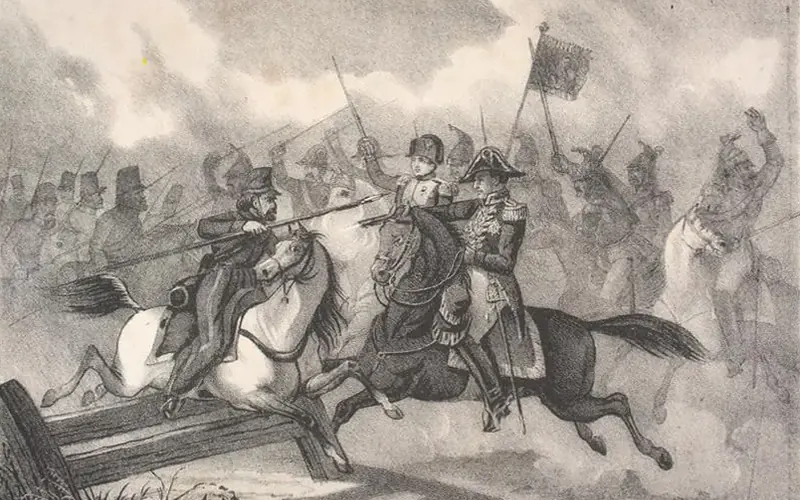 Victory
 Read the account
Brienne
29 January 1814
Brienne-le-Château, Aube, Champagne
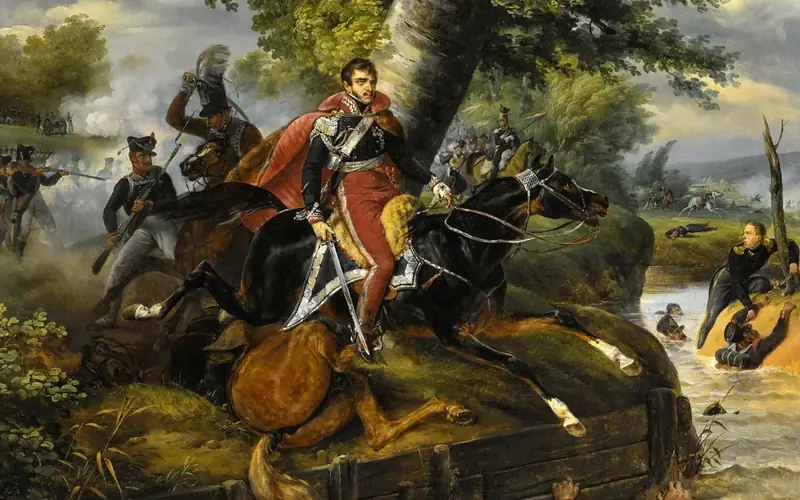 Defeat
 Read the account
Leipzig
16-19 October 1813
Leipzig, Saxony (Germany)
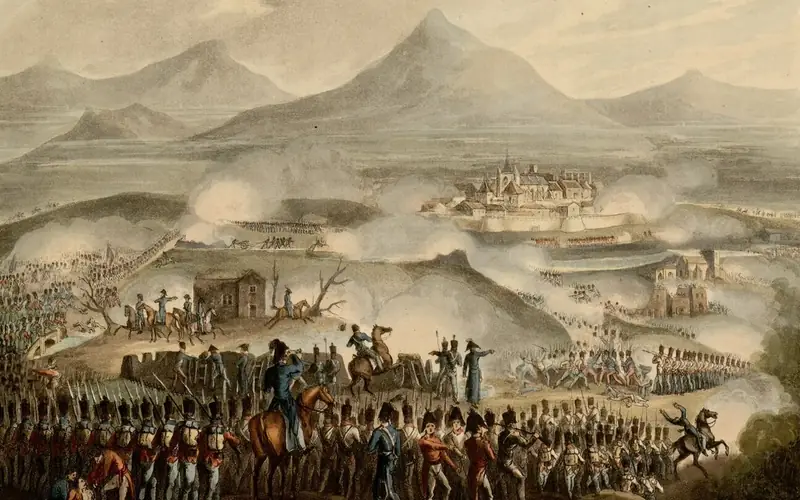 Inconclusive
 Read the account
Toulouse
10 April 1814
Toulouse, France
Go further
Recommended books to dig deeper (affiliate links)

Napoleon the Great
Andrew Roberts · 2014
A monumental biography drawing on Napoleon’s 33,000 surviving letters, admiring but rigorous.
See on Amazon
Napoléon ou le mythe du sauveur
Jean Tulard · 1977
The book that reshaped how the man is read: how France gave itself a saviour, and what it cost.
See on Amazon
Nouvelle histoire du Premier Empire
Thierry Lentz · 2002-2010
Four reference volumes on institutions, diplomacy and collapse: the scholarly synthesis of the subject.
See on AmazonAs an Amazon Associate, this site earns from qualifying purchases.
Support the encyclopedia
Napoleon Empire is an independent project. Your contribution helps grow the content and keep the site running.
DonateSecure payment on the platform you choose.