Why a coronation?
In the spring of 1804, Bonaparte had been consul for life for two years, and he had come close to death more than once. Early in the year, the police foiled the plot of Cadoudal, a Chouan leader who had come from England to kill him. During the night of 20 to 21 March, the Duke of Enghien, a prince of the House of Bourbon seized on German territory, was tried and shot at Vincennes. Around the First Consul, the lesson was drawn: as long as the regime rested on one man, a single bullet could bring it down. Making power hereditary would deprive conspirators of the hope of a vacuum.
On 18 May 1804 a senatus consultum proclaimed Napoleon Bonaparte "Emperor of the French". A plebiscite approved the hereditary imperial dignity by 3,572,329 votes to 2,569. But for Napoleon the vote was not enough. The kings of France had been anointed at Reims, and the sovereigns of Europe still saw him as nothing more than a lucky general. He wanted a religious consecration that would place his family among the old dynasties. The Concordat signed with Rome in 1801 made it possible. Reims was ruled out as too closely tied to the Bourbons; the ceremony would take place at Notre-Dame in Paris. And the Pope would come to him, whereas Charlemagne had gone to Rome to be crowned in the year 800.
Bringing the Pope to Paris
Pius VII hesitated for a long time. Travelling to Paris to anoint the man who had had a Bourbon executed a few months earlier was no simple matter for the head of the Church. But he hoped to obtain concessions in return, above all the withdrawal of the Organic Articles that the French government had added to the Concordat without Rome's agreement. He obtained nothing. He left Rome at the beginning of November and crossed France as winter set in.
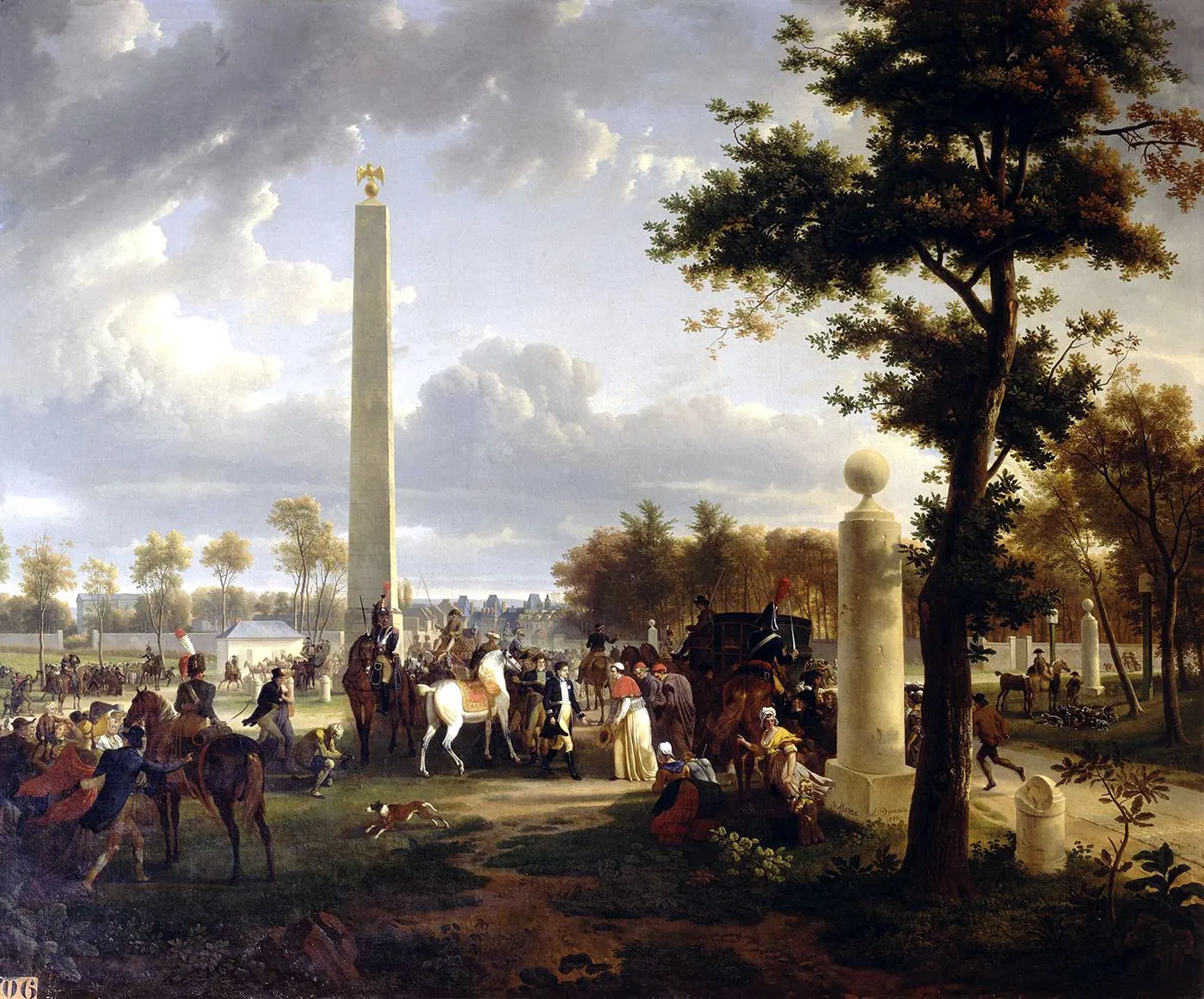
On 25 November Napoleon staged a "chance" meeting in the forest of Fontainebleau. The Emperor, in hunting dress, rode up just as the Pope's carriage was passing: the apparent coincidence avoided the questions of precedence that a formal reception would have raised. The two men went on together to the palace, then to Paris, where the Pope was lodged at the Tuileries on 28 November. To Napoleon's surprise, Parisians flocked to see him and receive his blessing.
One difficulty remained, and Josephine revealed it to the Pope herself: her marriage to Napoleon in 1796 had been a civil one only. In the eyes of the Church the couple were not married, and Pius VII refused to crown a union he did not recognise. On the eve of the coronation, 1 December, Cardinal Fesch, the Emperor's uncle, blessed the religious marriage at the Tuileries, almost in secret. Josephine kept a certificate. Five years later, at the time of the divorce, irregularities in that ceremony were invoked to have it annulled.
A ceremony to be invented
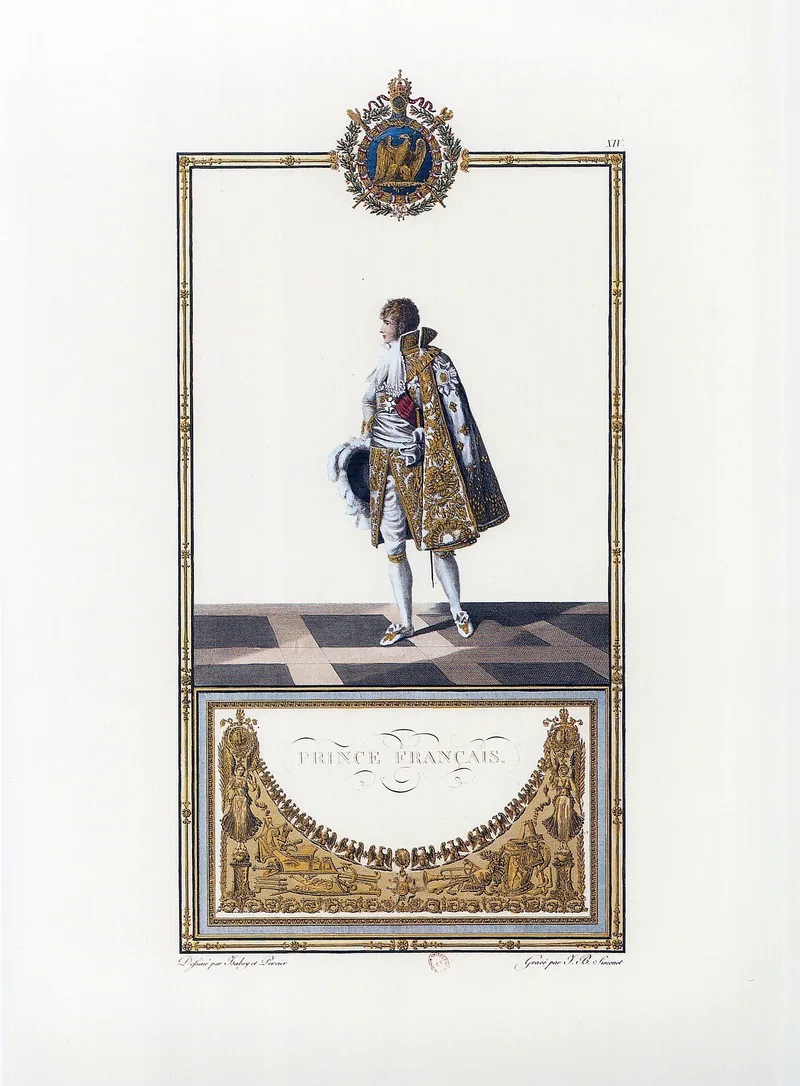
There was no model for crowning an Emperor of the French. The ceremonial, prepared over many months, mixed the old royal ritual, borrowings from imperial Rome and from Charlemagne, and elements inherited from the Revolution. The painter Jean-Baptiste Isabey designed the costumes, and the architects Percier and Fontaine transformed Notre-Dame, which had been damaged during the Revolution: stands were built, hangings put up, cardboard decorations imitating marble laid over the Gothic stone, then thought old-fashioned, and a neo-Gothic porch raised in front of the façade. The music was entrusted to Jean-François Le Sueur and Giovanni Paisiello.
Almost all the royal regalia had been melted down during the Revolution. The sceptre of Charles V, which had survived, was brought out, and the goldsmith Martin-Guillaume Biennais made the rest: a crown christened the "Crown of Charlemagne", a hand of justice, and for the Emperor himself a golden laurel wreath in the manner of the Caesars. It was so heavy that Napoleon had six leaves removed; two survive today, one of them on display at Fontainebleau. In place of the fleur-de-lis, the new dynasty adopted the bee, in memory of the golden bees found in 1653 in the tomb of Childeric, father of Clovis, and the eagle, emblem of emperors.
2 December
Sunday 2 December 1804 was bitterly cold. Many guests had been waiting in the cathedral since dawn. The ambassador of the Batavian Republic wrote to his wife that "even the men could no longer bear it", and pitied the ladies, whom the ceremonial forbade to wrap themselves in a shawl. The Pope's procession left the Tuileries at nine and entered Notre-Dame at about half past ten. The Emperor's, twenty-five carriages escorted by cavalry, then set off in turn. Napoleon stopped at the archbishop's palace to put on his full coronation robes. Madame de Rémusat, lady-in-waiting to Josephine, saw him then: "His small stature was lost beneath his enormous ermine mantle. A simple laurel wreath encircled his head; he looked like an antique medal."
The ceremony lasted nearly five hours. The Pope performed the anointings, then blessed the regalia one by one as they were handed to the Emperor: the ring, the sword, the mantle, the hand of justice, the sceptre. Then came the moment of the crowning. Napoleon took the crown from the altar himself and placed it on his own head, then crowned Josephine, kneeling before him. The gesture, often presented as an improvisation that humiliated the Pope, had been settled beforehand: according to Madame de Rémusat, it had been agreed that "the Emperor would crown himself and the Pope would only give his blessing". It said the essential all the same: Napoleon held his crown from no one. The Pope, the same witness noted, "always looked a little like a resigned victim, but nobly resigned".
The sovereigns then climbed to a great throne set up in the nave. Pius VII blessed them and intoned the Vivat imperator in aeternum. Then Napoleon, his hand on the Gospels, swore the oath laid down by the Constitution. Among other things, he swore "to respect and enforce equality of rights, political and civil liberty, and the irrevocability of the sales of national property". In a cathedral, before the bishops, the Emperor promised to preserve the gains of the Revolution. Tradition has it that amid the preparations he murmured to his brother Joseph: "If only our father could see us!"
A painting that replaced the day
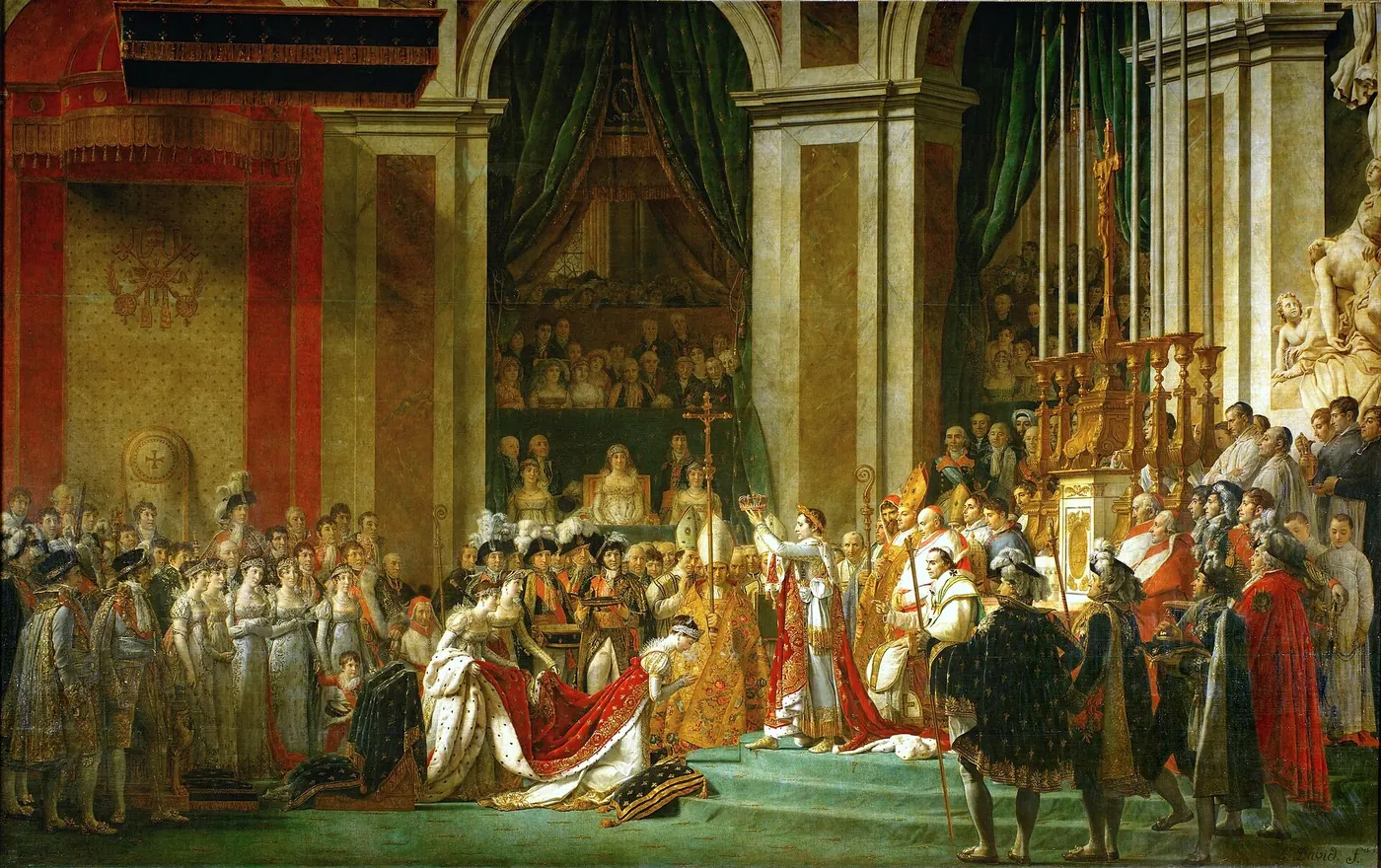
Napoleon commissioned from David, his First Painter, four large canvases on the coronation festivities; only two were painted. For The Coronation, David set up his studio in a former chapel near the Sorbonne and worked on it from December 1805 until the end of 1807. The canvas, nearly ten metres wide and over six high, brings together close to two hundred figures, almost all of them recognisable. It was shown at the Salon of 1808.
David had first sketched the Emperor crowning himself. In the end he painted the next moment, the crowning of Josephine, in which Napoleon appears more generous than proud. He took other liberties. Letizia Bonaparte, Napoleon's mother, presides from a gallery, although she had stayed in Rome, displeased at the treatment of her son Lucien. The Pope, first shown with his hands on his knees, raises one in blessing; the Emperor, the story goes, had not brought him all this way to do nothing. David later painted a replica, finished in exile in Brussels in 1822 and now at Versailles. And it is this image, far more than the witnesses' accounts, that has fixed the memory of 2 December for posterity.
The eagles, then the iron crown
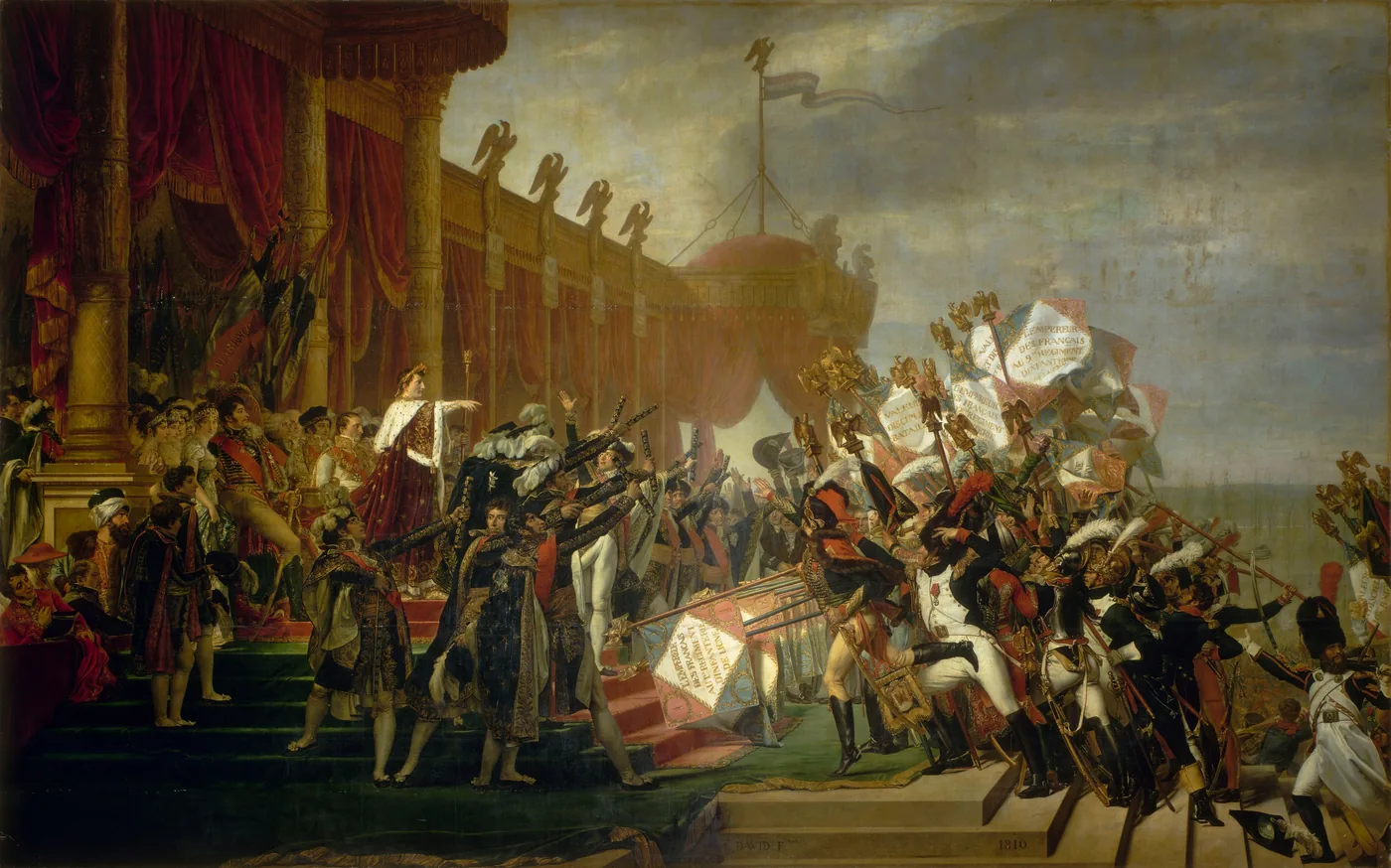
Three days after the coronation, on 5 December, on the Champ-de-Mars, Napoleon presented each regiment with a flag topped by a gilded bronze eagle. In the rain, the officers swore to defend these eagles to the death. The coronation had its military counterpart: the Empire rested on the Church and on the army. David drew from it his second great canvas, The Distribution of the Eagles, completed in 1810. In the meantime Napoleon had divorced: Josephine, who had stood near him, was painted out of the picture.
When the Italian Republic became a kingdom, Napoleon had himself crowned there too. On 26 May 1805, in Milan Cathedral, he placed on his head the iron crown of the old Lombard kings, pronouncing, according to tradition, the formula attached to it: "God gives it to me; beware whoever touches it."
What the coronation meant
The coronation was above all a synthesis. It borrowed from the rites of the kings of France, from the Roman emperors and from Charlemagne, and it had the Revolution sworn to in a cathedral. Napoleon sought to reassure the former revolutionaries, who watched a court, titles and etiquette return, by guaranteeing them civil equality and the national property; and he sought to win over Catholics and moderate royalists by persuading them that the new sovereign was a monarch like any other, blessed by the Church.
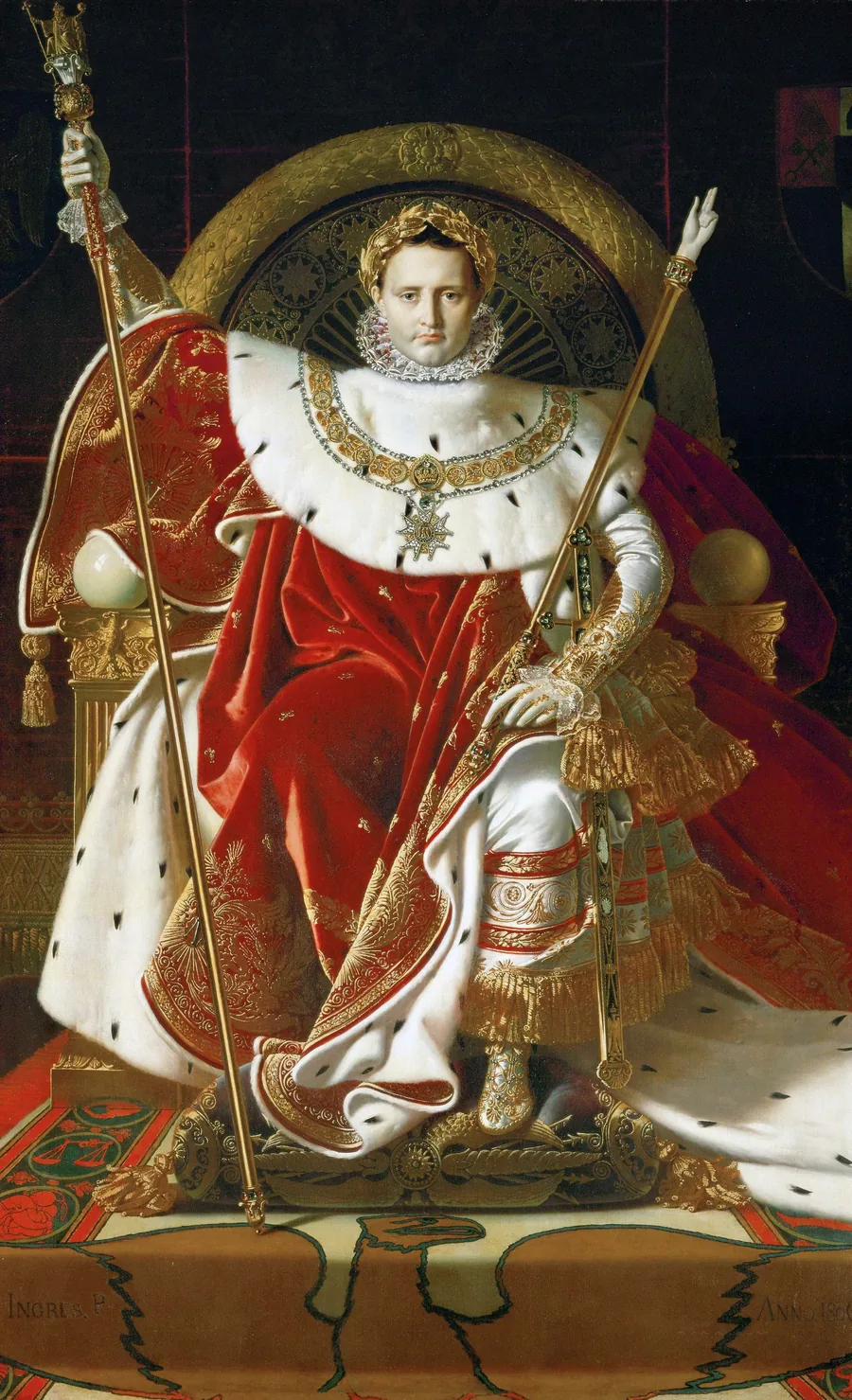
The portrait Ingres showed at the Salon of 1806 pushed this ambition to the point of strangeness. The Emperor sits facing the viewer, motionless as an icon, crowned with golden laurel, the sceptre of Charles V in one hand and the hand of justice in the other, the sword at his side, the collar of the Legion of Honour on ermine strewn with bees, an imperial eagle woven into the carpet at his feet. Every sign of the coronation is gathered on a single canvas. Critics found it cold and archaic, almost "Gothic". Yet it says exactly what 2 December had set out to show: a power born of the Revolution, clothed in all the majesty of the centuries.
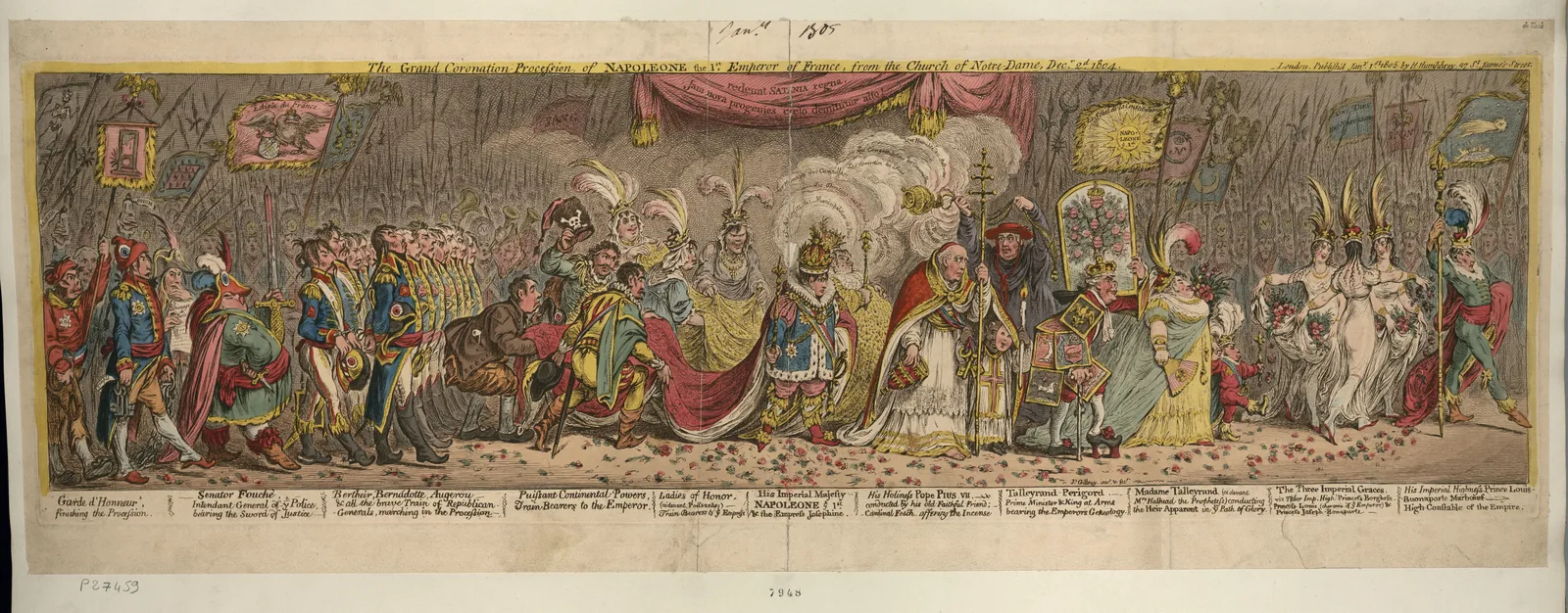
Not everyone was convinced. Many republicans saw it as a betrayal. According to his pupil Ferdinand Ries, Beethoven, on learning of the proclamation of the Empire in the spring, is said to have angrily struck Bonaparte's name from the title page of his third symphony. Royalists, for their part, mocked a usurper dressed up as a king. In London, the caricaturist James Gillray published his own version of the procession on 1 January 1805: three princesses of the family as the "Imperial Graces", Talleyrand carrying the Emperor's genealogy, the Pope led by Cardinal Fesch, and the rulers of the Continent reduced to carrying the new master's train.
Of the day itself, almost nothing remains. The decorations of Notre-Dame have gone, and the choir of the time was dismantled during Viollet-le-Duc's restoration in the mid-nineteenth century. The Emperor's own costumes and regalia were destroyed under the Restoration. The so-called Crown of Charlemagne, however, is kept at the Louvre; by an irony of history, it was used in 1825 at the coronation of Charles X, the last king to be anointed at Reims. Five of the procession's carriages are on display at Versailles, in the Gallery of Coaches. And there is David's painting, in front of which thousands of visitors to the Louvre stop every day, and which probably says better than anything else what Napoleon expected of that day.
Further reading
- José Cabanis, Le Sacre de Napoléon, 2 décembre 1804, Gallimard, 1970.
- Thierry Lentz (ed.), Le Sacre de Napoléon, Nouveau Monde, 2003.
- David Chanteranne, Le Sacre de Napoléon, Tallandier, 2004.
- Frédéric Masson, Le Sacre et le couronnement de Napoléon, 1908.
- A witness: Claire de Rémusat, Mémoires, published in 1880.