On 16 June 1815, near Fleurus, Napoleon attacked Blücher's Prussian army entrenched in the villages along the Ligny brook. In the evening the Guard broke the Prussian centre: it was his last victory. But the Prussians withdrew in good order towards Wavre, and two days later they would be at Waterloo.
Forces at play
Outcome: Incomplete French victory

France
- Napoléon
- Grouchy
- Vandamme
- Gérard
About 60,000 men
Casualties: 8,000 to 12,000 men

Prussia
- Blücher
- Gneisenau
- Zieten
- Pirch
- Thielmann
About 83,000 men and more than 200 guns
Casualties: 12,000 to 16,000 killed and wounded, some twenty guns and about 8,000 deserters
Flags: David Liuzzo, Wikimedia Commons
Battle coordinates
Ligny
Coordinates 50.5150° N · 4.5700° E
Battle narrative
Strike before the Allies unite
Back from Elba, Napoleon had returned to Paris on 20 March 1815. Facing him in Belgium, two armies were waiting to invade France: the Duke of Wellington's Anglo-allied army to the west and Marshal Blücher's Prussian army to the east. Together they far outnumbered the Army of the North. The Emperor's plan was to drive in between them and beat them one after the other.
On 15 June the French army crossed the Sambre at Charleroi. Zieten's Prussian corps fell back fighting towards Ligny. Napoleon divided his army: the left wing, entrusted to Marshal Ney, was to hold the crossroads of Quatre Bras against Wellington; Grouchy's right wing and the reserve, with the Guard, marched against the Prussians. Blücher, for his part, decided to give battle and gathered three of his four corps around Sombreffe; the fourth, Bülow's, coming from Liège, was still too far away.
A line of fortified villages
On 16 June about 83,000 Prussians, with more than 200 guns, held the Ligny brook and the villages along it: Wagnelée, Saint-Amand, Saint-Amand-la-Haye and Ligny. The houses had been loopholed, the streets barricaded, the large farms turned into strongpoints. Napoleon had about 60,000 men. In the early afternoon Wellington came to confer with Blücher at the Bussy windmill, from where the French could be seen deploying; he promised his help, although the accounts disagree on whether that promise was firm or conditional.
Napoleon's plan was to pin the Prussians frontally with the corps of Vandamme and Gérard, then bring part of Ney's troops down on their right flank and rear: the victory would then be complete.
3 p.m.: the struggle for the villages
At about 3 p.m. the Guard artillery gave the signal. Vandamme's corps attacked Saint-Amand, which Lefol's division carried; on the right, Gérard's corps went for Ligny. Pécheux's division reached the church but, caught by fire from three sides, lost some twenty officers and 500 men in a short time and had to fall back. House-to-house fighting went on for hours; Ligny was half ablaze. The villages changed hands several times, and Blücher personally led counter-attacks against Saint-Amand.
D'Erlon's corps, lost between two battles
At about 3.30 p.m. Napoleon sent Ney orders to direct the I Corps, Drouet d'Erlon's, onto the Prussian rear. General de La Bédoyère, who carried the message, turned that corps towards Ligny on his own initiative. At about 5 p.m. Vandamme saw a column of 20,000 to 30,000 men advancing towards Fleurus and took it for the enemy: Napoleon suspended his attack while it was identified. Meanwhile Ney, unaware of the Emperor's instructions and fighting hard at Quatre Bras, recalled d'Erlon. The I Corps turned back a few kilometres from Ligny: it fought nowhere all day.
The Guard breaks the centre
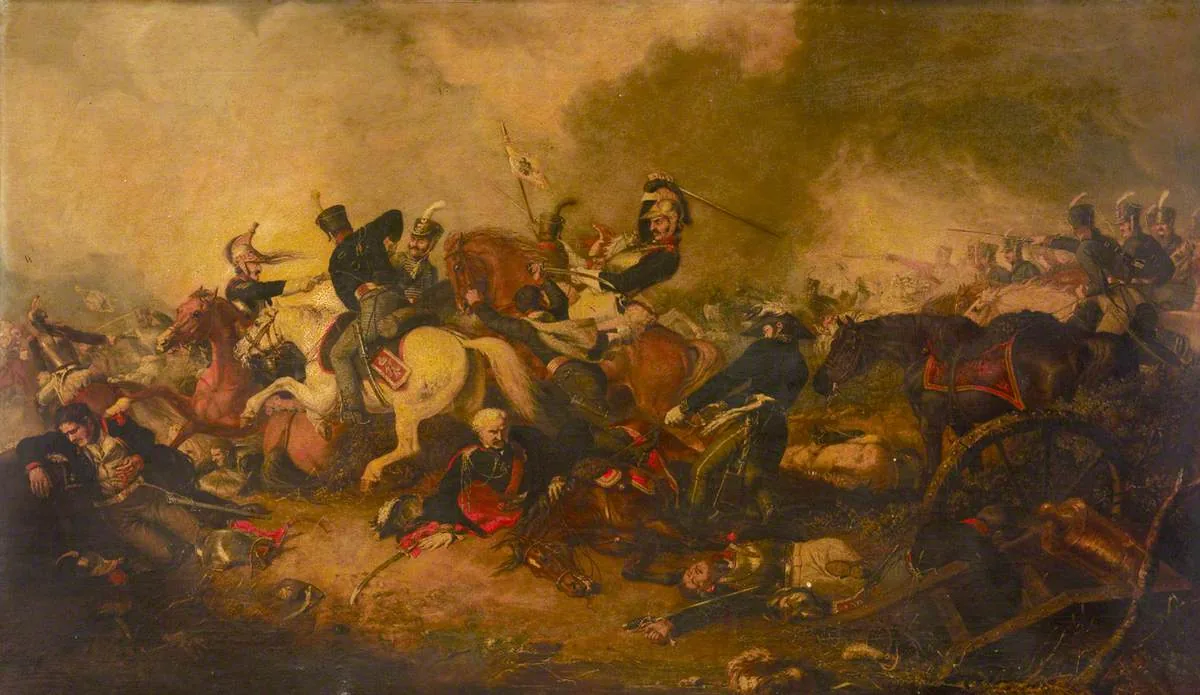
At about 7 p.m., learning that Wellington, himself engaged at Quatre Bras, could not come to his aid, Blücher threw his last reserves against Saint-Amand; they were driven back by the chasseurs of the Guard. Napoleon judged that the moment had come. Delayed by a thunderstorm, the attack went in at about 7.45 p.m. after a salvo from some sixty guns: the Old Guard, Gérard's corps and Milhaud's cuirassiers broke the Prussian centre at Ligny. The Prussians fell back in good order, formed in squares, to the heights of Brye and Sombreffe.
Blücher, aged 72, personally led a cavalry counter-charge. His horse was killed and fell on him; French cuirassiers passed close by without recognising him in the dusk. His aide-de-camp, Count Nostitz, who had stayed at his side, managed to free him, and he was carried away half-conscious. His chief of staff, Gneisenau, took command.
A retreat northwards
At about 10 p.m. the order to retreat was given. The choice of direction was crucial: instead of falling back eastwards along their lines of communication, the Prussians withdrew northwards, through Tilly towards Wavre, which let them stay in touch with Wellington. The sources differ on Gneisenau's exact share in this decision. Exhausted, the French did not pursue during the night; only on 17 June, at about 11 a.m., did Napoleon give Grouchy some 33,000 men to follow the Prussians.
Outcome
The French lost 8,000 to 12,000 men. The Prussians had 12,000 to 16,000 killed and wounded and lost some twenty guns; in addition, some 8,000 soldiers, mostly from provinces recently annexed by Prussia, deserted after the battle. Ligny was Napoleon's last victory. But the Prussian army had not been destroyed: two days later, at Waterloo, it was the Prussians, starting with Bülow's corps, which had been absent from Ligny, who struck the right flank of the French army.
Go further
Recommended books to dig deeper (affiliate links)

Napoleon the Great
Andrew Roberts · 2014
A monumental biography drawing on Napoleon’s 33,000 surviving letters, admiring but rigorous.
See on Amazon
Napoléon ou le mythe du sauveur
Jean Tulard · 1977
The book that reshaped how the man is read: how France gave itself a saviour, and what it cost.
See on Amazon
Nouvelle histoire du Premier Empire
Thierry Lentz · 2002-2010
Four reference volumes on institutions, diplomacy and collapse: the scholarly synthesis of the subject.
See on AmazonAs an Amazon Associate, this site earns from qualifying purchases.
Support the encyclopedia
Napoleon Empire is an independent project. Your contribution helps grow the content and keep the site running.
DonateSecure payment on the platform you choose.