A coalition, and a fleet that never came
In the spring of 1805, the army Napoleon had gathered on the Channel coast was still waiting to cross. For two years, around Boulogne, Ambleteuse, Étaples and Montreuil, some hundred and fifty thousand men had been drilling, building huts and learning to embark on a flotilla of flat-bottomed boats. The scheme depended on one condition that France could never quite secure: command of the Channel for a few days. To win it, Napoleon sent Villeneuve's squadron to the West Indies, hoping to draw the British fleet after it and to return ahead of it. The plan failed. After an indecisive action off Cape Finisterre on 22 July, Villeneuve gave up the idea of sailing north to Brest and took refuge in Cádiz, which he entered on 21 August.
Meanwhile, Europe had begun to stir again. On 11 April 1805, in St Petersburg, Britain and Russia signed a treaty of alliance that founded the Third Coalition. London promised subsidies, Russia soldiers; what was still missing was a great continental power ready to open hostilities. Napoleon supplied it himself. On 26 May, in Milan, he placed on his head the Iron Crown of the Lombard kings and became King of Italy; in June, the Ligurian Republic was annexed to the Empire. For Vienna, which had already lost most of its Italian positions at Lunéville in 1801, this was too much. Austria joined the coalition on 9 August. Sweden followed, and the Kingdom of Naples committed itself in secret.
Napoleon quickly understood that the war would not be fought in England. At the end of August, before he even knew that Villeneuve was shut up in Cádiz, he issued the orders that turned the army away from the coast and towards the Rhine. On 29 August it officially took the name of the Grande Armée. The movement was prepared in the utmost secrecy: Vienna had to go on believing that the French were still gazing out to sea when they were already in Germany.
Two armies, two timetables
The allies had planned a war on several fronts. The main Austrian effort was to fall on Italy, where Archduke Charles, the monarchy's finest general, held command against Masséna. In Germany, a second army, nominally under Archduke Ferdinand but in practice directed by General Karl Mack, was to occupy Bavaria and wait on the Danube for Kutuzov's Russians, who had set out from Galicia at the end of August. Other Russian corps, together with Swedes and British, were to land in northern Germany. On paper the coalition enjoyed overwhelming numerical superiority; in reality its armies were scattered and their timetables did not match.
The Austrian army was, moreover, in the middle of a reorganisation. Decrees issued in the summer of 1805 had just reshaped the regiments, and new drill regulations were barely coming into force. Mack, a believer in the offensive, had no wish to wait. He crossed the Inn at the beginning of September and occupied Bavaria, whose Elector he hoped to draw into the coalition. He did not know that Maximilian Joseph had signed a secret treaty of alliance with France on 24 August. The Elector left Munich on the night of 8 to 9 September and withdrew to Würzburg with his army. Mack then pressed on to the Iller and established himself around Ulm, facing the exits of the Black Forest, where he waited for the French.
The Grande Armée, for its part, had the advantage of unity. Napoleon alone was in command; his seven army corps, entrusted to Bernadotte, Marmont, Davout, Soult, Lannes, Ney and Augereau, each combined infantry, cavalry and artillery, and could march and fight separately before coming together. Murat's cavalry reserve and the Imperial Guard completed the whole. The long months at Boulogne had given the troops a training and cohesion that few European armies of the day could match. With the Bavarian, Baden and Württemberg contingents, Napoleon had some two hundred thousand men in Germany.
From the Rhine to the Danube
Having left Paris on 24 September, Napoleon was in Strasbourg on the 26th. His corps had been crossing the Rhine between Mannheim and Strasbourg since the 25th, while Bernadotte, coming from Hanover, and Marmont, coming from Holland, moved down through Franconia to join the Bavarians. At first the army was spread over nearly two hundred and forty kilometres, then it closed up as the columns neared the Danube. To save time, Bernadotte marched without permission through the Prussian principality of Ansbach, a breach of neutrality that greatly angered Berlin.
The whole manoeuvre rested on a simple idea: Mack was looking west, so the blow had to come from the north. Murat and part of the cavalry showed themselves at the exits of the Black Forest to keep alive the illusion of a frontal attack, while the bulk of the army swung up through Württemberg towards the Danube, downstream of Ulm. Historians long repeated that Napoleon had planned from Boulogne onwards to trap the Austrian army at Ulm; a study of his correspondence suggests rather a flexible plan, ready to strike wherever the enemy happened to be.
On the evening of 6 October, Vandamme's division of Soult's corps seized the bridge at Donauwörth. Over the following days Lannes, Murat, Davout, Marmont and Bernadotte crossed the river at Donauwörth, Neuburg and Ingolstadt, almost unopposed. The French army now stood south of the Danube, in Mack's rear, between him and Vienna. On 8 October, at Wertingen, Lannes and Murat caught an Austrian corps sent too late to close the road; drawn up in one great square, it was broken up and its commander, Auffenberg, taken prisoner.
Ulm: an army taken without a battle
Mack realised that he had been outflanked, but he could not make up his mind what to do. Three times he tried to escape along the north bank of the Danube towards Bohemia. On 9 October, at Günzburg, Ney's corps barred his way. On the 11th, at Haslach-Jungingen, Dupont's division alone, left isolated on the left bank by a mistake in Napoleon's dispositions, held out all day against far superior forces; Mack, believing he faced the main body of the French army, fell back into Ulm. The Bulletin of the Grande Armée took good care not to mention this action, which exposed a flaw in the manoeuvre. On 14 October, Ney crossed the river at Elchingen and overthrew Riesch's corps; he would be created Duke of Elchingen in 1808. That same day, Soult secured the surrender of Memmingen.
The vice was closing. Some of the Austrian troops managed to slip away: Archduke Ferdinand reached Bohemia with a few squadrons, while Werneck's corps, pursued by Murat, ended up capitulating in its turn. Inside Ulm, besieged and bombarded, Mack negotiated. A convention signed on 17 October granted him a delay: he would give up the town if no relief arrived before the 25th. Persuaded by Napoleon that none would come, he yielded before the deadline. On 20 October, at the foot of the Michelsberg, more than twenty thousand Austrian soldiers filed past the Emperor and laid down their arms.
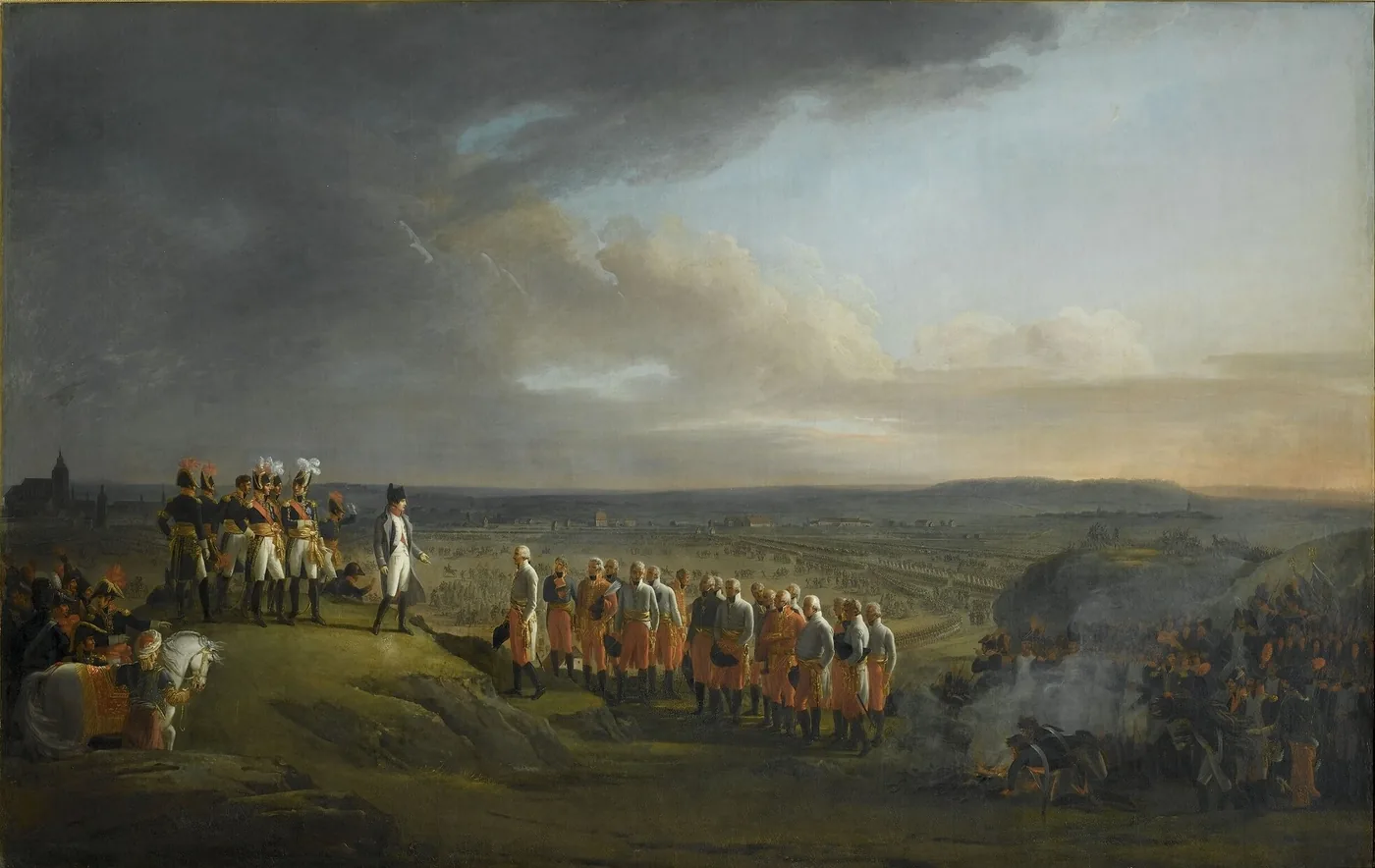
In three weeks, one of the two Austrian armies had ceased to exist. The Bulletins put into the soldiers' mouths a saying destined for a long career: the Emperor, they said, had found a new way of making war, and now waged it only with their legs. The phrase sums up the essence of the matter: at Ulm, the decision had been reached not through a great battle but through the speed and direction of the marches. Mack, once back in Vienna, was brought before a court martial and sentenced to death, a sentence later commuted to imprisonment.
Trafalgar and the road to Vienna
The day after the capitulation, on 21 October, Villeneuve's Franco-Spanish fleet, which had sailed out of Cádiz, met Nelson's squadron off Cape Trafalgar. Thirty-three ships of the line faced twenty-seven British vessels, which attacked in two columns perpendicular to the allied line. Nelson was killed aboard the Victory, but seventeen allied ships were taken and another blew up. Villeneuve was made prisoner. Trafalgar changed nothing in the campaign of 1805 on land; it did, however, close the sea to Napoleon for a long time to come. The invasion of England would never again be on the agenda, and the struggle against London would soon take the form of an economic war.
On the continent, the advance resumed at once. Kutuzov, who had reached the Inn with some forty thousand Russians, learned of the loss of Mack's army and fell back along the Danube, fighting rearguard actions such as the one at Amstetten on 5 November. On 11 November, at Dürnstein, he came close to destroying Gazan's division, which Mortier had committed on the left bank, cut off from the rest of the army; only the arrival of Dupont's division saved it. In Italy, Masséna attacked Archduke Charles at Caldiero at the end of October; the Archduke, on hearing of the disaster at Ulm, broke off the fight and withdrew eastwards to cover the monarchy. Ney, meanwhile, was detached towards the Tyrol, which he entered at the beginning of November.
On 13 November, Murat entered Vienna, which Emperor Francis had abandoned. That same day, Murat and Lannes took the great Tabor bridge over the Danube by a ruse: presenting themselves as envoys and claiming that an armistice had been concluded, they reached the bridge before the Austrians, who had prepared it for demolition, could set it alight. Napoleon took up residence at Schönbrunn. Three days later it was Murat's turn to be caught by the same trick: outside Hollabrunn, he accepted a suspension of arms proposed by the Russians. On 16 November Napoleon wrote to him that he could find no words to express his displeasure. At Schöngrabern, Bagration's rearguard, some seven thousand men, sacrificed itself in part so that Kutuzov could escape into Moravia.
In Moravia, a precarious position
On 20 November, Napoleon was at Brünn. His situation had been reversed. The Grande Armée was several hundred kilometres from the Rhine, its lines of communication were lengthening, and its strength was melting away through the detachments needed to hold Vienna and the Danube. Near Olmütz, Kutuzov had joined forces with Buxhoeveden's Russian reinforcements and the remnants of the Austrian army; the two emperors, Alexander I and Francis II, were both at allied headquarters. To the north, Prussia was threatening to enter the war: on 3 November, at Potsdam, Frederick William III had pledged to the Tsar an armed mediation, and his minister Haugwitz arrived at Brünn bearing proposals that looked very much like an ultimatum. Napoleon packed him off to Vienna to talk with Talleyrand. To the south, Archduke Charles was moving up towards Hungary.
Everything therefore pushed Napoleon to seek a battle quickly, and to fight it on ground of his own choosing. He had reconnoitred the country around Austerlitz, east of Brünn, and in particular the Pratzen Heights, which overlook the plain. He resolved to appear weaker than he was. He sent Savary to the Tsar to propose a meeting, received Prince Dolgorukov, one of Alexander's young aides-de-camp, with a show of anxiety, and then had the heights evacuated. He deliberately stretched his right along the Goldbach stream, as if to offer the allies the chance of cutting him off from the Vienna road. At the same time he called up Davout's corps from Vienna, whose Friant division covered more than a hundred kilometres in roughly two days, along with Bernadotte's corps, which came up from Iglau.
At allied headquarters, Alexander's young entourage prevailed over Kutuzov's caution. The plan, drawn up by the Austrian chief of staff Weyrother, provided for most of the army to descend from the heights and crush the French right, then swing north and drive Napoleon back away from Vienna. It was exactly what he had set out to provoke.
Austerlitz, 2 December
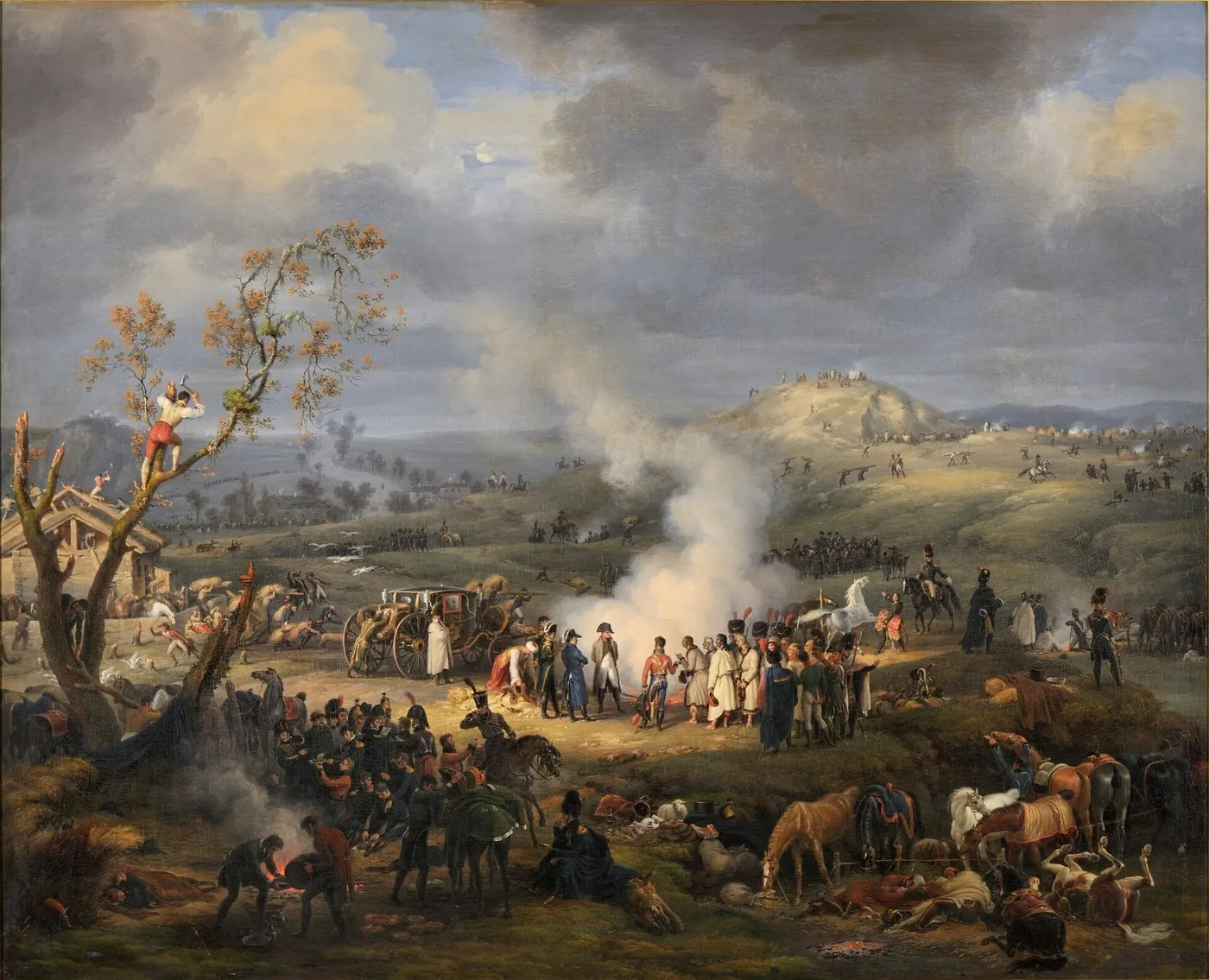
On the evening of 1 December, Napoleon rode along his lines. The soldiers, knowing that the next day marked the first anniversary of the coronation, lit torches of straw to light his way. Napoleon had about seventy-three thousand men; the allies fielded some eighty-five thousand. On the morning of 2 December, fog lay over the low ground. The allied columns came down from the heights towards the villages of Telnitz and Sokolnitz, held by Legrand's division and then by Davout's troops, who arrived that morning. The fighting there was ferocious and the villages changed hands several times, but the French right did not give way.
Around nine o'clock, as the sun broke through the mist, Napoleon sent Saint-Hilaire's and Vandamme's divisions of Soult's corps to storm the Pratzen Heights, half stripped of troops by the departure of the allied columns. Kutuzov and the Austrian General Kolowrat tried to retake the high ground and failed. Late in the morning, the Russian Guard under Grand Duke Constantine charged across the plateau and broke part of Vandamme's division. Napoleon then committed the cavalry of the Guard: Rapp's chasseurs à cheval and Mamelukes, supported by Bessières, drove back the Russian horsemen and captured Prince Repnin. To the north, Lannes and Murat held and then pushed back Bagration and the cavalry of Prince Liechtenstein, while the Santon hill, fortified the day before, anchored the French left.
Master of the centre, Napoleon wheeled his troops southwards and took the allied left wing in the rear, trapped between the heights and the ponds. In the afternoon the retreat turned into a rout. Some of the fugitives ventured onto the frozen Satschan ponds, which the French artillery took as its target. The Bulletins spoke of thousands drowned; eyewitness accounts and later excavations bring these losses down to far fewer. The toll remained crushing: according to the usual estimates, the allies lost around twenty-seven thousand men killed, wounded or captured, and some hundred and eighty guns; the French lost nearly nine thousand men, about thirteen hundred of them killed.
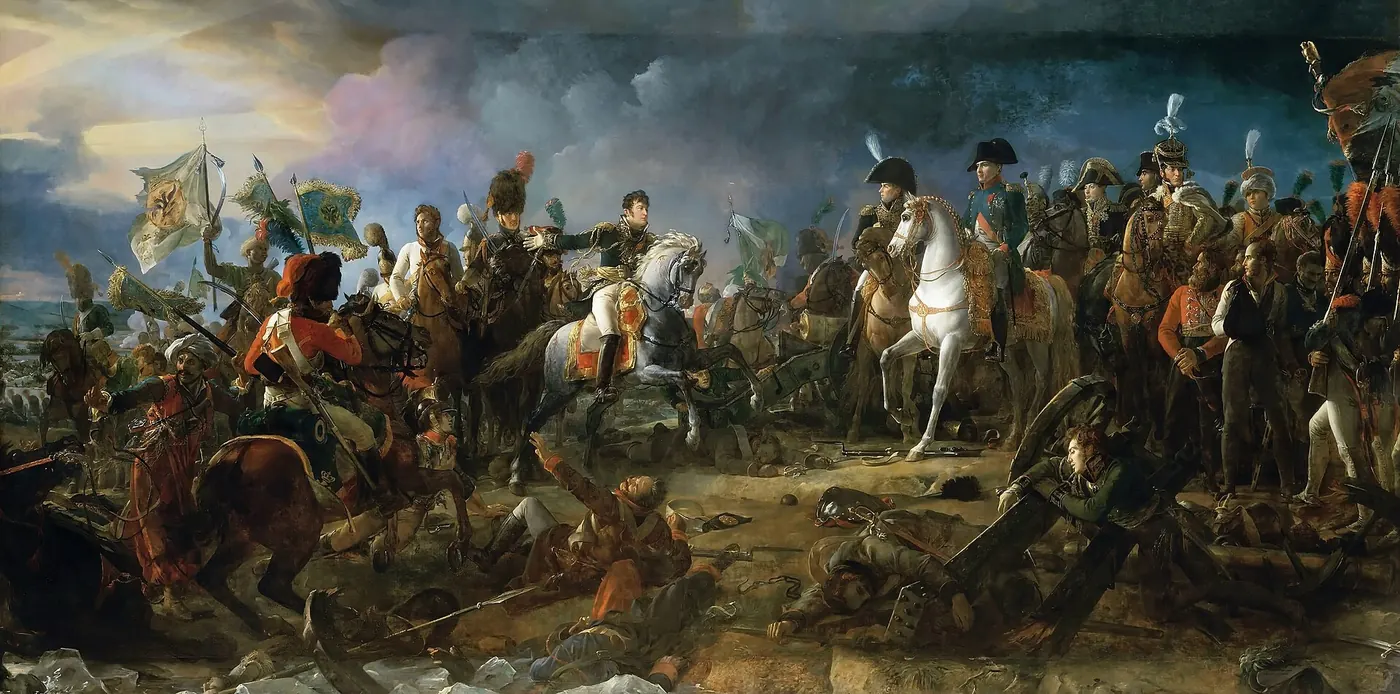
The next day, Napoleon issued a proclamation to his soldiers that opened with "Soldiers, I am pleased with you" and closed with a promise that has remained famous: they would need only to say "I was at the battle of Austerlitz" for people to reply "There is a brave man". Propaganda seized on the day at once; it was already being called the Battle of the Three Emperors.
From the armistice to the Peace of Pressburg
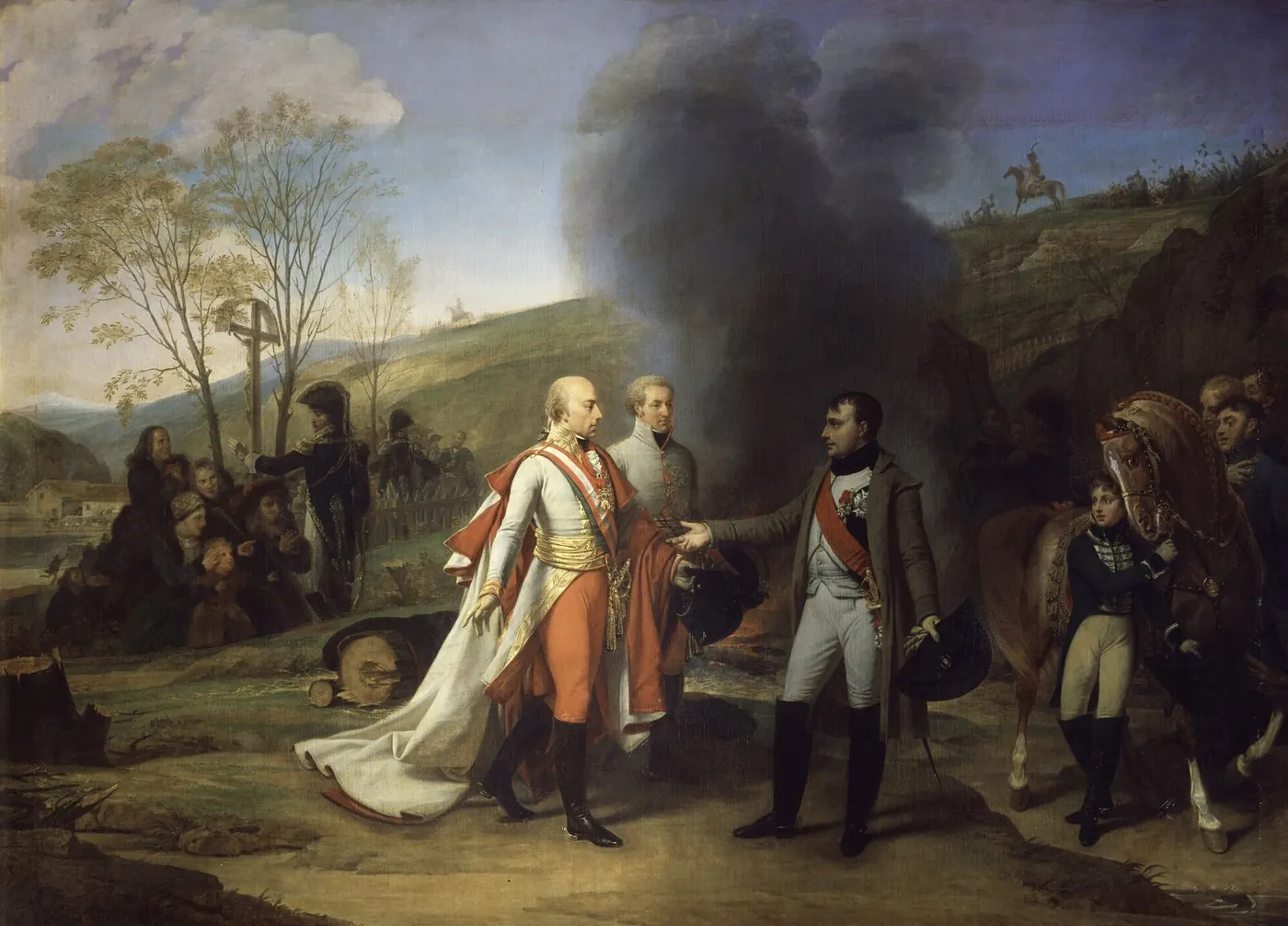
On 4 December, Francis II came to see Napoleon near a mill on the road to Hungary, close to the French bivouac. The two emperors talked in the open air around a fire. Francis asked for an armistice; Napoleon granted it, on condition that the Russians left the lands of the monarchy. The armistice was signed on 6 December, and Alexander led his troops back towards Russia. The Third Coalition had not survived the battle.
Prussia, which had been on the point of intervening, promptly changed its tune. On 15 December, at Schönbrunn, Haugwitz signed a treaty that bound it to France and awarded it Hanover in exchange for other territories. Austria, for its part, had to accept the victor's terms. Peace was signed on 26 December 1805 at Pressburg, present-day Bratislava, by Talleyrand and, for Vienna, by Prince John of Liechtenstein and Count Gyulay. Austria ceded to the Kingdom of Italy what it had received of Venice, together with Istria and Dalmatia; it gave up the Tyrol and the Vorarlberg to Bavaria, and its Swabian possessions to Württemberg and Baden. In compensation it received Salzburg, and it had to pay an indemnity of forty million francs. The Electors of Bavaria and Württemberg took the title of king on 1 January 1806.
Napoleon lost no time in drawing further consequences from his victory. On 27 December he proclaimed from Schönbrunn that the dynasty of Naples, which had joined the coalition, had ceased to reign; Joseph Bonaparte received the crown of Naples the following year. On 14 January 1806, in Munich, Eugène de Beauharnais, Viceroy of Italy, married Princess Augusta, daughter of the new King of Bavaria. Dynastic alliances thus rounded off the treaties.
What 1805 changed
The campaign of 1805 fixed the image of Napoleonic warfare. In little more than three months, from the Channel coast to Moravia, an army organised in self-contained corps had wiped out an Austrian army almost without fighting, taken Vienna and, in a single day, beaten the combined forces of two empires. Military historians made the march from the Rhine to the Danube and the day of Austerlitz into models, studied ever since in every staff college. They also point to the shadows, long erased by propaganda: Dupont's division left to its fate at Haslach, Gazan's division all but lost at Dürnstein, the Hollabrunn armistice that let the Russians slip away, and an army at the end of its strength in Moravia at the close of November.
The political consequences reached far beyond the battlefield. Austria, driven out of Italy and southern Germany, lost its dominant position in the Holy Roman Empire. The southern princes, enlarged by Napoleon, became his clients; on 12 July 1806 sixteen of them formed the Confederation of the Rhine under his protection, and on 6 August Francis II renounced the crown of the Holy Roman Empire, which vanished after a thousand years of existence. The Treaty of Schönbrunn left Prussia in an untenable position, which would end in the war of 1806. Austria, humiliated, would prepare its revenge, which it attempted in 1809.
There remained the sea. The same month of October had seen Napoleon triumph at Ulm and his navy collapse at Trafalgar. The Empire could now dominate the continent, but it could reach England only through trade. From this contradiction would spring the Continental Blockade, and with it the chain of wars that followed.
The memory of 1805, for its part, was carved into the stone of Paris. The Arc de Triomphe du Carrousel, built between 1806 and 1808, celebrates the campaign; the Vendôme Column, inaugurated in 1810, is clad in bronze from guns taken from the enemy. The "sun of Austerlitz", which Napoleon would invoke once more on the morning of Borodino, became an emblem of imperial good fortune. Yet it does not belong to legend alone: it is a reminder that, on that morning, the mist lifted over the Pratzen Heights just as the French columns were preparing to climb them.