After Jena, the war moves east
On 14 October 1806 two battles were fought on the same day, some twenty kilometres apart. At Jena, Napoleon crushed the army of Prince Hohenlohe; at Auerstedt, Marshal Davout, with about 27,000 men, stood up to the main Prussian army, more than 60,000 strong, and routed it. Prussia, which had mobilised at the end of the summer and sent its ultimatum in early October, saw the army whose reputation still rested on the memory of Frederick the Great collapse in a single day.
What followed was a pursuit. Davout's corps entered Berlin on 25 October and Napoleon on the 27th, through the Brandenburg Gate. Hohenlohe capitulated at Prenzlau on 28 October, Stettin and Küstrin opened their gates, Blücher laid down his arms near Lübeck on 7 November, and Magdeburg surrendered the next day. In six weeks nearly all the Prussian forces in the field had been destroyed or captured. From Berlin, on 21 November, the Emperor signed the decree declaring the British Isles in a state of blockade: the birth certificate of the Continental System.
Yet the war did not end. King Frederick William III and Queen Louise had fallen back eastward, to Königsberg and then Memel, and Tsar Alexander I had promised his help. Russian armies were advancing into Prussian Poland. Napoleon, with no peace to sign with an enemy on the run, chose to go and find them. Saxony, Prussia's ally, changed sides: the Treaty of Posen, on 11 December 1806, made it a kingdom and brought its ruler into the Confederation of the Rhine. The Grande Armée marched towards the Vistula. This was no longer the Prussian campaign but what contemporaries would call, in words that say much about what was at stake, the Polish war.
Poland in the wake of the Grande Armée
The French entered Posen on 27 November, and the welcome of the Poles struck every witness. Since the partitions of 1772, 1793 and 1795 the Polish state had ceased to exist, and part of its elites had served France for more than ten years, notably in Dąbrowski's legions in Italy. Jan Henryk Dąbrowski and Józef Wybicki, author of the song that would become the national anthem, called for troops to be raised in Greater Poland. Murat entered Warsaw on 28 November; Napoleon arrived on 19 December. A governing commission was set up in January 1807, and the Polish regiments, which would be in action until 1812, multiplied.
Yet the Emperor promised nothing. Restoring Poland would have meant quarrelling for good with Austria and Prussia, which held pieces of it, and closing every door to an understanding with Russia. He let the Poles hope, used their men and their supplies, and took care not to commit himself on the future. This ambiguity, which would weigh heavily in 1812, is already one of the features of the campaign: for many Poles France was the only power that could bring their country back to life; for Napoleon, Poland was one instrument among others.
Pułtusk, Golymin and the December mud
Facing him, the Russians were at first commanded by the aged Field Marshal Kamenski, who avoided battle and fell back, letting the French cross the Vistula almost without a fight. Then Bennigsen took over the army. On 23 December, at Czarnowo, the French seized a crossing of the Wkra. Three days later, on 26 December 1806, two bitter engagements were fought on the same day, at Pułtusk and Golymin, and settled nothing: the Russians withdrew, but neither of their armies had been destroyed.
It was less the Russians than the country that halted the French. The thaw had turned the roads of Poland into quagmires where the artillery sank, where the convoys could no longer pass and where the soldiers went short of bread. Napoleon, who had hoped to finish before winter, put his army into cantonments. The campaign seemed to be heading for a pause. It would not last a month.
Bennigsen's winter offensive
In January 1807 Bennigsen tried to surprise the French left wing by moving the bulk of his army north, into East Prussia, with a Prussian corps covering his right. He first ran into elements of Marshal Ney's VI Corps, which had pushed its cantonments well north of the assigned zone, against the Emperor's orders, and then turned on Bernadotte's isolated I Corps. The combat of Mohrungen, on 25 January, allowed Bernadotte to extricate himself.
Napoleon saw an opportunity. He ordered Bernadotte to fall back before the Russians to draw them on, and sent the rest of the Grande Armée north to envelop their left wing and cut their road east. Chance ruined the plan: Cossacks intercepted the officer carrying Bernadotte's orders and handed them to Prince Bagration. Bennigsen, forewarned, at once ordered a retreat. A pursuit of several days in the cold began, from Bergfried on 3 February to Hoff on the 6th, where each side lost about 2,000 men. After several attempts to make a stand, Bennigsen halted in front of the small town of Preußisch Eylau.
Eylau, 7 and 8 February 1807
The battlefield is a gently rolling plateau, broken by frozen ponds and woods, north-east of the town. The Russians lined up along two ridges, facing the French, who held the ground to the west. On 7 February Bagration's rearguard defended the plateau in front of Eylau, then the town itself. Sources disagree on how the fight began: Napoleon would say he had wanted to pin the enemy down and shelter his soldiers from the cold, while other accounts describe an engagement that started without orders. Whatever the truth, night fell with some 4,000 dead and wounded on each side and the French holding the town. Both armies slept in the snow without food.
On the morning of the 8th, Bennigsen fielded some 67,000 men and 400 to 460 guns. Napoleon had 48,000 to 49,000 soldiers and about 300 pieces. Everything depended on reinforcements: the French were waiting for Davout, with some fifteen thousand men, then Ney; the Russians for a Prussian corps of about 8,500 under L'Estocq. Snow fell without a break. A long artillery duel went rather in the French favour, sheltered as they were by the houses of Eylau and Rothenen.
Then came the moment that every account remembers. Napoleon, wanting to pin the Russians down while Davout enveloped their left, sent Augereau's VII Corps, Augereau himself ill, against the centre. A snow squall blinded the columns, which drifted to the left and found themselves, on their flank, a few hundred paces from the great Russian battery. In a few minutes the VII Corps lost about 5,200 men. The French centre was nearly broken through, and the Emperor, posted at the Eylau cemetery, watched the Russians come within reach of his own position. The Old Guard saved the situation with the bayonet, but the centre remained in disorder for hours.
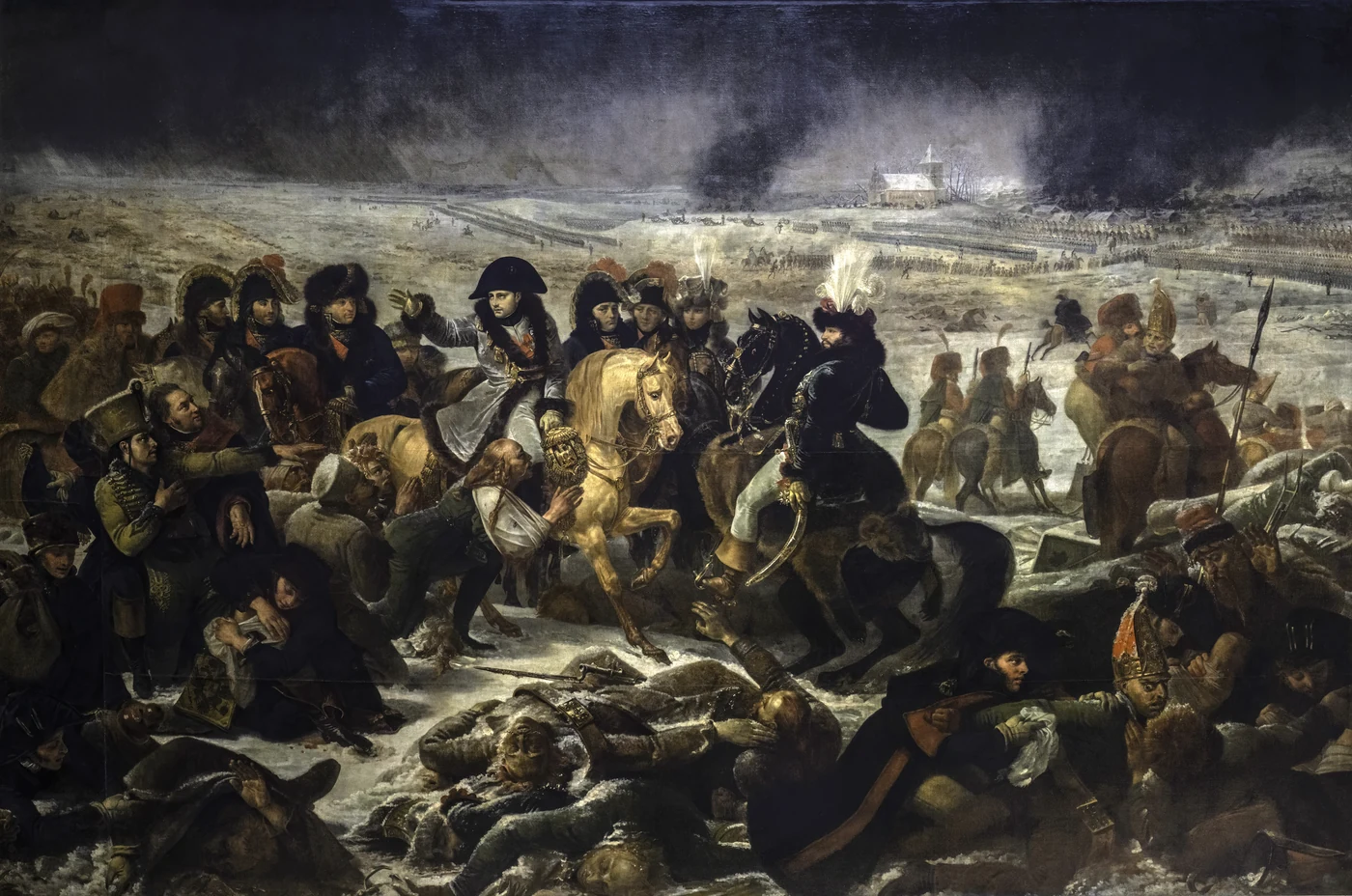
To restore the situation Napoleon had only one card left: the reserve cavalry. Murat launched between 10,700 and 11,000 horsemen, Grouchy's dragoons, d'Hautpoul's cuirassiers and the cavalry of the Guard. The charge cut through the Russian lines, sabred the gunners of the batteries, then rode back. It was costly, and General d'Hautpoul, his thigh shattered, refused amputation and died on 14 February, but it gave Davout time to deploy and broke the Russian momentum.
The day was then decided in the south-east, where Davout pushed back the Russian left wing until it formed a right angle with the centre. By about 3.30 p.m. it seemed about to break. That was when L'Estocq arrived. His 8,500 men counter-attacked Davout's exposed flank and drove him back for three hours. Around 7 p.m. the head of Ney's VI Corps at last emerged on the Russian rear, but it was too late to decide anything. At 11 p.m. Bennigsen gave up a third day of fighting and withdrew towards Königsberg. The exhausted French noticed only at 3 a.m.
The toll defies accounting. Estimates of losses run from 10,000 to 25,000 men on the French side and from 15,000 to 20,000 on the Russian, and the 58th Bulletin, with its 1,900 killed and 5,700 wounded, is no longer believed by anyone. Twenty-three French generals were put out of action, eight of them dead. Napoleon stayed ten days on the spot and had the wounded cared for, which was not his habit. He could not call himself beaten, since the field was his, but he had not destroyed his opponent either. Eylau was the first serious check inflicted on the Grande Armée, and the myth of invincibility emerged chipped. In Saint Petersburg it was regarded as a victory, and Bennigsen won the Order of Saint Andrew for it.
The spring of rebuilding
The day after Eylau, Napoleon had General Bertrand offer the King of Prussia a separate peace: French withdrawal and the frontiers restored. Berlin refused, because Prussia remained tied to Russia, and on 26 April 1807, at Bartenstein, the two powers pledged to continue the war together. It would take both armies more than three months to recover.
The Emperor used the respite for two tasks. The first was to secure his rear: the great Prussian fortress of Danzig, besieged since the spring by Marshal Lefebvre, capitulated at the end of May, which freed troops and secured the army's supplies on the lower Vistula. Lefebvre would earn the title of Duke of Danzig for it. The second was to rebuild an army that had lost part of its officers since Eylau. His headquarters moved in April to Finckenstein Castle in East Prussia; from there he governed the Empire, dealt with Paris business by courier and, on 4 May, concluded a treaty of alliance with Persia, the first step in an eastern diplomacy that would lead to nothing lasting.
Heilsberg and Friedland
The resumption of operations came from the Russians. On 5 June Bennigsen's columns converged on Ney's VI Corps, which fought, outnumbered three or four to one, two days of rearguard actions around Guttstadt and recrossed the Passarge with most of its troops. Napoleon then concentrated his army and found the Russians entrenched at Heilsberg, on the Alle. On 10 June Murat attacked without waiting for the bulk of the army, and his assaults on the redoubts proved very costly. Yet the next day Bennigsen broke off and moved down the Alle towards Königsberg. Napoleon divided his forces: Murat, Davout and Soult marched on the capital of East Prussia, while Lannes, Ney, Mortier and Victor followed the Russians with the Guard.
On 13 June Lannes's advance guard reached Friedland, a town built in a bend of the Alle whose bridges allowed Bennigsen to cross back to the left bank. The Russian general thought he saw a chance to crush an isolated corps before Napoleon arrived. His pontoon bridges were thrown in the narrow neck formed by the town: without knowing it, he was shutting his army inside the bend of the river.
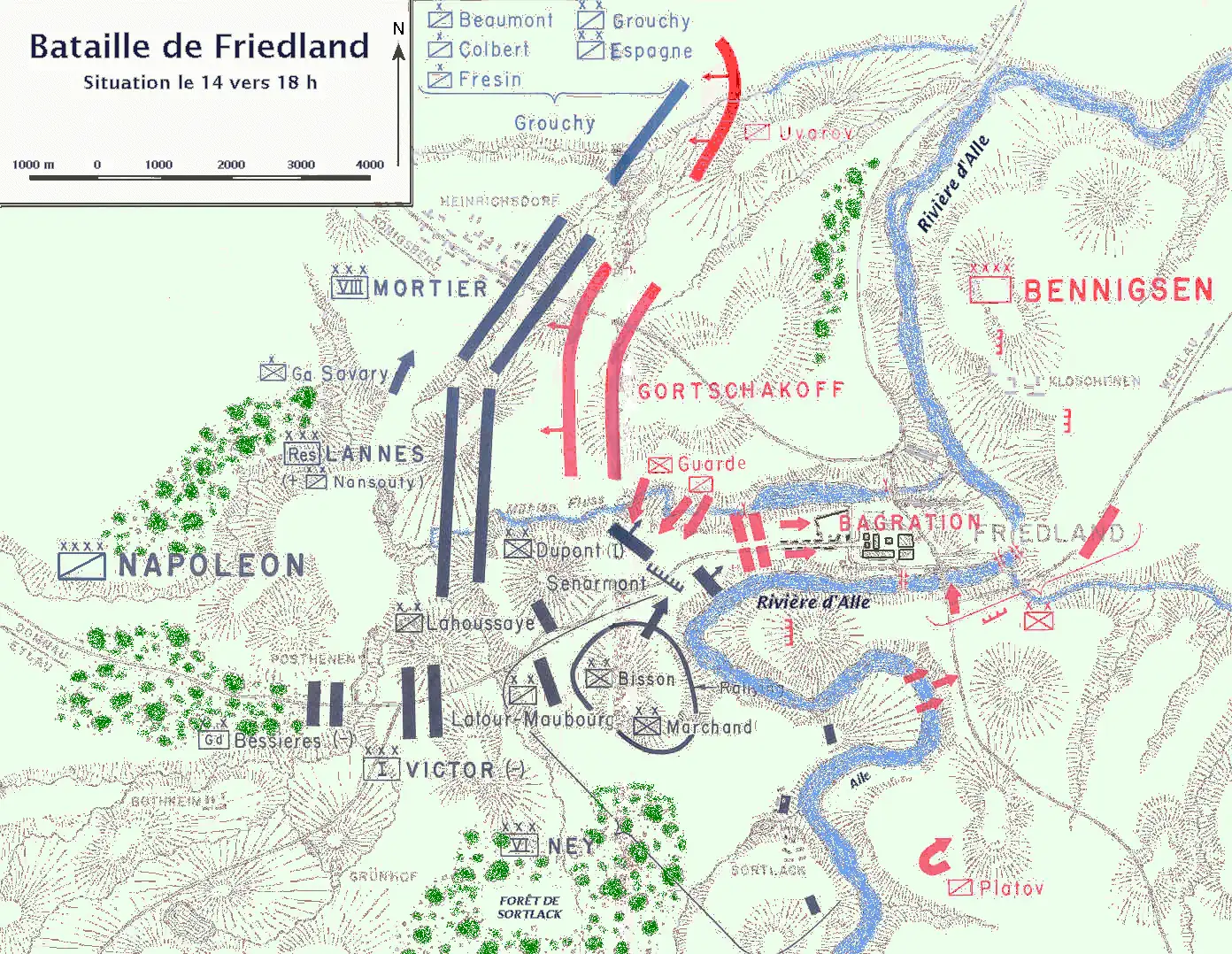
On 14 June, at three in the morning, the first shots rang out in the Sortlack wood. For nearly nine hours Lannes, with about 12,000 men, stretched his lines to look stronger and pinned down a Russian army of some 46,000 on the left bank. He urged the Emperor to come. Napoleon arrived shortly after noon, took command, and is said to have refused to postpone the attack until the next day, remarking that one does not catch the enemy out twice in such a mistake. 14 June was also the seventh anniversary of Marengo.
The attack was launched at 5.30 p.m., on a signal from twenty guns. Ney came out of the Sortlack wood and drove Bagration's left back towards the town, before the Russian cavalry, the Chevalier Guards in particular, broke his momentum. This was the critical moment. Napoleon then committed Victor's I Corps, and above all General Sénarmont, whose artillery advanced by successive bounds across the plain: first from 1,600 metres, then 150, and even less according to Russian accounts. At that range canister shot mowed down whole ranks. Within minutes the Russian left collapsed and flowed back towards Friedland, which Ney's troops reached around 8 p.m.
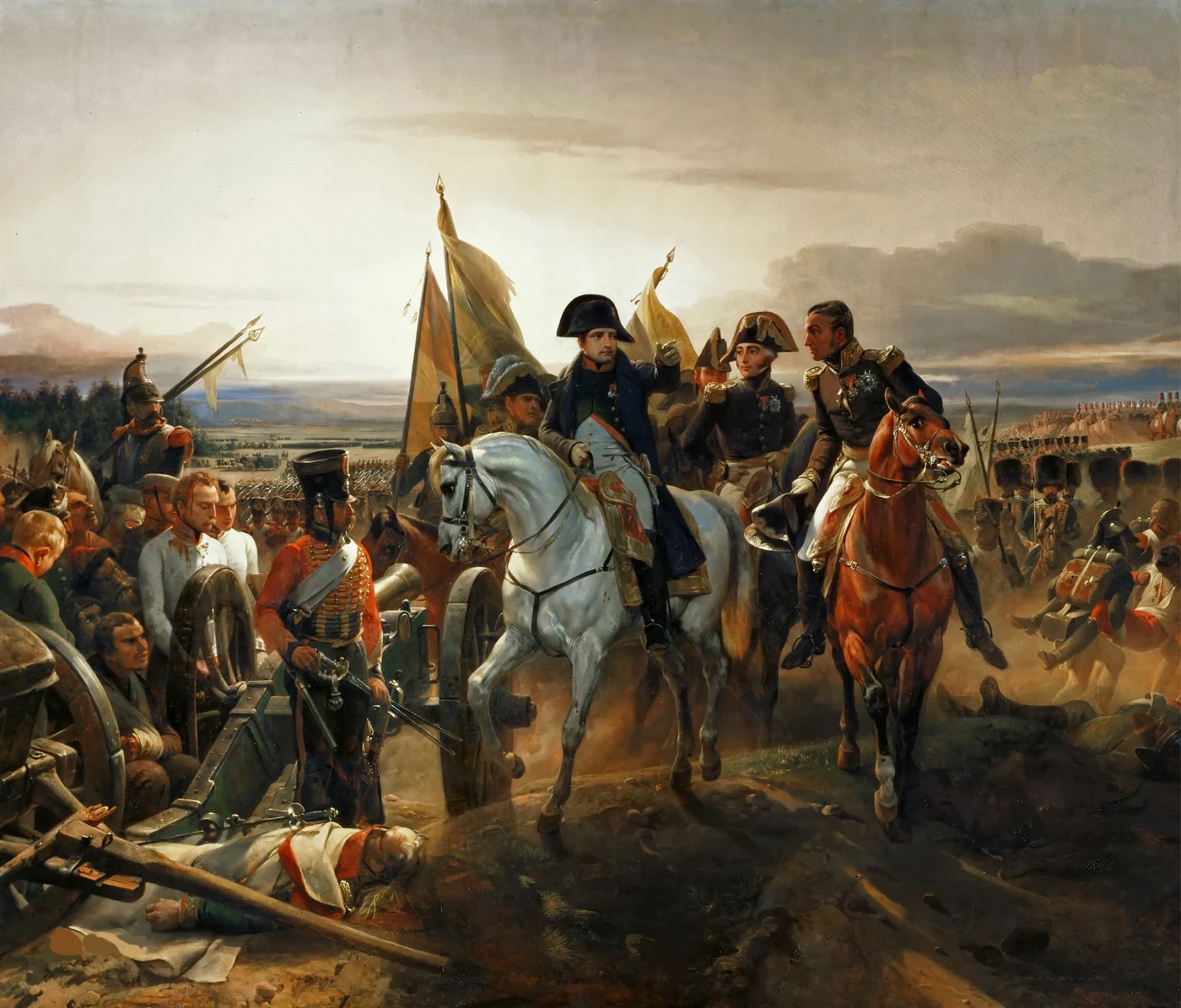
The town was burning, and the Russians had set fire to their bridges as they withdrew. Gorchakov's right wing, cut off from the rest of the army by the mill stream, forced its way to the river and found almost no bridge left; some soldiers drowned, others crossed at fords downstream. By 11 p.m. the guns fell silent. The figures are disputed: French reports give about 10,000 men out of action on their own side, foreign historians put Russian losses at 20,000 to 25,000, Russian authors at 10,000 to 15,000. But what nobody disputes is that Bennigsen's army had been driven from the left bank in disorder and could no longer hold. On 16 June Soult entered Königsberg, where he found large stores of supplies.
Tilsit
The defeat convinced Alexander I that peace was necessary. An armistice was signed on 21 June, and on the 25th the two emperors met on a raft moored in the middle of the Niemen, near Tilsit. In the following days Tilsit was declared neutral and the two sovereigns met there almost every day. The King of Prussia was kept at arm's length; Queen Louise came to plead his cause with Napoleon on 6 July, without success.
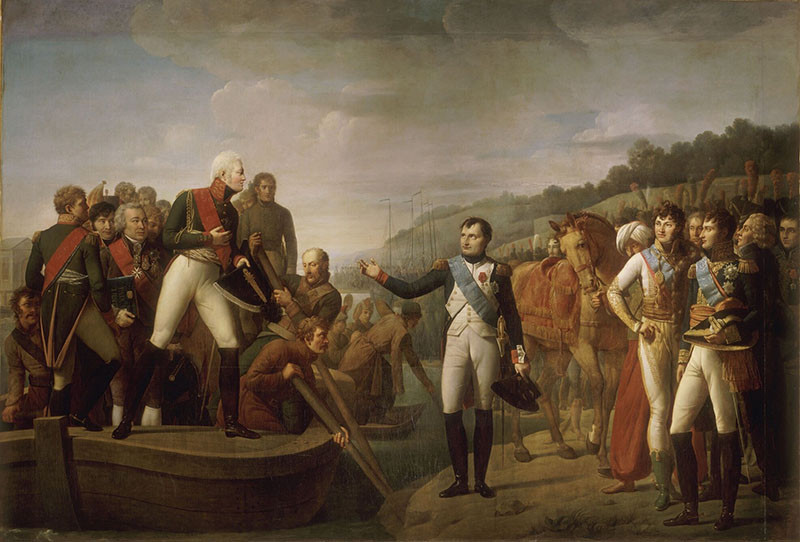
The treaties were signed on 7 July with Russia and on 9 July with Prussia. They did not treat their signatories alike. Russia, which lost little ground, became France's ally, joined the Continental System and was given the role of mediator with Great Britain. Prussia lost nearly half its territory. Its possessions west of the Elbe, added to other lands, formed the Kingdom of Westphalia, entrusted to Jérôme Bonaparte. The provinces it had gained in the partitions of Poland were used to create the Duchy of Warsaw, granted to the King of Saxony, while Danzig became a free city. Russia, for its part, received the Białystok region.
What the campaign changed
For many historians, Friedland and Tilsit mark the zenith of the Empire: no continental power any longer challenged French domination, and Prussia was a diminished state. Yet the campaign left weaknesses. Eylau had shown that the Grande Armée could be halted by climate, distance and a determined opponent; Friedland restored the superiority of artillery and manoeuvre, but at the price of a peace that rested on the goodwill of one man, the tsar. The Tilsit alliance would fray from 1810, and it was again across the Niemen that the Grande Armée entered Russia in 1812.
Prussia, for its part, undertook under Stein, Hardenberg and Scharnhorst the reforms that within a few years would transform its administration and its army. As for Poland, it obtained a state but not independence: the Duchy of Warsaw, endowed with a constitution and the French Civil Code, remained dependent on Napoleon and on Saxony. It would be enlarged in 1809 at Austria's expense and would vanish with the Empire. The name of Tilsit, finally, remained attached to an idea that contemporaries wanted to believe eternal: two emperors dividing Europe on a raft in the middle of a river. It lasted little more than five years.
Further reading
- Thierry Lentz, Nouvelle histoire du Premier Empire, vol. I, Napoléon et la conquête de l'Europe, 1804-1810, Fayard, 2002.
- David G. Chandler, The Campaigns of Napoleon, Macmillan, 1966.
- Francis Loraine Petre, Napoleon's Campaign in Poland, 1806-1807, London, 1901.
- Dominic Lieven, Russia Against Napoleon. The Battle for Europe, 1807 to 1814, Allen Lane, 2009.
- A witness: Marcellin de Marbot, Mémoires, published in 1891, Augereau's aide-de-camp at Eylau.