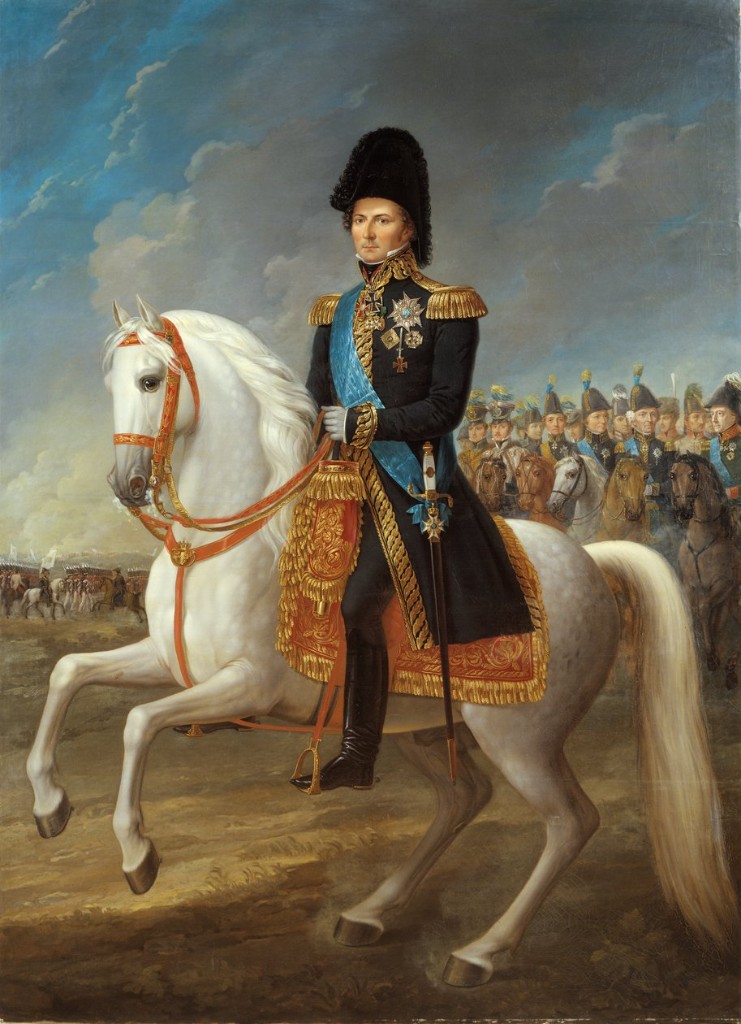
Jean-Baptiste Bernadotte (1763-1844), a prosecutor's son from Pau, served the whole Revolution in combat before becoming one of the Empire's first eighteen marshals. His marriage to Désirée Clary tied him to the Bonapartes without subduing him: he refused 18 Brumaire, drew Napoleon's fury after Auerstedt by failing to join Davout in time, then faced disgrace after Wagram. Elected Crown Prince of Sweden in 1810 as Charles John (Karl Johan), he broke with Paris, negotiated with tsars and the British, commanded the Army of the North at Leipzig, and ended his life as Charles XIV John, King of Sweden and Norway — founder of the Bernadotte dynasty, the only Napoleonic marshal to mount a European throne. His path mixes personal ambition, statecraft, and legend: on Saint Helena Napoleon was said to claim he was only « French » while France served him, and Swedish as soon as the crown called.
Pau, Revolution, Rhine, Italy and the Bonaparte sphere
Jean-Baptiste Bernadotte was born on 26 January 1763 at Pau, in Béarn. His father, king's prosecutor, embodied robe bourgeoisie; the family had neither spectacular titles nor fortune, but enough culture and connections for a second son to consider the army. In 1780 he enlisted in the Royal-Marine regiment; monarchical discipline taught him hierarchy before the Revolution overturned the rules. From 1792 volunteering and merit promotion raised him: sergeant-major, adjutant-general, then brigadier general in 1794 at thirty-one — a pace only mass war made possible.
Rhine campaigns, then Italy and Germany, forged the soldier and military courtier. Bernadotte served under generals of varied temper; he gained a reputation for controlled daring and assumed pride. Bulletins cited his brigades in clashes with Coalition forces; he moved in circles where constitution and national glory were debated. He was not yet the imperial marshal, but the man the Directory and soon Bonaparte would use — provided they accepted his independence of mind.
In August 1798, at Suresnes, he married Bernardine Eugénie Désirée Clary, daughter of a wealthy Marseille merchant and sister of Julie, Joseph Bonaparte's wife. Désirée had been engaged to Bonaparte in 1795 before his marriage to Josephine; that sentimental past wove an awkward yet useful symbolic kinship. Bernadotte entered the family by alliance without ever seeing himself as an obedient junior: he frequented Lucien, Joseph, sometimes Napoleon, but kept political views he voiced when the cost seemed acceptable.
During the coup of 18 Brumaire Year VIII, Bernadotte was Minister of War of the Directory. He refused openly to back the Bonaparte plot and stayed aloof — a gesture memorialists read as either cowardice or republican prudence. Napoleon, once First Consul, did not dismiss him: he needed tested generals and knew Bernadotte's wife tied the Béarnais to his clan. Gradual reintegration led to the marshalate of 1804: Bernadotte was among the first eighteen marshals, proof absolute loyalty was not the new regime's only criterion.
Consular and early imperial years saw him command army corps, inspect coasts, take part in great manoeuvres preparing Austerlitz and the Prussian campaign. His style — sharp orders, demands on staff, sometimes tactical stubbornness — fed both peers' jibes and flattering bulletins. The contrast with Davout, Murat, or Lannes was striking: Bernadotte was neither the favourite of spectacular charges nor the cold administrator; he embodied the Revolutionary officer convinced he had earned every stripe.
Before the Prussian storm of 1806 he received the sovereign principality of Pontecorvo in the Kingdom of Naples — a typically Napoleonic reward, half-feudal half-political theatre, giving him a court title without removing him from the German battlefield where his reputation would shift.
Marshal, Auerstedt, Pontecorvo and the disgrace of Wagram
The double battle of Jena and Auerstedt on 14 October 1806 remains at the heart of the dark — or grey — legend of Bernadotte. Napoleon expected his I Corps, under the marshal, to converge on the field where Davout alone faced a larger Prussian mass. Bernadotte, by his defence, took another route, cited prior orders or the need to preserve his corps; by the Emperor and part of the staff, he disobeyed and let Davout win an almost single-handed victory that would crown him « marshal of Auerstedt. » The phrase attributed to Napoleon — « Bernadotte disobeyed me » — sums lasting mistrust: henceforth every move by the marshal would be read through that lens.
Modern historians still debate: grave fault, contradictory reading of dispatches, or rivalry of pen between witnesses? In any case politics outweighs tactical chronicle alone: Bernadotte was not dismissed, but he was no longer in the inner circle. The Principality of Pontecorvo gave him a showcase in southern Italy while the Empire chained Friedland and Tilsit. Bernadotte administered there, levied contributions, had himself painted as a cabinet sovereign — paradox of a man whose European career had only begun.
In 1808 the Spanish war pulled him from the principality for commands in the Iberian theatre; there he faced guerrilla, the British, logistical complications that eroded the legend of the German campaigns. His record was neither Soult's nor that of complete losers; he remained a « correct » marshal in a thankless conflict. Letters to the Emperor mixed situation reports and wounded pride: Bernadotte knew he was watched.
In July 1809 at Wagram he commanded the Saxon corps in the decisive battle against Austria. His performance was judged mediocre: difficult coordination with allied troops, heavy losses, lack of brilliance compared to other wings. Bernadotte was wounded; worse, he lost active command. The break with Napoleon was complete on the military plane, even if titles and peerage remained. For a still relatively young officer, the impasse was clear: remain a secondary figure of the Empire or seek a stage where his name weighed alone.
The painting of the Battle of Auerstedt, familiar from textbooks and Prussian collections, embodies the day Davout entered legend — and Bernadotte, by his absence from the main clash, entered Napoleonic legend as the antithesis of the marshal faithful unto death. It is not his portrait; it is the setting that condemns or absolves according to the reader's camp.
Crown Prince of Sweden, Charles John and the Coalition
In 1810 Sweden faced a dynastic crisis: Charles XIII ascended without a viable male heir in traditional branches. Parliamentary and military factions sought a foreign prince able to restore the state after the loss of Finland to Russia. A pro-French party put forward Bernadotte: his presumed clemency toward Swedish prisoners in 1806, his fame as a general, and the idea that a link with the Empire might protect the kingdom. On 21 August 1810 the Estates elected him Crown Prince. Bernadotte left the French uniform to become Charles John — Karl Johan —, converted to Lutheranism, obliged to learn Swedish and embody an evolving constitutional monarchy.
The Crown Prince's first years mixed ambiguous loyalty to Paris and the need to please the Estates. By 1812 geopolitics forced a pivot: Bernadotte negotiated with Tsar Alexander and the British; Sweden abandoned the continental alliance imposed by Napoleon and joined the coalition against imperial France. For the Emperor it was treason; for Stockholm, survival. Karl Johan marched with Prussians and Russians; in 1813 he commanded the Army of the North — a mix of Swedish, Prussian, and other contingents — on the German theatre.
At Leipzig in October 1813 the « battle of the nations » saw Bernadotte as commander of a major allied formation. Tactical detail — where exactly to commit his wing, how to coordinate with Schwarzenberg or Blücher — remains matter for monographs; politically the image is clear: the former marshal of Napoleon contributed to the numerical collapse of the Grand Army. Swedish bulletins celebrated the prince; French memorialists called him renegade.
The Treaty of Kiel (1814) and subsequent negotiations reorganised northern Europe: Norway, united with the Danish crown, became a stake; Karl Johan conducted a brief military campaign leading to the personal union Sweden-Norway under the crown he would soon hold in full title. This phase illustrates his method: combine diplomatic manoeuvre, moderate armed pressure, and respect for local constitutional forms where possible.
The portrait in full royal dress, executed after his effective accession to the Swedish-Norwegian throne, contrasts with marshal's uniforms: ermine mantles, Scandinavian orders, the cool gaze of a sovereign who survived two centuries of Napoleonic historiography. For posterity it is the image of the « Frenchman who became king of the North » — journalistic simplification, yet a sign of the transformation accomplished in one decade.
Reign, Norwegian union and end under Oscar I
On the death of Charles XIII in February 1818, Bernadotte ascended the throne as Charles XIV John. He reigned over Sweden and, by personal union, Norway until his death in 1844. His style was that of a pragmatic conservative sovereign: he respected constitutional instruments inherited from Gustavian reforms and recent evolution, while asserting royal authority in foreign policy and high military command. Debates on parliamentarism, press freedom, and economic reform ran through his long reign without a revolutionary explosion comparable to 1789.
The Norwegian question occupied a central place: Norwegian society, heir to resistance to forced union, gradually obtained its own institutions — Storting, budgetary powers — under a crown Charles XIV John defended as guarantor of restored European order. Tensions did not vanish; they were channelled into compromises that would prepare the peaceful dissolution of the union in 1905, long after his death.
Internationally, the former marshal king kept prudent relations with Russia, Great Britain, and German monarchies. He did not forget his origins — French family visits remained possible — but Swedish state duty came first. Désirée, queen consort after 1818, embodied a French presence in Stockholm feeding chronicles and novels; their marriage, long geographically stretched, remained a solid dynastic alliance on paper.
The old king prepared the succession of his son Oscar, born Joseph François Oscar Bernadotte in 1799, raised in Swedish frameworks and trained to rule. In 1844 Charles XIV John died aged eighty-one after more than six decades in the service of Revolutionary France then the Scandinavian crown. Funerals mixed Lutheran rites and military pomp inherited from Enlightenment armies — last coherence of a bifurcated life.
Scandinavian historians stress administrative modernisation and state consolidation; French historians sometimes still read him as « defector. » Both readings coexist in a career that was, above all, that of a statesman who changed fatherland without renouncing the idea of having served each according to the lights of the moment.
Désirée, Napoleonic memory and the living dynasty
Désirée Clary survived her husband until 1860; she embodied the lasting link between the Stockholm court and memory of the Mediterranean Revolution. Her late arrival at court — she lived in Stockholm durably only after years spent largely in Paris — fed the romantic legend of a « two-headed » royal couple. For Bernadotte the marriage had been a political asset from 1798; for nineteenth-century Europe Désirée became a figure of comedy and tragedy alike, between Paris salons and northern palaces.
Napoleonic memory often truncates Bernadotte into anecdote: Auerstedt, Wagram, then the « betrayal » of 1812. Recent work restores a finer trajectory: Republican officer, marshal of the Empire, prince elected by a foreign parliament, constitutional king. Each stage obeyed precise constraints; the tale of the mere opportunist masks the coherence of a calculus where survival and perceived honour combined.
The Bernadotte dynasty still reigns over Sweden in the twenty-first century; only the Norwegian branch separated with independence in 1905. That institutional longevity far outlasts most houses founded by marshals of the First Empire — confiscated ducal titles, extinct branches, forgotten names. Bernadotte thus offers a powerful counter-example to the idea that Napoleonic state aristocracy produced only grand officers without sovereign posterity.
The remark attributed to Napoleon on Saint Helena — that Bernadotte was only French insofar as it served his interests — sums a cynical reading a balanced biography must confront with Swedish archives and personal letters: serving two successive nations does not necessarily imply duplicity at every turn; it may reflect shifting loyalties in a century when nation-states were recomposed by war.
Discover other characters
Napoleon Bonaparte
Emperor of the French
Louis-Nicolas Davout
Marshal of the Empire, Prince of Eckmühl
Joseph Bonaparte
King of Naples, then of Spain
Joséphine de Beauharnais
Empress of the French
Eugène de Beauharnais
Viceroy of Italy
Alexander I Pavlovich, Emperor of all Russia
Emperor of all Russia (1801–1825)
Go further
Recommended books to dig deeper (affiliate links)

Napoleon the Great
Andrew Roberts · 2014
A monumental biography drawing on Napoleon’s 33,000 surviving letters, admiring but rigorous.
See on Amazon
Napoléon ou le mythe du sauveur
Jean Tulard · 1977
The book that reshaped how the man is read: how France gave itself a saviour, and what it cost.
See on Amazon
Nouvelle histoire du Premier Empire
Thierry Lentz · 2002-2010
Four reference volumes on institutions, diplomacy and collapse: the scholarly synthesis of the subject.
See on AmazonAs an Amazon Associate, this site earns from qualifying purchases.
Support the encyclopedia
Napoleon Empire is an independent project. Your contribution helps grow the content and keep the site running.
DonateSecure payment on the platform you choose.