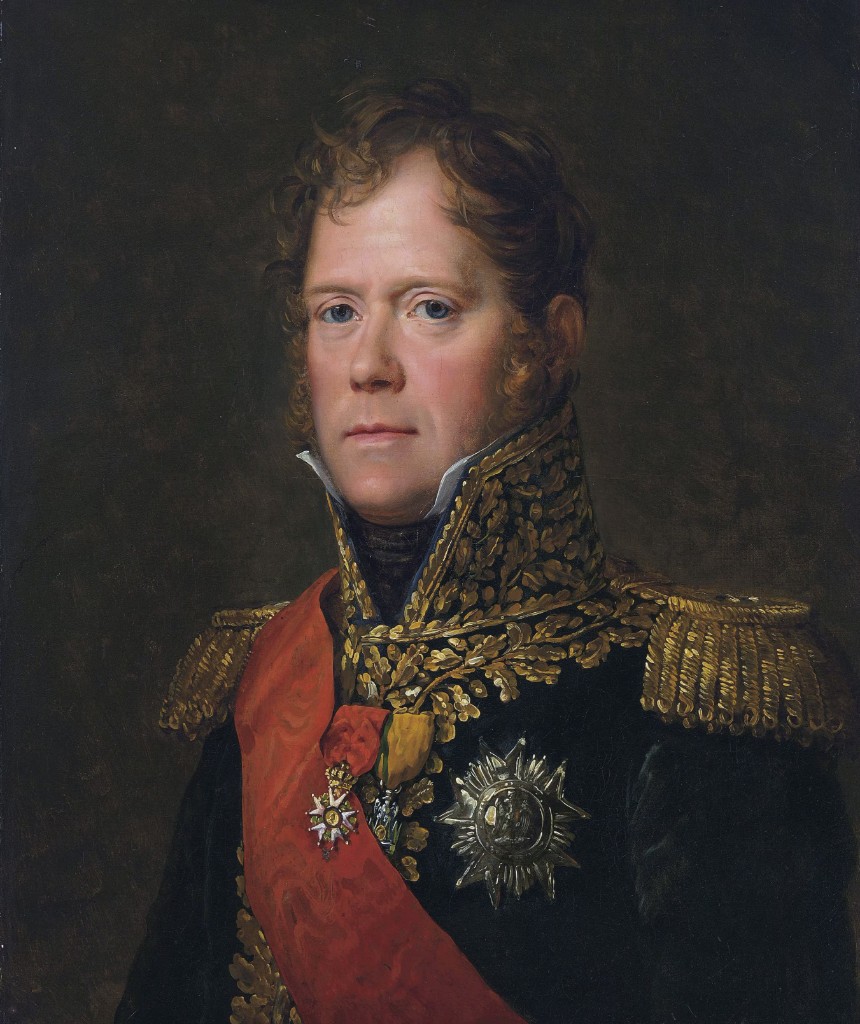
Michel Ney (1769-1815), Prince of the Moskova and Count of Elchingen, Marshal of the Empire from 1804, embodied the officer who rose through the Revolutionary wars and was crowned by the imperial state: nicknamed « the Bravest of the Brave » by Napoleon after Eylau, he remains the popular face of rearguard endurance in the Russian retreat and of tactical impetuosity at Quatre-Bras and Waterloo. Son of a cooper at Saarlouis, shaped by the French- and German-speaking borderlands, he climbed from hussar to general, married Aglaé Auguié in Joséphine's circle, commanded in Spain against Wellington, lived through the Berezina and Krasnoï, swore allegiance to the Bourbons then rallied the Emperor in 1815, was condemned for treason by the Chamber of Peers, and shot on 7 December 1815: between military glory, political dilemma, and a trial that shaped post-Napoleonic memory, his career sums the tensions of a fighting elite caught between Bourbon legality and Bonapartist loyalty.
Saarlouis, Revolution, and the marshalate: to the « Bravest of the Brave »
Michel Ney was born on 10 January 1769 at Saarlouis, a fortress town in Moselle, into a family of coopers: his father Pierre practised a respectable but narrow trade; his mother Marguerite Greiner ran the household. The town, French again after mid-eighteenth-century Lorraine annexations, lived in practical bilingualism where the young Michel early learned to move between administrative French and German-speaking Sarre country — flexibility that later helped read Rhineland maps and coordinate with German-speaking allies or foes.
In 1788 he enlisted in the 4th Hussar regiment (Colonel-General): the monarchy hesitated on reform, but light cavalry drew quick minds. The Revolution opened brutal social lifts: noble officers' departures freed posts; the endangered fatherland called for skill rather than name. Ney distinguished himself at Valmy (1792), Jemappes, and the long siege of Mainz (1793): the hussar became squadron chief, then brigadier general in 1794 — a pace then earned only by personal daring and a feel for ground.
Campaigns on the Rhine, then Switzerland under Masséna (1799), sharpened the tactician: war of posts, forced marches, cavalry-infantry liaison. At Hohenlinden (3 December 1800), his cavalry division's charge helped Moreau defeat Archduke Charles: Napoleon Bonaparte, now First Consul, noted the steady sabre of this general without salon glitter. The Peace of Amiens and the Consulate steadied the career: in 1802 Ney married Aglaé Louise Florence Auguié, daughter of one of Joséphine's ladies-in-waiting — a match that placed him in the future imperial circle without making him a courtier.
The senatus-consulte of 1804 counted him among the first eighteen marshals: at thirty-five, the Saarlouis cooper's son wore the grand embroidery and army command. The Austrian and Prussian campaigns (1805-1806) confirmed his stature: at Eylau (8 February 1807), in snow and shot, his corps held the Russian front long enough to stave off collapse; Napoleon publicly hailed « Marshal Ney, the Bravest of the Brave » — a phrase that for two centuries fixed the hero label on the man, beyond finer tactical shades.
At Friedland (14 June 1807), Ney broke the Russian left and helped win the decisive victory that led to Tilsit. Imperial dispatches then mingled his name with battles that cemented continental domination. But the Spanish war (1808-1811) showed the limits of courage alone: captures such as Ciudad Rodrigo, clashes before the Torres Vedras lines, constant friction with Wellington and with rival marshals (Soult, Masséna) exposed Ney to quarrels and debatable tactics — costly charges, late marches — that later legend would not erase as thoroughly as imperial propaganda.
Marshals' prints and portraits circulated under the Empire — here a colour engraving signed « Gautier sc. » showing Ney in full dress, grand cordon and orders — crystallise the official image of the « Bravest of the Brave » in the age of Eylau and the bulletins, a visual counterpart to Gros's canvas dominated by the imperial figure.
1812: the Moskova, the retreat, Krasnoï, and the Berezina
In 1812 Ney commanded the III Corps of the Grand Army in the Russian enterprise: a hundred and fifty thousand men at the start, stretched logistics, a political objective blurred once Moscow was taken. At the Moskova — Borodino to the Russians — on 7 September, his corps joined repeated assaults on the central redoubts; Ney was wounded in the neck. The day left two exhausted armies; Napoleon entered a capital that burned and emptied. From then the campaign shifted to a strategic retreat that cold, partisans, and Cossacks would turn into a mythical ordeal.
Ney took the rearguard: a post of honour and sacrifice. He fought for Smolensk, crossings, bivouacs where thousands of infantrymen died without battle. At Krasnoï (17 November), a scene documented by witnesses and memoirs: isolated with a reduced nucleus while the main columns had slipped west, he refused Russian capitulation, crossed woods and the frozen river, gathered scattered fragments, and rejoined Napoleon at Orsha. The Emperor, in the famous phrase, embraced him: « I have found my Ney again » — sometimes romanticised, yet revealing the marshal's symbolic role in the imperial story of survival.
At the Berezina (late November), Eblé's pontonniers threw up makeshift bridges under fire; Ney, with Victor and others, held the west bank against Wittgenstein while the army crossed in indescribable disorder. On 29 November, when the bridges went, thousands of stragglers and civilians stayed on the east bank. Ney crossed among the last, carrying the now metallic reputation of the soldier who does not let go.
Back in France, Napoleon made him Prince of the Moskova (March 1813): an ambiguous title — the battle had not been a clear French victory — but public recognition of courage at the river and on the retreat. The marshal, exhausted, nonetheless returned to duty in the 1813 German campaign; Leipzig and the Empire's collapse would soon lead him to the world of 1814 where loyalty was measured differently.
Adolphe Yvon's painting of Marshal Ney in the snow of the Russian retreat (c. 1812) sums for posterity the rearguard epic: fur-lined coat, plumed bicorne, sabre, exhausted figures in the distance — the visual legend of an endurance become a national symbol, beyond the Berezina crossing alone.
1814: abdication, Bourbon oath, and military government
After Leipzig, France closed in on itself; the Allies crossed the Rhine in early 1814. Ney still fought in Champagne, around Paris: he was among the marshals who, with more monarchist marshals, pressed Napoleon to abdicate to avoid unconditional capitulation. On 4 April the Emperor signed at Fontainebleau; Ney, like most great captains, then swore allegiance to Louis XVIII.
The Bourbon king made him a peer, kept him a marshal, named him commander of the 6th military division (Besançon): honourary and administrative duties in an army undergoing political « whitening. » Ney delivered loyal speeches; public opinion, fed by royalist pamphlets, chiefly wanted stable borders and bread. The marshal, hero of the Empire, became a functionary of the Restoration — a shift already heavy with contradiction for one who had carried the eagle on every field.
The following months saw amnesty bills, symbolic purges, quarrels between ultras and moderates. Ney, no man of the chancellery, sometimes wearied of inspections and reviews; he still followed Parisian intrigue and knew any Napoleonic return would shatter his oath to the king — a dilemma he would resolve spectacularly in spring 1815.
The Hundred Days: Lons-le-Saunier, Quatre-Bras, Waterloo
On 1 March 1815 Napoleon landed at Golfe-Juan. Louis XVIII gave Ney a mission to stop him: bring the « usurper » back in an iron cage — a promise the marshal himself had brandished before the chambers. At Lons-le-Saunier on 14 March he harangued his troops: « The Bourbons' cause is lost; the national cause has triumphed. » He rallied the Emperor at Auxerre with about six thousand men. Napoleon welcomed him: « I expected no less of you » — a phrase that sealed in imagination the idea of legal betrayal but « national » military loyalty.
During the Belgian campaign Ney commanded the left wing. At Quatre-Bras (16 June) he faced part of Wellington's forces in an indecisive battle: lack of reinforcements, imperfect coordination with d'Erlon, cavalry charges launched without enough infantry — historiography has endlessly weighed his share of responsibility for the « lost day » that delayed French concentration.
On 18 June, at Waterloo, Ney led the main effort against the Allied line: repeated heavy cavalry charges against British squares — several horses killed under him, face blackened with powder. The thrust did not break through; Wellington held. Blücher's Prussians arriving on the right flank tipped the day. Ney, on foot, sabre in hand, tried to rally fugitives: « Come and see how a Marshal of France dies! » — a cry witnesses reported and legend magnified, though the rout did not stop.
Defeat was total. Ney covered the retreat to the border then Paris; he tried to group what could be grouped before the second abdication. The Bourbons returned; the marshal hid for a time in the south-west, hesitating between exile and surrender, before arrest on 3 August (in some accounts) or being identified and handed over — the judicial file would hold the figure of the « double traitor » marshal in ultra eyes.
Trial, execution, and memory: from the Chamber of Peers to the Arc de Triomphe
The trial opened on 21 November 1815 before the Chamber of Peers. The charge: treason for swearing to Louis XVIII then rallying Napoleon. Ney sometimes invoked the right to a court-martial rather than a peer tribunal; the peers, sitting as a high political court, rejected the argument. The vote of 6 December was final: of a hundred and sixty-one peers, a hundred thirty-nine demanded death, seventeen abstained, only five favoured mitigating circumstances. The sentence: death by firing squad.
On 7 December 1815, around nine in the morning, on the Luxembourg ground (linked to today's observatory site), Ney refused the blindfold and, by tradition, gave the firing squad the order himself: « Soldiers, aim at the heart. Long live France! » The execution shocked part of Europe: Wellington, though an opponent at Waterloo, is said to have remarked that one does not thus shoot a marshal — a disputed testimony yet revealing the unease of « honourable » armies before a peer tried by peers for shifting loyalty.
Aglaé Auguié, widowed, obtained permission to bury her husband at Père-Lachaise; in 1853 Napoleon III had the remains moved under a more visible monument. Bonapartists made Ney a martyr of the « fatherland » against Bourbon vengeance; royalists saw just punishment for a broken oath. Modern historiography nuances: Ney appears as symptom of a military society caught between two legitimacies more than as simple hero or simple traitor.
His name remains inscribed on the Arc de Triomphe among the generals of the Revolution and the Empire: there he is no longer the condemned man of December 1815 but the officer of victories — proof that public memory willingly separates campaign glory from political outcome. Between the ceremonial print and Yvon's canvas, between Waterloo and the firing squad, Michel Ney remains one of the most human — and most debated — faces of the imperial marshalate.
Discover other characters
Napoleon Bonaparte
Emperor of the French
Louis-Nicolas Davout
Marshal of the Empire, Prince of Eckmühl
Joachim Murat
Marshal of the Empire, King of Naples
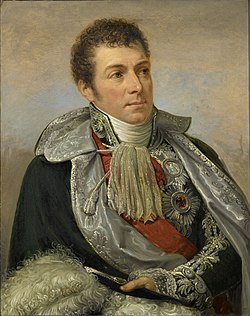
Louis-Alexandre Berthier
Marshal of the Empire, Prince of Neuchâtel and of Wagram, major-general of the Grande Armée (1805–1814)
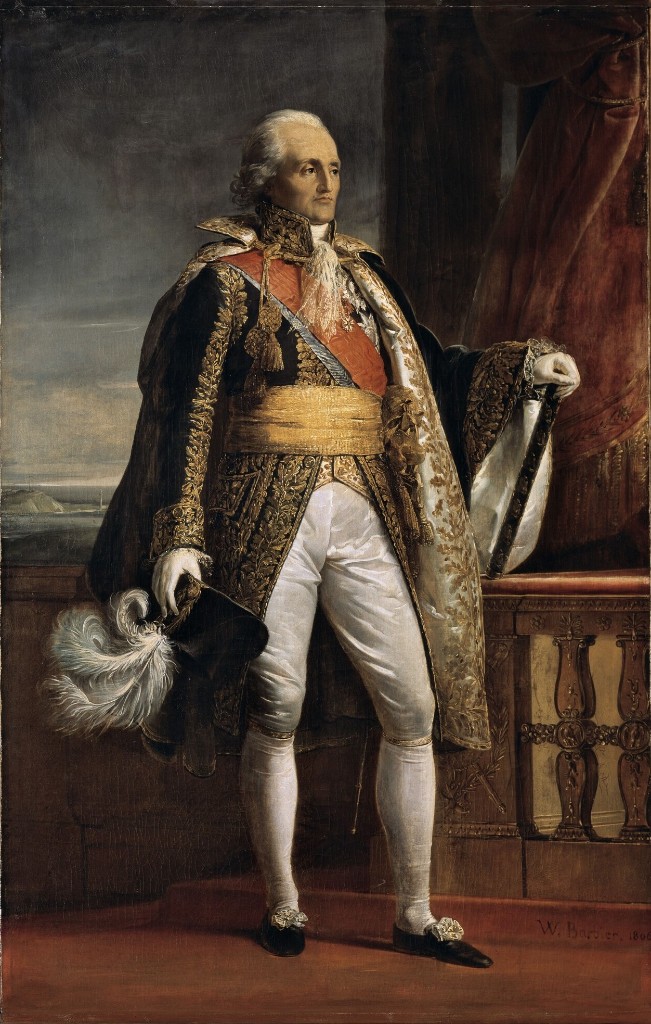
Bon-Adrien Jannot de Moncey
Marshal of the Empire, Duke of Conegliano
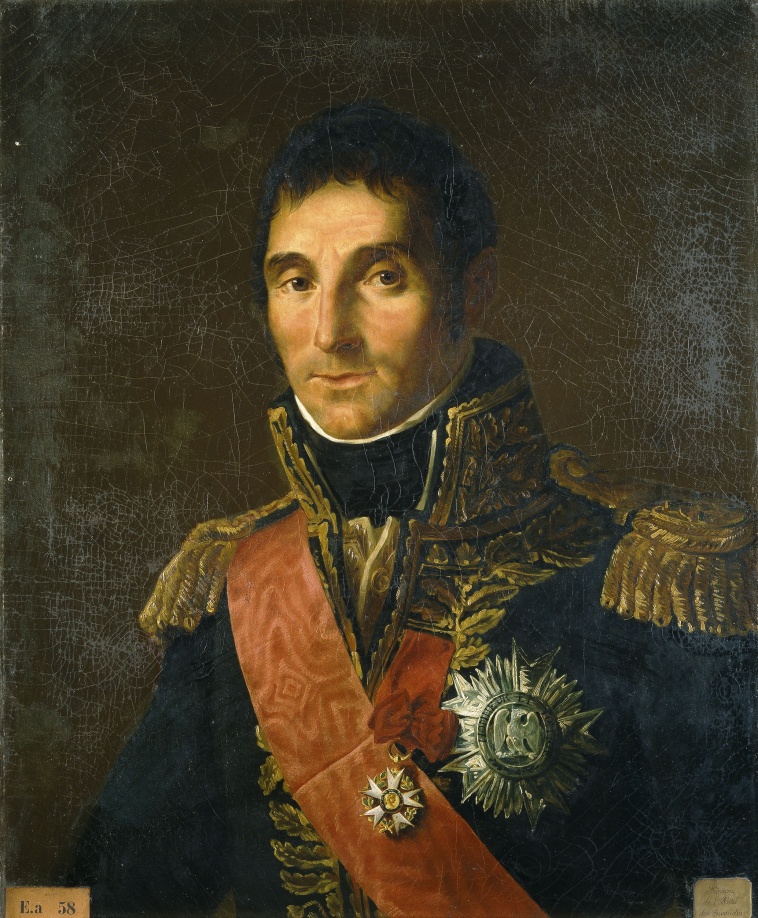
André Masséna
Marshal of the Empire, Prince of Essling
Go further
Recommended books to dig deeper (affiliate links)
Napoleon the Great
Andrew Roberts · 2014
A monumental biography drawing on Napoleon’s 33,000 surviving letters, admiring but rigorous.
See on Amazon
Napoléon ou le mythe du sauveur
Jean Tulard · 1977
The book that reshaped how the man is read: how France gave itself a saviour, and what it cost.
See on Amazon
Nouvelle histoire du Premier Empire
Thierry Lentz · 2002-2010
Four reference volumes on institutions, diplomacy and collapse: the scholarly synthesis of the subject.
See on AmazonAs an Amazon Associate, this site earns from qualifying purchases.
Support the encyclopedia
Napoleon Empire is an independent project. Your contribution helps grow the content and keep the site running.
DonateSecure payment on the platform you choose.