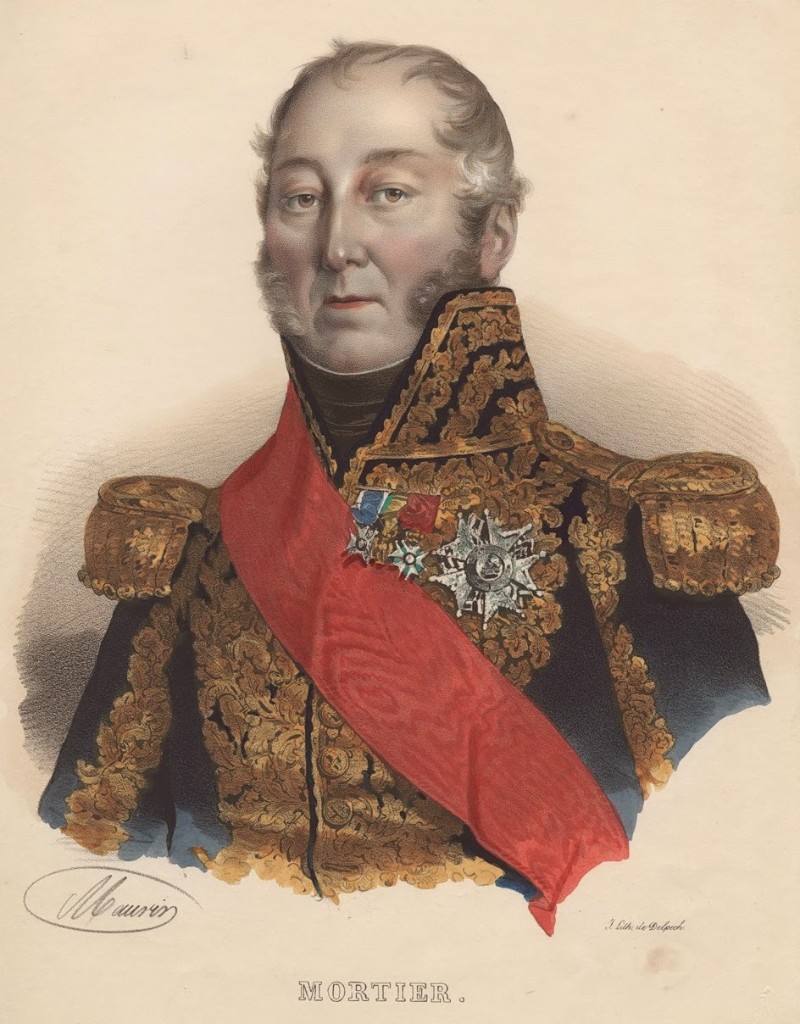
Adolphe Édouard Casimir Joseph Mortier (1768-1835), son of a Cambrésis farmer who became a Third Estate deputy to the Estates-General, embodied the Republican then imperial rise of the line soldier: enlistment in 1791, ranks won on the northern and Dutch fronts, divisional general after the Swiss campaign under Masséna. In 1803 Napoleon entrusted him with the conquest of Hanover — the electorate tied to George III — accomplished within weeks without a memorable pitched battle; promoted marshal in 1804 among the first eighteen, Duke of Treviso in 1808. The Spanish war brought him the siege of Saragossa, one of the deadliest ordeals of the age, then Ocaña and Gebora. In 1812 he commanded the Young Guard in Russia, governed the Kremlin at Moscow and refused to blow up the imperial palace in the name of the retreat's strategic priority; at the Berezina he covered the crossing with Ney. In 1814 he defended the Plaine Saint-Denis alongside Marmont; having rallied to the Bourbons, he returned for the Hundred Days but kidney stones kept him from Waterloo. Under Louis-Philippe, grand chancellor of the Legion of Honour then President of the Council, he died in 1835 on the Boulevard du Temple, victim of Fieschi's infernal machine — the only Marshal of the Empire to fall in a political assassination in office.
Le Cateau, the Estates-General and the Revolutionary forge
Adolphe Édouard Casimir Joseph Mortier was born at Le Cateau-Cambrésis on 13 February 1768, into a rural northern family: his father, a farmer, climbed the political ladder of 1789 by being elected Third Estate deputy for the bailiwick of Cambrai to the Estates-General. The boy grew up amid peasant life suddenly exposed to public speech: cahiers de doléances, the Night of 4 August, the federation — all that, from Versailles to Paris, reshuffled the monarchy's cards.
In 1791 Mortier enlisted in the Revolutionary troops. The trade he learned was that of manoeuvre infantry, columns on the roads of Flanders and Artois, combat against Coalition forces and émigrés. The early years were not those of a media prodigy: they were those of perseverance, possible wounds, slow then accelerated promotions when the endangered nation demanded young, available captains.
Northern campaigns and the Dutch expedition gave him a taste for combined operations — march, light siege, negotiation with local authorities — as much as for pitched battle. Mortier was neither a genius gunner nor a legendary sabreur; he was the reliable executor, the man given a sector and found still in position when the report came.
Promotion followed Republican victories and the mass needs of the army: chief of brigade, brigadier general, then, after the Swiss trials, divisional general. Switzerland in 1799, with Masséna, forged officers able to hold cols, river lines and orderly retreats in a demanding theatre. There Mortier won the trust of staffs already preparing the Bonapartist age.
The coup of 18 Brumaire found him among generals who believed military stability required a strong executive. He was not one of the plot's romantic figures; he belonged to the core who, once the Consulate was installed, accepted the new chain of command without principled opposition.
Under the Consulate, postings alternated garrisons, inspections and preparation of corps to hold the Rhine or Italy. Mortier acquired an administrative reputation — keeping regiments fed, avoiding breakdown on long roads — complementing his tactical skill. It was this « all-terrain » profile Napoleon would test in 1803 on a delicate politico-strategic objective: Hanover.
On the eve of the imperial senatus-consultum, Mortier already embodied the marshal-to-be: not the most publicised general of the Republic, but the one whose career curve showed continuity from volunteer of 1791 to pillar of the First Consul's armies.
Hanover, the marshalate of 1804 and the Duchy of Treviso
In 1803 the breakdown of Amiens returned France to war with Great Britain. Napoleon sought to strike King George III's Hanoverian interests: entrusting the operation to Mortier, recently tested and able to mix military diplomacy with rapid manoeuvre, was a choice of precision rather than a media spotlight. French corps entered the Electoral territory; within weeks resistance resolved without a pitched battle that would mark textbooks — cold efficiency that earned the general his master's recognition.
The campaign illustrated Napoleonic logic: strike where the political opponent is contractually vulnerable, occupy depots and roads, impose a capitulation that deprives the maritime enemy of a continental lever. Mortier knew how to keep that tempo: advance, cut, negotiate with local authorities, avoid needless escalation that would delay the next move.
The senatus-consultum of 1804 promoted eighteen marshals of the nascent Empire. Mortier was in the first promotion: the peasant turned divisional general joined the gallery of imperial batons alongside already mythic names. The honour was immense; so was the burden: henceforth every bulletin could cite his name, every potential setback would expose him to courtly criticism.
The years 1805-1807 saw him take part in the great continental manoeuvre — Ulm, Austerlitz, then the Prusso-Polish cycle — not always holding the most visible role in popular memory, but holding posts requiring coordination between infantry, artillery and services. Marshal Mortier became a piece of the imperial apparatus, not merely a parade star.
In 1808 Napoleon granted him the title of Duke of Treviso — an Italian reference to a Venetian city integrated into the satellite empire. The major-fief duchy of the Napoleonic hierarchy, even more than a simple count or baron title, anchored him in imperial nobility; it also marked expectation: serve wherever the Emperor demanded presence and firmness.
Precisely toward Spain, a thankless and costly theatre, destiny called after this titled promotion: the Iberian Peninsula would test the Young Guard and marshals differently from the German plains or Polish fields.
Saragossa, Ocaña and the price of the Spanish war
From 1808 Mortier joined the French deployment in Spain: Joseph Bonaparte's kingdom, local insurrections, thankless logistics. The most terrifying chapter remains the second siege of Saragossa: a city mixing barricades, fortified convents, cellar and roof fighting. Mortier commanded one of the assault corps; progress was bought in bloody days, cumulative losses, epidemics decimating besiegers and besieged alike.
The horror was not merely military: it was civilian. Civilians caught between fanaticism, fear and Aragonese patriotism held positions siege artillery reduced stone by stone. Contemporary accounts — soldiers, surgeons, officers — describe an urban hell without immediate equivalent in Central European campaigns. Mortier emerged with the reputation of a man who completed a technical mission at the cost of a heavy moral imprint.
After Saragossa the Peninsular War continued: the Battle of Ocaña in 1809, a major French victory that temporarily broke part of the regular Spanish forces; fighting at Gebora and other clashes reminding that Napoleonic occupation in Iberia was never a simple administrative formality.
There Mortier worked alongside other marshals and generals whose temperaments clashed almost as much as enemy armies: jealousies, priority quarrels, contradictory orders from Paris or Madrid. His relative stability often made him executor of large manoeuvres rather than theorist of a counter-insurrection no strategist fully mastered.
Historians stress that the Spanish war eroded the Grand Army: whole divisions rotted there while the Tsar prepared his game in the east. For Mortier the peninsula was a school of patience and harshness — where one measured the gap between staff map and the reality of a resisting street.
When the Emperor recalled forces for the gigantic 1812 Russian project, Mortier was among marshals tested but not broken by Iberian experience: he carried the memory of ruined houses and days without easy glory, useful for facing another immensity — that of the Muscovite plains.
Young Guard, Moscow Kremlin and retreat
In 1812 Mortier commanded the Young Guard in the colossal advance into Russia: crossing the Niemen, battles of position, heat then dust of endless roads. At Borodino, Guard units — young elite recruits mixed with hardened cadres — were committed sparingly by the Emperor, who husbanded his reserve for the decisive blow that, on paper, should follow.
Entry into burned Moscow upended strategy: empty capital, devastation, waiting for a capitulation that never came. Napoleon gave Mortier governorship of the Kremlin — symbolic fortress and seat of tsarist power. There the marshal organised military police, bivouacs, partial protection of treasures, arbitration between exhausted soldiers and imperial discipline.
Then came the order to blow up the imperial palace — a destructive gesture meant to deprive the Russians of an emblem and mark riposte brutality. Mortier opposed it with a responsible officer's arguments: bridges, depots, lines of retreat were priorities; mining the Kremlin would delay evacuation and waste powder at the worst moment. Napoleon, after hesitation, endorsed the reasoning: a rare case where a subordinate put efficiency over symbol.
The retreat turned the Young Guard into a fighting rear guard: less brilliance than endurance, marches in cold, Cossack ambushes, hunger. Mortier preserved cohesion as far as possible, sharing with Ney and others the burden of critical passages. Losses were huge; the Young Guard's manpower curve would never regain its pre-June strength.
At the Berezina in late November pontoneers threw bridges under Russian fire; Mortier took part in the covering operation that let a fraction of the army cross — not without leaving thousands behind. The later image of the frozen river and precarious bridges became the visual symbol of Napoleonic collapse in Russia.
The marshal brought back what remained of his corps, tested but still identifiable as an imperial unit. The 1812 experience marked a line: after Moscow every European campaign was read against that strategic break — and Mortier had seen both faces of imperial power: the destructive order refused at the Kremlin, then the relentless retreat where terrain reality could no longer be denied.
Paris 1814, Hundred Days, July Monarchy and Fieschi
In 1814 the invasion of France put Mortier back on the northern theatre: defence of Paris approaches in the Plaine Saint-Denis alongside Marmont and other worn marshals. The Coalition forces were too numerous; Napoleon in Champagne could not relieve the capital in time. On 31 March Paris capitulated. Mortier, like several military peers, swore to the Bourbons: a closing gesture more than deep monarchical enthusiasm.
The return from Elba in March 1815 saw him rally to the Emperor without notable hesitation — soldier's loyalty more than fine political calculation. But gravel — painful kidney stones — laid him low at Waterloo: he did not command the Guard on the battlefield, contrary to what legend sometimes expects of marshals. Kept in the rear, he avoided direct defeat and, paradoxically, the immediate moral lynching that struck other names.
The Second Restoration left him his peerage: involuntary absence at Waterloo was not treated as treason. Mortier then lived a relative wilderness, broken by court honours and military functions less visible than the great imperial campaigns.
The July Revolution of 1830 and Louis-Philippe's accession opened a second political career: Mortier became grand chancellor of the Legion of Honour in 1831 — guardian of the regime's ribbons and symbolic promotions — then President of the Council of Ministers in November 1834. His government was brief; he chiefly embodied the respectable marshal the citizen monarchy wished to display.
On 28 July 1835, for the review commemorating the Three Glorious Days, the crowd packed the Boulevard du Temple. Giuseppe Marco Fieschi, a Corsican conspirator, had built an « infernal machine »: twenty-five loaded musket barrels in salvo, aimed at the king's passage. The volley went off; Louis-Philippe escaped; Mortier, General La Tour-Maubourg and others fell. The marshal died instantly, aged sixty-seven.
National funerals celebrated the soldier; political debate questioned security failures. Mortier remains in history as the last Marshal of the Empire to die in office under the July Monarchy — and as the only one victim of an assassination: an end that sums, in one powder flash, the passage from one revolutionary century to another where political violence also borrowed the artisan technology of urban terror.
Discover other characters
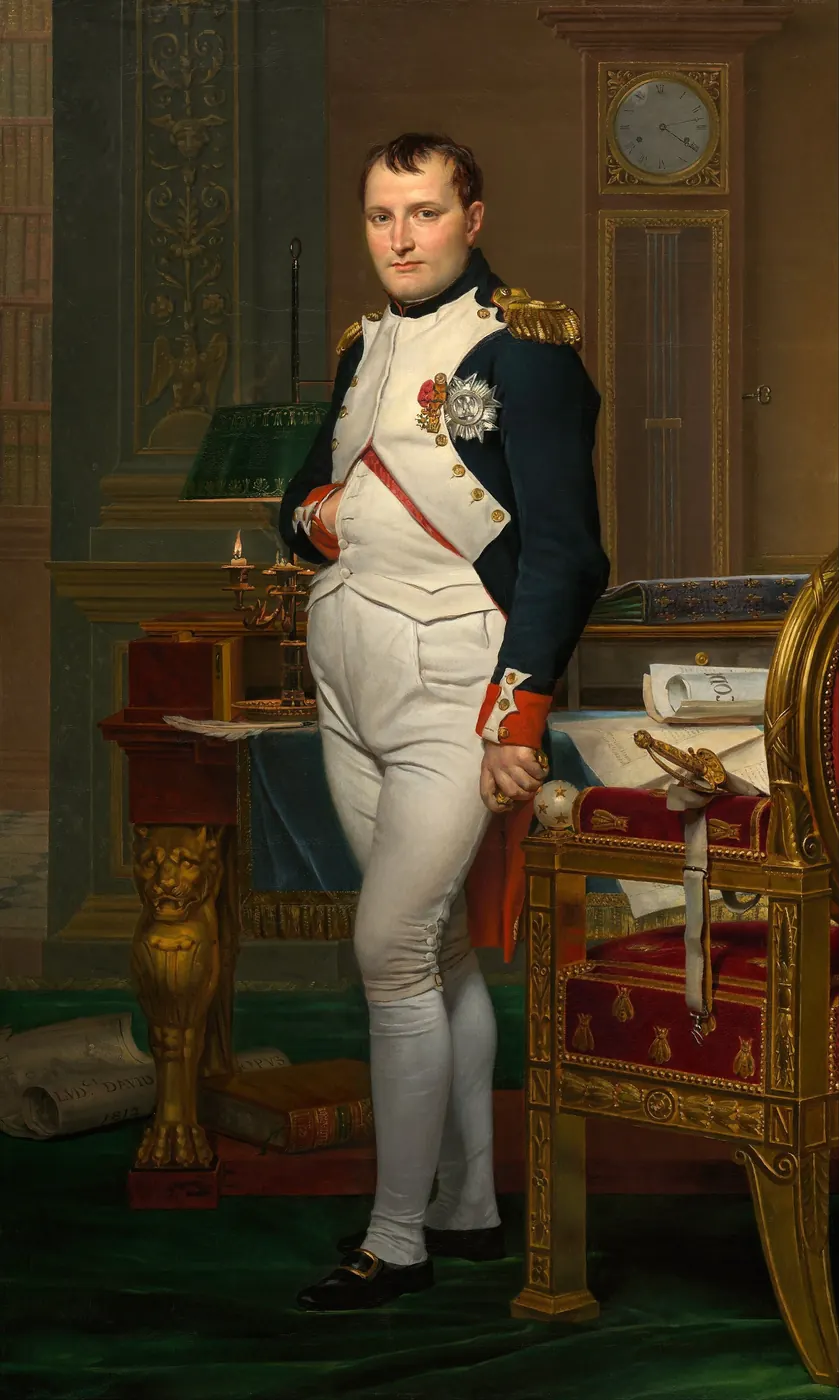
Napoleon Bonaparte
Emperor of the French
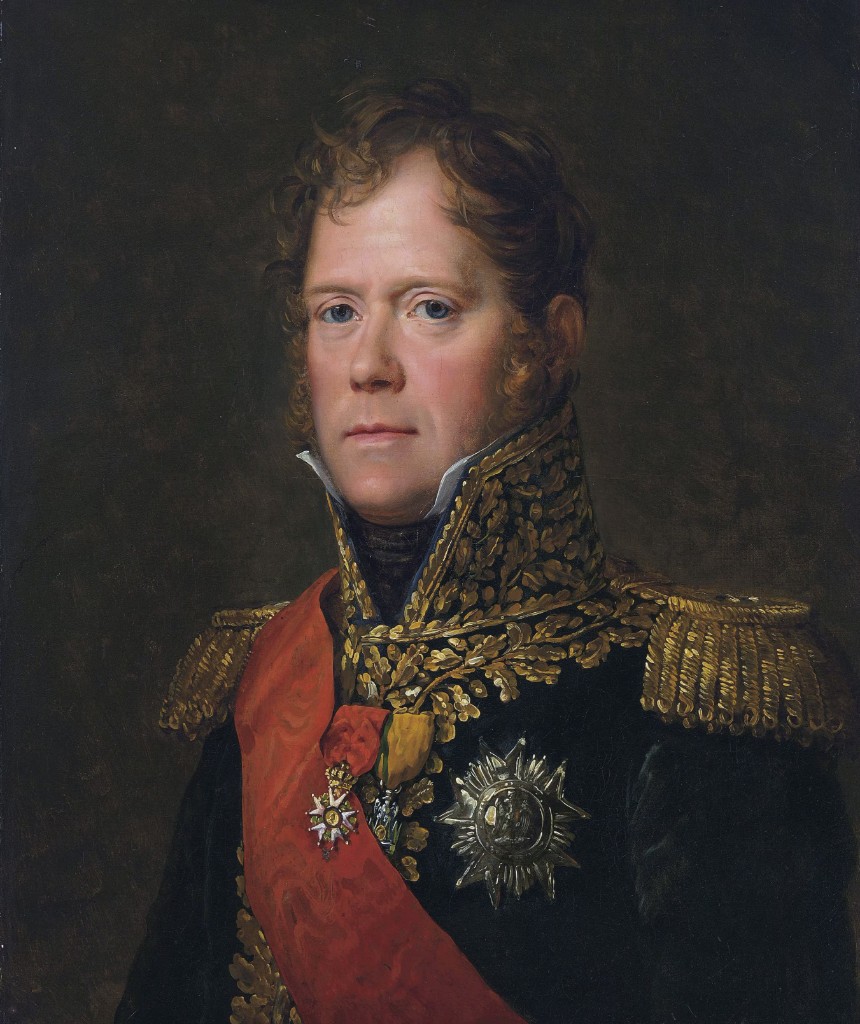
Michel Ney
Marshal of the Empire, Prince of the Moskova
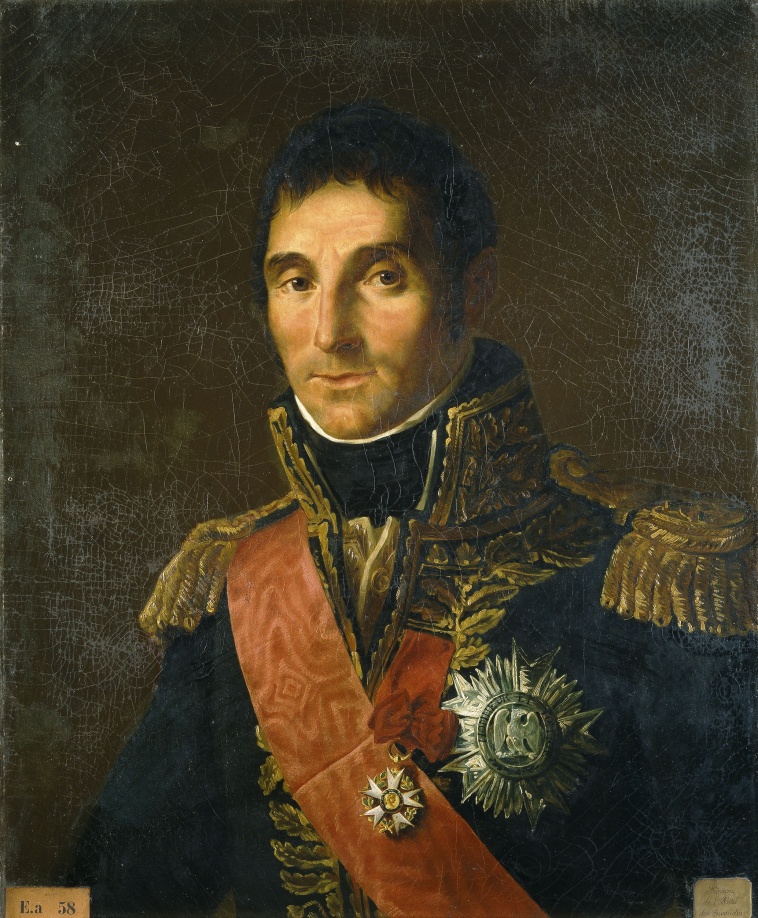
André Masséna
Marshal of the Empire, Prince of Essling
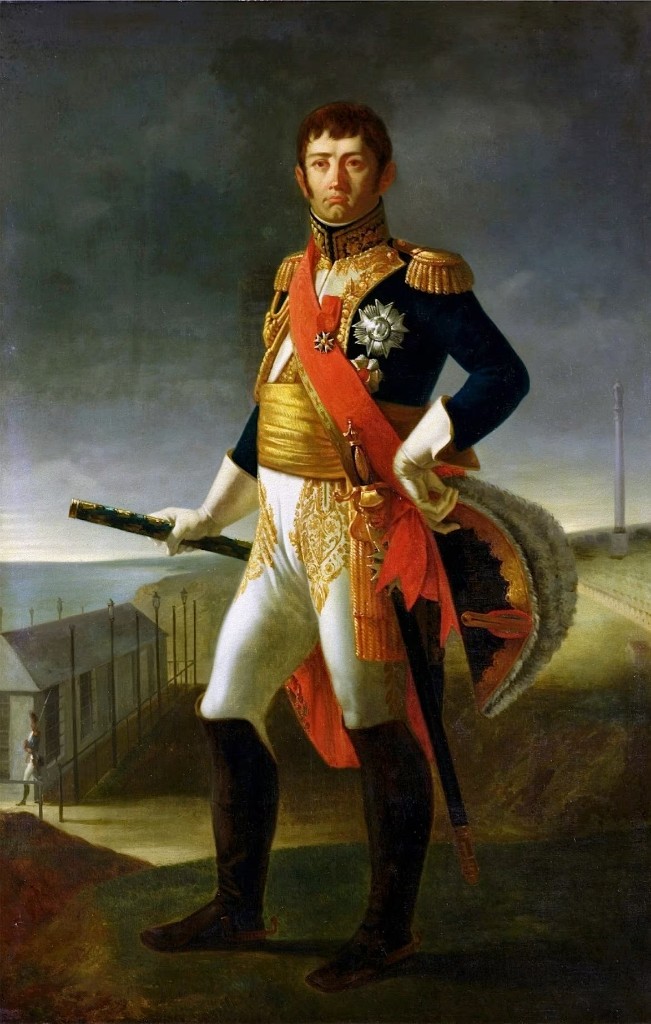
Jean-de-Dieu Soult
Marshal of the Empire, Duke of Dalmatia
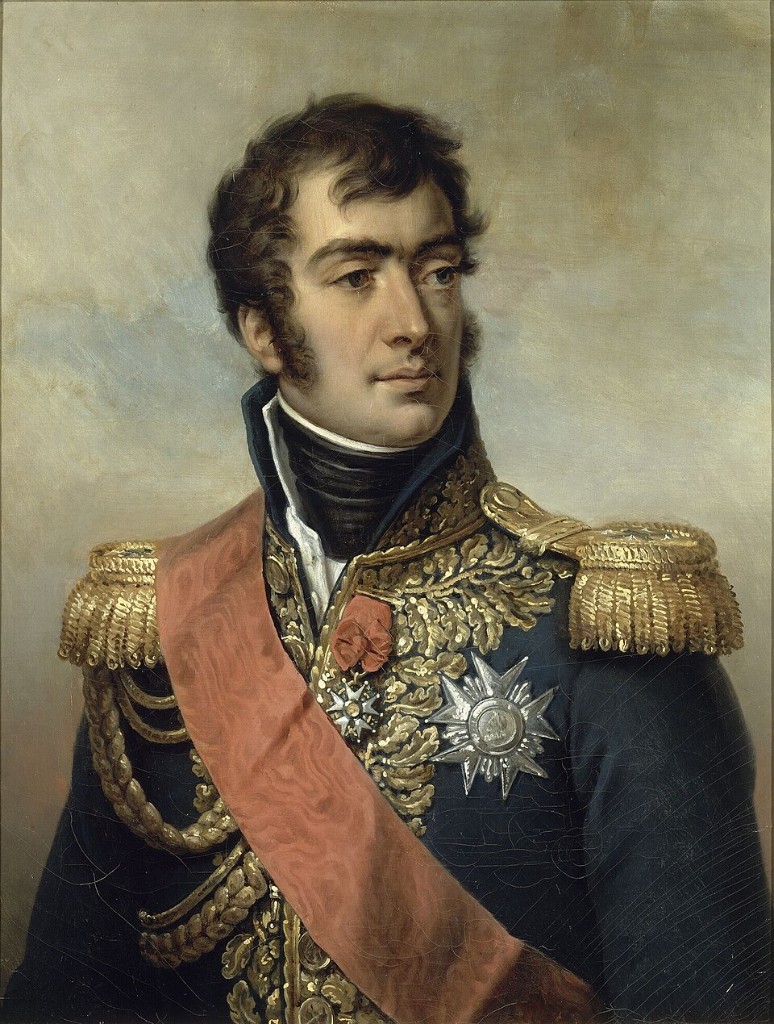
Auguste de Marmont
Marshal of the Empire, Duke of Ragusa
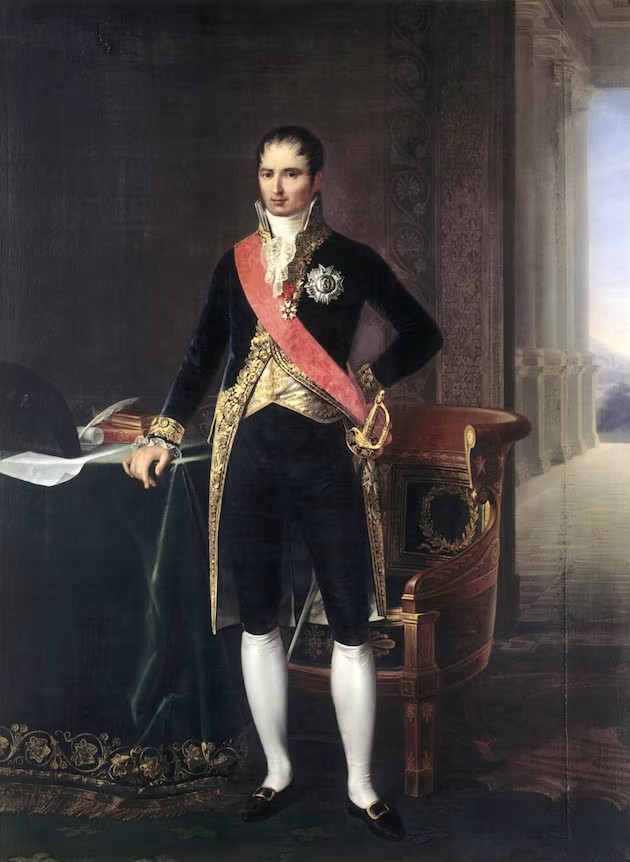
Joseph Bonaparte
King of Naples, then of Spain
Go further
Recommended books to dig deeper (affiliate links)
Napoleon the Great
Andrew Roberts · 2014
A monumental biography drawing on Napoleon’s 33,000 surviving letters, admiring but rigorous.
See on Amazon
Napoléon ou le mythe du sauveur
Jean Tulard · 1977
The book that reshaped how the man is read: how France gave itself a saviour, and what it cost.
See on Amazon
Nouvelle histoire du Premier Empire
Thierry Lentz · 2002-2010
Four reference volumes on institutions, diplomacy and collapse: the scholarly synthesis of the subject.
See on AmazonAs an Amazon Associate, this site earns from qualifying purchases.
Support the encyclopedia
Napoleon Empire is an independent project. Your contribution helps grow the content and keep the site running.
DonateSecure payment on the platform you choose.