A neutrality wearing thin
Throughout 1805, Prussia watched the war go by. It hesitated between France, whose forbearance it had accepted since the Peace of Basel in 1795, and Russia, which pressed it to join the Third Coalition. On 3 November 1805, at Potsdam, King Frederick William III signed a convention with Tsar Alexander I providing for armed mediation; according to tradition, the two sovereigns sealed their friendship that night, between 3 and 4 November, before the tomb of Frederick II. The minister Haugwitz set off to carry an ultimatum to Napoleon. He caught up with him after Austerlitz and ended up signing, at Schönbrunn on 15 December, a treaty that gave Prussia Hanover, a possession of the King of England, in exchange for territories ceded to France and to Bavaria.
The gift was a poisoned one. Prussia fell out with London, which declared war and seized its ships, without gaining the security it had sought. In the summer of 1806, France also upset the German order: on 12 July sixteen princes formed the Confederation of the Rhine under Napoleon's protection, and on 6 August Francis II laid down the crown of the Holy Roman Empire. Berlin had hoped to lead a northern league; instead it found an armed neighbour at its door, and it learned, or believed it learned, that Napoleon, in talks with the British, was prepared to give them back Hanover.
The court swung round. Around Queen Louise, Prince Louis Ferdinand and Prince Hohenlohe, the war party prevailed over the cautious counsels of the minister Haugwitz, and the king allowed himself to be persuaded. Mobilisation began in August. In early October an ultimatum demanded that French troops recross the Rhine before the 8th. Napoleon took up the challenge. The Fourth Coalition took shape, with Prussia, Saxony, Russia, the United Kingdom and Sweden among its members; but the Russians were far away, and the Prussians would go into battle alone.
Two armies, two eras
The Prussian army lived on its past. It had been forged by Frederick II and had not fought seriously for more than ten years. Its line tactics had scarcely changed since the Seven Years' War, it had many elderly generals, and its supply depended on heavy baggage trains and magazines. Its organisation into corps had been decided only on the eve of the conflict. Above all, the command was fragmented. The Duke of Brunswick, seventy-one years old, led the main army in the king's presence; Hohenlohe directed a second army, Rüchel a third. Three officers shared the duties of chief of staff, Phull, Scharnhorst and Massenbach, and plans followed one another without anyone knowing which had been adopted.
Facing it, the Grande Armée was fresh from the 1805 campaign. It was organised in army corps able to manoeuvre and fight on their own, it lived off the country rather than off convoys, and it knew how to combine skirmishers, columns and line. Napoleon committed between 180,000 and 190,000 men, depending on the count; the Prussians and their Saxon allies fielded some 150,000, of whom about 20,000 were Saxons. The numerical disproportion was modest. The gap lay in speed, unity of command and familiarity with war.
The battalion square in the Thuringian forest
Napoleon had left Paris on 25 September. He wanted to beat Prussia before the Russians arrived, and to outpace it. He concentrated his corps in Franconia, then marched north-east towards Leipzig and Berlin, to separate the Prussians from their capital and the Saxons from their country. On 8 October, the day the ultimatum expired, the Grande Armée crossed the Thuringian forest in three columns: on the left, Lannes and Augereau towards Saalfeld; in the centre, Bernadotte, Davout, the Guard and Murat's cavalry by way of Kronach and Lobenstein; on the right, Soult and Ney towards Hof. The columns marched close enough to support one another: this was the so-called "battalion square".
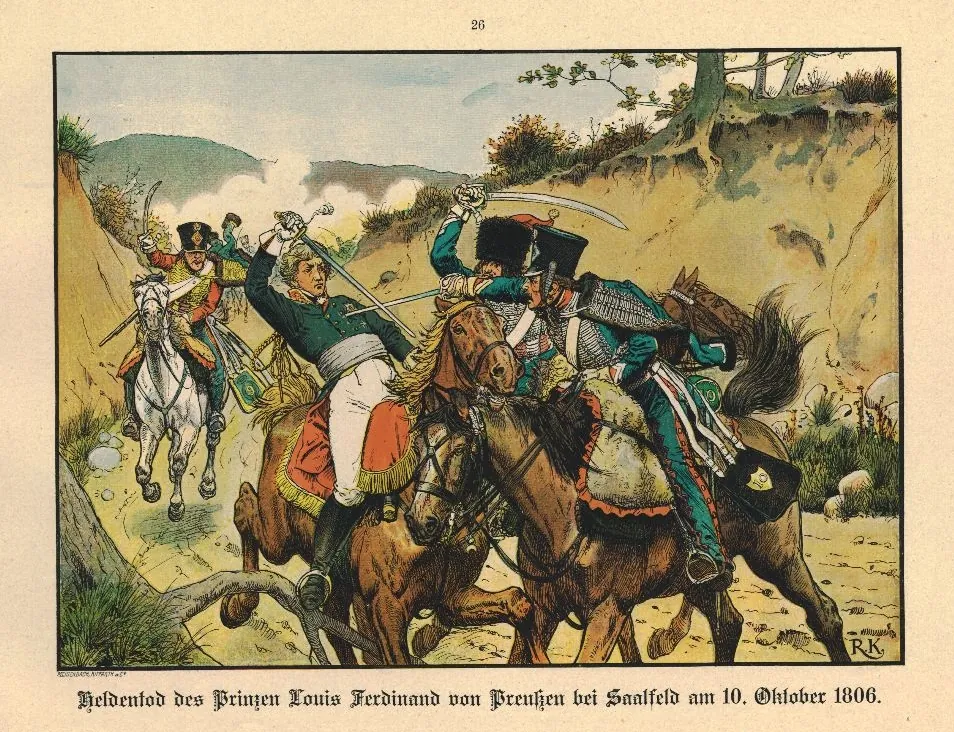
On 9 October at Schleiz, Murat's cavalry and Bernadotte's infantry shoved aside Tauentzien's advance guard; the next day, at Saalfeld, Lannes crushed that of Prince Louis Ferdinand. A nephew of Frederick II, a brilliant officer and a musician to whom Beethoven had dedicated his third piano concerto, the prince threw himself into a cavalry melee in which he was killed, according to the most probable account, by a sergeant of the 10th Hussars. The news of his death weighed on the morale of the Prussian army, which lost a very popular leader in the first week of the campaign.
14 October: Jena and Auerstedt
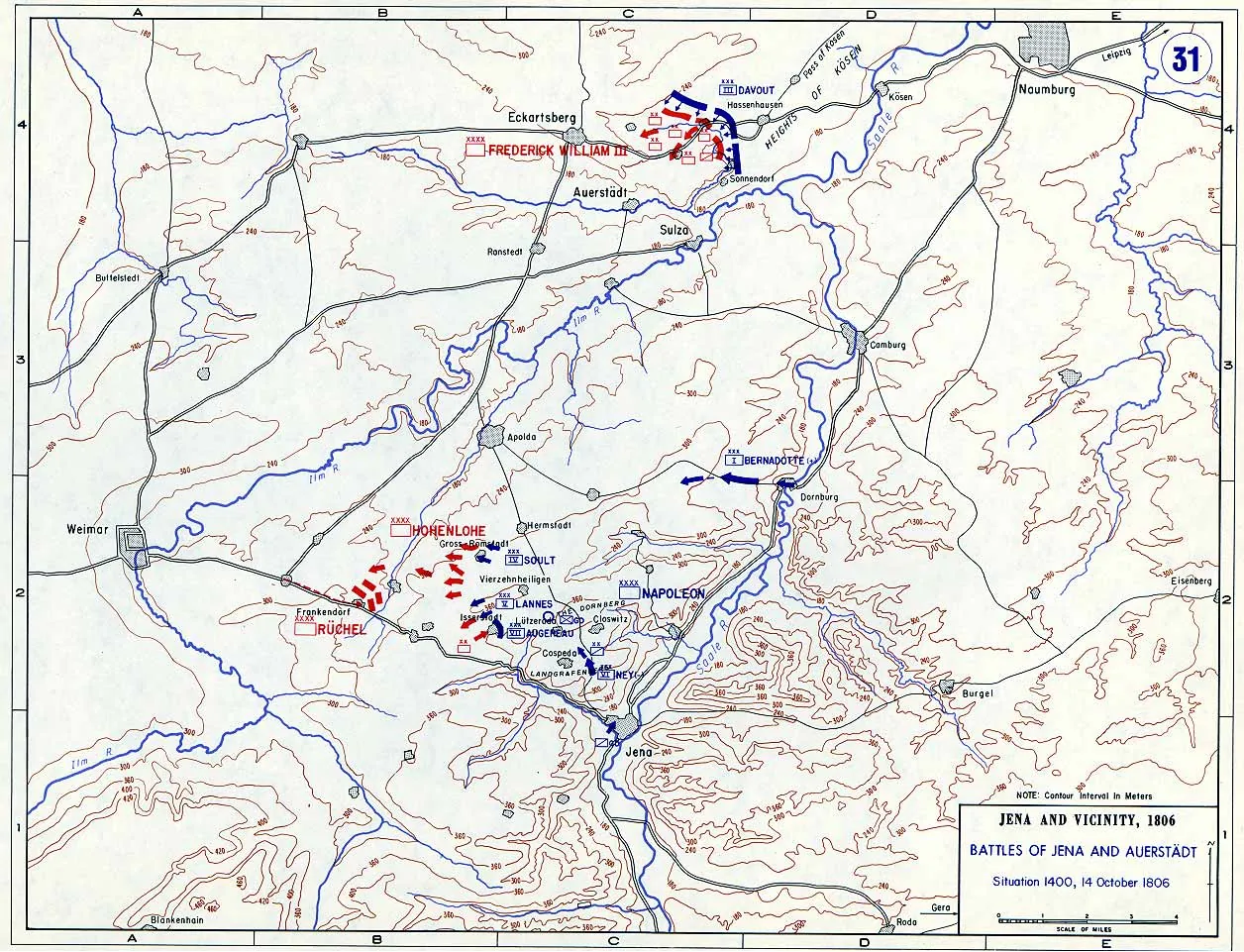
Napoleon did not know exactly where the bulk of the enemy army lay. On 13 October Lannes gained a foothold on the Landgrafenberg, which overlooks Jena, and sighted Hohenlohe's bivouacs on the plateau. The Emperor concentrated his corps on that side, believed he had the Prussian army in front of him, and had the artillery hauled up the slope during the night. The next morning, in fog, Lannes's divisions fell on Tauentzien's advance guard, then the corps of Augereau, Soult and Ney emerged on the flanks. Hohenlohe, who had only some 38,000 men to hand, was broken by early afternoon; the late arrival of Rüchel's corps, about 15,000 strong, changed nothing, and Murat's cavalry turned the retreat into a rout. The battle is described in detail in the entry on the Battle of Jena.
The real surprise came about twenty kilometres further north, on the same day. Davout's 3rd Corps, about 27,000 men, was marching south from Naumburg and ran near Hassenhausen into the main army, that of the king and the Duke of Brunswick, which numbered between 50,000 and 64,000 depending on the estimate. Davout held. His battalions formed square against Blücher's cavalry, and at about 10 o'clock the Duke of Brunswick, struck in the head by a bullet, left the army without a commander; at 11, Davout went over to the offensive with the divisions of Gudin, Friant and Morand. In the afternoon Frederick William III ordered a retreat without having committed all his reserves. Davout had lost a quarter of his corps, more than 7,000 men; he had beaten, at odds of about one to two, the kingdom's main army. On hearing the first report, Napoleon is said to have replied that his marshal was seeing double. He then accepted the evidence, and Davout would receive the title of Duke of Auerstedt.
Marshal Bernadotte, whose 1st Corps might have weighed on either of the two battlefields, did not fight. His conduct caused a scandal, and his quarrel with Davout lasted. But no precise order has been found that told him to march with Davout, and Napoleon contented himself with a severe reprimand. That same evening, the columns of the king's army, still in order, threw themselves into the stream of fugitives from Jena on the road to Weimar, and the two defeated armies merged in a single disaster. What fell that day was not only an army: it was the idea it had of itself.
The pursuit
The rest of the campaign rests on a decision that sets Jena apart from Austerlitz: Napoleon gave his opponent no time to breathe. From the 15th, Murat's cavalry and the corps of Soult and Ney launched a pursuit that did not stop until the sea. On 16 October Erfurt capitulated to Murat with several thousand men. On the 17th, at Halle, Bernadotte crushed the Duke of Württemberg's reserve. On the 24th Napoleon was at Potsdam. Davout, whom he wished to reward, entered Berlin at the head of his corps on the 25th; the Emperor made his entry on 27 October, through the Brandenburg Gate, amid a crowd of inhabitants.
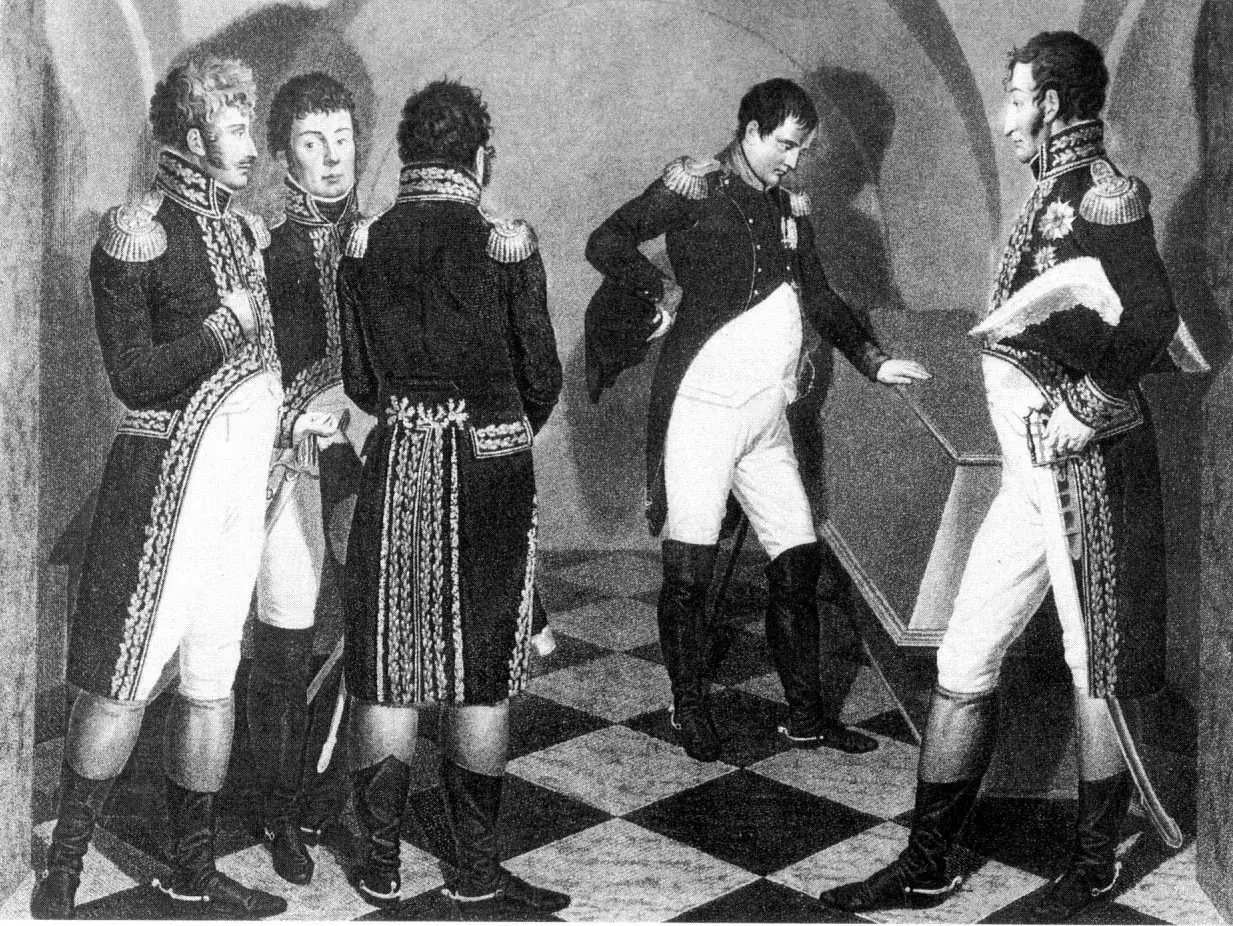
At Potsdam he stood in silence before the tomb of Frederick the Great. The king's sword and several of his insignia were sent to Paris, from where they would pass to the Invalides. Napoleon is said to have told his officers that if Frederick were still alive they would not be there. The gesture had a political meaning: it presented the victory not as the defeat of a people but as the collapse of a monarchy that had failed to renew itself. In the same spirit, Napoleon sent the Saxon prisoners home and treated Saxony gently, intending to detach it from Prussia. On 11 December the Treaty of Posen would make it a kingdom and a member of the Confederation of the Rhine.
The fortresses fall
The remnants of the Prussian army were caught one by one. Hohenlohe, who had set out for the Oder with nearly ten thousand men, was cornered at Prenzlau on 28 October: Murat, Lasalle and their cavalry forced him to capitulate. Among the officers taken prisoner was the young Carl von Clausewitz, aide-de-camp to Prince August, who would draw several of his writings from the campaign. The next day Lasalle and his hussars obtained the surrender of Stettin, defended by more than 5,000 men. Küstrin gave in on 1 November.
Blücher, who had gathered some 21,000 men west of the Oder, was pursued without respite by Bernadotte, Soult and Murat. Unable to reach Denmark, he violated the neutrality of the free city of Lübeck and entrenched himself there. On 6 November the French forced the gates; the city was given over to plunder for several hours. On the 7th, at Ratkau, Blücher surrendered with about 9,000 men, declaring, it is said, that he capitulated for lack of bread and ammunition. Scharnhorst, his chief of staff, was taken with him. Among the prisoners of the fighting at Lübeck was a Swedish detachment, which Bernadotte treated with consideration; some historians see this as one of the factors that prepared his election in 1810 as crown prince of Sweden. Magdeburg, the great fortress on the Elbe, opened its gates to Ney in November with more than 20,000 men.
The ease of these surrenders scandalised the king. Withdrawn to Königsberg and then Memel, on 1 December he issued the Ortelsburg Publicandum, which threatened with death any fortress commander who capitulated without exhausting his means of defence. A few strongholds, among them Danzig, Graudenz and Kolberg, where Major Gneisenau distinguished himself, would still hold out. The commanders of the surrendered fortresses were brought before courts martial; several were sentenced, some to death, but the sentences were not carried out.
Berlin, an occupied capital
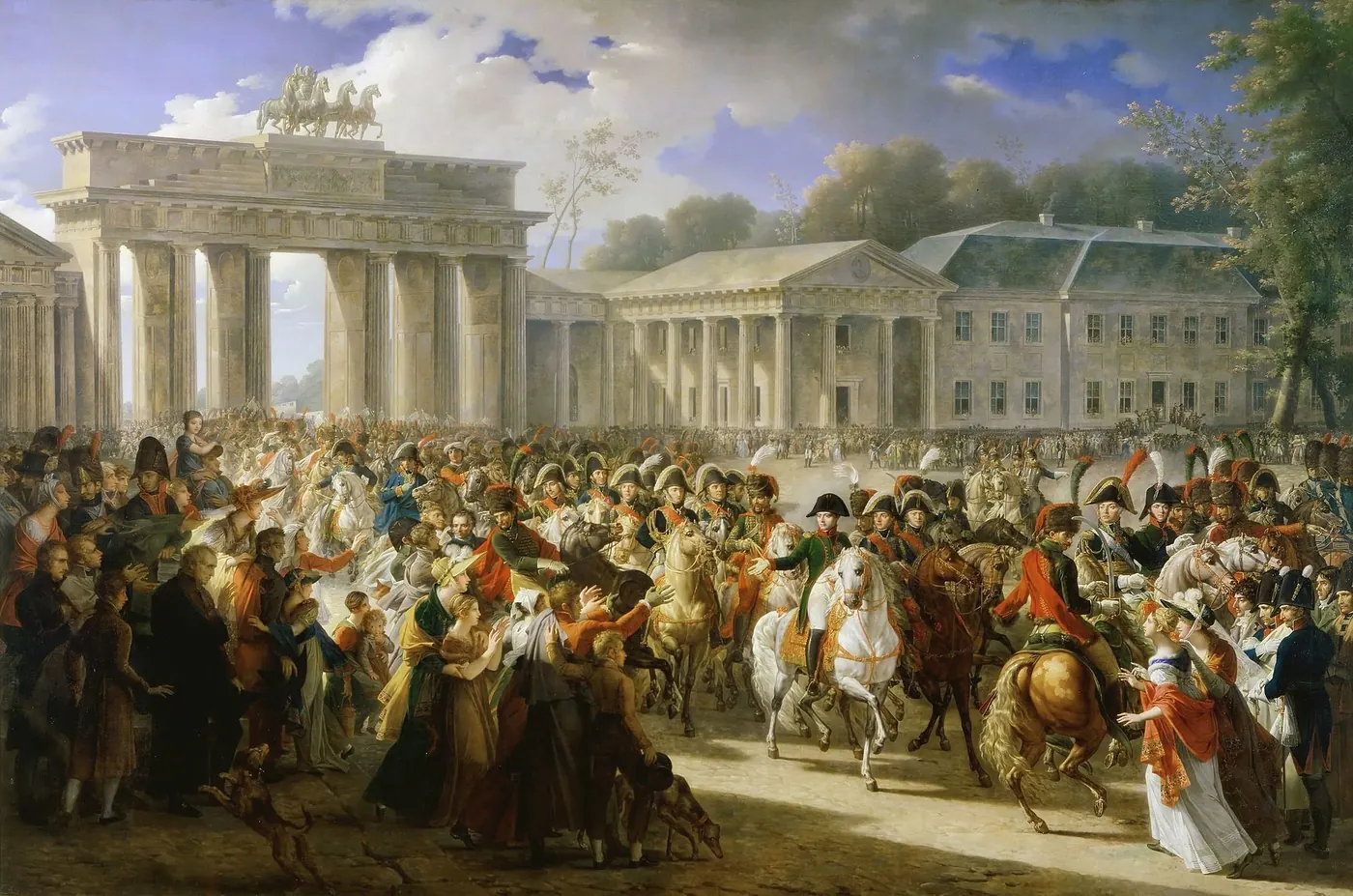
Napoleon spent a month in Berlin and conducted both the war and the government from there. He imposed a French administration and contributions on the city, had the royal collections inventoried, and charged Vivant Denon, director of the Napoleon Museum, with choosing works for Paris. The quadriga crowning the Brandenburg Gate was taken down and sent to the French capital; it would not return to Berlin until 1814. The bulletins of the Grande Armée mocked Queen Louise, whom the court regarded as the soul of the war party.
The act of greatest consequence was signed in Berlin on 21 November 1806. The decree declared the British Isles in a state of blockade, forbade all trade and correspondence with them, and closed the ports controlled by France and her allies to British ships. This was the charter of the Continental Blockade. The victory over Prussia, which opened the North Sea coast to the Emperor, finally gave him the means to wage the economic war that the British fleet, victorious at Trafalgar the previous year, had denied him at sea.
The King of Prussia, for his part, had not laid down his arms. An armistice negotiated at Charlottenburg by General Zastrow on 16 November was repudiated: Frederick William III still hoped for help from the Russians, who were arriving in Poland. The war changed in nature. Napoleon, who had no counterpart with whom to sign a peace, left Berlin at the end of November and marched towards the Vistula. The Prussian campaign merged into the Polish campaign, whose high points would be Eylau and then Friedland.
Why so swift a collapse
The speed of the disaster struck contemporaries, beginning with the Prussians themselves. In a little over four weeks, from 8 October to 7 November, an army reputed to be the best in Europe ceased to exist as an organised force. Several causes combined.
- Command. Lacking a single leader, the three Prussian armies never acted in concert. At Auerstedt, Brunswick's wound left the king's army without direction while Davout, with half its numbers, held his ground.
- Speed. The French corps covered distances the Prussians could not match. Each time the Prussians tried to re-form they were overtaken by the cavalry, and each fortress saw the French arrive before its defences were ready.
- Doctrine. The Prussian army had been built for a slow war of stages and positions. It now met the instrument Napoleon had devised over ten years: a set of corps that marched separately and fought together.
- Morale. The chain of surrenders shows that an army which had believed itself invincible no longer trusted its leaders. The fortress commanders, often elderly, judged resistance futile, and several opened their gates without a fight.
It would nevertheless be too simple to see here only a contrast between past and future. Clausewitz, who lived through the campaign in the Prussian ranks, insisted that the Battle of Jena was not lost in advance: massing troops on a narrow ridge was a gamble, and a resolute attack by Hohenlohe at dawn might have wrecked it. The Prussian defeat therefore owes something to the hesitations of the command, and not only to the archaism of the army.
From Tilsit to the Prussian revival
Peace was signed with Russia at Tilsit on 7 July 1807, and with Prussia on the 9th. The kingdom lost nearly half its territory: the provinces west of the Elbe passed to the new Kingdom of Westphalia, the Polish lands formed the Duchy of Warsaw, and Danzig became a free city. Prussia had to pay a heavy indemnity, accept French garrisons and, under the Convention of Paris of 1808, limit its army to 42,000 men. Napoleon agreed to let the state survive, partly out of consideration for the tsar.
Defeat did not extinguish Prussia; it forced it to remake itself. Around Baron vom Stein, then Hardenberg, a group of ministers and senior officials set about modernising the state: the October Edict of 1807 abolished serfdom, the ordinance of 1808 gave towns their autonomy, and the University of Berlin opened in 1810 under the impulse of Wilhelm von Humboldt. Under Scharnhorst, joined by Gneisenau, Boyen and Clausewitz, a commission reorganised the army, opened the officer corps to commoners and prepared what would become universal military service. In occupied Berlin, the philosopher Fichte delivered his Addresses to the German Nation during the winter of 1807-1808.
It was this reformed Prussia that rose in 1813, that played a decisive role at Leipzig and then at Waterloo, where Blücher, the man defeated at Lübeck, arrived in time to weigh on the outcome of the battle. The memory of 1806 became one of the foundations of the German national narrative, so much so that Bismarck, after 1871, is credited with the remark: "Without Jena, no Sedan." For France, the campaign of 1806 remains one of the models of Napoleonic mobile warfare. It also fed in the Emperor a confidence in the speed of his manoeuvres that Poland, and then Russia, would put to a severe test.
Further reading
- Thierry Lentz, Nouvelle histoire du Premier Empire, vol. I, Napoléon et la conquête de l'Europe, 1804-1810, Fayard, 2002.
- François-Guy Hourtoulle, Iéna-Auerstaedt. L'apogée de l'Aigle, Histoire & Collections, 1998.
- Francis Loraine Petre, Napoleon's Conquest of Prussia, 1806, John Lane, 1907.
- Christopher Clark, Iron Kingdom. The Rise and Downfall of Prussia, 1600-1947, Allen Lane, 2006.
- A Prussian witness: Carl von Clausewitz, The Campaign of 1806 in Prussia and Notes on Prussia in Her Great Catastrophe, written in 1823-1824.