A young general and an army to rebuild
On 2 March 1796 the Directory appointed brigadier general Napoleon Bonaparte, aged twenty-six, commander-in-chief of the Army of Italy. The appointment owed much to Barras, who had noticed Bonaparte after he crushed the royalist rising of 13 Vendémiaire, and something to the marriage the young general contracted on 9 March with Joséphine de Beauharnais, a Creole widow well connected in the Directory's salons. Two days after the wedding, Bonaparte left Paris to join his army; he reached Nice on 27 March.
What he found was far from a parade-ground force. The roughly 38,000 men of the Army of Italy lacked pay, boots and bread; the depots were empty, and the general officers, veterans of the Alpine campaigns, eyed with suspicion this newcomer pushed forward by Parisian intrigue rather than a battlefield reputation. Bonaparte had to assert himself before he had even fought, over subordinates such as Augereau and Masséna, older and more seasoned soldiers than he was.
For the Directory, Italy was only a secondary theatre: the decisive blow was to come from Germany, where the armies of Jourdan and Moreau were to march on Vienna down the Danube valley. Bonaparte was simply asked to pin down the Austro-Sardinian forces facing him, more than 50,000 men divided between the Austrian army of General Beaulieu and the Sardinian army of General Colli.
With nothing to expect from an exhausted treasury in Paris, Bonaparte had to improvise his troops' supply from the country they crossed from the very start. It was also the price of the authority he needed to assert over general officers older and better connected than himself: in the first weeks he made his grip felt as much through quick victories as through firmness towards subordinates tempted to question his orders.
Montenotte, Millesimo, Dego: divide to conquer
Bonaparte applied from the outset the principle that would make his name: strike fast at the seam between two enemy armies to keep them from joining, then beat them one after the other. On 11 and 12 April 1796, at Montenotte, he committed some 9,000 men and eighteen guns against the 6,000 men and twelve guns of the Austrian general Argenteau, sent forward as an advance guard. The Austrian position was carried after fierce fighting; Argenteau lost close to 3,500 men, killed, wounded or captured, along with his guns, against about 200 French casualties.
The victory was exploited at once. On 13 and 14 April, at Millesimo and then at the redoubt of Cosseria, the French army broke up the remnants of the Austrian column and part of the Piedmontese troops sent to their aid. On 14 and 15 April, at Dego, an Austrian counter-attack briefly caught the French off guard, but they retook their positions and finished separating the two allied armies. In four days, the junction between Austrians and Piedmontese, on which their whole defence rested, was broken.
Mondovì and the armistice of Cherasco: Piedmont out of the war
Left to fend for himself, the Piedmontese general Colli tried to cover Turin. On 21 April 1796, at Mondovì, his army was defeated with heavy losses. The road to Piedmont lay open, and King Victor Amadeus III of Sardinia, whose kingdom had just lost its best troops and its fortresses in western Piedmont within a matter of days, sued for peace.
The armistice of Cherasco, signed on 28 April 1796, took Piedmont out of the war: the kingdom ceded to France the fortresses of Cuneo, Tortona and Alessandria and granted the French army free passage across its territory. In under a month, one of Bonaparte's two opponents had left the game. All that remained was to face, alone, Beaulieu's Austrian army, now withdrawn eastward behind the Po.
The Po, the Adda, Lodi: the road to Milan
Beaulieu waited for the French army at Valenza, expecting it to cross the Po there and continue eastward. Bonaparte outwitted him by crossing the river at Piacenza, eighty kilometres downstream, out of reach of any swift response. Beaulieu narrowly avoided encirclement, but had to abandon Milan and fall back behind the Adda, leaving a rearguard to hold the bridge at Lodi.
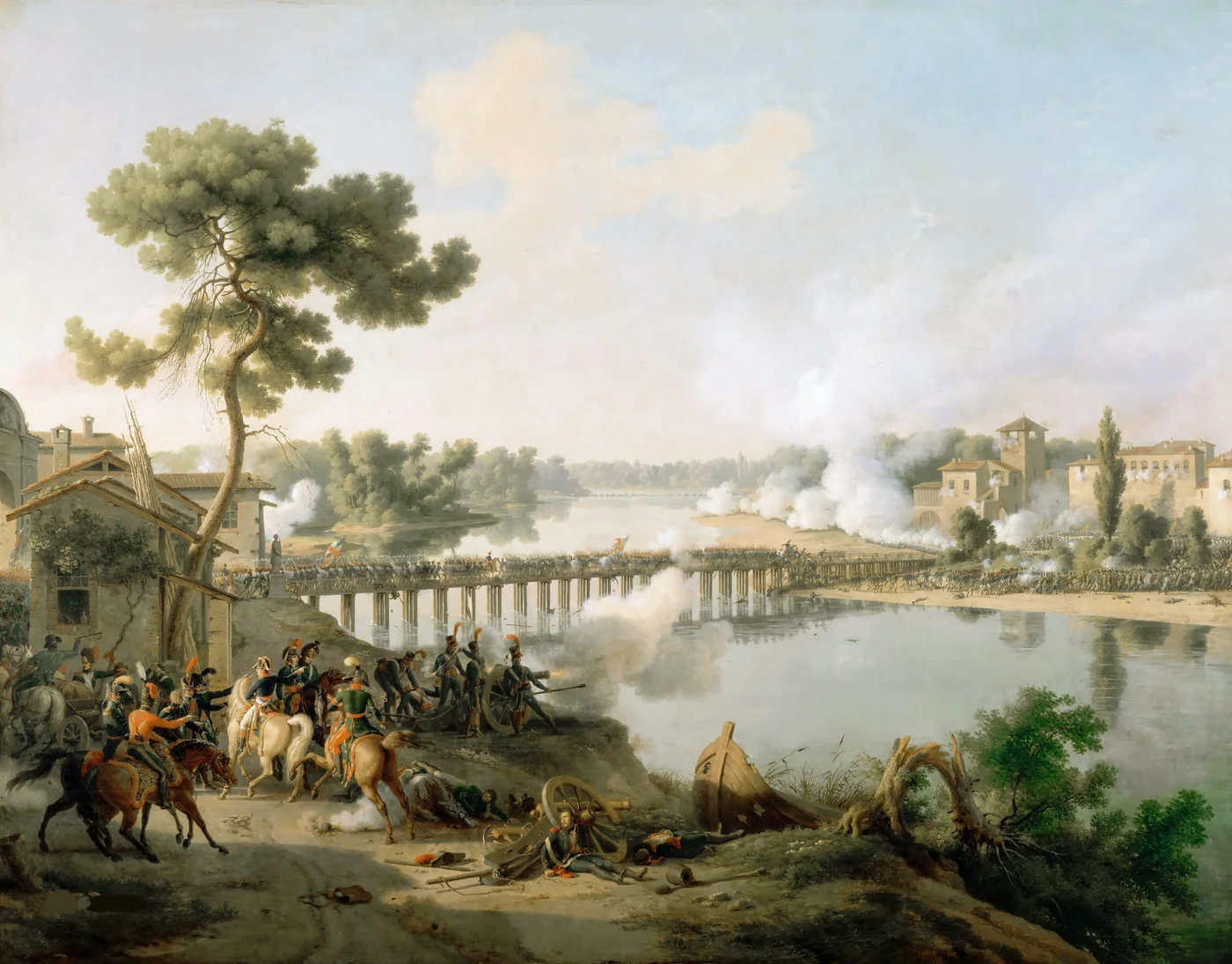
On 10 May 1796 the French army caught up with that rearguard. After a long artillery duel, a column of grenadiers and carabiniers, driven forward by several generals who threw themselves at its head — Masséna, Berthier, Lannes — carried the bridge under canister fire. French losses are put at anywhere from 350 to 900 men; the Austrians lost about 2,000, most of them taken prisoner. Militarily the action settled nothing: the bulk of Beaulieu's army got away. But the storming of the bridge caught the public imagination, and it was later said, though no contemporary account bears it out, that the soldiers had nicknamed their general "the little corporal" that day.
On 15 May 1796 Bonaparte entered Milan, capital of Austrian Lombardy. The city welcomed him as a liberator; he began levying heavy war contributions in money, horses and supplies, which at last allowed him to pay and feed an army that had gone without for so long. The Directory, its own finances exhausted, took full advantage and sent out a commission of scholars — among them the mathematician Gaspard Monge and the chemist Claude-Louis Berthollet — tasked with selecting, from the Italian collections, the paintings and manuscripts to be shipped to the museums of Paris. Within a few weeks, a general unknown to the wider public had become the master of northern Italy.
Mantua under siege: three relief attempts repulsed
With Beaulieu pushed back, Austria's one remaining trump card in northern Italy was the fortress of Mantua, locked in by its lakes and marshes, where the survivors of the defeated army had taken refuge. In June 1796 the French army began to invest it; the first siege parallels were opened on 4 June. As long as Mantua held, Austria kept a bridgehead for reconquering Italy; if it fell, the whole province was lost.
Vienna therefore sent, one after another, armies to relieve it. The first, commanded by the old field marshal Wurmser, came down from the Tyrol in late July 1796 and forced Bonaparte to lift the siege for a time. But on 3 and 4 August, at Lonato, and then on 5 August, at Castiglione, where some 30,000 French faced 25,000 Austrians, Wurmser's columns were beaten one after another: the Austrians lost about 3,000 men and twenty guns there, against 1,300 French casualties, and had to retreat towards the Tyrol.
Wurmser tried again in September, coming down the Brenta valley. On 8 September 1796, at Bassano, his army was beaten once more: with about 20,000 men on each side, the Austrians lost close to 600 killed or wounded, 6,000 prisoners, thirty guns and eight colours, against 400 French casualties. Rather than fall back towards Austria, Wurmser took refuge with the remnants of his army inside Mantua itself, unwittingly reinforcing the besieged garrison instead of relieving it. In the city, ringed by ponds and marshland where malarial fever compounded the shortage of food, supplies ran out and the death toll climbed week by week; the old field marshal, who had spent his life fighting Turks and Frenchmen alike, now found himself a prisoner of the very stronghold he had come to save.
Arcole: the flag and the legend
A third relieving army, entrusted to General Alvinczy, advanced in November 1796 in two columns, one through Friuli towards Verona, the other through the Tyrol towards Rivoli. The campaign began badly for Bonaparte, pushed back at Bassano and then at Caldiero. Reduced to about 18,000 men available against Alvinczy's 23,000, he chose to turn the enemy's flank rather than face him head-on: Masséna and Augereau marched down the Adige to Ronco, into marshland where movement was possible only along narrow dykes.
From 15 to 17 November 1796, three days of fierce fighting were fought along these causeways, around the village of Arcole and its bridge over the Alpone. It was there that the campaign's most famous episode took place: on 15 November, to revive an attack stalled by canister fire, Bonaparte seized a flag and stepped out alone onto the dyke, before being pulled out of the line of fire and falling into a ditch, without ever having crossed the bridge. The village was not finally taken until the third day, after repeated assaults.
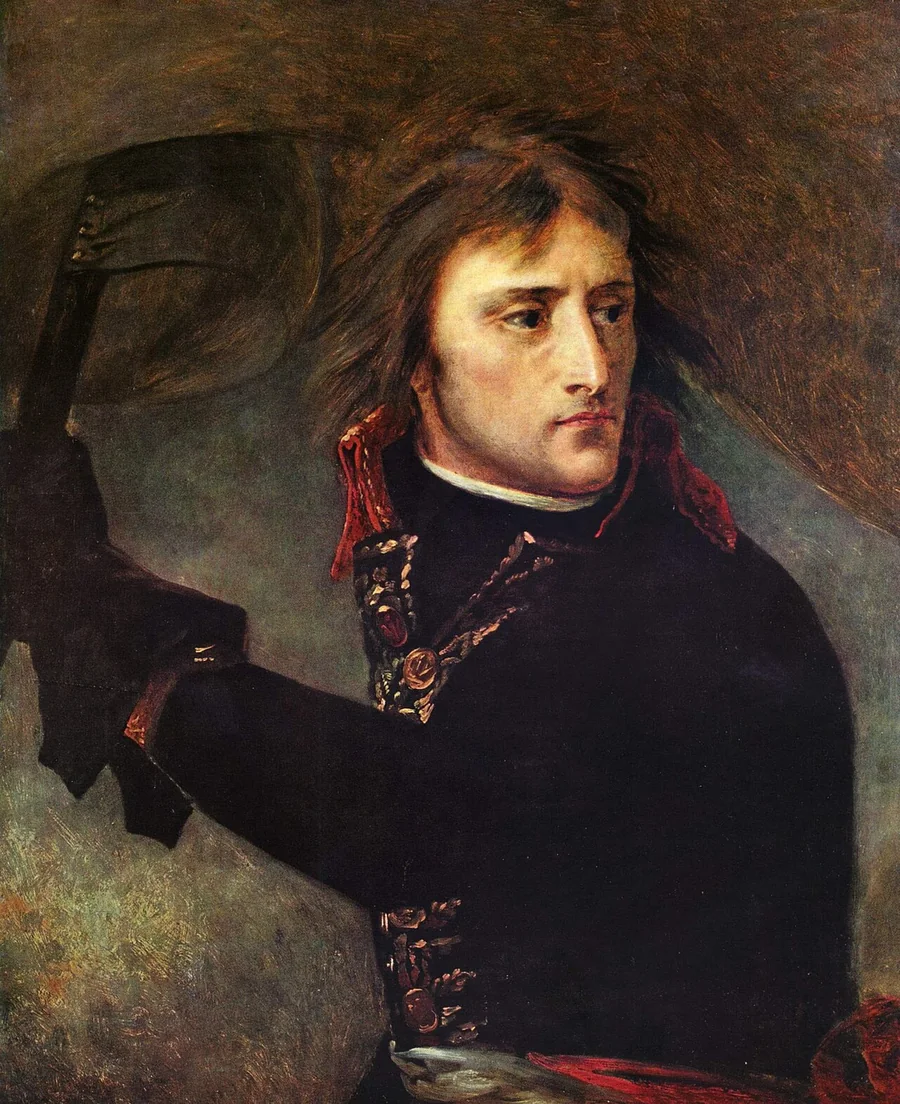
French losses came to about 3,500 killed and wounded and 1,300 prisoners or missing; the Austrians had about 2,200 killed and wounded, but left behind 4,000 prisoners and eleven guns. The third relief attempt had failed, by a narrow margin. The flag episode, put on canvas as early as 1796 by the painter Antoine-Jean Gros, very quickly became a founding image: Arcole is often seen as the start of the Napoleonic legend.
Rivoli: the fall of Mantua
In January 1797 Alvinczy tried a fourth and final time to relieve Mantua. The bulk of his army, some 28,000 men, was this time to overwhelm Joubert's division in the mountains to the north, while diversionary attacks kept the French occupied further east. But his columns, separated by difficult terrain in the depths of winter, failed to arrive together on the Rivoli plateau, between Lake Garda and the Adige.
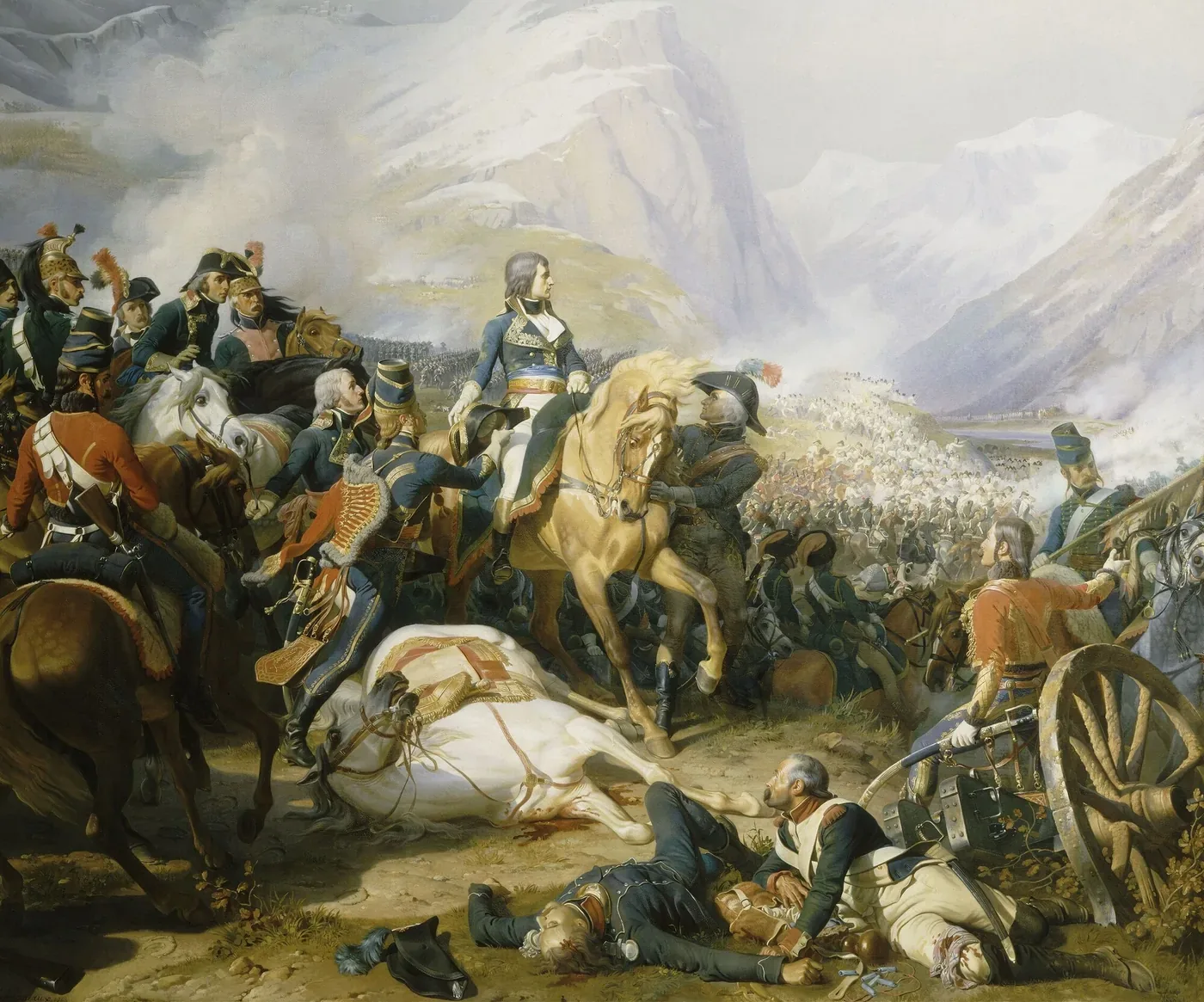
On 14 January 1797 Bonaparte, hurrying up with reinforcements to about 22,000 men, crushed the Austrian columns one after another as they appeared. The defeat was total: of 12,000 to 14,000 Austrian losses, 8,000 to 10,000 men were taken prisoner, along with some forty guns, against about 3,200 killed and wounded and 1,000 prisoners on the French side. A sortie attempted too late by Wurmser from Mantua failed in its turn.
Rivoli sealed Mantua's fate. Worn down by eight months of blockade, hunger and disease, which by some estimates — the historian David Chandler's among them — killed as many as 18,000 of its men from all causes, Wurmser's garrison capitulated on 2 February 1797: of the thousands of men still on its rolls, barely 16,000 were fit to march out of the city under their own power. Austria lost its last stronghold in northern Italy at a stroke.
From Tolentino to Campo Formio: peace forced on Austria
With Mantua fallen, Bonaparte turned first against Pope Pius VI, whose states had for a time backed the coalition. The Treaty of Tolentino, signed on 19 February 1797, forced the Holy See to cede Avignon and the Comtat Venaissin, to give up the legations of Bologna, Ferrara and Romagna to the Cispadane Republic, to pay a heavy indemnity and to hand over to the Louvre some hundred works of art and manuscripts taken from the papal collections.
That front cleared, Bonaparte marched north-east, crossed the Tagliamento and pushed into the Habsburg hereditary lands towards Vienna. The Austrian court, fearing for its capital, resolved to negotiate: on 18 April 1797 preliminary terms of peace were signed at Léoben. At the same time, Bonaparte used an anti-French uprising at Verona in mid-April, and then the sinking of a French frigate by Venetian forts on 20 April, as a pretext to put an end to the Republic of Venice: on 12 May 1797 the Great Council voted its own dissolution, and the last doge, Ludovico Manin, abdicated.
Over the following months, Bonaparte reshaped the map of northern Italy as he pleased. The Ligurian Republic, replacing the ancient Republic of Genoa, was proclaimed in June 1797; on 29 June, the Cisalpine Republic, with its capital at Milan, was born of the merger of the Cispadane and Transpadane republics. The final treaty, signed on 17 October 1797 at Campo Formio, a village in Friuli, sealed these upheavals: Austria ceded the Austrian Netherlands to France and recognised the Cisalpine Republic over Lombardy, but received in compensation most of Venice's former mainland territories east of the Adige, together with Istria and Dalmatia. The Republic of Venice, which had gone eleven centuries without being conquered, vanished from the map.
The arrangement caused a scandal even in France: Bonaparte had negotiated alone, without waiting for detailed instructions from a Directory kept at arm's length, and he had handed to Austria a city the French themselves had briefly dreamed of as a sister republic. But the treaty ended five years of war against the First Coalition, left only the United Kingdom still in the field, and brought France the left bank of the Rhine and a dominant position in northern Italy; the Directory, unable to afford disowning it, ratified it without argument.
A method, a legend
For nineteen months, a twenty-six-year-old general had waged war on his own, governed millions of people, created republics, negotiated treaties and filled the coffers and the museums of Paris, with scarcely a serious word to a Directory that simply cashed the money and let him carry on. Back in France, Bonaparte was welcomed as a hero and elected to the Institut de France on 25 December 1797. Uneasy about his popularity, the Directory approved his plan for an expedition to Egypt on 5 March 1798, only too glad to send off a general who had become an embarrassment.
In a little over a year, the first Italian campaign had set the method Bonaparte would repeat in every war he fought: strike fast to keep numerically superior enemies from joining forces, seek the decisive battle rather than the cautious manoeuvre, and press every victory to the full. It also built, around the young general with the flag at Arcole, an image and a popularity that neither the Directory nor his own generals would ever again be able to contain. The sister republics he had brought into being in Liguria and Lombardy foreshadowed, on a small scale, the vassal kingdoms with which he would surround the Empire a decade later.
This war also forged a staff that would follow Bonaparte all the way to the Empire: Berthier, a chief of staff of rare efficiency, would remain his right-hand man until 1814; Masséna, Augereau, Lannes and Sérurier would become Marshals of the Empire eight years later. Between battles, Bonaparte still found time to write Joséphine, left behind in Paris, passionate letters in which an anxious lover shows through beneath the victorious general — a contrast his contemporaries, used to the image of the victor of Arcole, would discover with some surprise once his correspondence was published.
Further reading
- Patrice Gueniffey, Bonaparte, 1769-1802, Gallimard, 2013.
- David G. Chandler, The Campaigns of Napoleon, Macmillan, 1966.
- Martin Boycott-Brown, The Road to Rivoli: Napoleon's First Campaign, Cassell, 2001.
- Jean Tulard (ed.), Dictionnaire Napoléon, Fayard, 1987.
- Fondation Napoléon, Correspondance générale de Napoléon Bonaparte, vol. I, Les Apprentissages, 1784-1797, Fayard, 2004.