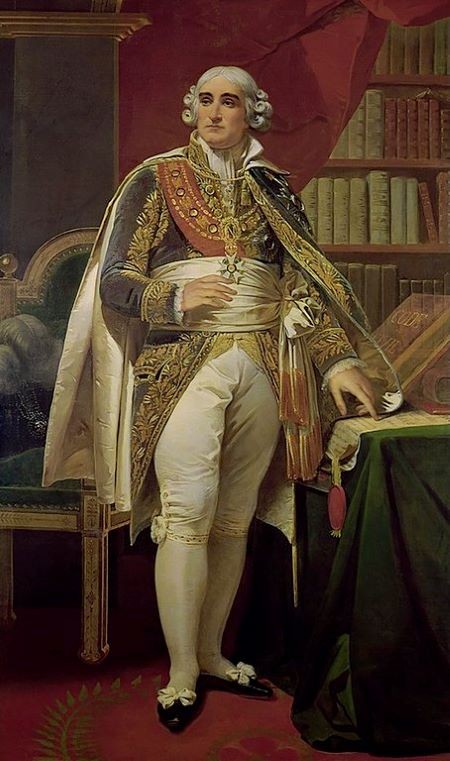
Born at Montpellier on 18 October 1753 into a family of the long robe, Jean-Jacques Régis de Cambacérès embodied legal continuity between enlightened monarchy, Revolution, and Empire. Elected to the Estates General for the Hérault, a moderate conventionnel, he voted for Louis XVI's death with reprieve — a gesture that made him a regicide in Bourbon eyes while distinguishing him from the most radical. From the 1790s he pursued the dream of unified private law; under the Consulate the commission he chaired, with Portalis, Tronchet, and Bigot de Préameneu, produced the French Civil Code, promulgated in 1804. Second Consul then, under the Empire, Archchancellor — first dignitary after the Emperor — he presided over the Senate, kept the great seal, and registered sénatus-consultes. Prince of the Empire, Duke of Parma in 1808, a discreet courtier whose homosexuality, notorious but tolerated, fed gossip without shaking Napoleon's trust. In April 1814 he surrendered the seal to Louis XVIII, suffered regicide exile, returned after the 1818 amnesty, and died in Paris on 8 March 1824. His legacy is the Civil Code: one of the most widely exported achievements of modern legal civilisation.
From Montpellier to Brumaire: the robe, the Convention, and the first codification projects
Jean-Jacques Régis de Cambacérès was born at Montpellier into a milieu where law and royal administration were second nature: his father held judicial office; the young man followed the classic path of avocat at the parlement, acquired technical culture of southern customary law and written law, and was noted for the clarity of his briefs and a political prudence that did not stop him embracing the Revolution when it opened careers to men of the robe.
Elected deputy of the Third for the Hérault to the Estates General of 1789, he sat among moderates, defended constitutional monarchy, then accepted the Revolutionary widening of the legislative frame. In 1792 he entered the Convention: the vote on the king's fate in January 1793 marked him for posterity. Cambacérès voted for death, but with reprieve and appeal to the people — a nuance that would not spare him the regicide list under the Restoration, while showing distance from the Montagne's hardliners. He joined the Legislation Committee, where first sketches of coherent national law were drafted: harmonising decrees, customs, and revolutionary principles became his methodical obsession.
Between Thermidor and the Directory, he avoided proscription lists thanks to a profile as useful jurist rather than club orator: he multiplied reports and motions on successions, substitutions, and land publicity, themes foreshadowing the Code. That « technical visibility » let him cross 1794–1799 without vanishing from the Parisian scene, while so many other conventionnels sank or went into exile; he remained the man consulted when a decree had to be drafted without provoking the chambers' indignation.
Under the Terror, codification fell back; under the Directory, Cambacérès returned to the Council of Five Hundred and presented civil-code projects that failed before the complexity of matters and assembly fatigue. The ambition remained: replace the patchwork of Parisian, Norman, and southern customs with a single text, readable, applicable by judges trained to the same rules. That programme required stable executive power: 18 Brumaire Year VIII supplied it. Appointed Second Consul in December 1799, Cambacérès became Bonaparte's institutional partner for everything touching justice, the Conservative Senate, and soon the Consulate's great legislative work.
The Second Consulship placed him in relative shadow of the First, but gave effective presidency of legislative sessions during the general's absences on campaign. Napoleon, who disliked long debate and doctrinal subtlety, nonetheless recognised him as the indispensable interlocutor: Cambacérès translated political ambitions into articles, foresaw conflicts between Tribunate and government, and prepared ground so the Civil Code commission, from Year IX, could work in conditions unseen since 1789.
The Civil Code commission and Consular legislative work
On 24 Messidor Year IX (13 July 1801), four jurists — Portalis, Tronchet, Bigot de Préameneu, Maleville — were tasked, under Cambacérès's presidency, to draft successive titles of the code. The method was industrial: regular sessions, confrontation of local traditions, balancing of interests (dowry, succession, contract), tight drafting. Cambacérès did not merely preside: he decided, reread, imposed stylistic choices aimed at clarity for practitioners. Council of State archives preserve traces of those nights when each article was debated like a brick of an edifice meant to outlast any regime.
The First Consul intervened in Council of State sessions on the project: Napoleon sometimes imposed patriarchal solutions — marital authority, divorce rules — that jurists would have softened; he also meant the code to serve social order and transactional stability. Cambacérès mediated between the chief's haste and the drafters' caution, without breaking the momentum toward promulgation. The final text, adopted in March 1804 and entitled French Civil Code, counted 2,281 articles; it unified marriage, filiation, property, contracts, and obligations in a language that would become a model for several foreign legislations.
Beyond the Civil Code, the same team prepared the other codes — commerce, procedure, penal — in the imperial wake; Cambacérès remained the spearhead of that legislative enterprise. The propagandist dimension did not escape the regime: the code was presented as synthesis of Revolution and authority, as proof that France could govern by written law and not by arms alone. For legal historians, Cambacérès embodies the administrator of modern private law: less the solitary theorist than the organiser of an elite collective.
Napoleonic posterity would readily cite the Emperor's phrase on the Code's glory rather than battles; Cambacérès was, with Portalis, its principal craftsman. The Council of State debates, where the First Consul presided surrounded by embroidered-coated councillors, remain the symbolic image of that phase: military power subjects society to a single law, and the Montpellier jurist is its silent but decisive coordinator.
From 1804, spreading the text across departments and courts of appeal required circulars, ministerial commentaries, and training magistrates: Cambacérès followed these steps with an administrator's care, knowing a code dead in libraries would not change society. First annotated collections, consultations to the Council of State, and clashes between old local case law and the new letter still occupied his time as Archchancellor; they fixed him as pivot between the chamber of sessions and the world of tribunals.
Archchancellor, Senate, and life under the Empire
The Empire's proclamation in May 1804 transformed the hierarchy of dignities: Cambacérès became Archchancellor of the Empire — an office placing him immediately after the Emperor in protocol. He presided over the Senate, the conservative institution charged with registering organic laws and sénatus-consultes that clothed Bonapartist power in revived Roman legality. The great seal of state was entrusted to him: every major act passed through his « chancellery » ministry, understood broadly as maintaining legal continuity between Consulate and imperial monarchy.
Raised Prince of the Empire then Duke of Parma in 1808, Cambacérès led a sumptuous Parisian life matching ceremonial demands: furnished town houses, salons, honorific offices. His homosexuality, known to courtiers and memoirs, met official silence as long as it did not scandalise public opinion: Napoleon, pragmatic, preferred the indispensable jurist to gossip he deemed secondary while administrative efficiency held. The master's attributed phrase — « Cambacérès is a man of law, not a man of the court » — sums a functional alliance between two temperaments opposed in lifestyle.
The Empire's organic sénatus-consultes — successions, majorats, integration of notables — emerged from deliberations where the Archchancellor played technical safeguard: avoid contradictions between texts, ensure coherence of new public law with the Civil Code already in force. Cambacérès was neither Minister of War nor of Police; his influence worked in the slow maturing of written acts structuring the Napoleonic state for decades.
At imperial ceremonies — coronation, marriage to Marie Louise, diplomatic presentations — his place in order of march showed the Empire as a state of law, not conquest alone. Foreign ambassadors met him in antechambers of power; they knew serious negotiation on annexations or treaties would ultimately cross the chancellery's views. Cambacérès remained until 1814 the silent pillar of that institutional façade.
The Empire at war: the jurist in the shadows (1805-1814)
The campaigns of Austerlitz, Jena, Spain, or Russia did not find Cambacérès on the battlefield; his field was the texts framing conscription, administration of annexed departments, normalisation of law in lands integrated into the Empire or allied. That thankless task held the background: no bulletin glory, yet it fixed rules by which millions of Europeans would meet French legislation. The Archchancellor oversaw adaptations when borders retreated or advanced.
As Coalition pressure rose after 1812, the political regime hardened; the Senate registered exceptional measures Cambacérès applied without public break with the Emperor. Historians debate his real margin for manoeuvre: minister of legal continuity, he was not the military adviser who would dissuade Napoleon from the campaign of France; he nonetheless saw to it that abdication or transition did not occur in a legal void. Meanwhile, the legal framing of blockades, Rhenish annexations, and satellite principalities fed chancellery work bearing his name on opinions the public never read but prefects applied daily.
In April 1814, after Fontainebleau, Cambacérès surrendered the great seal to Louis XVIII in a sequence where Bourbon legality reclaimed state symbols. He withdrew without theatrical confrontation, aware that his status as a conventionnel who had voted for the king's death placed him on the ultras' blacklist. The seal's surrender symbolically closed ten years of archchancellery and opened forced exile that neither the Code's prestige nor years of service would fully spare.
Regicide, exile, return, and the Code’s legacy
The Restoration treated regicides with severity varying by faction: Cambacérès appeared on exile lists; he stayed in Brussels then Rome, living on his means and European reputation as a jurist. The Civil Code remained in force: the Bourbons, while blackening revolutionaries, did not challenge the legal instrument that stabilised property and contracts. That irony of fate reinforced the 1804 text's dimension « beyond regimes » — and, by ricochet, memory of its principal coordinator.
The amnesty law of 1818 allowed some exiles to return; Cambacérès recovered France, divided his time between Montpellier and Paris, moved in bar and academy circles, without regaining power's heights. He died on 8 March 1824, aged seventy, and was buried at Père-Lachaise Cemetery. Funeral orations stressed the jurist, sometimes occluding the revolutionary dimension; later historical scholarship reintegrated both facets.
Cambacérès's posterity is above all that of the Civil Code: exported, adapted, commented for two centuries, it remains a reference for family law and obligations across much of the world — from the Mediterranean basin to the Americas, where colonies or republics drew on it for their own codifications. French schoolbooks readily cite Napoleon on battles and the Code; behind the phrase stand Portalis, Tronchet, Bigot de Préameneu — and the Archchancellor who held together pieces of a juridical puzzle inherited from the Revolution. Cambacérès embodies the builder-magistrate: neither romantic hero nor pure ideologue, but patient craftsman of a written order that outlived empires.
Discover other characters
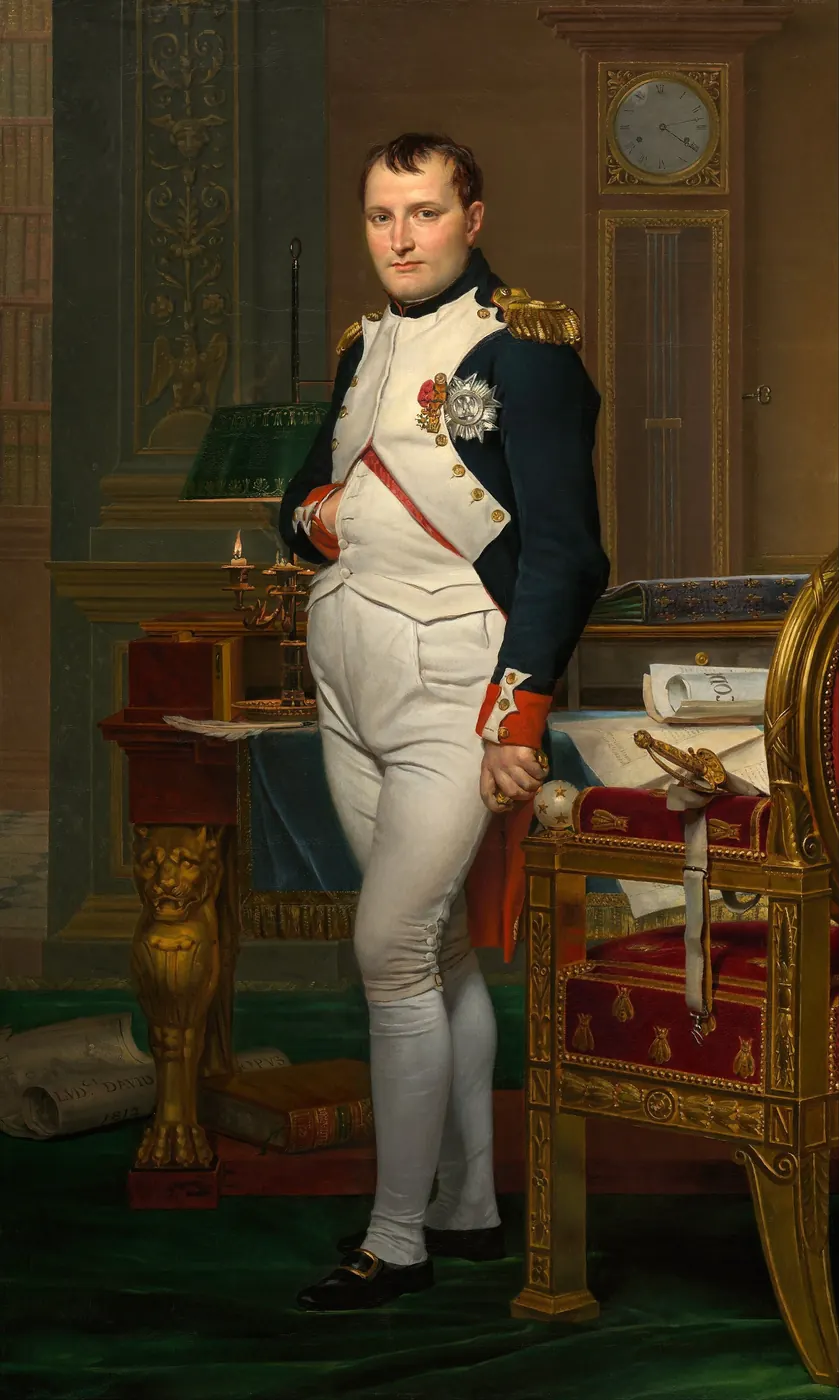
Napoleon Bonaparte
Emperor of the French
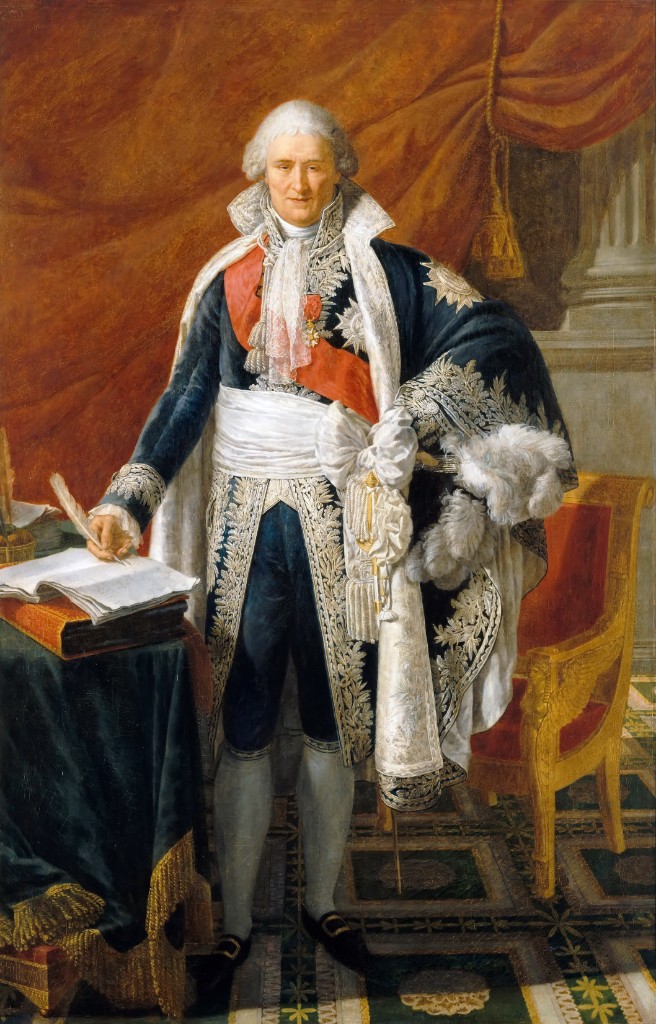
Jean-Étienne-Marie Portalis
Lawyer, co-drafter of the Civil Code, Minister of Religious Affairs
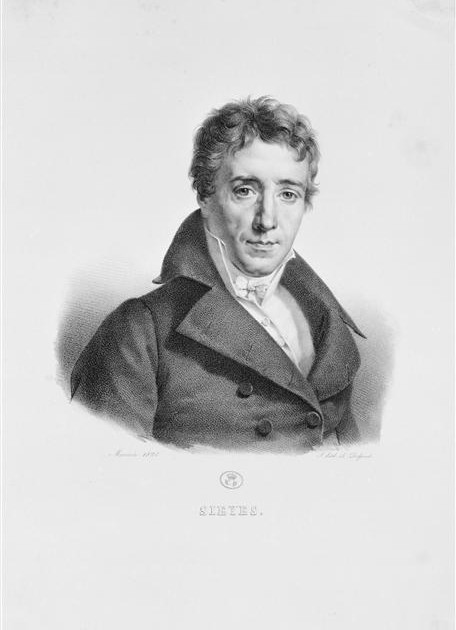
Emmanuel Joseph Sieyès
Political theorist, deputy, Director, Consul
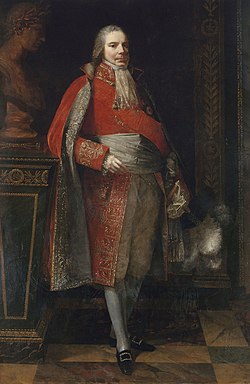
Charles-Maurice de Talleyrand
Minister for Foreign Affairs, Prince of Benevento, diplomat
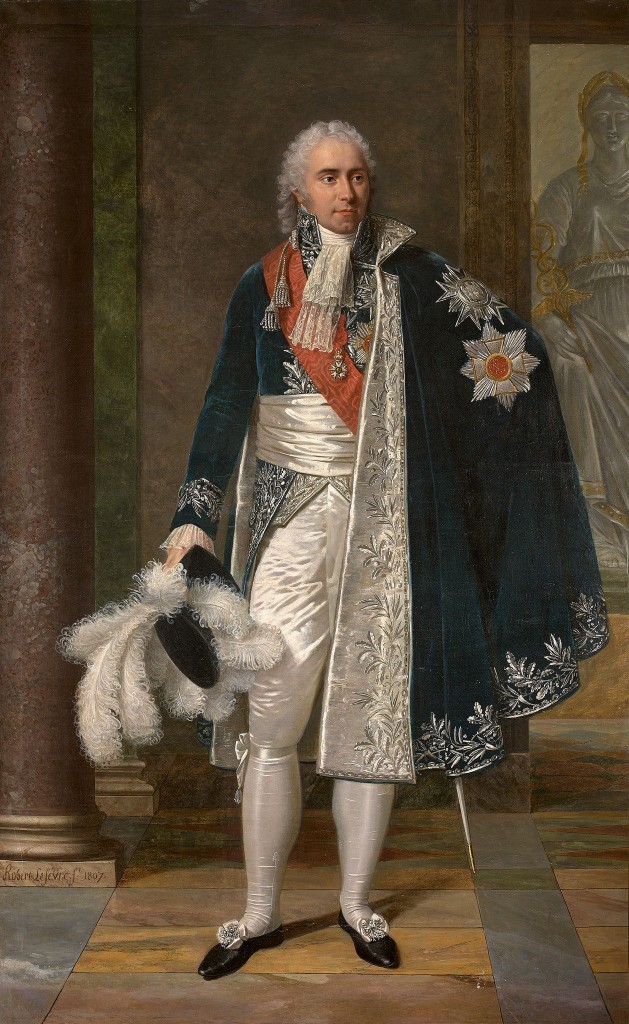
Hugues-Bernard Maret
Duke of Bassano, Secretary-General of the Government then Minister for Foreign Affairs and Secretary of State (1811–1813)
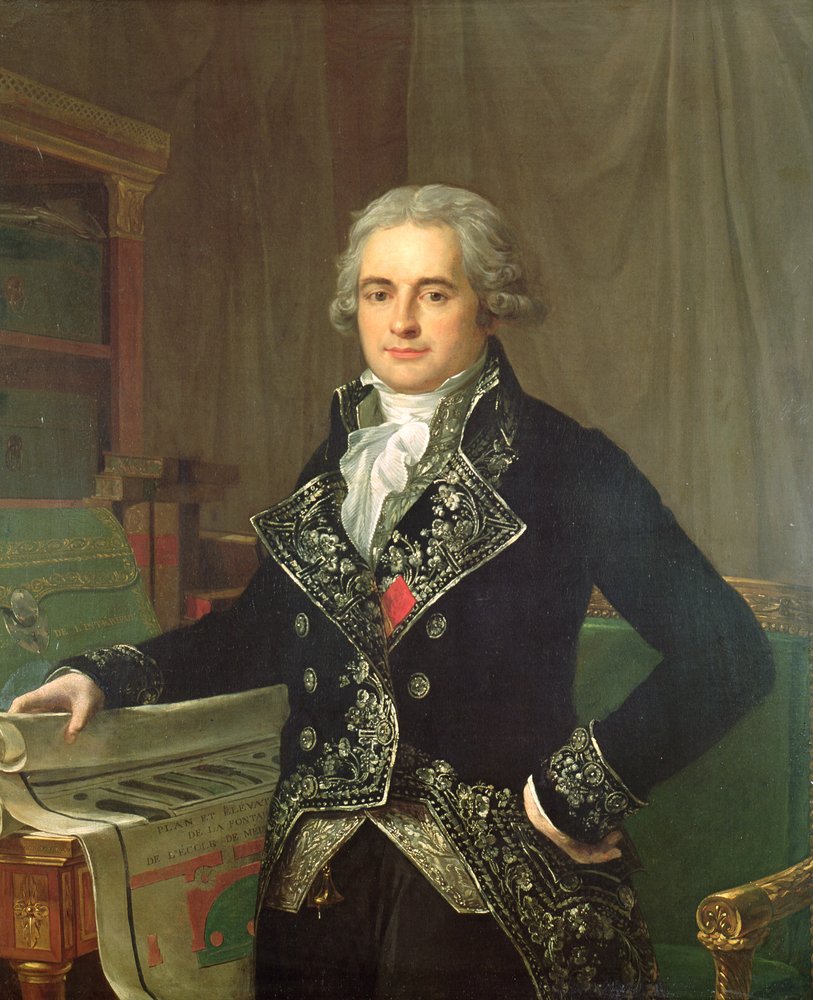
Jean-Antoine Chaptal, Count of Chanteloup
Chemist, industrialist, Minister of the Interior (1800–1804)
Go further
Recommended books to dig deeper (affiliate links)

Napoleon the Great
Andrew Roberts · 2014
A monumental biography drawing on Napoleon’s 33,000 surviving letters, admiring but rigorous.
See on Amazon
Napoléon ou le mythe du sauveur
Jean Tulard · 1977
The book that reshaped how the man is read: how France gave itself a saviour, and what it cost.
See on Amazon
Nouvelle histoire du Premier Empire
Thierry Lentz · 2002-2010
Four reference volumes on institutions, diplomacy and collapse: the scholarly synthesis of the subject.
See on AmazonAs an Amazon Associate, this site earns from qualifying purchases.
Support the encyclopedia
Napoleon Empire is an independent project. Your contribution helps grow the content and keep the site running.
DonateSecure payment on the platform you choose.