From Portugal to Madrid
The Spanish affair begins in Lisbon. Portugal, England's old ally, refused to close its ports to British trade, and Napoleon could not leave such a breach open in the Continental Blockade. On 27 October 1807 the Treaty of Fontainebleau, signed with the Spain of Charles IV, allowed French troops to cross the peninsula and already provided for the partition of Portugal. Junot entered Lisbon on 30 November 1807, the day after the Portuguese royal family had sailed for Brazil with its court, aboard ships escorted by the British fleet.
Behind Junot, troops kept pouring into Spain. In early 1808 French garrisons installed themselves, by surprise or by ruse, in northern strongholds such as Pamplona, Barcelona, San Sebastián and Figueras. Napoleon no longer spoke of mere passage. Spain was a weakened ally: an indolent king, Charles IV, a queen, Maria Luisa, and above all the favourite Manuel Godoy, "Prince of the Peace", hated by much of the nobility and the people. The Prince of Asturias, Ferdinand, heir to the throne, was plotting against him and against his own parents.
The crisis broke at Aranjuez on 17 and 18 March 1808. A riot overthrew Godoy, and on 19 March Charles IV abdicated in favour of his son, who became Ferdinand VII. On the 23rd Murat, whom Napoleon had placed at the head of the French troops in Spain, entered Madrid; Ferdinand made his entry the next day to an enthusiastic welcome. But Murat would not recognise him as king. Napoleon had found the opportunity he was waiting for: two rival claimants to a crown, each of whom needed him.
Bayonne: the crown of Spain
Napoleon reached Bayonne on 14 April 1808. He drew Ferdinand VII there, who crossed the frontier on 20 April convinced that the Emperor would confirm his title, and then Charles IV and the queen, who arrived on the 30th. The talks were stage-managed from start to finish. On 5 May Charles IV ceded his rights to Napoleon; on the 6th Ferdinand handed the crown back to his father before renouncing his own rights. The whole royal family was interned in France, Ferdinand and his closest relatives at the château of Valençay, which belonged to Talleyrand.
Napoleon then gave the crown to his elder brother Joseph, until then King of Naples, who was declared King of Spain and the Indies by a decree of 6 June 1808. Joseph was a cultivated man and a sincere reformer, with no taste for war. An assembly of Spanish notables, meeting at Bayonne in June and July, adopted a statute that served as a constitution: equality before the law, abolition of privileges, an opening towards reforms inspired by France. Part of the elite, the afrancesados, saw in it a chance to modernise Spain. Joseph entered Madrid on 20 July. At Naples, Murat succeeded him.
The operation had been carried out with an ease that explains the miscalculation. Napoleon thought he would receive a crown without a fight, as he had so many others, and he overlooked an essential fact: the Spaniards' attachment to their dynasty, their Church and their local customs, all of which the deposition of Ferdinand struck head-on. Spain was neither Italy nor Germany.
The Dos de Mayo and the uprising
The spark came from Madrid before the outcome at Bayonne was known. On 2 May 1808 a crowd gathered in front of the royal palace to prevent the departure of the last members of the royal family still in the capital. French soldiers opened fire; the riot became an insurrection. Murat repressed it violently: cavalry, including the mamelukes of the Guard, charged through the streets, notably at the Puerta del Sol. During the night of 2 to 3 May, Madrileños arrested with arms in their hands, or simply in the street, were shot in groups on the hill of the Montaña del Príncipe Pío. By the next day the city was quiet. The rest of the country was not.
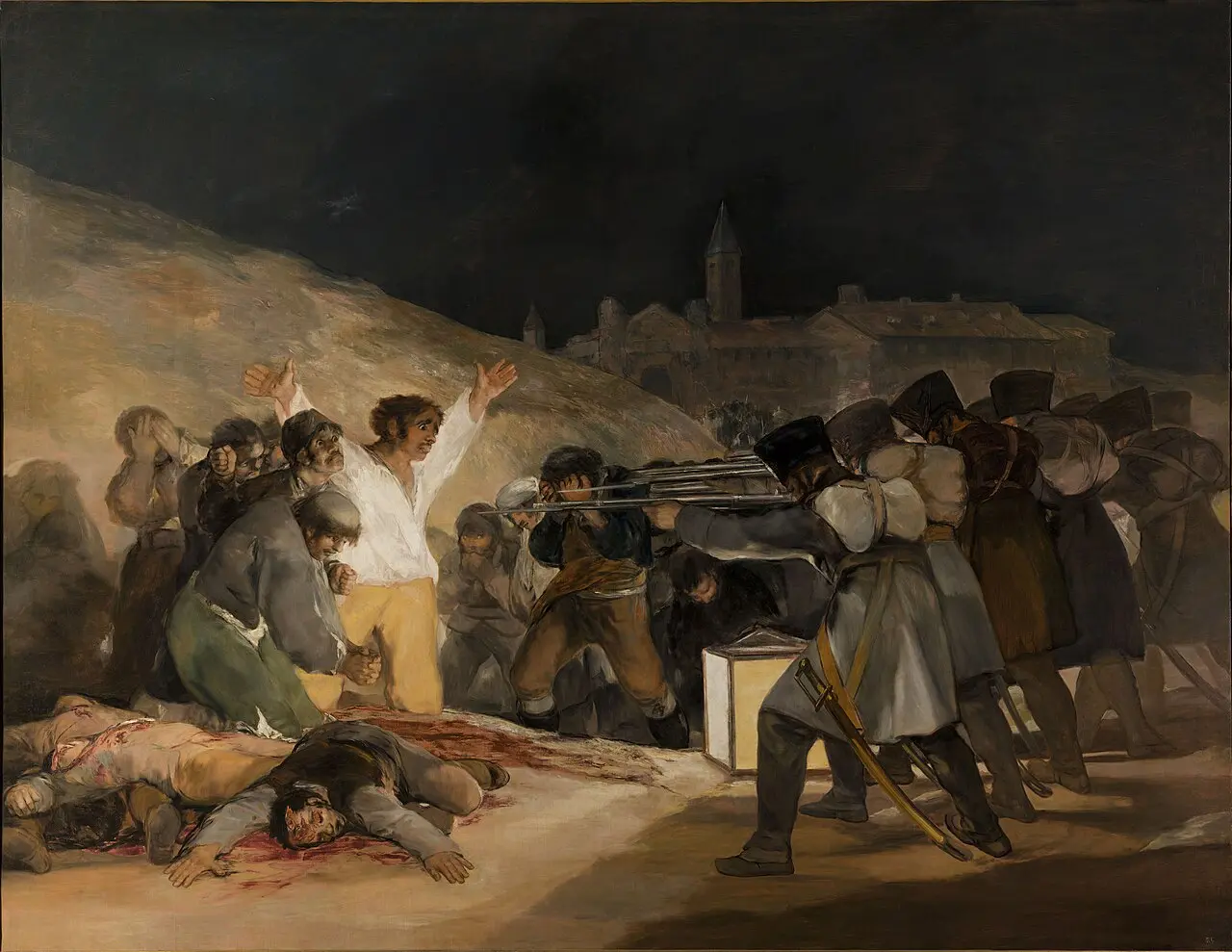
Goya, then a court painter, would turn these days into two large canvases painted in 1814, after the return of Ferdinand VII: the charge of the mamelukes and the executions. The second has become the universal image of the massacre of the innocent by a regular army, so much so that it is often read as more than an episode: as a verdict on war itself.
In the following weeks Spain filled with juntas, local committees that raised troops and governed in the name of Ferdinand VII: in Asturias at the end of May, then in Seville, Valencia, Saragossa and Galicia. These juntas sent envoys to London, where the British government, until then at war with Spain, changed sides within days and promised arms and money. A conflict that Napoleon believed he could settle by simple occupation became a national war, fought in the name of king, religion and fatherland. In September a Supreme Central Junta settled at Aranjuez to coordinate the effort.
Bailén, the first setback
Napoleon had sent several columns to pacify the country. In the south General Dupont was ordered to reach Andalusia and Cádiz. He took Córdoba on 7 June 1808, which was sacked, and then found himself isolated, at the head of young conscripts worn out by the Andalusian summer heat and encumbered with plunder. He fell back to the north. On 19 July, at Bailén, at the foot of the Sierra Morena, he ran into the Army of Andalusia under Generals Castaños and Reding, more numerous and better placed, and could neither force the passage nor join his reinforcements.
On 22 July Dupont capitulated with nearly 18,000 men. It was the first time a Napoleonic army corps had surrendered in the open field. The military disaster was limited, but the psychological effect was enormous: across Europe it became known that the imperial army was not invincible. The Spaniards, for their part, did not honour the convention that had been signed, which provided for the repatriation of the prisoners: the captives were sent to hulks at Cádiz, then deported to the island of Cabrera in the Balearics, where many of them died.
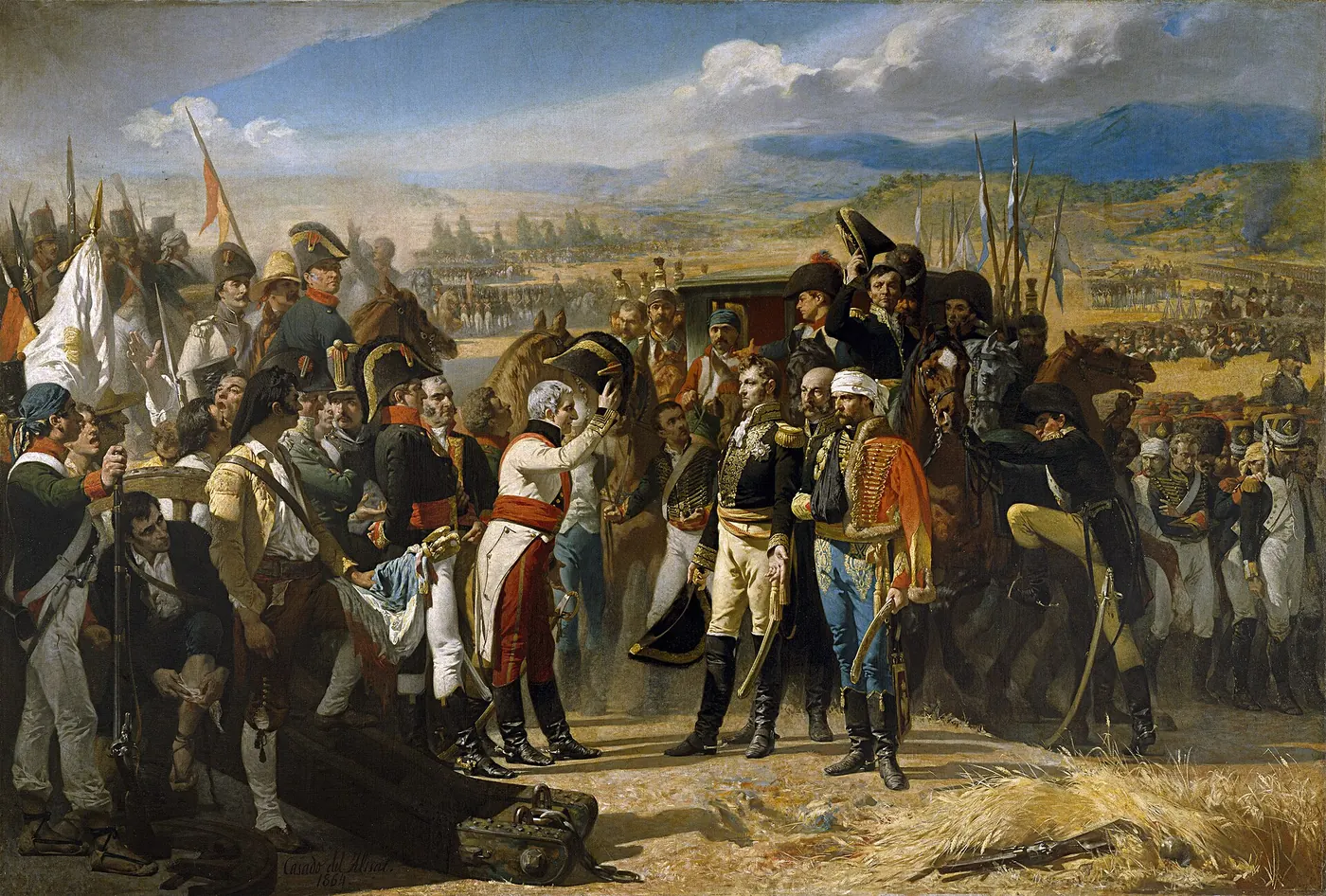
Joseph, who had stayed only eleven days in Madrid, left the capital on 1 August and withdrew behind the Ebro with most of the army. In Portugal, Wellesley landed in August with a British corps; he beat Junot at Vimeiro on the 21st, and the Convention of Sintra, signed on 30 August, allowed the French to evacuate the country with their weapons, carried by the British navy. Within a few weeks the peninsula had slipped from Napoleon's grasp. And the defeat encouraged Austria, which began to rearm.
Napoleon in Spain
The Emperor decided to come himself. After the Erfurt meeting with Alexander, he left Paris at the end of October 1808, reached Bayonne on 3 November and joined the army at Vitoria. Whole corps had been recalled from Germany. A few weeks were enough to reverse the situation. The scattered Spanish armies were beaten at Gamonal and Espinosa de los Monteros on 10 and 11 November, then at Tudela on the 23rd by Lannes. On 30 November, at the pass of Somosierra, which barred the road to Madrid, the Polish light horse of the Guard took by charge the Spanish batteries defending the pass. Madrid capitulated on 4 December.
At Chamartín, at the gates of the capital, Napoleon issued several decrees meant to stamp Joseph's reign with a revolutionary mark: abolition of the Inquisition and of feudal rights, suppression of internal customs barriers, a reduction in the number of convents. He then turned on the British army of General John Moore, which had advanced as far as Sahagún in the north-west, and set off in pursuit across the Sierra de Guadarrama in appalling weather. Moore retreated towards the coast, and Napoleon, informed of Austria's armaments and of intrigues in Paris, handed the pursuit to Soult.
On 16 January 1809, at Corunna, Soult attacked the British as they were embarking; Moore was killed, but his men got away. The Emperor had already left: he quit Valladolid around 17 January and never came back to Spain. He took away the conviction that he had restored the situation, and that was his mistake. He had won battles, but he left behind a vast, rugged, hostile country that his lieutenants would have to hold without him, with ever scarcer means.
A war without a front
What the Spaniards lost in pitched battle they won back through small war. The word guerrilla, Spanish for "little war", entered the European vocabulary. Bands of peasants, smugglers, scattered soldiers and sometimes priests, called guerrilleros, sprang up in the mountains of Navarre, Aragon, Castile and Galicia under leaders such as Juan Martín Díez, known as "El Empecinado", or Francisco Espoz y Mina. They attacked convoys, killed stragglers and cut the couriers. The French had to escort every dispatch and tie down thousands of men to guard roads they never truly controlled. Repression, often ferocious, fed the hatred it was meant to extinguish.
Joseph had little real authority. The French generals each governed their province as a fief, and Napoleon, from Paris, remained the only one who decided. Some, like Suchet in Aragon and then at Valencia, tried to administer and to pacify, with real success; others lived off the land. In 1810 Soult conquered almost all of Andalusia, but could not take Cádiz, which was besieged from February 1810 to August 1812. Behind its walls an extraordinary Cortes met from September 1810 and, on 19 March 1812, promulgated a liberal constitution proclaiming the sovereignty of the nation.
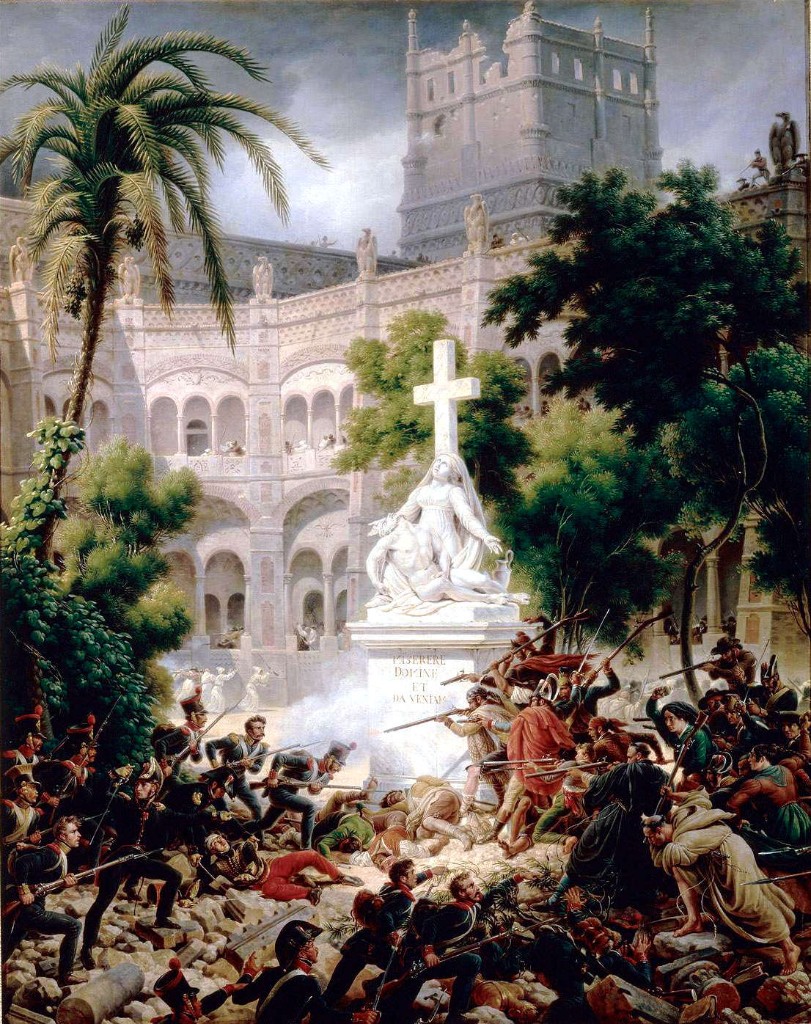
The sieges of the war are etched in memory. At Saragossa, defended by General Palafox, the French lifted a first siege on 14 August 1808, then returned in December. The second siege lasted until 20 February 1809: the city had to be taken house by house, convent by convent, through hand-to-hand fighting, mines and countermines, while hunger and epidemics ravaged the besieged. The capitulation came when tens of thousands of inhabitants and soldiers, civilians included, had already perished. Girona resisted in the same way, until December 1809. Saragossa and Girona became names of legend in Spain.
Between 1810 and 1820 Goya etched a series of eighty-two prints, The Disasters of War, published only in 1863. He glorifies no one: he shows executions, rapes, famine, corpses left at the roadside, without distinguishing sides. It is perhaps the best testimony of what this war was for those who lived through it.
Wellington and Portugal
To hold the peninsula, Britain relied on Portugal, whose army it reorganised. Wellesley, back in April 1809 after Soult had taken Oporto, drove the latter out of the north of the country in May. He then entered Spain and, with the Spanish troops of General Cuesta, fought at Talavera, on 27 and 28 July 1809, a battle that the British and their allies held against Joseph, Victor and Jourdan. He was made Viscount Wellington of Talavera but, for lack of supplies, had to fall back towards the Portuguese frontier.
He then prepared, in the greatest secrecy, a line of fortifications north of Lisbon, the Lines of Torres Vedras, built between the autumn of 1809 and the autumn of 1810. In the summer of 1810 Masséna, commanding the Army of Portugal, invaded the country. He took Almeida in August, but his assaults were repulsed at Buçaco on 27 September, and in October he discovered, stunned, the lines in front of which he halted. For nearly a month he stayed before the fortifications without being able to take them, then withdrew to Santarém, where his army went hungry, for Wellington had laid waste the countryside. He fell back towards Spain only in March 1811, leaving thousands dead of disease and hunger, not counting the Portuguese population.
The war of 1811 was made of indecisive, bloody battles: Fuentes de Oñoro in early May, where Masséna tried in vain to relieve Almeida, then Albuera on 16 May, where Soult faced Beresford in one of the deadliest clashes of the war. In 1812, while Napoleon drew his best units away for Russia, Wellington went on the offensive. He took Ciudad Rodrigo in January and Badajoz in April, then beat Marmont at Salamanca on 22 July. Joseph left Madrid, and Wellington entered it on 12 August. The same year Soult evacuated Andalusia and lifted the siege of Cádiz. Wellington's failure before Burgos in the autumn sent him back to Portugal, but the south of Spain was lost to the French.
The fall (1813-1814)
After Russia, Napoleon needed men and recalled cadres and regiments from Spain. Joseph commanded weakened armies with Marshal Jourdan as chief of staff. On 21 June 1813, at Vitoria, Wellington inflicted a complete defeat on him: nearly all the artillery and baggage was abandoned, including the treasures accumulated in Madrid. Joseph fled; the Emperor removed him from command and gave it to Soult.
In July Soult launched a counter-offensive in the Pyrenees, at Maya, Roncesvalles and then Sorauren, which failed. San Sebastián was taken and burned on 31 August. On 7 October Wellington crossed the Bidassoa and entered France. He then fought the battles of the Nivelle, the Nive and Orthez, before reaching Toulouse, where he faced Soult on 10 April 1814, a few days after Napoleon's abdication, of which neither army yet knew.
Napoleon, for his part, tried to escape the impasse through diplomacy. By the Treaty of Valençay of 11 December 1813 he recognised Ferdinand VII as King of Spain and accepted his return, hoping thereby to detach Spain from the coalition. But the regency in Madrid refused to ratify the treaty. Ferdinand left Valençay in March 1814; he entered Madrid on 13 May. A decree of 4 May had already annulled the acts of the Cortes and the constitution of 1812, and restored absolutism. The afrancesados who had served Joseph took the road of exile, by the thousand, to France. Joseph himself withdrew to France, then to the United States after Waterloo, and returned to Europe only to die in Florence in 1844.
The balance sheet
Historians agree on the essentials. For six years the Spanish war tied down, on a secondary theatre, hundreds of thousands of men whom Napoleon would lack in Russia, in Germany and in France. It offered England a land battlefield where it could send an army and supply it by sea, and where Wellington was formed. It undermined the legitimacy of the Emperor, who had betrayed an ally, and encouraged all the peoples of Europe to believe that a Napoleonic army could be beaten. The expression "Spanish ulcer" took hold to describe it. At Saint Helena Napoleon is said to have declared: "That unfortunate war ruined me; all the circumstances of my disasters are tied to that fatal knot."
The event should not be reduced to a single cause of the fall of the Empire: Russia, the defection of Prussia and Austria, and the weariness of France played at least an equal role. Nor should the price paid in Spain be forgotten. The country emerged from the war bled white: losses, civilian and military, are counted in hundreds of thousands of dead, without any certain figure being possible, and the countryside was devastated. The following years were marked by the struggle between absolutists and liberals, which replayed the division born of this war. In America, the power vacuum in Madrid prompted the colonies to form their own juntas from 1809-1810, and the process that led them to independence, in the 1810s and 1820s, began there.
For the Spaniards this conflict is the Guerra de la Independencia, a founding act of the modern nation, which Madrid celebrates every year on 2 May. For the French it was long a shameful war, an expedition little spoken of. It is through Goya's painting, which has never ceased to haunt museums, that the whole world knows it today.
Further reading
- Thierry Lentz, Nouvelle histoire du Premier Empire, vol. II, L'Effondrement du système napoléonien, 1810-1814, Fayard, 2004.
- Charles Esdaile, The Peninsular War. A New History, Allen Lane, 2002.
- David Gates, The Spanish Ulcer. A History of the Peninsular War, George Allen & Unwin, 1986.
- A French eyewitness: Albert de Rocca, Mémoires sur la guerre des Français en Espagne, 1814.