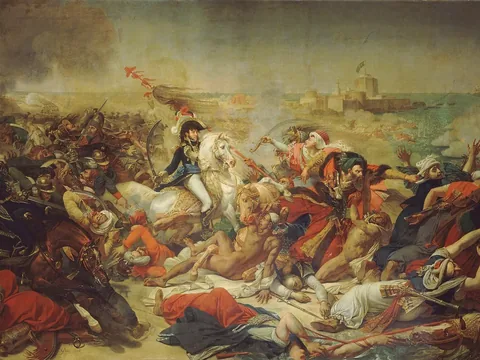
A country of a thousand customs
Before 1804, a Frenchman who moved to another province often moved into another body of law. In the south, the so-called lands of written law applied Roman law adapted by centuries of practice. In the north, the lands of customary law, each region and sometimes each town followed its own rules, written down from the sixteenth century onwards. The Custom of Paris was the most influential, but the customs of Normandy, Brittany or Orléans dealt differently with marriage, inheritance and debt. Voltaire mocked the situation in his Philosophical Dictionary: "A man travelling in this country changes laws almost as often as he changes post-horses."
On top of this patchwork came differences of rank. Nobles, clergy and commoners did not have the same rights, and in noble families the eldest son often took most of the inheritance. The kings had tried to unify what they could. Louis XIV made the teaching of "French law" compulsory in the law faculties in 1679; in the eighteenth century the ordinances of Chancellor d'Aguesseau brought gifts and wills into line; and jurists such as Domat and later Pothier looked for common principles behind the diversity of customs. Pothier, who died in 1772, would be one of the authors most heavily drawn upon by the drafters of the Code. But under the old monarchy nobody had the means to start again from scratch.
Ten years of failure
The Revolution set itself that ambition. The Constitution of 1791 promised that "a code of civil laws common to the whole kingdom shall be drawn up". In the meantime the assemblies legislated piece by piece: they abolished privileges and primogeniture, handed the registers of births, marriages and deaths to the municipalities and legalised divorce in 1792, and imposed equality between heirs. The code itself never came.
Cambacérès, a lawyer from Montpellier, tried three times. His first draft, 719 articles, was presented in 1793 and judged too legalistic, not "philosophical" enough. The second, 297 articles in 1794, seemed too thin. The third, 1,104 articles in 1796, got bogged down under the Directory. A fourth, presented by Jacqueminot in December 1799, was not even debated. The legal historian Jean-Louis Halpérin summed up the decade in the title of a book: L'Impossible Code civil. Yet a great deal of work had been done, and the drafters of 1800 would make ample use of it.
Four jurists, four months
Bonaparte, First Consul since the coup of Brumaire, took up the project again on his return from Marengo. On 12 August 1800 (24 Thermidor Year VIII), a decree of the consuls appointed a commission of four jurists. Tronchet, who had defended Louis XVI before the Convention, knew the Custom of Paris better than anyone; Bigot de Préameneu came from Rennes and Breton law; Portalis, a lawyer from Aix, had been raised on Roman law; Maleville, a magistrate from the Périgord, another land of written law, served as secretary. Two men of customary law and two of written law: the line-up was a programme in itself.
They worked fast. Drafted in four months, the text was printed in January 1801 and sent to the Court of Cassation and the courts of appeal, which returned their comments in writing. Portalis wrote its introduction, the Preliminary Address, still counted among the finest pages of French legal prose. In it he rejected the idea of a code derived entirely from reason: "The codes of nations are made with time; but, strictly speaking, they are not made at all." The Code, he said, would be a compromise between written law and the customs, between the old France and the Revolution.
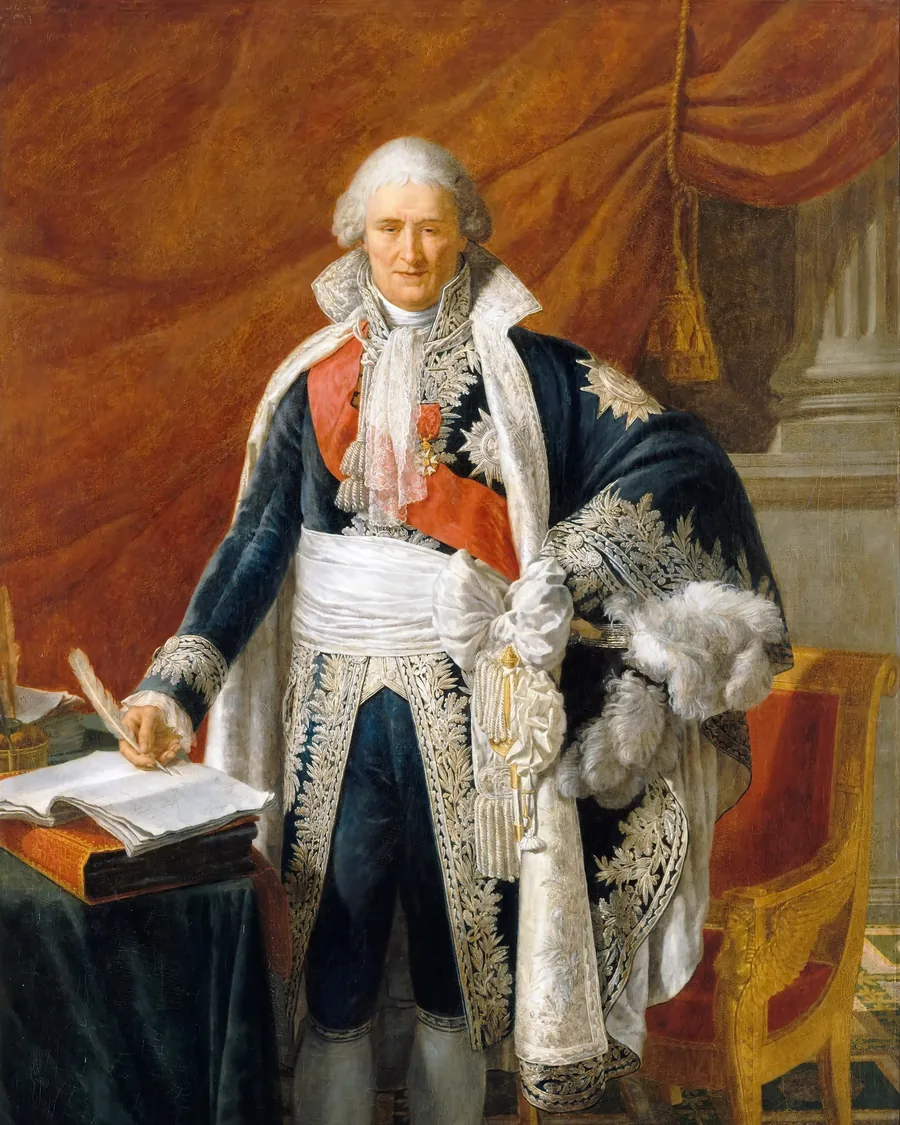
Bonaparte at the Council of State
The draft then went to the Council of State, the body created by the Constitution of Year VIII to prepare legislation. From July 1801 to March 1804 it was debated there article by article, in about a hundred sessions according to the minutes. Bonaparte chaired more than half of them and Cambacérès the rest; historians' counts differ, but there is no doubt about the First Consul's diligence. He was no lawyer. He asked questions, came back to the points that interested him, pressed the experts to reach a conclusion and settled matters when the debate went round in circles.
What held his attention above all was the family. He argued for keeping divorce, including divorce by mutual consent, and for keeping adoption. Several historians see his own situation behind this: married to a woman who had given him no child, he was already thinking about his succession. On most other matters he usually left the last word to the jurists, and the bulk of the text owes far more to Tronchet, Portalis and the councillors of state than to him.
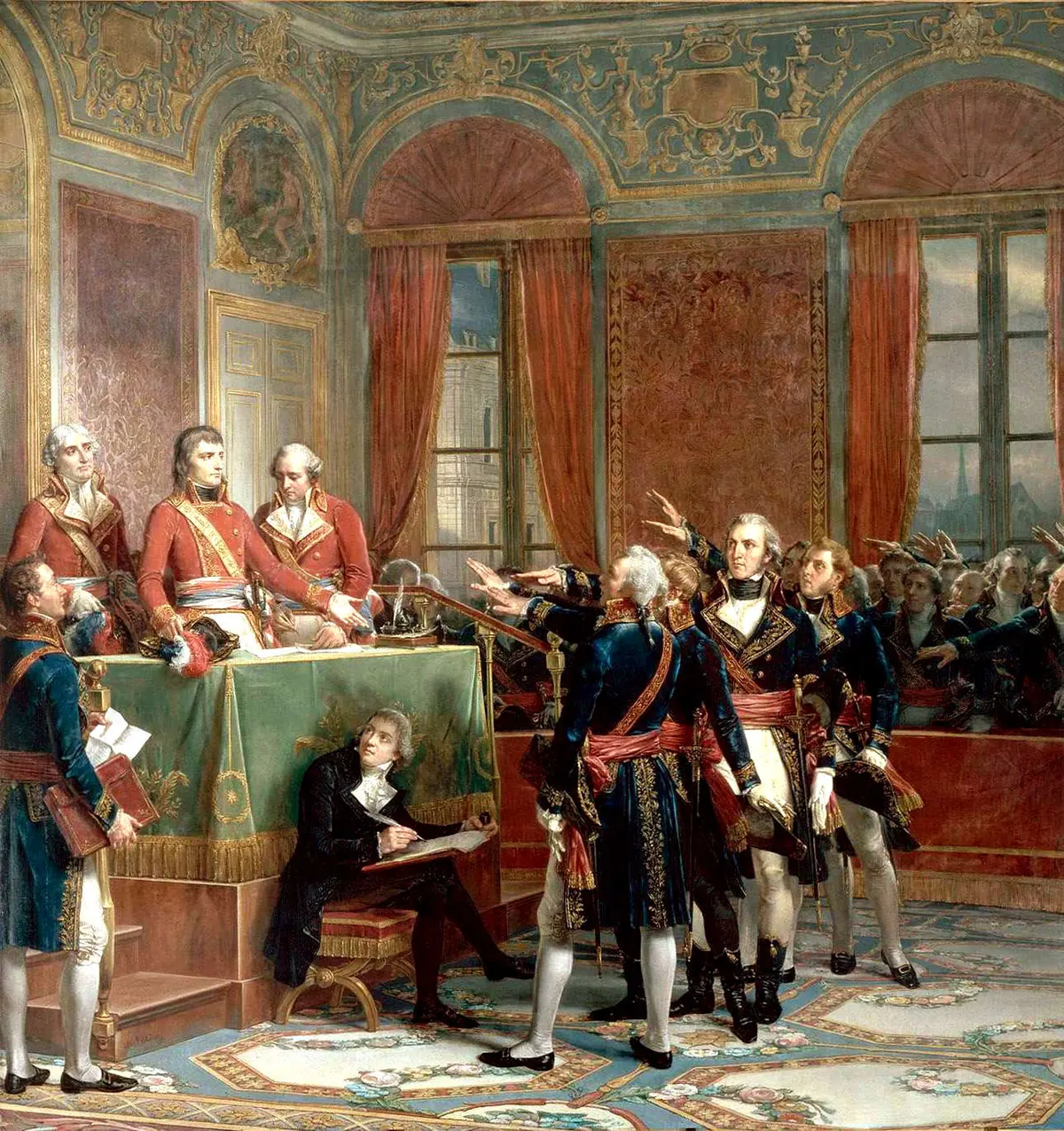
The test of the assemblies
The Constitution of Year VIII gave the government alone the right to propose laws. The Tribunate debated bills and the Legislative Body voted on them without discussion. Yet this is where the Code nearly foundered. At the end of 1801 the Tribunate, where former revolutionaries uneasy about the First Consul's growing power still sat, attacked the preliminary title, and the Legislative Body rejected it by a narrow majority. Bonaparte did not negotiate: on 2 January 1802 he withdrew all the bills. In the spring, the renewal of a fifth of the assemblies was used to remove the most determined opponents, among them Benjamin Constant, and the Tribunate was reorganised to examine bills before they were formally tabled.
The way was clear. The Code's 36 titles were voted one by one, as so many separate laws, between March 1803 and March 1804. The law of 30 Ventôse Year XII, 21 March 1804, brought them together as a single body of 2,281 articles: the Civil Code of the French. That same 21 March, in the middle of the night, the Duke of Enghien had been shot in the moat of Vincennes. In 1807 the Code took the name Code Napoléon. The name then followed the regimes: Civil Code under the Restoration, Code Napoléon again under the Second Empire, Civil Code since 1870.
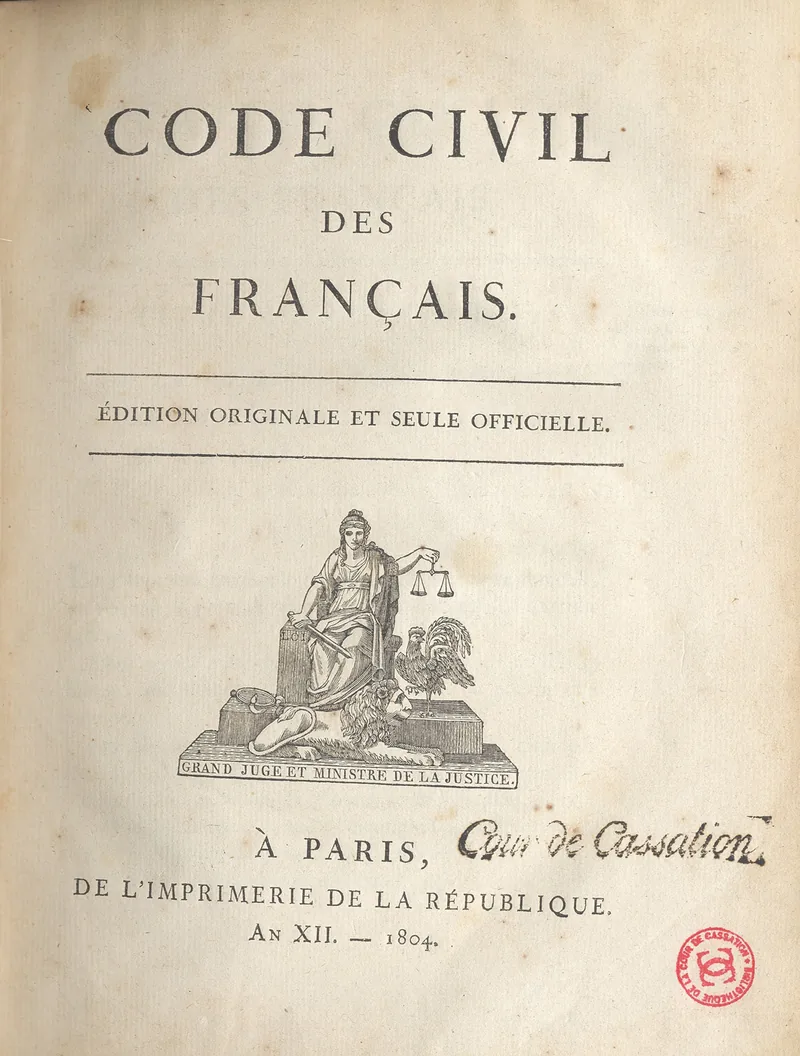
What the Code says
After a short preliminary title on laws in general, the Code is divided into three books: persons; property and its modifications; and the various ways of acquiring property, which bring together inheritance, gifts, contracts and the property arrangements between spouses. The sentences are short, the vocabulary plain, the exceptions few. An educated citizen could read it without a lawyer, and that was the intention.
First of all, the Code establishes civil equality. "Every Frenchman shall enjoy civil rights," says Article 8: in private law there are no longer nobles and commoners. Primogeniture does not return; children inherit in equal shares, daughters as well as sons, and a father may freely dispose of only part of his estate, a part that shrinks as the number of his children grows. Registers of births, marriages and deaths remain in the hands of the mayors, and marriage is a civil contract, celebrated at the town hall.
Next, it protects property, which according to Article 544 is "the right to enjoy and dispose of things in the most absolute manner, provided that no use is made of them that is prohibited by laws or regulations". It gives contracts an almost sacred force: "Agreements lawfully entered into take the place of law for those who have made them" (Article 1134). And it sets out the whole law of civil liability in one sentence: "Any act whatever of a person which causes damage to another obliges the one by whose fault it occurred to make reparation for it" (Article 1382). For the buyers of biens nationaux, the peasants and townsmen who had bought the lands of the Church and of the émigrés, property this firmly protected amounted to a guarantee: what the Revolution had sold would not be taken back.
The father, the husband and the master
Equality did not mean in 1804 what it means today. The Code organises a society of property owners with the father of the family at its centre. "The husband owes protection to his wife, the wife obedience to her husband," states Article 213. A married woman could not sell, give, mortgage or go to court without her husband's authorisation. Adultery was treated differently according to sex: a husband could seek divorce for his wife's adultery, but a wife could do so only if her husband had "kept his concubine in the common home".
A father could have a child under sixteen locked up for up to a month, simply by applying to the president of the court. A child born outside marriage had only limited rights, and "inquiry into paternity is forbidden" (Article 340). In labour relations, Article 1781 settled wage disputes in advance: "The master is believed on his word." Finally, in the colonies, where Bonaparte had restored slavery in 1802, the enslaved remained outside this common law.
Divorce, kept in 1804 but made far harder than in 1792, was abolished in 1816 under the Restoration and restored in 1884. Married women had to wait until 1938 to cease being legally incapable, until 1965 to be able to work and open a bank account without their husband's consent; parental authority replaced paternal power in 1970, and the law proclaimed the equality of children born outside marriage in 1972. These rules were not oversights. They reflected the society of notables who had written the Code, and many of them came straight from the old regime.
The Code beyond France
The Code followed the armies. It applied at once in the annexed territories: Belgium, the left bank of the Rhine, Piedmont, and later Holland and the Hanseatic departments. States under French influence adopted it in turn: the Kingdom of Italy in 1806, the Kingdom of Westphalia and the Duchy of Warsaw in 1808, the Kingdom of Naples in 1809. In 1809 the Grand Duchy of Baden turned it into its own code, translated and supplemented.
The fall of the Empire did not wipe it out everywhere, far from it. In Prussia's Rhine Province and in Baden it remained in force until the German Civil Code took effect on 1 January 1900. In the former Kingdom of Poland, what was left of it was repealed only at the end of 1946. In Belgium and Luxembourg it never ceased to apply; Belgium has been replacing it book by book only since 2020, and the 1804 text is now officially called the "old Civil Code" there.
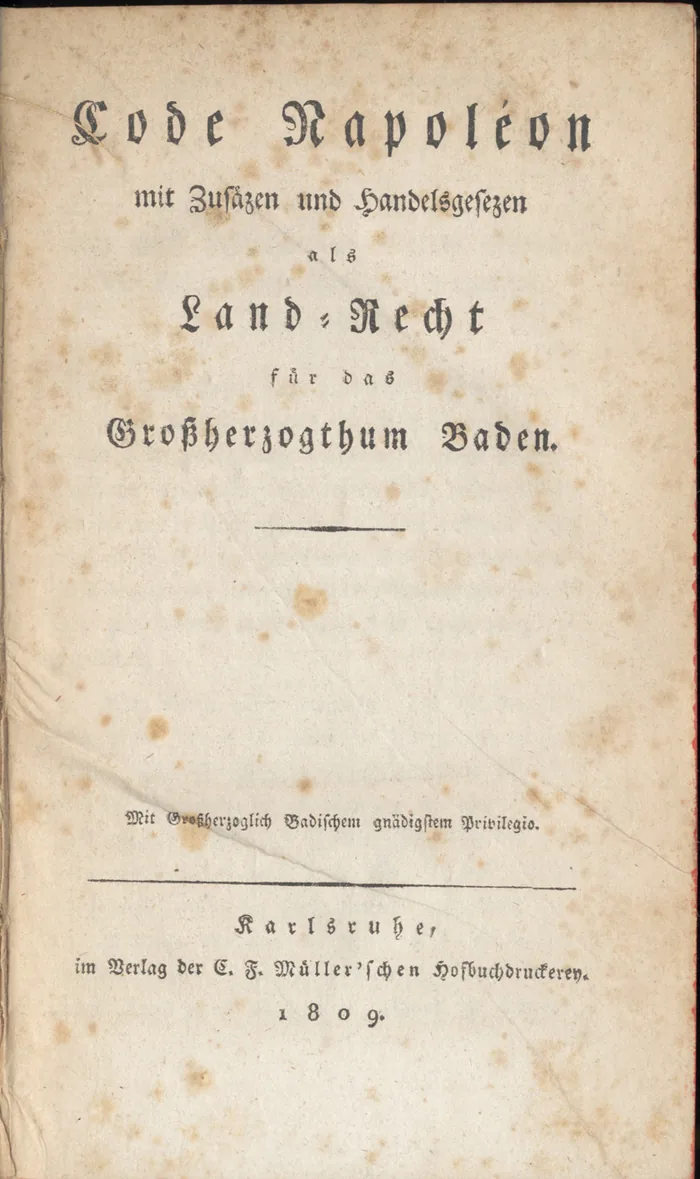
Elsewhere, the Code served as a model without being imposed. Louisiana drew on it from 1808, Haiti in 1826, Lower Canada in 1866. The civil codes of the Netherlands (1838), Romania (1864), united Italy (1865), Portugal (1867) and Spain (1889) owe it a great deal, as do those of Latin America, often by way of Andrés Bello's Chilean code (1855). As late as the twentieth century, the Egyptian Civil Code of 1949, itself taken up by several Arab countries, relied partly on French law. No other French legal text has travelled so far.
Two centuries later
The Civil Code is still in force in France. It has changed a great deal, slowly at first (barely 130 articles amended between 1804 and 1880), then at great speed since the 1960s: family law, parentage, matrimonial property and, in 2016, a complete overhaul of contract law. In the early 2000s, more than 1,100 of the original 2,281 articles were still in force, according to legal scholars' counts. The most famous of them, the former Article 1382 on liability, was renumbered in 2016 as Article 1240 without a single word being changed. The eminent jurist Jean Carbonnier called the Code "the civil constitution of the French".
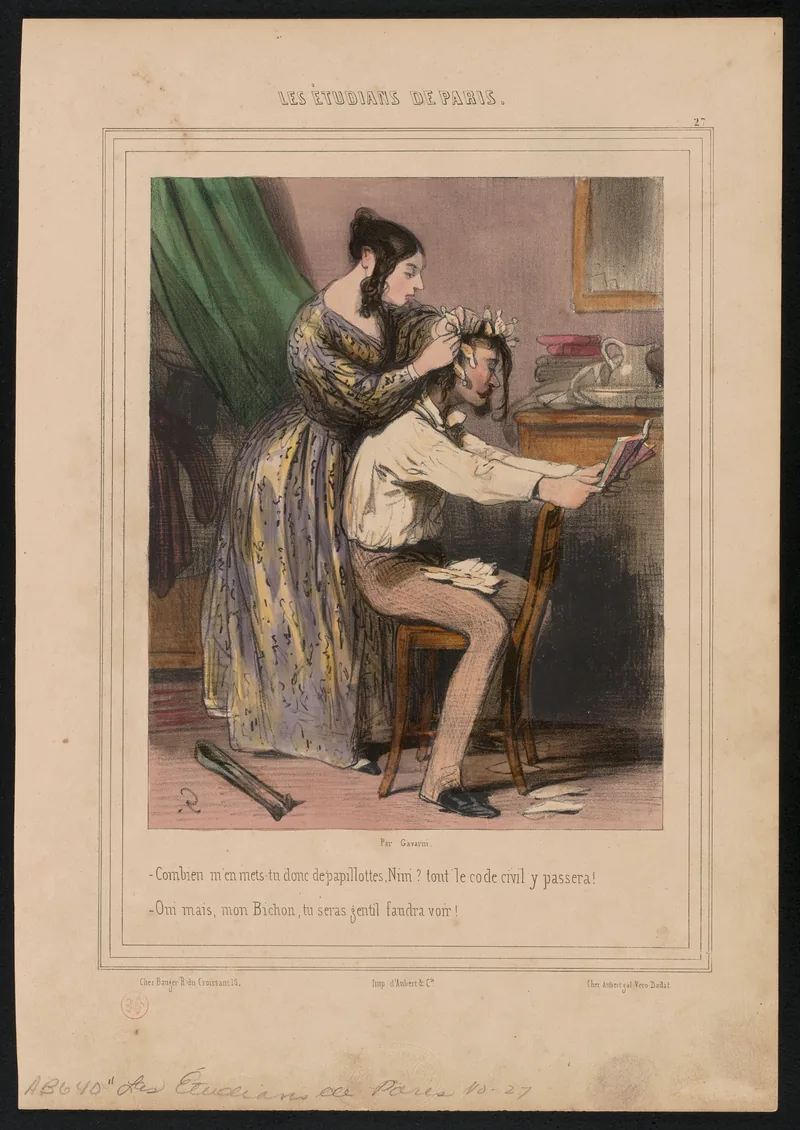
Its language also appealed to writers. On 30 October 1840 Stendhal wrote to Balzac: "While composing the Charterhouse, to get the tone, I read two or three pages of the Civil Code every morning, so as always to be natural." The same year, Gavarni drew a law student letting his mistress curl his hair in papers torn from his Code.
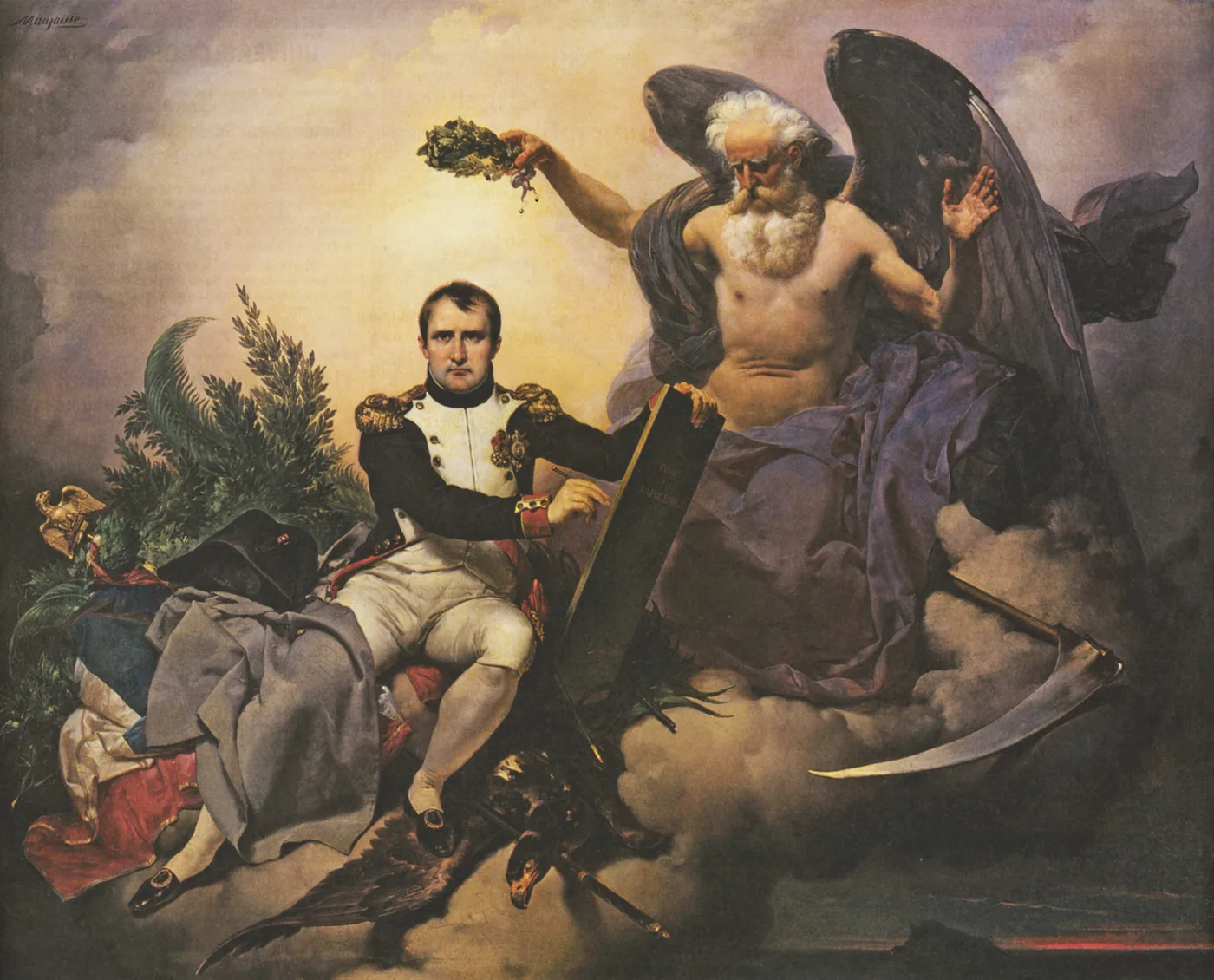
Napoleon knew what would last. On Saint Helena, according to General de Montholon, who shared his exile, he declared: "Waterloo will wipe out the memory of so many victories […]. But what nothing will wipe out, what will live for ever, is my Civil Code." Many versions add an adjective, "my true glory", which is not in Montholon's account. The sentence did not need it. Two centuries on, hundreds of millions of people live under laws descended, closely or distantly, from the 2,281 articles of 1804.
Further reading
- Jean-Étienne-Marie Portalis, Discours préliminaire du premier projet de Code civil, 1801.
- Jean-Louis Halpérin, L'Impossible Code civil, Presses universitaires de France, 1992.
- Jean-Louis Halpérin, Histoire du droit privé français depuis 1804, Presses universitaires de France, 1996.
- Jean Carbonnier, "Le Code civil", in Pierre Nora (ed.), Les Lieux de mémoire, vol. II, La Nation, Gallimard, 1986.
- Yves Lequette and Laurent Leveneur (eds), 1804-2004. Le Code civil, un passé, un présent, un avenir, Dalloz, 2004.