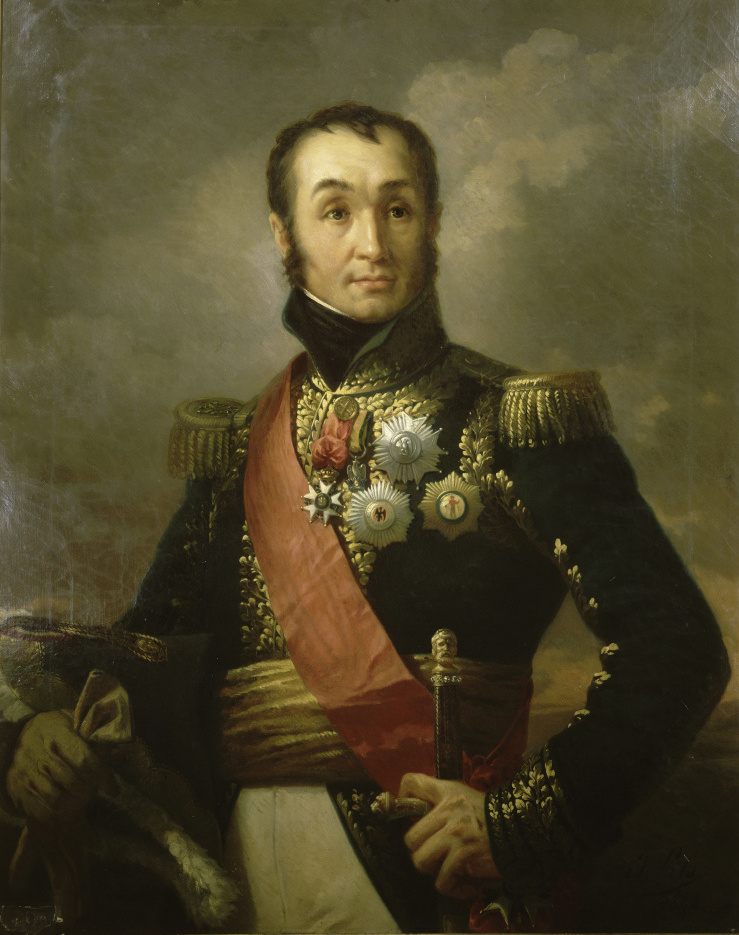
Nicolas Charles Oudinot (1767-1847), son of a Bar-le-Duc brewer who became one of the most battle-worn marshals of the corps, carried a grim distinction: by military tradition, thirty-four war wounds — a record often cited among marshals of the First Empire. NCO then officer of the monarchy, he climbed the Revolutionary ranks by sabre and obedience. Under Masséna he distinguished himself at Zurich; he took part in Austerlitz, Jena and the 1808 campaign where, at the head of the 2nd Corps, he forced the Danube crossing before Vienna — technical prelude to the Wagram clash. On 5 and 6 July 1809 his corps broke through the Austrian centre on the Marchfeld; Napoleon made him Duke of Reggio on the battlefield and promoted him marshal in the wake of that decisive victory. In 1812 the 2nd Corps in Russia; at the Berezina, seriously wounded while covering the crossings, he was evacuated in a cart. He fought again in 1813, defended Paris in 1814 with the Guard on the Plaine Saint-Denis and capitulated alongside Marmont. Having rallied to the Bourbons, he avoided the Hundred Days and Ney's scaffold. Peer of France, governor of the Invalides under the July Monarchy, he died in Paris in 1847, an almost octogenarian witness to a century he had crossed through blade and grapeshot.
Bar-le-Duc, brewing and the Revolutionary forge
Nicolas Charles Oudinot was born at Bar-le-Duc in Lorraine on 25 April 1767. His father ran a brewery: the boy grew up among merchants and garrison soldiers, far from court grand nobility but close to militias and military roads toward the Rhine. Enlisting as a volunteer, then regimental life under the Ancien Régime, taught him barrack discipline and the slow promotions of an infantry corps where one climbed rung by rung.
The Revolution upended hierarchies: posts opened, raw talent could emerge. Oudinot was neither theorist nor courtier; he was the soldier who advanced when the charge sounded, who held men when the line wavered. Early campaigns brought wounds — the tally began early — and mentions that did not yet make him a bulletin star, but a battalion then brigade commander whose superiors knew his tenacity.
In Italy and on the Rhine he worked alongside generals who would become marshals; he observed the difference between grand manoeuvre and local execution, between army order and the reality of a platoon under fire. That school forged the « field » officer: the one who accepts being hit first so the division holds a few minutes longer.
In 1799, under Masséna's orders, he played a notable part in the Second Battle of Zurich: a major French victory over Russians and Austrians that momentarily stabilised the Helvetic and Rhenish situation. Oudinot gained visibility there; the Swiss general's name figures as much as his in accounts, but promotion followed: divisional general, growing trust from the staff already preparing the Consular then imperial age.
At Austerlitz in December 1805 he commanded a division of Soult's 4th Corps; the breakthrough on the Pratzen and the Coalition collapse placed him among the victors of a day legend fixed as the Napoleonic model par excellence. Oudinot was not the mediatised hero of the frozen plain, but he collected fragments — wounds and decoration — as the usual price of his trade.
In October 1806 at Jena, then in the Prussian pursuit, he confirmed his status as reliable executor: French armies crushed the old military machine of Frederick the Great; Oudinot, with others, turned tactical victory into strategic disaster for Berlin. The road opened toward Poland, Friedland, the Continental System — and toward Danubian campaigns where his name would attach to a river crossing and an Austrian plain.
The Danube before Vienna — bridges, roundshot and prelude to Wagram
The War of the Fifth Coalition in 1809 pitted Napoleon against Archduke Charles, regarded as the best Austrian tactician of his generation. The French had to cross the Danube again after initial setbacks that cost the imperial army dearly. Crossing logistics — pontoon bridges, bridgeheads, shore artillery — became a major technical issue: without a secure crossing, no pitched battle on the Marchfeld.
Oudinot, at the head of the 2nd Corps, took part in that decisive preparatory phase. Forcing or holding a crossing on a wide river under enemy batteries on the heights required coordination between engineers, pontoneers and assault infantry. Contemporary engravings show aligned boats, taut cables, columns plunging under fire: later military romanticism masks the fear and noise of sinking teams.
The operation around Vienna in May-June 1809 prepared Wagram: it wore men down, used bridges, forced the staff to choose between boldness and caution. There Oudinot gained a reputation as a corps commander able to execute complex orders on constrained terrain — river, islands, embankments — without breaking under Austrian pressure.
Losses before the great battle were already significant; officers knew each Danube day brought closer the mass clash where tens of thousands of bayonets would be wagered. For Oudinot the prospect was not abstract: he had already paid in blood for smaller crossings; he knew Wagram would be paid in lives and guns.
When armies finally deployed on the Marchfeld north of Vienna, the Austrian array held villages and ridges; the French sought the central breakthrough that would unhinge the enemy line. Oudinot would receive one of the most exposed missions of that theatre: punch the centre between knots of resistance where Austrian artillery had dug murderous positions.
Wagram — breakthrough, Duchy of Reggio and marshal’s baton
On 5 and 6 July 1809 the Marchfeld plain became one of the deadliest battlefields of the Napoleonic age. Archduke Charles held a strong line; Napoleon sought to break it in the centre while manoeuvring on the wings. Oudinot, commanding the 2nd Corps, received orders to thrust into the critical sector between Baumersdorf and Wagram — where Austrian resistance was densest and artillery most concentrated.
At dawn on 6 July the divisions moved off. Austrian guns decimated the ranks; Oudinot was wounded — yet again — without leaving the field. His troops held despite losses; French pressure on the centre helped unbalance the enemy line while other corps outflanked or pinned reserves. When the Archduke ordered retreat, victory was won at a terrifying human cost: Wagram was no tactical stroll but disciplined slaughter.
On the field itself Napoleon raised Oudinot to Duke of Reggio — an Italian reference within the imperial major-fief system, a noble anchor distinguishing the marshal in the hierarchy of titles. Soon after, promotion to the marshalate crowned a career built on stubborn execution more than salon politics. Oudinot entered the gallery of eighteen then twenty-six batons, not as a courtier but as a soldier whose body bore a map of the campaigns.
The thirty-four wounds invoked by tradition — a figure often repeated by memorialists — symbolised for him a simple truth: every great day cost him blood. Bullets, fragments, sabre cuts followed across decades; army surgeons knew him; soldiers knew he did not demand what he would not risk himself.
After Wagram the Treaty of Schönbrunn closed the coalition; the Empire reached maximum extension in Central Europe. Oudinot alternated inspections, garrisons and preparation of corps soon to serve in other theatres — notably the huge Russian venture where the 2nd Corps would again play its part.
Popular memory often remembers Macdonald and the column of the same day; Oudinot remains nonetheless one of the makers of the central breakthrough without which Napoleonic manoeuvre on the Marchfeld would have paid an even higher price. His stature as marshal « of battle hell » was set before the snows of the Berezina.
Russia, the Berezina and the German campaign (1812-1813)
In 1812 Oudinot commanded the 2nd Corps of the Grand Army in the Russian venture. From the Niemen to Borodino successive stages seemed to confirm Napoleonic mastery; yet taking Moscow did not end the war, and retreat from autumn brutally reversed the strategic curve. The 2nd Corps, like the rest of the army, endured cold, disorganisation, Cossack harassment.
In late November at the Berezina Éblé's pontoneers threw makeshift bridges on the frozen river; thousands of combatants and civilians in the column awaited crossing under Russian fire. Oudinot covered the manoeuvre with his troops — a rear-guard and covering-fire mission maximally exposed. He was seriously wounded; surgeons evacuated him in a cart, among the wounded the retreat carried westward as best it could.
Survival, for him as for thousands, hung on stretcher luck and the tenacity of cadres still standing. Out alive from the white hell, he embodied for veterans the marshal who paid physically for every great campaign — not a bronze figure on a monument, but flesh under fire.
In 1813, despite the Russian ordeal, he returned to duty in the German campaign: Bautzen, then the gigantic « battle of the nations » at Leipzig. The Napoleonic coalition's collapse on the Elster and general retreat showed Europe no longer forgave imperial overstretch. Oudinot was no longer the man of easy breakthroughs; he remained loyal executor until France's own borders were threatened.
Coalition forces converged; the exhausted French army tried glorious but insufficient rear-guard fights. Oudinot had seen too many maps burn to believe in miracles; he stayed at his post while the Emperor commanded — until Paris became the last rampart.
Collective memory fixes on the Berezina an image of frozen river and precarious bridges; for Oudinot it was a major wound among others, but also the symbol of the turn where Guard and line corps ceased to be invincible by presence alone.
Paris 1814, Bourbons and the wisdom of last fires
In March 1814 the Coalition entered France. Napoleon still fought textbook battles in Champagne, but enemy weight was crushing. Oudinot found himself defending Paris approaches: on the Plaine Saint-Denis, with the Young Guard and elements of the Imperial Guard, he tried to hold a line disproportion of forces made almost indefensible. On 30 March, after bitter fighting, capitulation became inevitable; he signed alongside Marmont — a gesture tying him to the capital's surrender without making him the symbol of betrayal like other figures of 1814.
The First Restoration found him rallied to the Bourbons: peer of France, he kept honours and military functions in a monarchical frame he did not idealise but accepted as new order. When Napoleon landed from the Gulf of Juan in March 1815, Oudinot did not take arms for the Hundred Days — a personal choice Napoleonic legend sometimes judged coldly, but which spared him Ney's trial and firing squad.
Under Louis XVIII then Charles X he remained a figurehead of the restored army: governor of the Invalides, symbol of continuity between Empire and monarchy. Under Louis-Philippe, the July Monarchy kept him in those functions of military memory — guardian of the tomb of glories and war-wounded.
He died in Paris on 13 September 1847, at eighty, almost octogenarian, witness to the century of revolutions and coalition wars. His son Charles, also a career soldier, extended the line under the nascent Second Empire — a historical loop where the name Oudinot remains tied both to the First Empire and to France's industrial transformations.
Posterity remembers in him the wound record and exceptional longevity: a man who should have died twenty times and marched into old age, as if condensed violence and resilience of the Napoleonic century.
Discover other characters
Napoleon Bonaparte
Emperor of the French
André Masséna
Marshal of the Empire, Prince of Essling
Louis-Nicolas Davout
Marshal of the Empire, Prince of Eckmühl
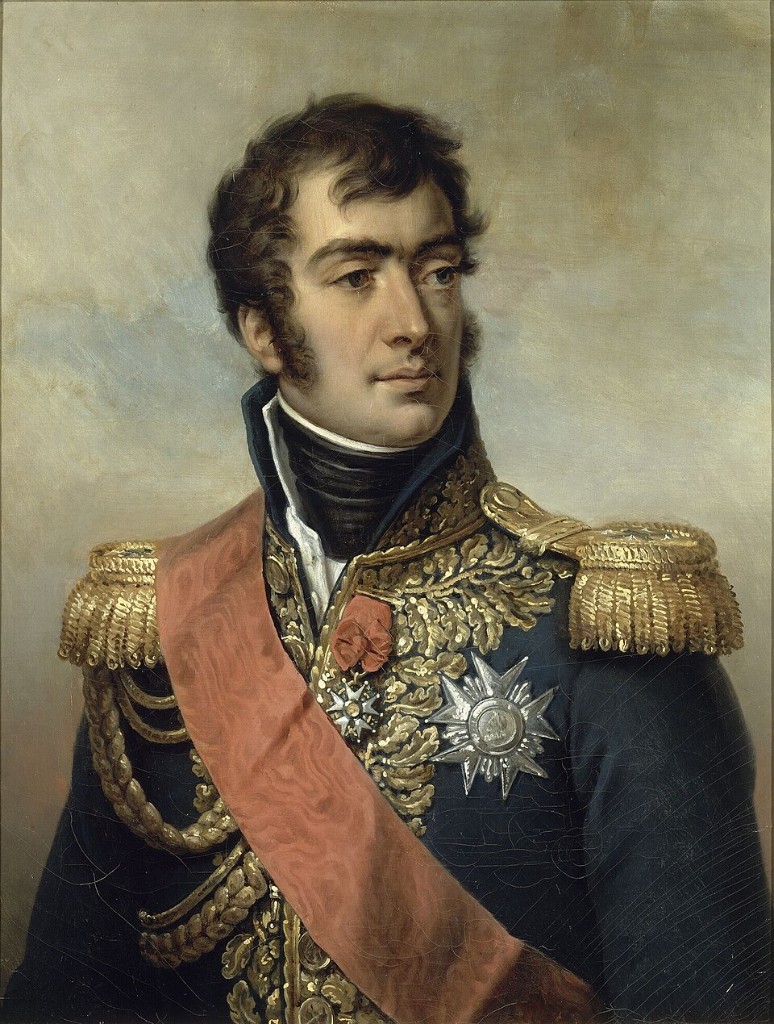
Auguste de Marmont
Marshal of the Empire, Duke of Ragusa
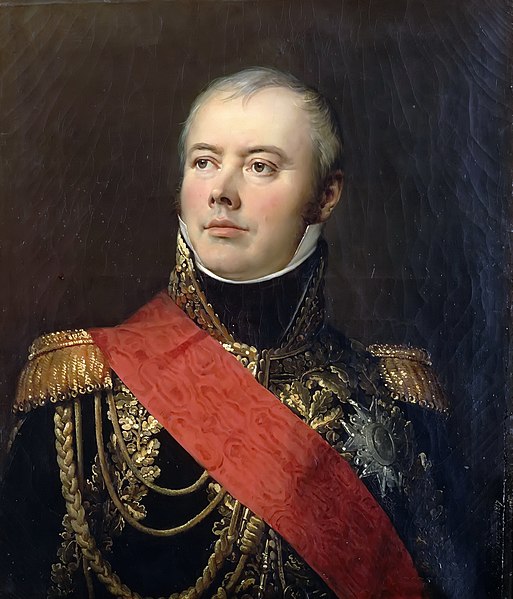
Jacques Macdonald
Marshal of the Empire, Duke of Taranto
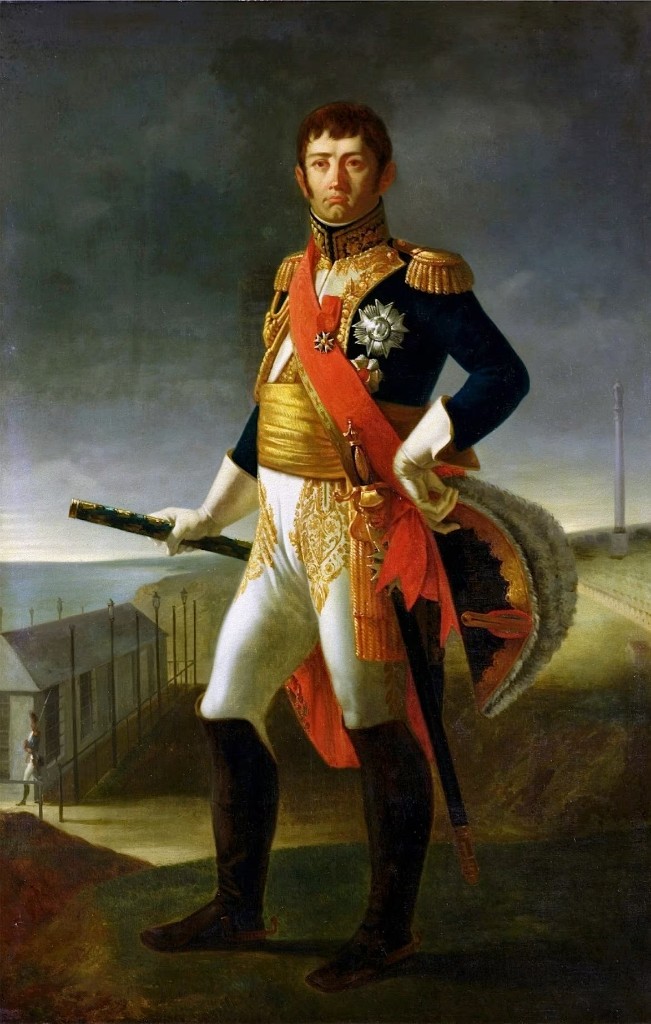
Jean-de-Dieu Soult
Marshal of the Empire, Duke of Dalmatia
Go further
Recommended books to dig deeper (affiliate links)

Napoleon the Great
Andrew Roberts · 2014
A monumental biography drawing on Napoleon’s 33,000 surviving letters, admiring but rigorous.
See on Amazon
Napoléon ou le mythe du sauveur
Jean Tulard · 1977
The book that reshaped how the man is read: how France gave itself a saviour, and what it cost.
See on Amazon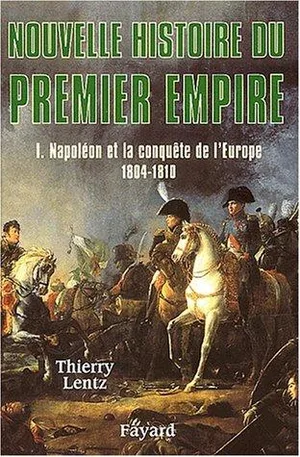
Nouvelle histoire du Premier Empire
Thierry Lentz · 2002-2010
Four reference volumes on institutions, diplomacy and collapse: the scholarly synthesis of the subject.
See on AmazonAs an Amazon Associate, this site earns from qualifying purchases.
Support the encyclopedia
Napoleon Empire is an independent project. Your contribution helps grow the content and keep the site running.
DonateSecure payment on the platform you choose.