In July 1808, in Andalusia, General Dupont's corps, strung out along the Guadalquivir, let itself be cut off by the Spanish army of Castaños and Reding. Exhausted by heat and thirst, his soldiers failed on 19 July to force their way through at Bailén, and more than 17,000 men capitulated: for the first time, an entire Napoleonic army laid down its arms.
Forces at play
Outcome: French capitulation

France
- Dupont
- Vedel
20,000 to 24,000 men according to the sources
Casualties: 2,000 to 3,000 killed and wounded; 17,000 to 17,600 prisoners
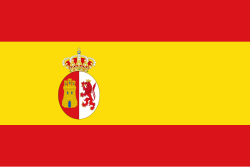
Spain
- Castaños
- Reding
- Coupigny
27,000 to 30,000 men, regulars and militia
Casualties: About 1,000 killed and wounded
Flags: FDRMRZUSA, CC BY-SA 4.0, Wikimedia Commons
Battle coordinates
Bailén
Coordinates 38.0950° N · 3.7770° W
Battle narrative
Spain in revolt
In May 1808, at Bayonne, Napoleon forced King Charles IV and his son Ferdinand to give up the throne of Spain, which he handed to his brother Joseph. Already on 2 May Madrid had risen against the French troops, and the repression led by Murat had been bloody. Within a few weeks the insurrection spread to almost the whole country; juntas were formed in the provinces, among them that of Seville, which raised an army in Andalusia.
To hold the country, Napoleon sent out several columns. One of them, the corps of General Dupont de l'Étang, was to reach Cádiz, where Admiral Rosily's French squadron had been blockaded since Trafalgar, and to restore order in Andalusia. The Emperor believed it strong enough to sweep aside any resistance; yet it was made up largely of young, inexperienced conscripts.
Dupont's column
Leaving Toledo on 24 May with about 12,000 men, joined by two Swiss regiments in Spanish service that had been enlisted by force, Dupont crossed the Sierra Morena. On 7 June he brushed aside Spanish volunteers at the bridge of Alcolea and entered Córdoba the same day; his troops sacked the city for several days, and the plunder fuelled hatred of the occupier throughout Andalusia. On 14 June Rosily's squadron surrendered to the Spaniards; the objective of Cádiz no longer made sense.
Dupont then fell back north to Andújar, on the Guadalquivir, and called for reinforcements. Several of his couriers were intercepted. The divisions of Vedel and then Gobert joined him, but Dupont, ill and encumbered with wagons loaded with the loot of Córdoba, waited without acting. By July his forces were strung out along the Madrid road: Dupont at Andújar, Vedel at Bailén, Gobert at La Carolina, at the foot of the sierra.
The Spaniards close in
Facing him, General Castaños had assembled about 30,000 men, regular soldiers and militia, in four divisions: those of the Swiss Theodor von Reding, of Coupigny, of Walloon origin, of Felix Jones, of Irish origin, and of La Peña. Castaños pinned Dupont in front of Andújar while Reding crossed the river further upstream. On 16 July, at Mengíbar, Reding drove back the French; General Gobert, hurrying up from Bailén, was shot in the head and died of his wound.
The French then made a series of mistakes. Believing that the Spaniards were threatening the passes of the sierra, Vedel and Dufour, Gobert's successor, marched back towards La Carolina. Bailén was left empty: Reding occupied it on 17 July. Dupont was now between Castaños and Reding, and Reding between Dupont and Vedel.
19 July: the assault on Bailén
On the evening of 18 July Dupont slipped out of Andújar unseen to fall back on Bailén. At dawn on the 19th his vanguard ran into Reding's troops near the Rumblar stream, a few kilometres from the village. Although surprised, Reding quickly deployed his divisions and some twenty guns in an olive grove cut by ravines. Dupont, fearing that Castaños would catch up with him, committed his troops as they arrived, without keeping a reserve.
The assaults followed one another all morning. General Duprès fell mortally wounded; the cuirassiers reached the Spanish batteries and sabred the gunners, but had to fall back. At about 10 a.m. Dupont, wounded in the hip, launched a last attack around the battalion of the Sailors of the Guard, some 300 men. It broke through the first Spanish line, then ebbed back under the canister. The soldiers, worn out by the night march, suffered terribly from heat and thirst. The Swiss regiments went over to the Spaniards, and Castaños's troops were approaching the French rear. By about midday Dupont had only some 2,000 men fit to fight: he asked for a suspension of arms.
Vedel arrives too late
Vedel, who had heard the guns, did not appear before Bailén until the afternoon. Told by Spanish envoys that Dupont had asked for a truce, he attacked anyway: he took a height and 1,500 prisoners, but broke against the position of San Cristóbal. He first withdrew northwards; but Dupont had included him in the capitulation, and the Spaniards threatened to take it out on the soldiers already disarmed. Vedel had to come back and lay down his arms in turn.
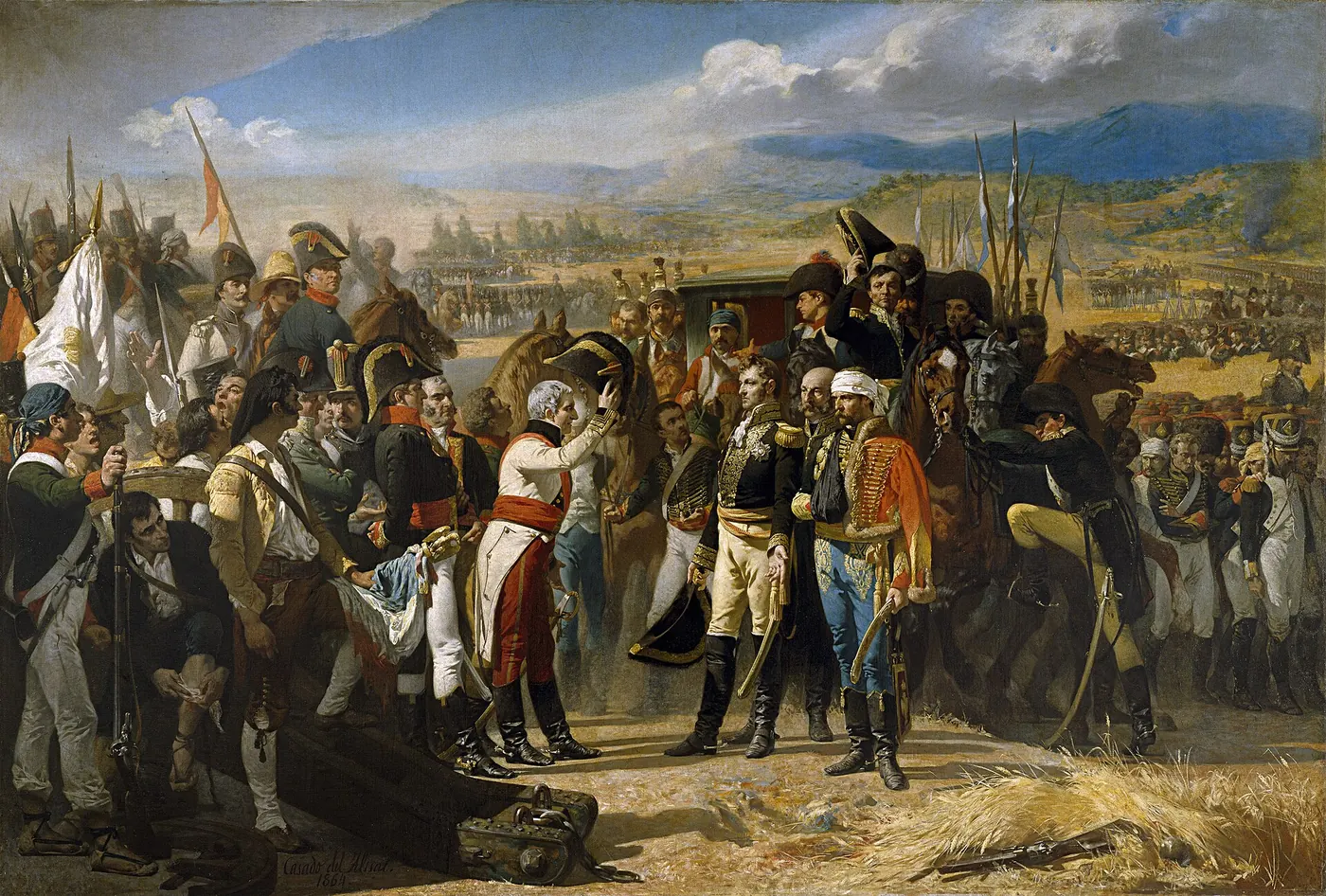
The capitulation
On 22 July the capitulation was signed: 17,000 to 17,600 soldiers, Vedel's division included, laid down their arms. The convention provided for their repatriation to France by sea; the Seville junta refused to apply it. Only Dupont and his generals returned to France. According to an often-quoted account, Dupont, on handing over his sword, remarked that he had never lost a battle, and Castaños replied that he himself had never fought one.
The fate of the prisoners was terrible. First crammed onto hulks in the bay of Cádiz, many were then abandoned on the uninhabited island of Cabrera, in the Balearics, where supplies arrived irregularly. Fewer than half of the soldiers of Bailén saw France again in 1814.
A thunderclap in Europe
The fighting at Bailén cost the French 2,000 to 3,000 killed and wounded, the Spaniards about a thousand. But it was the capitulation that struck people's minds: for the first time in years, an entire French army had laid down its arms. Joseph abandoned Madrid, which he had only just entered, and the French fell back behind the Ebro. Throughout Europe the news shook the myth of French invincibility and encouraged the war party in Vienna, which would prevail in 1809.
Napoleon felt Bailén as a personal affront. Dupont and Vedel were disgraced, stripped of their rank and imprisoned; Dupont regained his freedom only with the Restoration. In the autumn of 1808 the Emperor himself crossed the Pyrenees with the Grande Armée and retook Madrid in December. Castaños was beaten at Tudela in November, and Reding was mortally wounded at Valls in 1809. But the war in Spain was only beginning.
Go further
Recommended books to dig deeper (affiliate links)

Napoleon the Great
Andrew Roberts · 2014
A monumental biography drawing on Napoleon’s 33,000 surviving letters, admiring but rigorous.
See on Amazon
Napoléon ou le mythe du sauveur
Jean Tulard · 1977
The book that reshaped how the man is read: how France gave itself a saviour, and what it cost.
See on Amazon
Nouvelle histoire du Premier Empire
Thierry Lentz · 2002-2010
Four reference volumes on institutions, diplomacy and collapse: the scholarly synthesis of the subject.
See on AmazonAs an Amazon Associate, this site earns from qualifying purchases.
Support the encyclopedia
Napoleon Empire is an independent project. Your contribution helps grow the content and keep the site running.
DonateSecure payment on the platform you choose.