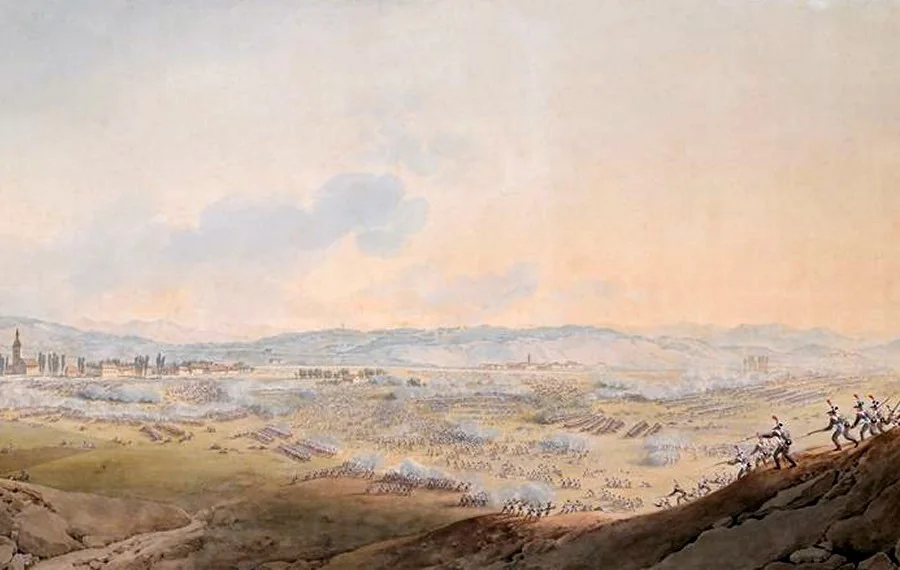
On 21 and 22 April 1809, in Bavaria, Marshal Davout held off Archduke Charles's army almost alone until Napoleon, returning by forced marches from Landshut, fell on the Austrian flank at Eckmühl. Beaten, the Archduke recrossed the Danube at Ratisbon; Davout won the title of Prince of Eckmühl.
Forces at play
Outcome: French victory


France · Bavaria · Wurtemberg
- Napoléon
- Davout
- Lannes
- Lefebvre
- Vandamme
About 36,000 men on 21 April, nearly 70,000 on the 22nd
Casualties: About 3,000 killed and wounded on 22 April, and about 2,000 at Schierling on the 21st

Austria
- Archiduc Charles
- Rosenberg
- Hohenzollern
- Kollowrat
Fewer than 50,000 men engaged on 22 April, out of about 75,000
Casualties: 10,700 to 11,000 men on 22 April, including about 5,000 prisoners
Battle coordinates
Eckmühl
Coordonnées 48.8347°, 12.1397°
Battle narrative
Austria takes up arms again
On 10 April 1809 Archduke Charles's Austrian army crossed the Inn and invaded Bavaria, France's ally. Napoleon, who had not expected so swift an attack, had to hurry from Paris; for the first time since he had worn the imperial crown, he had left the initiative to his opponent. His troops were scattered along the Danube, and a good many of them were conscripts or contingents from the allied German states, such as the Bavarians and the Württembergers.
Yet Napoleon regained the upper hand within a few days. On 20 April, at Abensberg, he attacked the Austrian centre and cut the Archduke's army in two: the left wing, under Hiller, was driven back towards Landshut and the Isar, while Charles fell back northwards with the rest of his forces.
Davout alone against the Archduke
Napoleon now believed that the bulk of the enemy was fleeing towards Landshut. He sent most of his army there under Lannes and Masséna, leaving facing north only Davout's corps and Lefebvre's Bavarian corps, about 36,000 men in all, tasked with sweeping away what he took to be a mere screen of troops. He did not know that on the same day the Austrians had seized Ratisbon and its bridge over the Danube, capturing the French garrison: the Archduke could now call in his corps left on the north bank.
Charles decided to crush Davout. The corps of Rosenberg and Hohenzollern were to pin him frontally, between Eckmühl and the Danube, while Kollowrat's fresh corps and Liechtenstein's grenadiers and cuirassiers, coming from Ratisbon, would outflank his left. On 21 April a fierce meeting engagement broke out around Schierling, without decisive result.
22 April: the march north
On the morning of the 22nd General Piré brought Napoleon, at Landshut, a precise report on Davout's situation. The Emperor realised his mistake and turned his army round: in a letter written at 4 a.m., he told Davout he would arrive by noon with about 40,000 men — Lannes's troops, Masséna's corps, Vandamme's Württembergers and a mass of cavalry. Lannes's soldiers covered nearly 30 kilometres that morning. Meanwhile, in the fog, the Austrians began to attack Davout's left, where Montbrun's cavalry slowed their advance.
Between 1 and 2 p.m. the first troops from Landshut appeared south of the Grosse Laaber, the small river that runs through Eckmühl. Napoleon sent the Württembergers against the bridge and the village. Twice repulsed by the Austrian Grenzer, they succeeded at the third attempt and took the castle, helped by a French battalion.
The woods of Laichling
Hearing the guns, Davout too went over to the attack at about 2 p.m. Saint-Hilaire's division, with the 10th Light, took the village of Unterlaichling and fought hard in the neighbouring woods, supported by Deroy's Bavarians; further north, Friant's division drove the Austrians out of Oberlaichling. In the south, Napoleon sent Gudin's division across the river to turn the Austrian left.
Informed of the danger, the Archduke gave up the battle and ordered a retreat towards Ratisbon and the north bank of the Danube; the troops of Kollowrat and Liechtenstein would not be engaged against Davout. Rosenberg's corps, some 18,000 men, was given the task of delaying the French. Two of the best Austrian cavalry regiments still held the Bettelberg ridge above Eckmühl until the cuirassiers of Nansouty and Saint-Sulpice, launched by Napoleon, scattered them and sabred the gunners.
The night of Alteglofsheim and Ratisbon
At about 7 p.m., near Alteglofsheim, a great cavalry melee pitted some thirty Austrian squadrons covering the retreat against more than sixty French and allied squadrons backed by artillery. Committed piecemeal, the Austrian horsemen were beaten. But the French infantry, exhausted by its marches, could not pursue at night, and the Archduke took his army across the Danube by the stone bridge of Ratisbon and a pontoon bridge.
On 23 April Napoleon ordered Ratisbon stormed. Lannes personally led the decisive attack on the walls. During the fighting the Emperor was slightly wounded in the foot by a ball; to reassure his troops, he rode along the lines. The town was taken, but the Archduke's army had already found safety in Bohemia.
Outcome
On 22 April the Austrians lost about 10,700 to 11,000 men, some 5,000 of them prisoners, and the French about 3,000 killed and wounded, not counting the losses of the 21st at Schierling. Over all the April fighting the Archduke's army lost more than 30,000 men. Davout, who had held alone for two days, would be made Prince of Eckmühl. The Archduke himself wrote to Napoleon on 28 April: "Your Majesty announced your arrival with cannon fire, without leaving me time to congratulate you."
The victory was nevertheless not decisive: the Austrian army had escaped destruction. Napoleon marched on Vienna, which he entered on 13 May, but the campaign would be decided beyond the Danube, at Aspern-Essling and then Wagram. Napoleon is said to have judged the manoeuvres that culminated at Eckmühl the finest he ever conducted.
Go further
Recommended books to dig deeper (affiliate links)

Napoleon — A magisterial biography
An exhaustive biography of the Emperor, the fruit of rigorous research.
≈ £14.99 Napoleon's Army
Organization, tactics and daily life of the Grande Armée soldiers.
≈ £18.00 Austerlitz 1805
The detailed account of the Battle of the Three Emperors.
≈ £12.99As an Amazon Associate, this site earns from qualifying purchases.
Support the encyclopedia
Napoleon Empire is an independent project. Your contribution helps grow the content and keep the site running.
Donate