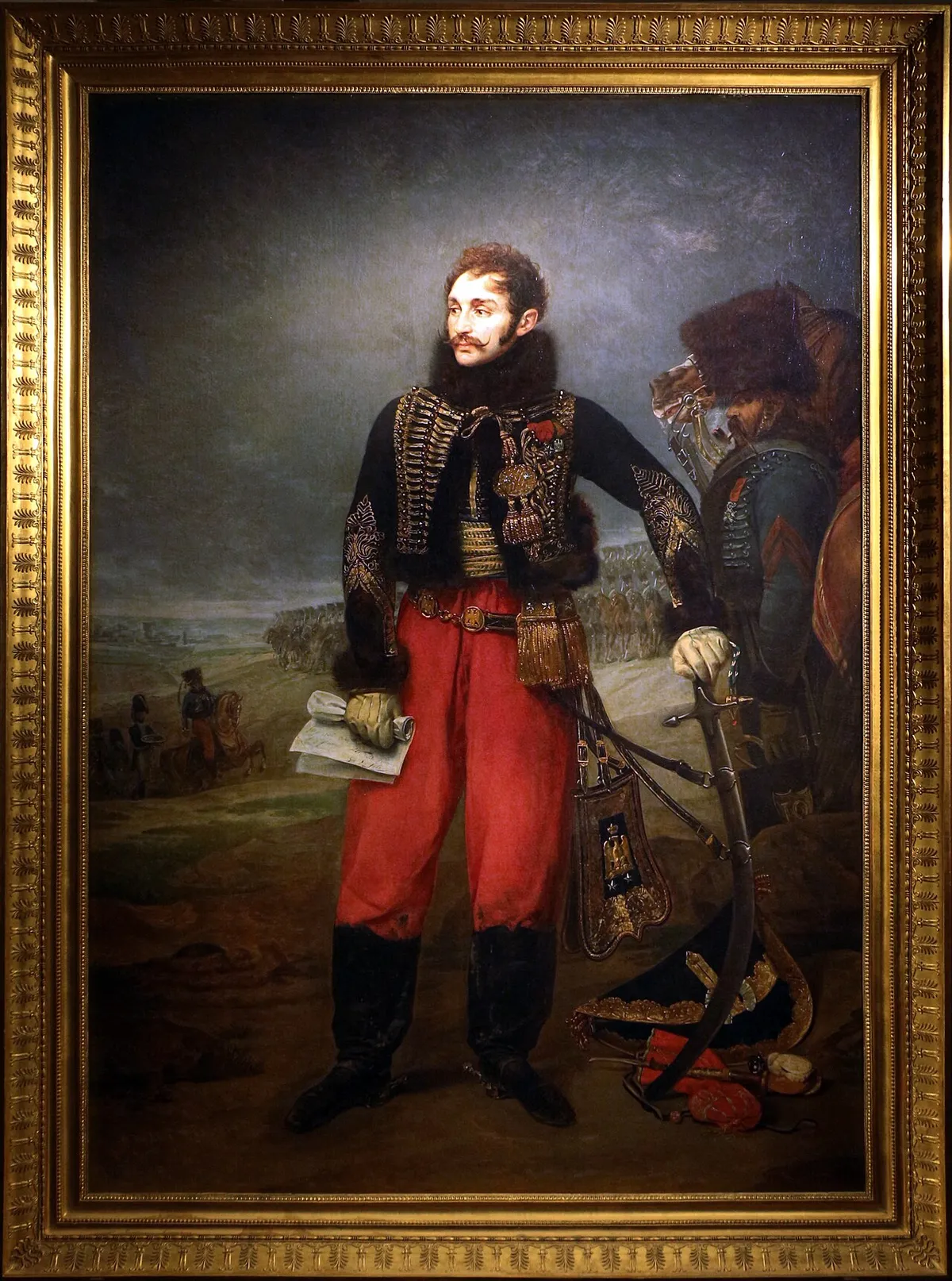
Antoine Charles Louis de Lasalle (1775-1809), Count of the Empire and general of division, has remained for posterity the hussar par excellence: swordsman, gambler, hard drinker, provocatively elegant, but also one of the most dependable light cavalry commanders Napoleon ever had. Born in Metz on 10 May 1775 into a noble family, the son of a war commissary, he wore a second lieutenant's epaulette at the age of eleven, as Old Regime custom allowed. The Revolution, which pushed noble officers aside, forced him to start again from the ranks: a private in the 23rd Chasseurs à Cheval, he won back his rank step by step. Aide-de-camp to General Kellermann, then assistant to his son in the Army of Italy, he made his name at Rivoli in January 1797. Provisional colonel on the evening of the Battle of the Pyramids, commander of the 10th Hussars on his return from Egypt, general of brigade in February 1805, he passed into legend in the autumn of 1806: at the head of the « Infernal Brigade » of the 5th and 7th Hussars, he hounded the remnants of the Prussian army and, in the night of 29 to 30 October, obtained without a fight the surrender of the fortress of Stettin and its 5,300 or so defenders. General of division on 30 December 1806, he went on to command the light cavalry in Poland and then in Spain, where he distinguished himself at Medina de Rioseco and Medellín. Recalled to Germany in 1809, he fought at Essling and fell at Wagram on 6 July, shot through the head at thirty-four. The saying attributed to him — that a hussar who is not dead by thirty is a « jean-foutre », a good-for-nothing — fixed his legend, at the risk of obscuring the rigour of the cavalry commander he was first of all. His remains have rested at Les Invalides since 1891.
Metz, the Revolution and the road back through the ranks (1775-1795)
Antoine Charles Louis de Lasalle was born on 10 May 1775 in Metz, in the Hôtel de Gournay, where a plaque now records his birth. His father, Pierre-Nicolas de La Salle, was a commissaire ordonnateur des guerres — one of the military administrators who saw to the pay, rations and marching stages of the troops; his mother was Suzanne Dupuy de la Garde. Originally from Castelnaudary, the family had settled in Lorraine in the seventeenth century. Metz, the great fortress of the north-eastern frontier, was then one of the most military towns in the kingdom: the child grew up among uniforms.
The Old Regime opened a career to him before he was even an adolescent. On 19 June 1786, aged eleven, he was appointed supernumerary second lieutenant in the Alsace infantry regiment, a foreign regiment in French service: such a commission owed more to birth than to actual service. On 25 May 1791 he became second lieutenant in the 24th Cavalry Regiment. The choice of the mounted arm, which would shape his whole life, dates from these years, when the young nobleman learned riding and the sabre rather than infantry drill.
The Revolution broke this momentum. In 1792 the mass emigration of officers and the growing distrust of the military nobility cost him his commission. His family moved to Paris, where he was admitted to the Section des Piques. In 1793 he enlisted among the volunteers bound for the Army of the North, then on 20 February 1794 joined the 23rd Chasseurs à Cheval as a private. The former eleven-year-old second lieutenant thus started all over again at eighteen, in the humblest condition the cavalry offered.
He climbed back quickly. Quartermaster sergeant on 21 March 1794, he became a lieutenant again on 10 March 1795 and aide-de-camp to General François Christophe Kellermann, the victor of Valmy, then commanding the Army of the Alps. When Kellermann was attached to the Italian frontier in the spring of 1795, Lasalle followed him. From this broken and rebuilt career he kept a double imprint: the manners and ease of an Old Regime gentleman, and the hands-on experience of the trooper in the ranks, who knows by heart the fatigue of horses and the worth of a good sergeant.
The Army of Italy: Vicenza, Rivoli, the Tagliamento (1796-1797)
In May 1796 Lasalle became assistant to Adjutant-General François Étienne Kellermann, the general's son, in the army Bonaparte had just hurled onto the plain of the Po. He then moved to the staff of Masséna, whose division formed the spearhead of the campaign. On 7 November 1796, at twenty-one, he was made captain. In this war of movement, fought for bridges, passes and roads, a horseman who could read the ground and bring back accurate information was worth a company.
He first made his mark with a raid. In the night of 16 December 1796, with eighteen troopers of the 1st Cavalry Regiment, he pushed right into Vicenza, then held by the Austrians: some fifteen enemy soldiers were killed or taken, for the loss of four men. Modest in itself, the episode already showed what would make his reputation: the calculated daring of an officer who struck fast, with few men, and knew how to pull back before the enemy could react. On 6 January 1797 he was promoted chef d'escadron, squadron commander.
Eight days later the Battle of Rivoli made his name. On 14 and 15 January 1797, on the plateau above the Adige, Alvinczy's Austrian army tried to relieve Mantua. At the height of the mêlée Lasalle charged with a handful of chasseurs — twenty-six in the usual account — and brought about the surrender of an isolated battalion; his biographers credit him with the capture of several colours. A phrase attributed to Bonaparte, readily repeated by the general's biographers, ranks him with Masséna and Joubert among the makers of the victory: it should not be taken as a staff assessment, but it shows the standing the young squadron commander had just won.
The campaign of 1797 confirmed that reputation. In March, during the crossing of the Tagliamento, he rode into Valvasone with a few guides and forced an Austrian squadron to evacuate the place. Bonaparte then wrote to his mother that « this brave officer has covered himself with glory in the Army of Italy ». Squadron commander in the 7th bis Hussars, Lasalle then served in garrison at Mantua, Peschiera and Rome. It was in Italy that he met Joséphine d'Aiguillon, wife of General Victor Léopold Berthier, brother of the army's chief of staff: their affair, which became public, would end in marriage a few years later.
Egypt and the 10th Hussars (1798-1805)
On 26 May 1798 Lasalle embarked at Civitavecchia with Desaix's division, aboard the frigate La Courageuse, for a destination most officers still did not know. The army landed near Alexandria on 1 July. On 21 July, at the Battle of the Pyramids, he seized with some sixty men the exit of the Embabeh entrenched camp towards Giza, cutting off the retreat of part of the Mamluks. That same evening Bonaparte appointed him provisional chef de brigade of the 22nd Chasseurs à Cheval.
The Egyptian war put the French cavalry to a severe test: scarce and indifferent horses, mounted opponents superior in numbers and in individual skill. In August 1798, sent in pursuit of Ibrahim Bey, Lasalle charged at Salheyeh with about a hundred and fifty horsemen; the fight long hung in the balance and cost his troop some fifty men. He then followed Desaix in the conquest of Upper Egypt, taking part in the fighting of the winter of 1799, notably at Samhoud on 22 January, in a campaign of skirmishes and pursuits along the Nile.
He left Egypt in January 1800, after the Convention of El Arish, and returned to Europe. The First Consul had a sabre of honour and a pair of pistols presented to him, then on 25 August 1800 gave him command of the 10th Hussars. At their head he served in Italy in the winter of 1800-1801; in a fight in January 1801, according to his service record, he had three horses killed under him. The thirty-year-old colonel was already a model for young light cavalry officers.
The years of peace revealed the other side of the man. A great gambler and a great drinker, Lasalle founded with his comrades a « Société des Altérés » — the Society of the Thirsty — whose name says enough about its purpose; his taste for panache, fine dress and the challenge set him in a legend his contemporaries were happy to nurture. In 1803 he married Joséphine d'Aiguillon, divorced from General Berthier; their daughter, Joséphine Charlotte, was born in 1806. Commander of the Legion of Honour on 14 June 1804, he was promoted general of brigade on 1 February 1805 and given a dragoon brigade stationed at Amiens, which he led through the campaign of 1805 as far as Austerlitz.
The « Infernal Brigade »: from Zehdenick to Stettin (1806)
For the Prussian campaign Lasalle was given a light cavalry brigade made up of the 5th and 7th Hussars, attached to Murat's cavalry reserve. History would remember it as the « Infernal Brigade ». After the double victory of Jena and Auerstedt on 14 October 1806, the Grande Armée set off in pursuit of the remnants of the Prussian army, streaming back towards the Oder and the Baltic. The light cavalry then became the decisive arm: the task was no longer to win a battle, but to prevent a beaten enemy from re-forming.
On 26 October at Zehdenick, Lasalle attacked and routed the cavalry of the Prince of Hohenlohe, who was trying to reach Stettin. Two days later, on 28 October, the French advance guard reached Prenzlau; Hohenlohe, cut off from his route, surrendered to Murat with the bulk of his troops. Lasalle's hussars were at the heart of this pursuit, during which they notably captured the Gendarmes regiment of the King of Prussia's Guard, one of the most prestigious corps of the old Frederician army.
The next day, 29 October, Lasalle appeared before Stettin, the fortress at the mouth of the Oder, with his two hussar regiments and two light guns — five hundred to eight hundred horsemen by the various estimates. He summoned the governor, Lieutenant-General von Romberg, an elderly officer, to surrender, implying that a whole army was close behind. In the night of 29 to 30 October Romberg capitulated: some 5,300 men and 281 guns fell into the hands of a cavalry brigade that could neither have besieged nor stormed the fortress. The governor was later condemned by Prussian military justice in 1809.
The bluff at Stettin went round Europe. Napoleon wrote to Murat on 31 October: « My brother, I compliment you on the capture of Stettin. » In 1808 Antoine-Jean Gros painted Lasalle receiving the capitulation of the fortress, a portrait that fixed the image of the hussar in black dolman and red trousers. The brigade pressed on as far as Lübeck, taken from Blücher's troops on 6 November. Lasalle then moved into Poland; he charged at Golymin on 26 December 1806 and on 30 December was promoted general of division, at thirty-one.
Poland and Spain: Heilsberg, Medina de Rioseco, Medellín (1807-1809)
In 1807 Lasalle commanded the light cavalry division of the reserve. At Heilsberg on 10 June, in a battle in which the French cavalry wore itself out against Bennigsen's entrenched positions, he rescued Murat, surrounded by Russian horsemen; tradition has it that Murat had done him the same service earlier in the day, and the episode feeds the legend of a brotherhood in arms between the two swordsmen. In July 1807, after the Peace of Tilsit, he received the decoration of the Order of the Iron Crown.
On 15 February 1808 he transferred to the Army of Spain. At the start of the insurrection his cavalry was tasked with holding Old Castile. In June he beat a gathering of insurgents at Torquemada, occupied Palencia, and then on 12 June, together with General Merle's division, scattered at Cabezón the troops raised by Captain-General Cuesta; that same day he entered Valladolid. These quick successes against forces still poorly organised for a while sustained the illusion that Spain would submit easily.
On 14 July 1808 at Medina de Rioseco, under Marshal Bessières, he led the charge that decided the day against the combined armies of Cuesta and Blake. The victory opened the road to Madrid for Joseph Bonaparte, only a few days before the capitulation of Bailén wrecked the French position in the south. Lasalle was made Count of the Empire in 1808 and Grand Officer of the Legion of Honour in September of that year.
He then took part in the counter-offensive led by Napoleon in person that autumn: on 10 November 1808 he contributed to the success at Gamonal, before Burgos. In 1809, attached to Marshal Victor's corps, he crossed the Tagus and commanded all the cavalry at the Battle of Medellín on 28 March, where Cuesta's Spanish army was routed. The day, one of the bloodiest of the war for the Spanish, sealed his reputation as the army's finest light cavalry commander.
By then the character had already outgrown the man. He is credited with the saying that « any hussar who is not dead by thirty is a jean-foutre », reported by memoirists though its exact source is unknown; the drinking song Fanchon has even been attributed to him, without proof. Such phrases made him the very type of the swaggering hussar. They leave in the shadow what his superiors valued: an officer attentive to the condition of his horses, precise in reconnaissance and able to conduct a pursuit over several hundred kilometres without his troop falling apart.
Essling, Wagram and remembrance (1809-1893)
Recalled from Spain in the spring of 1809, as Austria took up arms again, Lasalle was given a light cavalry division of the Grande Armée. He distinguished himself at Essling on 21 and 22 May, in the confused battle fought around the villages of Aspern and Essling on the left bank of the Danube, before the withdrawal to the island of Lobau. In June he took part in the operations around Raab in Hungary, where Prince Eugène's Army of Italy defeated Archduke John on 14 June and obtained the surrender of the town on the 24th.
At Wagram on 6 July 1809 his division fought on the left wing, with Masséna's corps, which was swinging south along the Danube to clear the Lobau bridges threatened by Klenau. Towards the end of the afternoon, near Leopoldau, the French cavalry ran into Austrian battalions formed in masses. Separated from his hussars, Lasalle himself led a charge with troopers of the 1st Cuirassiers; he was killed by a bullet through the head, fired, according to the accounts, by a Hungarian grenadier. He was thirty-four.
The day before, according to the reported testimony of his aide-de-camp Charles Yves César Cyr du Coëtlosquet, he is said to have announced that he would not survive the coming day. A phrase from his last letter to his wife is also often quoted: « My heart is yours, my blood the Emperor's, my life honour's. » Handed down through family memory and his biographers, these words have become inseparable from his figure, so much so that it is hard to tell their exact share from the echo they were given.
The Emperor honoured his memory at once. A decree of 1 January 1810 provided for his statue to be erected on the Pont de la Concorde, among those of officers killed in action: the project came to nothing, but a plaster model by Charles-Auguste Taunay is preserved at Versailles. As early as 1811 the rue Saint-Symphorien in Metz became the rue Lasalle. His name is engraved on the east pillar of the Arc de Triomphe de l'Étoile. In 1891 his young cousin Adrien Robinet de Cléry, published his correspondence.
In that same year, 1891, his remains were brought back from Austria and buried at Les Invalides, in the governors' vault. In 1893 Lunéville, a cavalry garrison town, unveiled in the courtyard of the château's outbuildings an equestrian statue by the sculptor Henri-Louis Cordier. The École spéciale militaire de Saint-Cyr named its 1979-1981 class after him. More than two centuries after Wagram, Lasalle remains less the hero of a great battle than the hero of a style: the daring of the light horseman, tempered by a very sure command of pursuit and reconnaissance.
Discover other characters
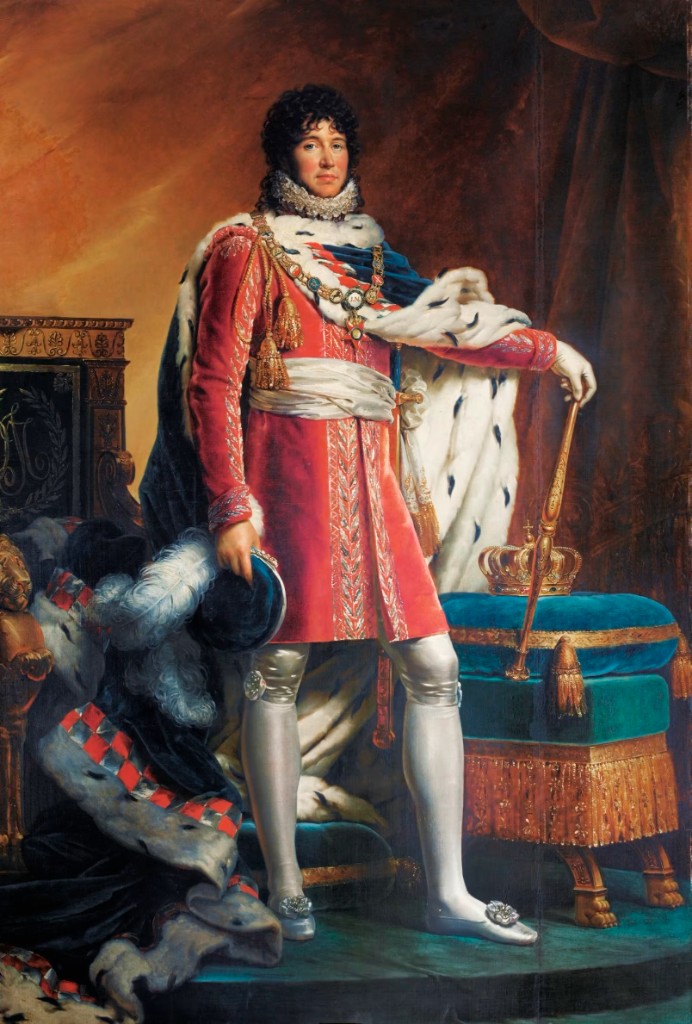
Joachim Murat
Marshal of the Empire, King of Naples
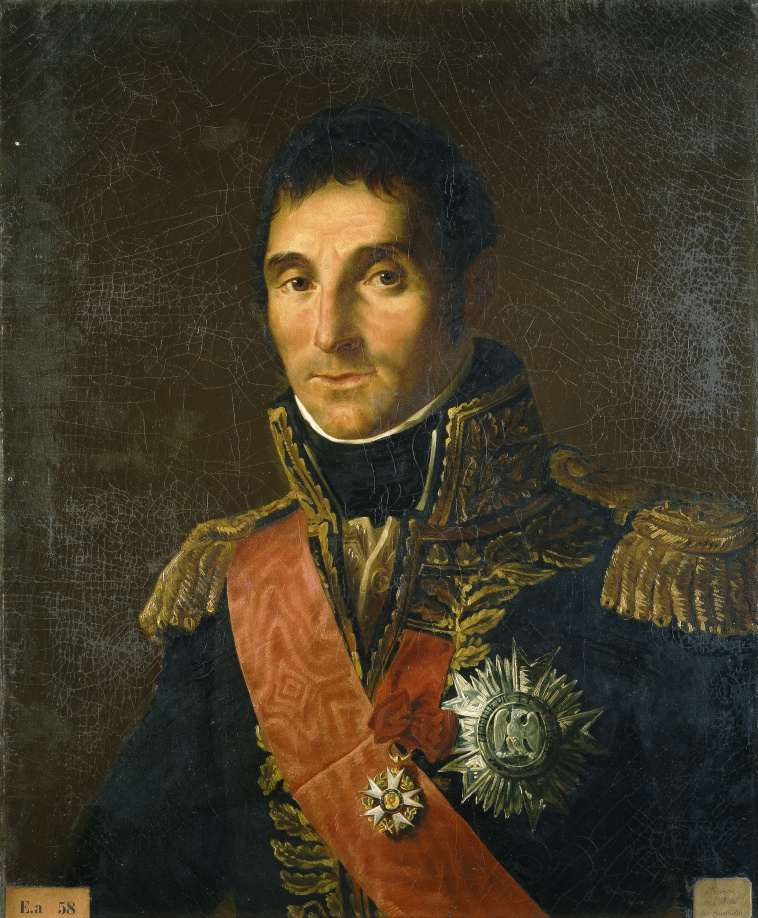
André Masséna
Marshal of the Empire, Prince of Essling
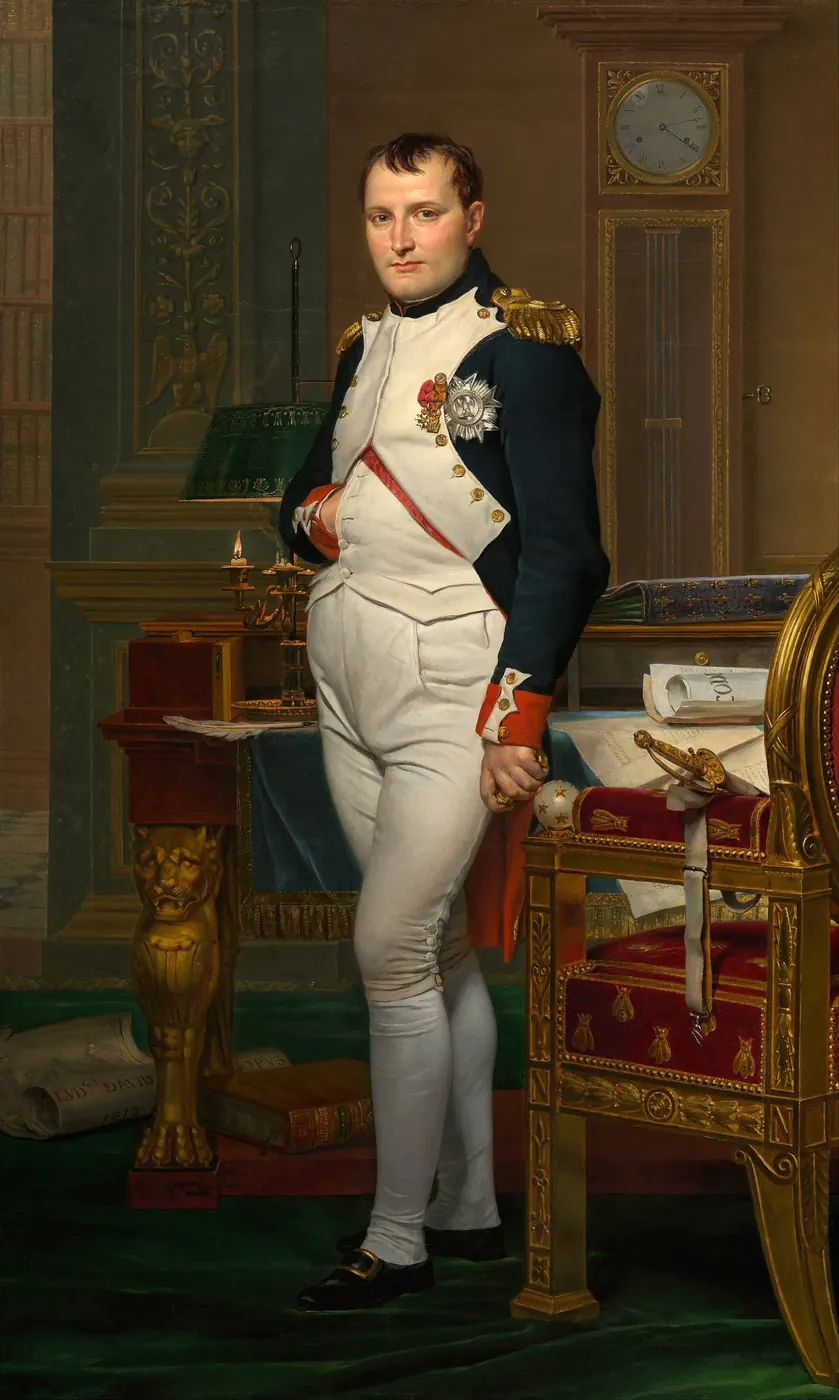
Napoleon Bonaparte
Emperor of the French
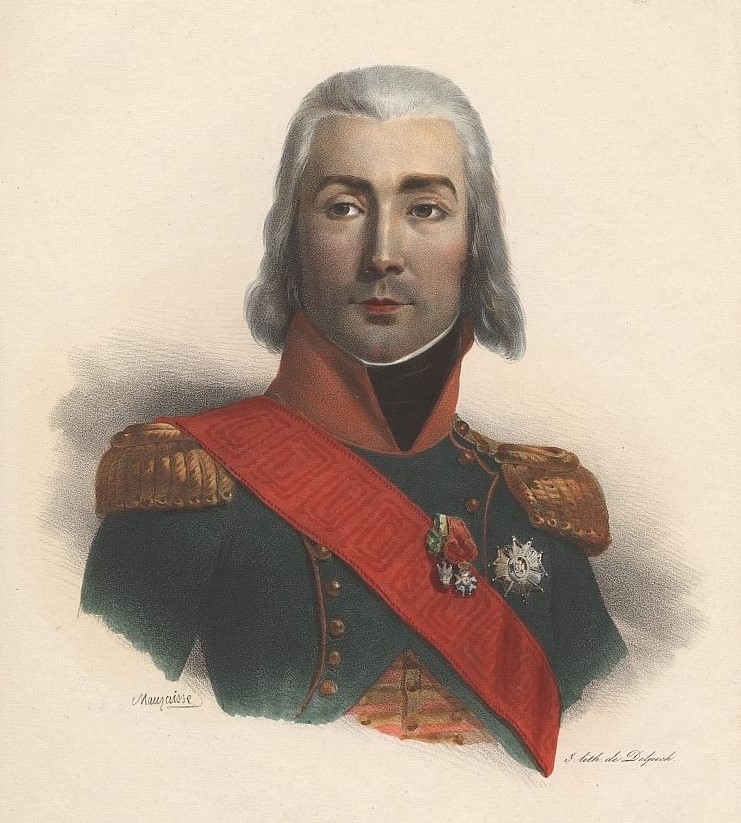
Jean-Baptiste Bessières
Marshal of the Empire, Duke of Istria
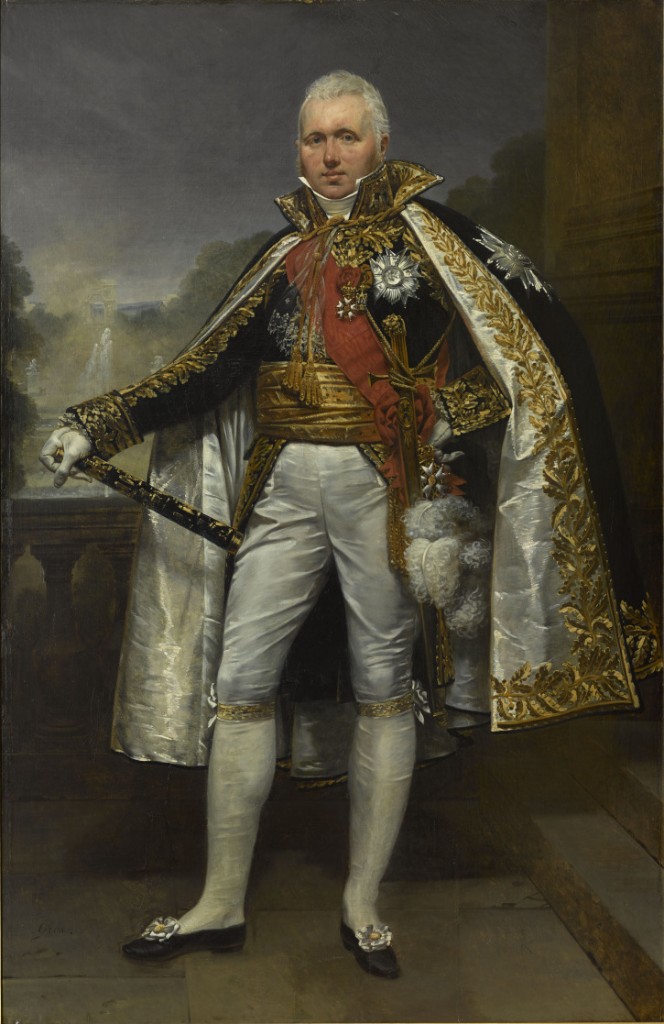
Claude Victor-Perrin
Marshal of the Empire, Duke of Bellune
François Christophe Kellermann
Marshal of the Empire, Duke of Valmy
Go further
Recommended books to dig deeper (affiliate links)
Le général Antoine-Charles-Louis de Lasalle, 1775-1809. L'héritage d'une légende
Aude Nicolas · 2018
A biography of the light cavalry general killed at Wagram, published in French in 2018 by Bernard Giovanangeli with a preface by General Jean-Pierre Bosser; an art historian, the author sets Lasalle's military career against the image painters and sculptors built of him.
See on Amazon
Napoleon the Great
Andrew Roberts · 2014
A monumental biography drawing on Napoleon’s 33,000 surviving letters, admiring but rigorous.
See on Amazon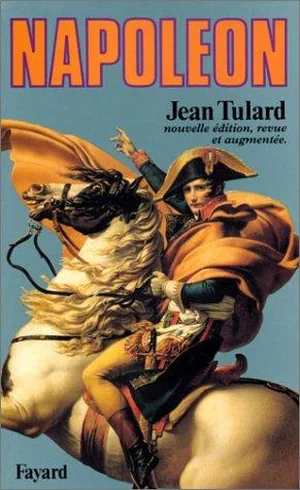
Napoléon ou le mythe du sauveur
Jean Tulard · 1977
The book that reshaped how the man is read: how France gave itself a saviour, and what it cost.
See on AmazonAs an Amazon Associate, this site earns from qualifying purchases.
Support the encyclopedia
Napoleon Empire is an independent project. Your contribution helps grow the content and keep the site running.
DonateSecure payment on the platform you choose.