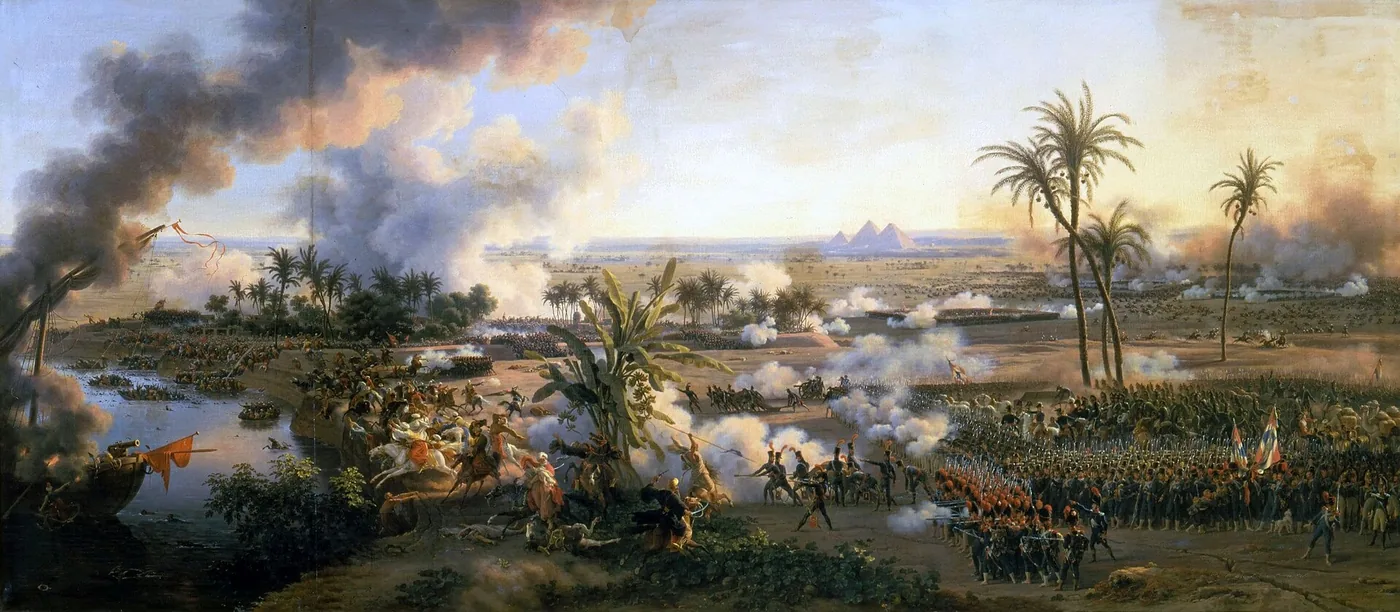
On 21 July 1798, near Embabeh, on the left bank of the Nile opposite Cairo, the Army of the Orient, formed in squares, broke the charges of Murad Bey's Mamluk cavalry and then stormed the entrenched village. The victory opened the gates of Cairo to Bonaparte; he named it after the pyramids glimpsed on the horizon.
Forces at play
Outcome: Decisive French victory

French Republic
- Bonaparte
- Desaix
- Reynier
- Dugua
- Bon
20,000 to 25,000 men
Casualties: 29 killed and 260 wounded according to French reports

Mamluks · Ottoman Empire
- Mourad Bey
- Ibrahim Bey
From 12,000 to more than 50,000 men according to the sources, including about 6,000 Mamluks
Casualties: From a few thousand to 10,000 men according to the estimates
Battle coordinates
Battle of the Pyramids
Coordinates 30.0808° N · 31.2000° E
Battle narrative
From Alexandria to the Nile
Landing in Egypt at the beginning of July 1798, the Army of the Orient took Alexandria on 2 July. Egypt was then a province of the Ottoman Empire, but real power lay with the Mamluk beys, a military caste of slave origin recruited mainly in the Caucasus. Two of them dominated the country: Murad Bey and Ibrahim Bey. Bonaparte wanted to break their power and hold Cairo before Ottoman reinforcements could arrive.
The march on the capital, across the desert and then along the Nile, in crushing heat, was gruelling. On 13 July, at Shubra Khit, a first engagement went the way of the French: their artillery destroyed the Mamluk flagship on the Nile and forced Murad to retreat. The Mamluk leader then decided to give battle before Cairo.
Murad Bey's army
Murad Bey took up position on the left bank of the Nile, opposite Cairo, which lay on the other bank. His right rested on the river, in the village of Embabeh, hastily entrenched and defended by infantry and forty to fifty guns; his left extended towards the village of Biktil. In the centre stood his main force: several thousand Mamluk horsemen, a heavily armed and armoured elite cavalry. Across the river, Ibrahim Bey's army watched the battle without being able to take part.
Murad's numbers are very poorly known: estimates range from about 12,000 to more than 50,000 men, depending on how one counts the Egyptian foot soldiers, the Janissaries and the Arab horsemen who accompanied the 6,000 or so Mamluks. Against them Bonaparte had 20,000 to 25,000 men.
The squares
On 21 July, after a night march, the French arrived before Embabeh. To withstand the charges of the Mamluk cavalry, Bonaparte formed each of his five divisions into a large square several ranks deep, with the artillery at the corners and the cavalry and baggage in the centre. From right to left came the divisions of Desaix, Reynier, Dugua — standing in for Kléber, wounded at Alexandria — Vial and Bon. The squares advanced in echelon, right leading, the left resting on the Nile; Desaix detached a force to occupy Biktil.
It was at this moment that Bonaparte is said to have told his soldiers: "From the top of these pyramids, forty centuries look down upon you." The phrase, which became famous, is known only from later accounts, and its authenticity is disputed. The pyramids of Giza themselves stood some fifteen kilometres away: they were no more than a silhouette on the horizon.
The Mamluk charge
Murad's plan was to pin the French on his two fortified wings, then strike them in the centre with his cavalry. The Mamluks launched charge after charge against the squares; one of them, it is said, rode alone to within a few paces of the French lines to demand single combat before being shot down. At about 3.30 p.m. Murad ordered his defterdar, Ayyub Bey, to launch the general assault. The mass of horsemen broke against the squares of Desaix, Reynier and Dugua, which did not give way: musketry and canister mowed down the attackers. Some of the Mamluks turned on Desaix's detachment, with no more success.
The storming of Embabeh
Bonaparte judged that the moment had come. Near the river, Bon's division formed attack columns and threw itself on the entrenchments of Embabeh, which it carried with the bayonet. The garrison broke; many defenders, caught between the French and the Nile, tried to escape by swimming, and hundreds drowned. Wounded in the face by a sabre cut, Murad Bey broke off the fight and withdrew towards Upper Egypt with a few thousand horsemen.
Outcome
French reports gave 29 killed and 260 wounded. The losses of Murad's army were much heavier, but their extent is uncertain: from a few thousand men to 10,000 according to the estimates, among them Ayyub Bey and perhaps 3,000 Mamluks. The French captured some forty guns, 400 camels and considerable booty.
The road to Cairo was open: Bonaparte entered the city on 24 July. Ibrahim Bey withdrew towards Syria and was beaten at Salheyeh on 11 August; Murad would wage a long war of movement against Desaix in Upper Egypt. Bonaparte set up a French administration in Cairo and founded the Institute of Egypt, but he soon had to put down the population's revolts by force. Above all, the victory lost much of its significance as early as 1 August: in Aboukir Bay, Nelson's squadron destroyed the French fleet, and the Army of the Orient found itself cut off from France.
A name for the legend
The battle was fought around Embabeh, hence the name Battle of Embabeh that it is sometimes given. It was Bonaparte who chose to call it the "Battle of the Pyramids", after the monuments glimpsed in the distance — a more prestigious name, which led many to believe that the fighting had taken place at their foot. Painters and engravers did much to spread this image, from Lejeune to Gros. In Paris, the Place des Pyramides preserves its memory.
Go further
Recommended books to dig deeper (affiliate links)

Napoleon the Great
Andrew Roberts · 2014
A monumental biography drawing on Napoleon’s 33,000 surviving letters, admiring but rigorous.
See on Amazon
Napoléon ou le mythe du sauveur
Jean Tulard · 1977
The book that reshaped how the man is read: how France gave itself a saviour, and what it cost.
See on Amazon
Nouvelle histoire du Premier Empire
Thierry Lentz · 2002-2010
Four reference volumes on institutions, diplomacy and collapse: the scholarly synthesis of the subject.
See on AmazonAs an Amazon Associate, this site earns from qualifying purchases.
Support the encyclopedia
Napoleon Empire is an independent project. Your contribution helps grow the content and keep the site running.
DonateSecure payment on the platform you choose.