Origins: the Army of Italy under Eugène
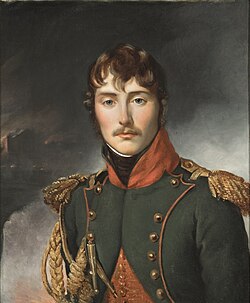
Eugène de Beauharnais, adopted by Napoleon and named Viceroy of the Kingdom of Italy in 1805, was not merely a court prince: he learned the soldier's trade beside the Emperor then received real commands. In 1809, when Austria reopened hostilities, he led the Army of Italy against Archduke John, on a secondary theatre nonetheless tied to the general Danube manoeuvre.
The fighting at Sacile (April 1809) marked an initial setback; Eugène recovered, crossed the Piave, then marched north to join the Grande Armée. That junction march illustrated the strategic role of the Army of Italy: not a decorative contingent, but a mass able to weigh on the Austrian flank.
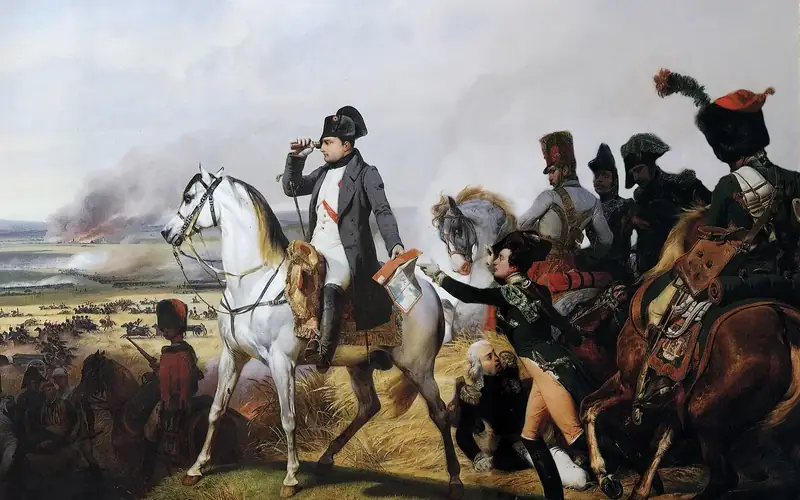
At Wagram on 5–6 July 1809, forces from Italy under Eugène took part in operations on the French wing. Their presence strengthened Napoleon's disposition against Archduke Charles after the losses at Essling.
Organisation of IV Corps in 1812
For the Russian campaign Napoleon entrusted Eugène with IV Army Corps, largely composed of Kingdom of Italy troops and French contingents. Theoretical strength sat in the order of magnitude of the great corps — several tens of thousands at the outset — but disease and marches quickly thinned the ranks.
The corps fielded infantry divisions, artillery and cavalry elements according to period situation reports. Italian cadres served beside French officers; Italian and French mixed in daily orders. That duality was a political strength — symbol of Napoleonic Italy — and a logistical constraint.
Eugène ran his staff with care to execute Napoleon's intentions without theatrical improvisation. Contemporaries judged him loyal, sometimes too cautious; historians chiefly retain his ability to keep a composite corps in marching order deep into Russia.
Composition and appearance
IV Corps uniforms mixed French cuts with Italian distinctions: green or blue coats according to Kingdom of Italy regiments, shakos, eagles and numbers. Integrated French soldiers wore the usual line coats. On the muddy ground of 1812 those distinctions quickly vanished under dust and rags.
Armament followed Empire standards: flintlock muskets, bayonets, field guns drawn by the train. Italian matériel quality did not always match French arsenals, but fire and column doctrine remained common.
Wagram and Borodino
At Wagram, Eugène and the Italian troops contributed to the July 1809 victory after joining the main theatre. Their commitment belonged to wing pressure and holding the line against an Austrian army still formidable.
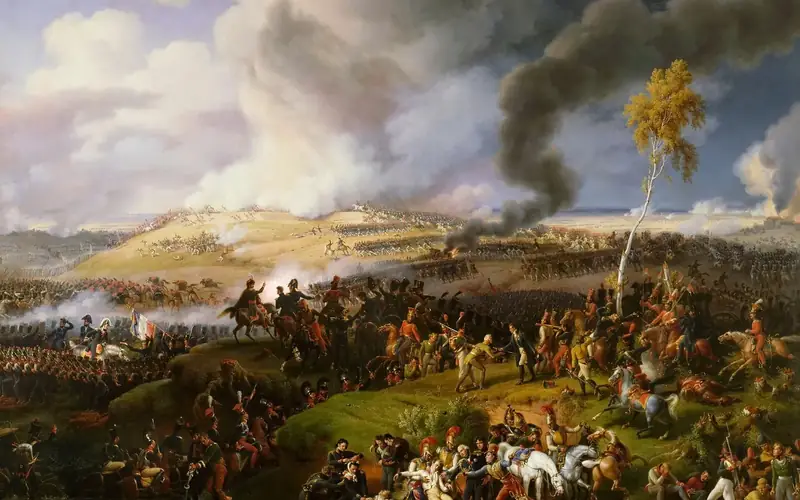
On 7 September 1812 at Borodino, Eugène's IV Corps fought in the sector of the Great Redoubt and the approaches to the Russian centre. Repeated assaults on the fortified works cost dearly in men; the corps' artillery and infantry were committed in the general mêlée that decided little and bled much.
After Moscow and during the retreat, IV Corps shared the Grande Armée's fate: cold, famine, Cossack harassment, gradual dissolution of companies. Eugène somehow maintained relative cohesion; the strength that recrossed the Niemen was only a fraction of those who had left in spring.
These two campaigns — 1809 and 1812 — define Eugène's military profile as a corps commander: a faithful executor, able to manoeuvre a composite army, more rarely inventor of autonomous plans. Napoleon trusted him for flank and junction missions.
Legacy and memory
After 1814 the Kingdom of Italy collapsed and IV Corps cadres scattered. Military memory nonetheless retains the Eugène–Army of Italy pairing as one of the Empire's allied pillars, distinct from the purely French corps of Davout or Soult.
For Empire Napoléon this entry links Eugène's biography to the battles of Wagram and Borodino: two trials where a multinational corps served the Emperor's personal strategy without ever becoming mere court pageantry.