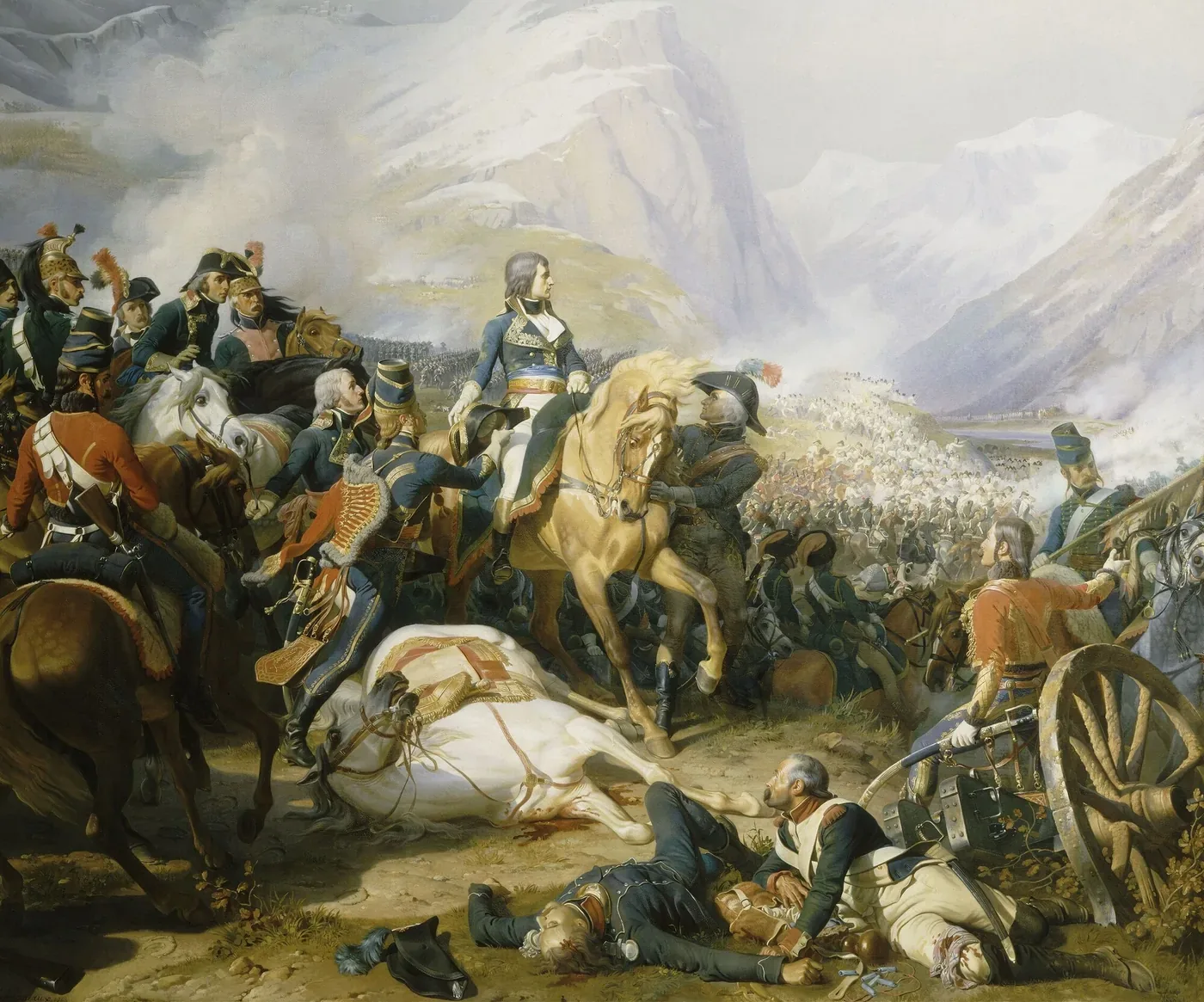
On 14 January 1797, on the Rivoli plateau between Lake Garda and the Adige, Bonaparte defeated Alvinczy's army, which had come for the fourth time to relieve Mantua. Arriving piecemeal, the Austrian columns were crushed one after another; three weeks later Mantua surrendered and Austria lost northern Italy.
Forces at play
Outcome: Decisive French victory

French Republic
- Bonaparte
- Joubert
- Masséna
- Rey
About 22,000 men
Casualties: About 3,200 killed and wounded and 1,000 prisoners; up to 5,000 men according to other sources

Austria
- Alvinczy
- Quosdanovich
- Lusignan
About 28,000 men
Casualties: 12,000 to 14,000 men, including 8,000 to 10,000 prisoners, and some forty guns
Battle coordinates
Rivoli
Coordinates 45.5720° N · 10.8110° E
Battle narrative
The last attempt to save Mantua
After the failure at Arcole in November 1796, Austria did not give up on Mantua, where Field Marshal Wurmser was still holding out with a garrison ravaged by hunger and disease. In January 1797 Alvinczy launched a fourth relief attempt. This time the main effort came from the north, between Lake Garda and the Adige: some 28,000 men, divided into several columns, were to overwhelm Joubert's division in the mountains and break out into the plain north of Mantua, where their numerical superiority could tell. To mislead Bonaparte, two diversionary attacks were launched further east: Bajalics before Verona, Provera on the lower Adige, near Legnago.
The Army of Italy was spread out to watch everything: Joubert held the Adige valley in the north, Masséna Verona, Augereau the Adige towards Legnago, while Rey stayed in reserve south of Lake Garda and Sérurier blockaded Mantua. On 12 January Alvinczy attacked Joubert's 10,000 or so men, who held firm and then fell back onto the Rivoli plateau. Realising that this was where the game would be decided, Bonaparte hurried there and reached Rivoli at about 2 a.m. in the night of 13 to 14 January, with Masséna's division marching behind him.
The Rivoli plateau
North of Rivoli a plateau stretches between the snow-covered massif of Monte Baldo to the west and the gorge of the Adige to the east. To the north it is overlooked by the Trambasore heights and the chapel of San Marco. The valley road runs along the right bank of the Adige at the bottom of the gorge, then climbs onto the plateau through a narrow ravine near the hamlet of Osteria.
Alvinczy's plan was ambitious and required perfect coordination. Three infantry columns were to attack frontally, between Caprino and San Marco; Quosdanovich's column, accompanied by cavalry, was to climb through the ravine; Vukassovich followed the left bank of the Adige and was to give support with his guns; finally Lusignan's brigade skirted Monte Baldo on the Austrian right to turn the French and cut off their retreat. But these columns, separated by difficult ground in winter, would not arrive together.
The morning of 14 January: the crisis
Before daybreak Joubert retook the chapel of San Marco. At about 9 a.m. the Austrian brigades of Koblos and Lipthay counter-attacked on the Trambasore heights and dislodged the French. On the right, Vukassovich's guns, set up on the other bank of the Adige, and pressure from Quosdanovich drove the French out of Osteria. By about 11 a.m. Bonaparte's position was becoming critical: Lusignan's column appeared in his rear, south of Rivoli, threatening to cut off his retreat.
Bonaparte sent against it the 18th Demi-brigade, just arrived from Masséna's division, and turned all his attention to the Osteria ravine: the defeat of Quosdanovich's column, he judged, would decide the battle. Lacking reserves, he thinned out Joubert's line facing the heights as far as he could.
Midday: the column in the ravine
Fifteen French guns, massed facing the mouth of the ravine, fired canister at point-blank range into the Austrian column as it emerged. The leading dragoons broke and stampeded back through their own infantry; according to some accounts, exploding ammunition wagons completed the panic. Leclerc's brigade then charged the column head-on, while Joubert took it in the flank with fire from San Marco. The young Lasalle, with only a few dozen mounted chasseurs, threw himself into the melee; he is credited with capturing a whole battalion and five flags. In the centre Ocskay was still pushing back Vial's brigade, but around midday Murat's cavalry charged his flanks and drove him back to his morning positions. Quosdanovich, unable to force the defile, ordered a retreat out of range of the guns.
The destruction of Lusignan
In the French rear, Brune's brigade was engaging Lusignan's column head-on when Rey's division, coming up from Castelnuovo, and Victor's brigade arrived in their turn. The column was crushed; Lusignan fled west with fewer than 2,000 men. The next day Joubert and Rey pursued the remnants of Alvinczy's army, which streamed back north in disorder through the Adige valley.
La Favorita and the fall of Mantua
Bonaparte did not wait for the pursuit to end. Provera had crossed the Adige near Legnago on 13 January and was marching on Mantua with about 9,000 men. On the 15th Bonaparte sent Masséna's division south, fresh from the fighting at Rivoli. On 16 January, near La Favorita, at the gates of Mantua, Wurmser attempted a sortie that was thrown back by Sérurier; surrounded by Masséna, Augereau and Sérurier, Provera surrendered with about 6,000 men. On 2 February 1797 Mantua capitulated in turn. In tribute to his defence, old Wurmser was allowed to leave freely with his staff and an escort; the garrison marched out with the honours of war.
Outcome
The French committed about 22,000 men at Rivoli; they lost about 3,200 killed and wounded and some 1,000 prisoners. Austrian losses were crushing: about 4,000 killed and wounded, 8,000 to 10,000 prisoners and some forty guns, 12,000 to 14,000 men out of 28,000. With the surrender of Mantua, Austria lost northern Italy; in the spring Bonaparte marched towards Vienna, and the preliminaries of Leoben, in April, prepared the peace of Campo Formio.
A victory remembered
Rivoli was then Bonaparte's greatest victory: he had beaten a numerically superior army by manoeuvring on interior lines, concentrating his artillery at the decisive point and bringing up his reinforcements in time. Masséna, whose division had marched and fought without respite, later received its name: in 1808 the Emperor made him Duke of Rivoli. In Paris, the Rue de Rivoli is named after the battle.
Go further
Recommended books to dig deeper (affiliate links)

Napoleon the Great
Andrew Roberts · 2014
A monumental biography drawing on Napoleon’s 33,000 surviving letters, admiring but rigorous.
See on Amazon
Napoléon ou le mythe du sauveur
Jean Tulard · 1977
The book that reshaped how the man is read: how France gave itself a saviour, and what it cost.
See on Amazon
Nouvelle histoire du Premier Empire
Thierry Lentz · 2002-2010
Four reference volumes on institutions, diplomacy and collapse: the scholarly synthesis of the subject.
See on AmazonAs an Amazon Associate, this site earns from qualifying purchases.
Support the encyclopedia
Napoleon Empire is an independent project. Your contribution helps grow the content and keep the site running.
DonateSecure payment on the platform you choose.