Why war came
In June 1807, on a raft moored in the middle of the Niemen, Napoleon and Tsar Alexander I met as victor and vanquished, and parted as allies. The peace of Tilsit made Russia France's partner and obliged it to close its ports to British trade: this was the Continental System. Five years later the two emperors were at war, and it was across the same river that the Grande Armée marched into Russia.
The alliance came apart little by little. The blockade was costly for Russia, which sold its grain, timber and hemp to the British and bought their manufactured goods in return. In December 1810, Alexander reopened his ports to neutral shipping and put heavy duties on French goods. The Duchy of Warsaw, created by Napoleon and enlarged in 1809 at Austria's expense, worried St Petersburg: it looked too much like a Poland coming back to life. Then came the annexation of the Duchy of Oldenburg, whose heir had married one of the Tsar's sisters, and Napoleon's marriage to Marie-Louise of Austria, after a plan to wed a Russian grand duchess had been dropped. For eighteen months both sides armed, each accusing the other of preparing to attack.
Napoleon wanted a short war: defeat the Russian army near the border, then dictate a peace that would bring Alexander back into the blockade. On 22 June 1812 he told his soldiers that "the second Polish war" had begun.
The largest army Europe had ever seen
For this campaign Napoleon gathered a force without precedent. Some 450,000 men crossed the border at the start of the summer; with the reinforcements sent later, more than 600,000 soldiers would enter Russia. Fewer than half were French. There were nearly 100,000 Poles, Germans from the Confederation of the Rhine (Bavarians, Saxons, Westphalians, Württembergers), Italians, Swiss, Croats, Spaniards and Portuguese, and, on the wings, a Prussian corps in the north and an Austrian corps in the south, supplied grudgingly by defeated allies. Russians would speak of the invasion of the "twelve tongues".
Behind the troops came more than 150,000 horses, over a thousand guns and thousands of wagons. The logistics had been prepared with care: huge depots were built up at Danzig and along the Vistula, and new transport battalions were raised. But the whole machine was designed for a campaign of a few weeks, in a country with few roads, poor villages and enormous distances.
Facing them near the border, Russia had two main armies: in the north, the 1st Western Army under Barclay de Tolly, the minister of war; further south, Bagration's 2nd Western Army. Together they numbered about 200,000 men, with a third army facing the Austrians. The Russians were outnumbered at the start, but they were fighting at home, and they would grow stronger month by month.
An army melting away before the fighting
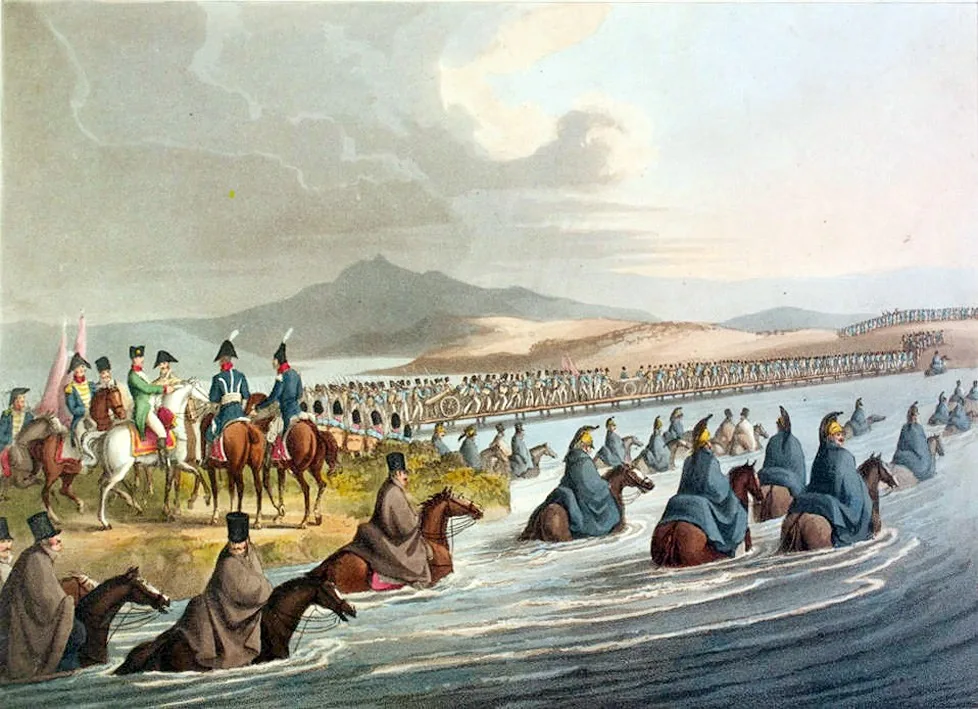
During the night of 23 to 24 June 1812, the first troops crossed the Niemen near Kovno on pontoon bridges. No one opposed them. Barclay refused battle and fell back, destroying whatever he could not carry off. Napoleon entered Vilna on 28 June and stayed eighteen days, long enough to organise supplies and a government for Lithuania.
He tried to split the two Russian armies: Davout marched on Minsk to block Bagration's path while the main body pursued Barclay towards Vitebsk. The manoeuvre failed, partly because Jérôme, King of Westphalia, moved too slowly on the right wing; offended at being placed under Davout's orders, he left the army in mid-July. Bagration slipped away to the south, and the two Russian armies joined up at Smolensk in early August.
The Grande Armée had yet to fight a major battle, and it had already lost a large share of its strength. Summer heat, storms that turned the roads into quagmires, foul water, dysentery and then typhus did terrible damage. The convoys could not keep up; the soldiers lived off a country the Russians had stripped bare. Horses died by the thousand for lack of fodder. By most estimates the main body lost about a third of its men in eight weeks, to sickness, exhaustion, desertion and the garrisons left behind.
Smolensk, then Borodino
Outside Smolensk, from 16 to 18 August, Napoleon thought he had his battle at last. The Russians defended the burning town, then evacuated it by night and resumed their retreat. In Russia, the army and public opinion could no longer stomach this endless withdrawal, which was blamed on Barclay, a man of Baltic origin. Alexander gave the supreme command to Kutuzov, a popular old general and a veteran of the wars against the Turks.
At Smolensk, Napoleon hesitated. Should he stop there for the winter, or march on Moscow, nearly four hundred kilometres away? Murat and others urged him to go no further. He chose Moscow, convinced that the Russians would not give up their ancient capital without a fight.
On that point he was right. Kutuzov took up position near the village of Borodino, about a hundred kilometres west of Moscow. The battle of Borodino, which the French call the Moskova, was fought on 7 September. It involved more than 250,000 men and left at least 70,000 killed and wounded in a single day, the bloodiest day of the Napoleonic Wars. The French took the Russian earthworks at the cost of fierce frontal assaults, but Napoleon refused to commit his Guard, his last reserve, more than two thousand kilometres from France, and the Russian army withdrew in good order. On 13 September, at Fili, Kutuzov decided to abandon Moscow in order to save the army.
Moscow
On 14 September the Grande Armée entered an almost empty city. Of some three hundred thousand inhabitants, only a few thousand remained. Napoleon waited in vain for the delegation that, by custom, would hand over the keys of a conquered capital. The very next night, fires broke out in several places; the governor, Rostopchin, had had the fire pumps taken away. The city, built mostly of wood, burned for four days. Napoleon had to leave the Kremlin for the Petrovsky Palace. When the fire died down, two thirds of Moscow were gone, along with much of the food the army had been counting on for the winter.
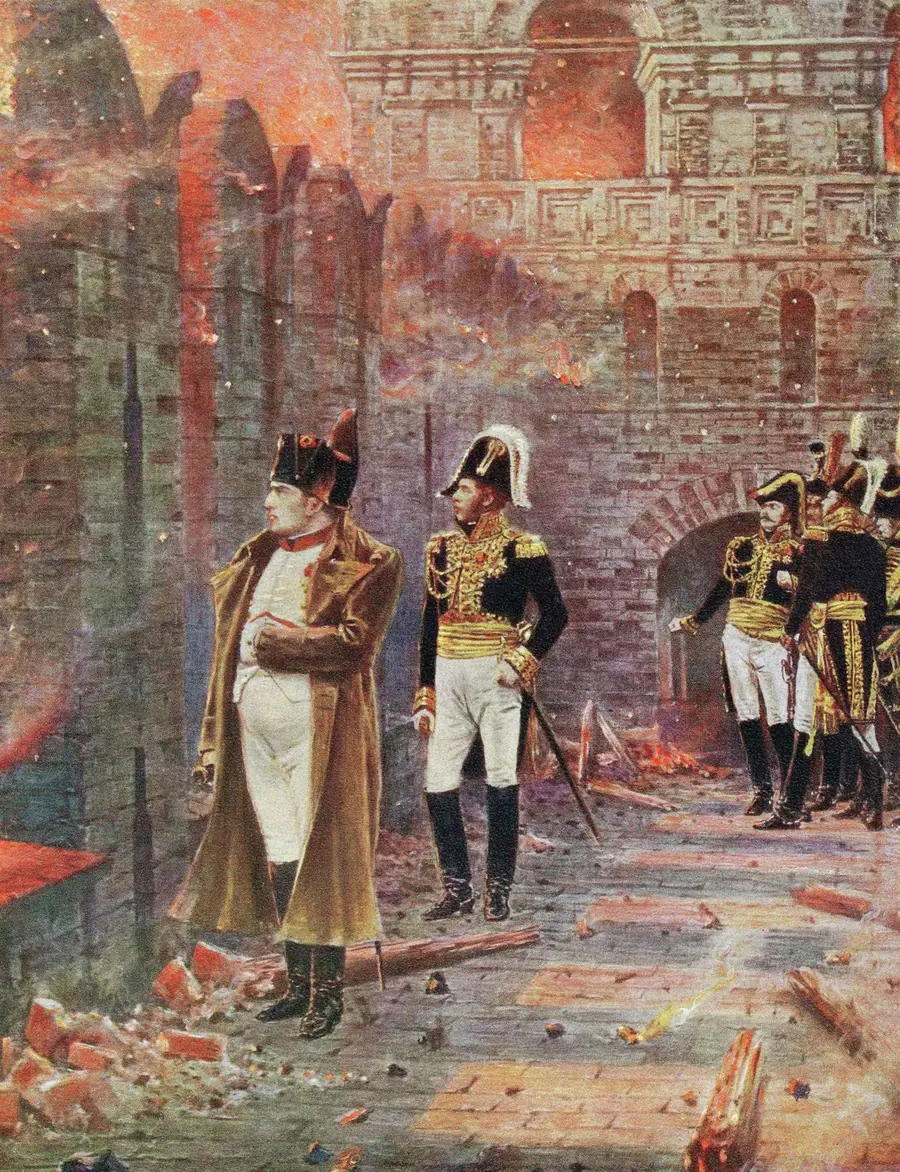
The Emperor stayed five weeks in Moscow. He wrote to Alexander and sent Lauriston to the Russian camp to propose peace. No answer came. The Tsar had let it be known that he would not negotiate while a single enemy soldier remained on Russian soil, and time was on his side. While the Grande Armée wore itself down in a ruined city where discipline was slipping, Kutuzov rebuilt his strength at the camp of Tarutino, south of Moscow, and Cossacks and partisans harried the convoys and foraging parties.
The retreat
On 18 October, at Tarutino, the Russians surprised and beat Murat's cavalry. The next day Napoleon left Moscow with about a hundred thousand men and an enormous train loaded with plunder. He meant to head south-west through Kaluga, an untouched region, and avoid the road he had laid waste on the way in. On 24 October, at Maloyaroslavets, Prince Eugène's corps ran into the Russians; the town changed hands several times, and Kutuzov remained in a position to bar the southern road.
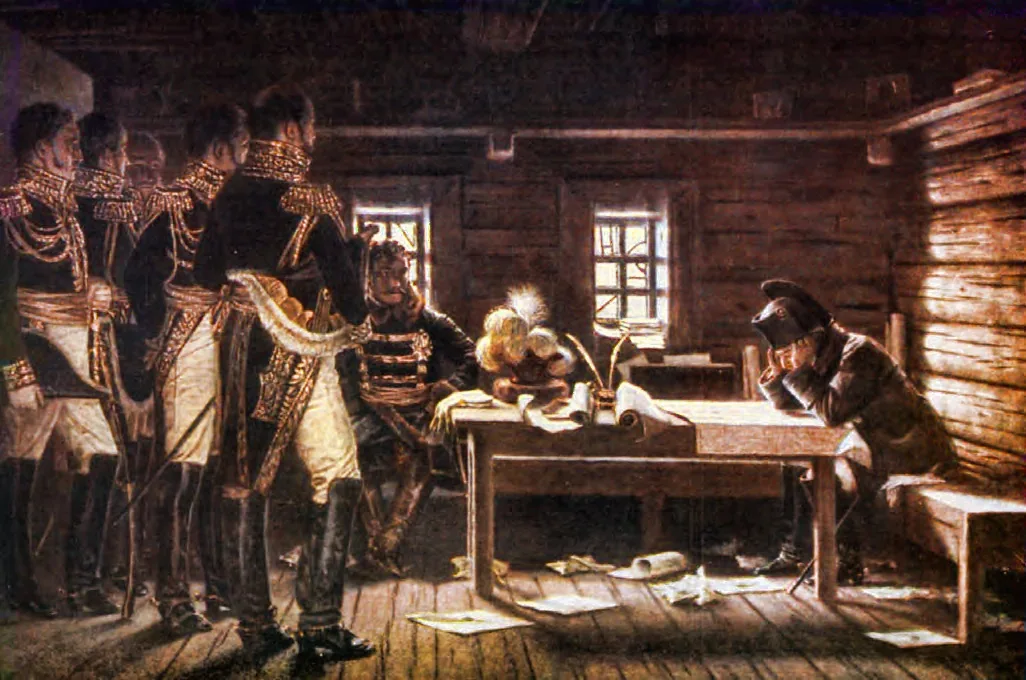
The day after the battle, Napoleon gave up: the army would turn west again along the Smolensk road, the one it had come by, already ravaged. That choice weighed on everything that followed. Along this strip of scorched earth there was no fodder left and no village still standing. The Russians had no need to offer battle; they only had to follow, harass and wait. On 3 November, at Vyazma, Davout's rearguard was nearly cut off. It was around this time that Napoleon learned that in Paris, on 23 October, General Malet had attempted a coup by announcing his death.
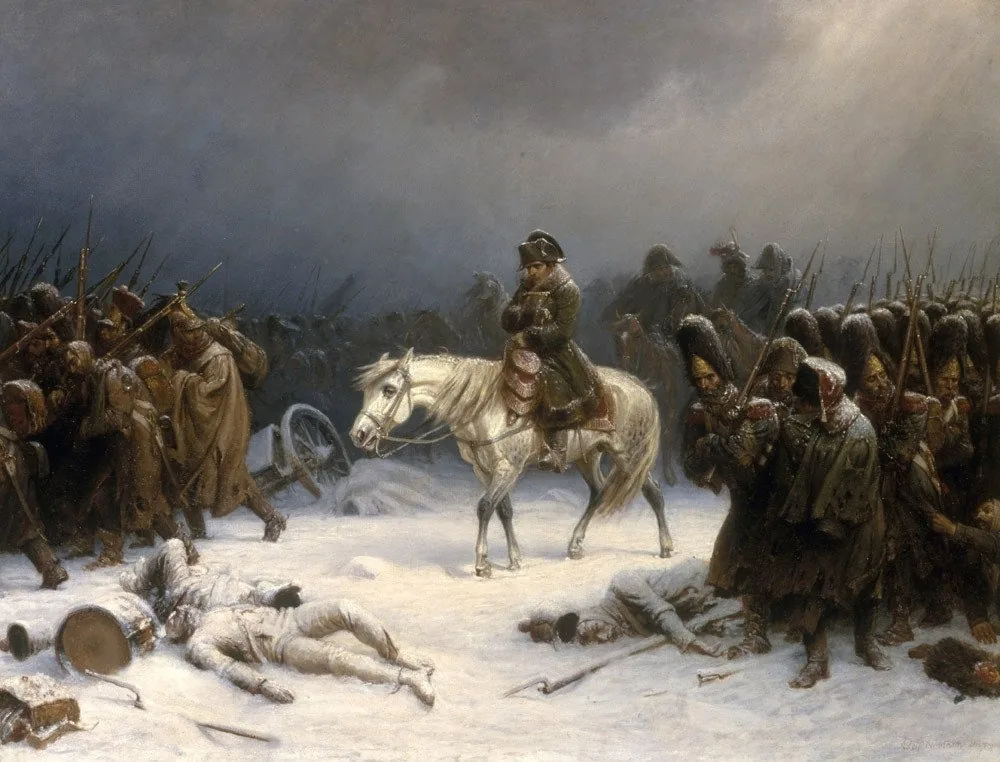
The first snow fell in early November. The horses, which had not been shod for ice, went down by the thousand; guns, wagons and wounded had to be abandoned. The columns broke up into a mob of stragglers whom Cossacks and armed peasants finished off. At Smolensk, reached around 9 November, the depots the army had hoped for lasted only a few days and were looted. From 15 to 18 November, around Krasnoi, the Russians tried to cut the road: Napoleon sent in the Old Guard to clear it while the corps of Eugène, Davout and Ney passed one by one under fire. Ney, cut off with the rearguard, had only about 6,000 men left; he led them across the frozen Dnieper by night and rejoined the army a few days later with only part of them.
The Berezina
At the end of November the retreat came up against the Berezina. Chichagov's Russian army, coming up from the south, had taken Minsk and its depots, then the bridge at Borisov, which it destroyed on 21 November. Wittgenstein was approaching from the north, and Kutuzov followed from the east. Napoleon was in danger of being trapped between three armies.
He staged a feint to the south and chose to cross further north, at the ford of Studianka. From 26 to 29 November, General Éblé's pontoniers, often chest-deep in freezing water, built and repaired two bridges without respite, one for the infantry and the other for the artillery and wagons. The corps of Oudinot and Victor fought on both banks to hold the Russians off. On the morning of the 29th, on Napoleon's orders, the bridges were set on fire; thousands of stragglers left on the east bank were killed or captured. Éblé, worn out, died a few weeks later at Königsberg.
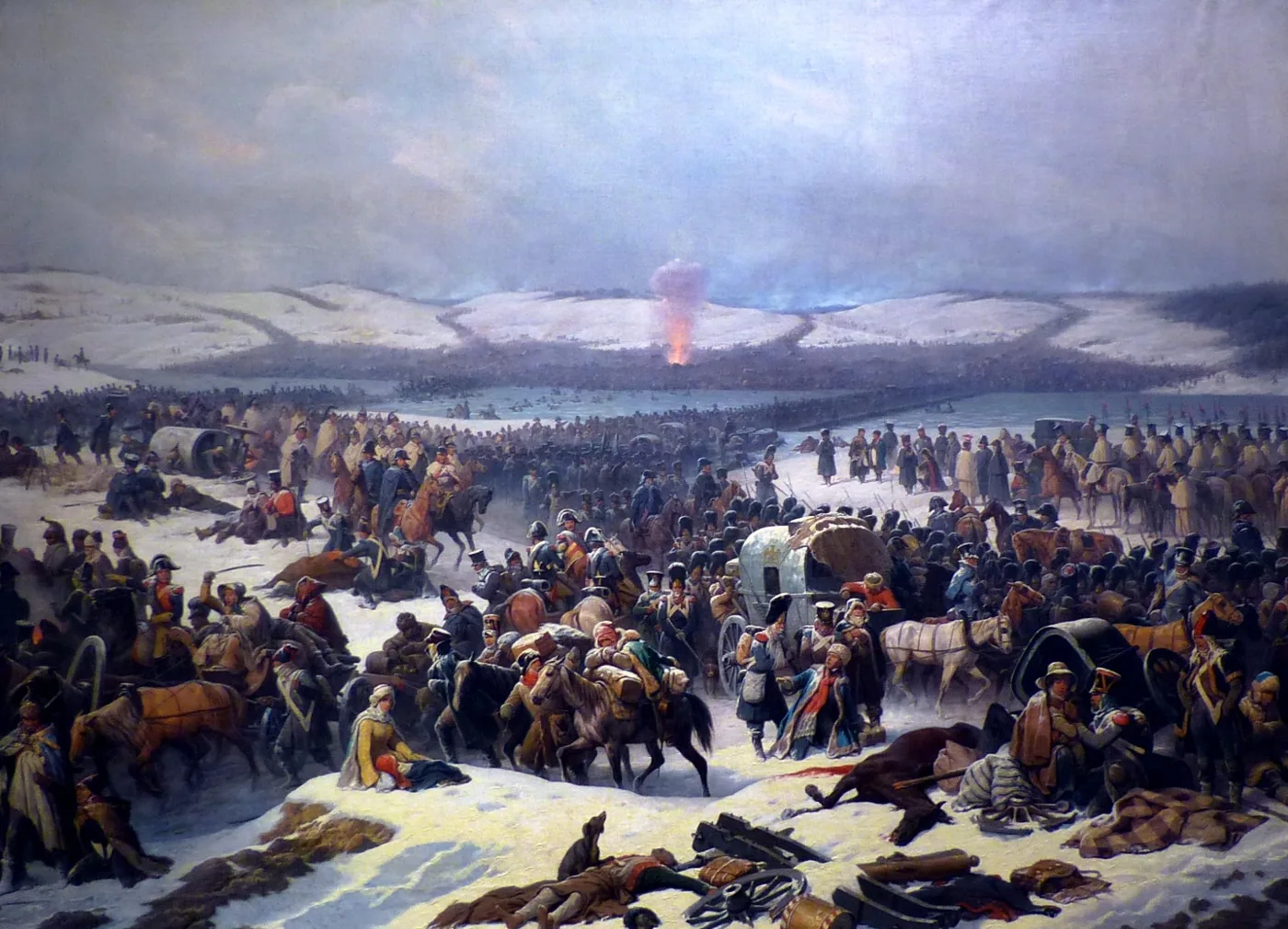
In military terms the Berezina was a rescue: Napoleon had escaped encirclement and saved what could be saved. But the Grande Armée had ceased to exist as an organised force. In French, the name of the river has become a byword for disaster.
The end of the Grande Armée
On 3 December, at Molodechno, Napoleon dictated the 29th Bulletin, which for the first time admitted the scale of the disaster and blamed it on the cold. On 5 December, at Smorgon, he handed command to Murat and left for Paris by sledge with Caulaincourt. He arrived during the night of 18 to 19 December, two days after the bulletin was published, to take back control of a regime that the Malet affair had shown to be fragile. During a brief stop in Warsaw he is said to have remarked to the French ambassador, the abbé de Pradt: "From the sublime to the ridiculous there is only one step."
Behind him the cold grew even worse. The survivors reached Vilna from 9 December onwards; the depots were stormed, the sick abandoned, and the town had to be evacuated under the threat of the Cossacks. On 14 December, at Kovno, Ney and a handful of men from the rearguard recrossed the Niemen, six months after crossing it the other way. In the north, on 30 December, the Prussian general Yorck, whose corps had been serving under Macdonald, signed the Convention of Tauroggen with the Russians and took his troops out of the war. It was the beginning of Prussia's change of sides.
The toll
The figures are still debated, for want of complete records, and they vary depending on whether one counts the Austrian and Prussian wings, the reinforcements or the stragglers. Of more than 600,000 men who entered Russia, only a small fraction came back fit to fight: in January 1813, about 23,000 men regrouped behind the Vistula, not counting some 35,000 Austrians and Prussians from the wings. According to the historian Thierry Lentz, the Grande Armée's dead numbered about 200,000, half in battle and the other half from cold, hunger or disease, and between 150,000 and 190,000 were taken prisoner, many of whom died in captivity. Almost all the horses and nearly all the artillery were lost.
Russian losses are even harder to establish. They were very heavy in the army, which had fought, marched and suffered from the cold as well, and heavier still among civilians, along a road where everything had been burned. From all causes, the campaign is thought to have cost somewhere in the order of a million lives, soldiers and civilians on both sides.
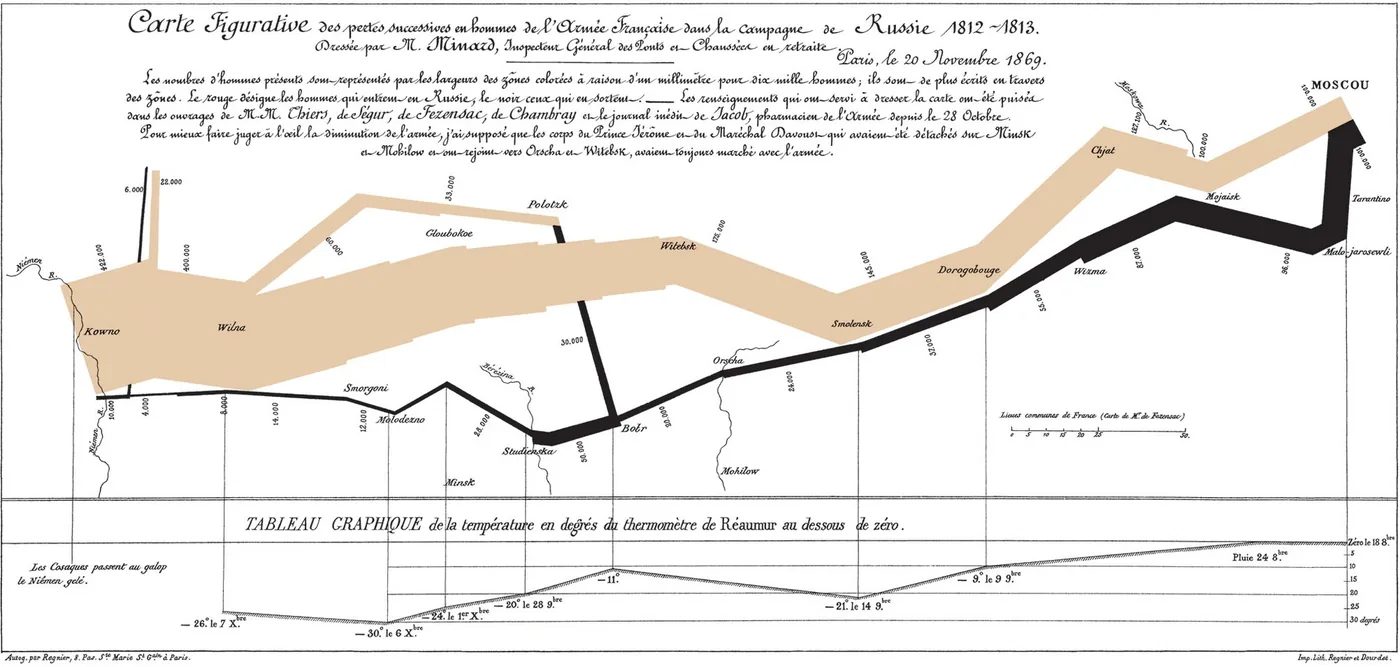
In 1869 the engineer Charles Joseph Minard summed up the campaign in a single image that has become a classic of data visualisation. His band leaves the Niemen with 422,000 men, reaches Moscow with 100,000 and returns with 10,000. Above all, it shows that the army melted away on the way in, long before winter.
Why such a disaster?
As early as 1812, people were quick to blame "General Winter". The cold was terrible, but mostly it finished off an army that was already broken. Most of the losses came during the summer and autumn, from disease, hunger and exhaustion, before the first snow. Historians today stress other causes.
- Space and logistics. The supply system, excellent for a short campaign in central Europe, could not keep an army of this size going over more than a thousand kilometres of bad roads, in a poor country emptied by the enemy.
- Russian strategy. By refusing battle for so long, burning what they left behind and sacrificing Moscow, the Russians denied Napoleon the decisive victory he was looking for.
- Alexander's resolve. Napoleon was counting on a negotiated peace once Moscow had fallen. The Tsar never replied, and the wait cost five weeks.
- Napoleon's own decisions. The eighteen days spent at Vilna, the march on Moscow instead of wintering at Smolensk, the long stay in Moscow, then the return along the devastated road after Maloyaroslavets each made matters worse.
The consequences
The Russian campaign destroyed the Empire's best army, its veterans, its officers and almost all its cavalry. Napoleon raised new troops within a few months, but the young conscripts of 1813 lacked experience and horses: at Lützen and Bautzen he won without being able to pursue. Prussia changed sides early in 1813, and Austria followed in August. In the autumn the coalition defeated Napoleon at Leipzig, and the campaign in France in 1814 ended with his first abdication.
In Russia, 1812 became the "Patriotic War", a national epic. Leo Tolstoy made it the setting of War and Peace, published between 1865 and 1869, and in 1880 Tchaikovsky composed his 1812 Overture, in which the theme of La Marseillaise ends up drowned out by the Russian imperial anthem and the sound of cannon. Two centuries later, the campaign remains the classic example of a great power defeated by distance, logistics and the stubbornness of an opponent who refuses to negotiate.
Further reading
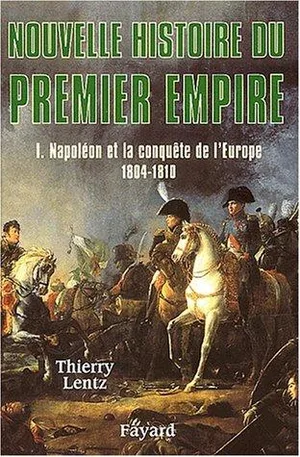
- Thierry Lentz, Nouvelle histoire du Premier Empire, vol. II, L'Effondrement du système napoléonien, 1810-1814, Fayard, 2004.
- Marie-Pierre Rey, L'Effroyable Tragédie. Une nouvelle histoire de la campagne de Russie, Flammarion, 2012.
- Dominic Lieven, Russia Against Napoleon. The Battle for Europe, 1807 to 1814, Allen Lane, 2009.
- Adam Zamoyski, 1812. Napoleon's Fatal March on Moscow, HarperCollins, 2004.
- Two eyewitnesses: Armand de Caulaincourt, Mémoires, published in 1933, and Philippe-Paul de Ségur, Histoire de Napoléon et de la Grande Armée pendant l'année 1812, 1824.