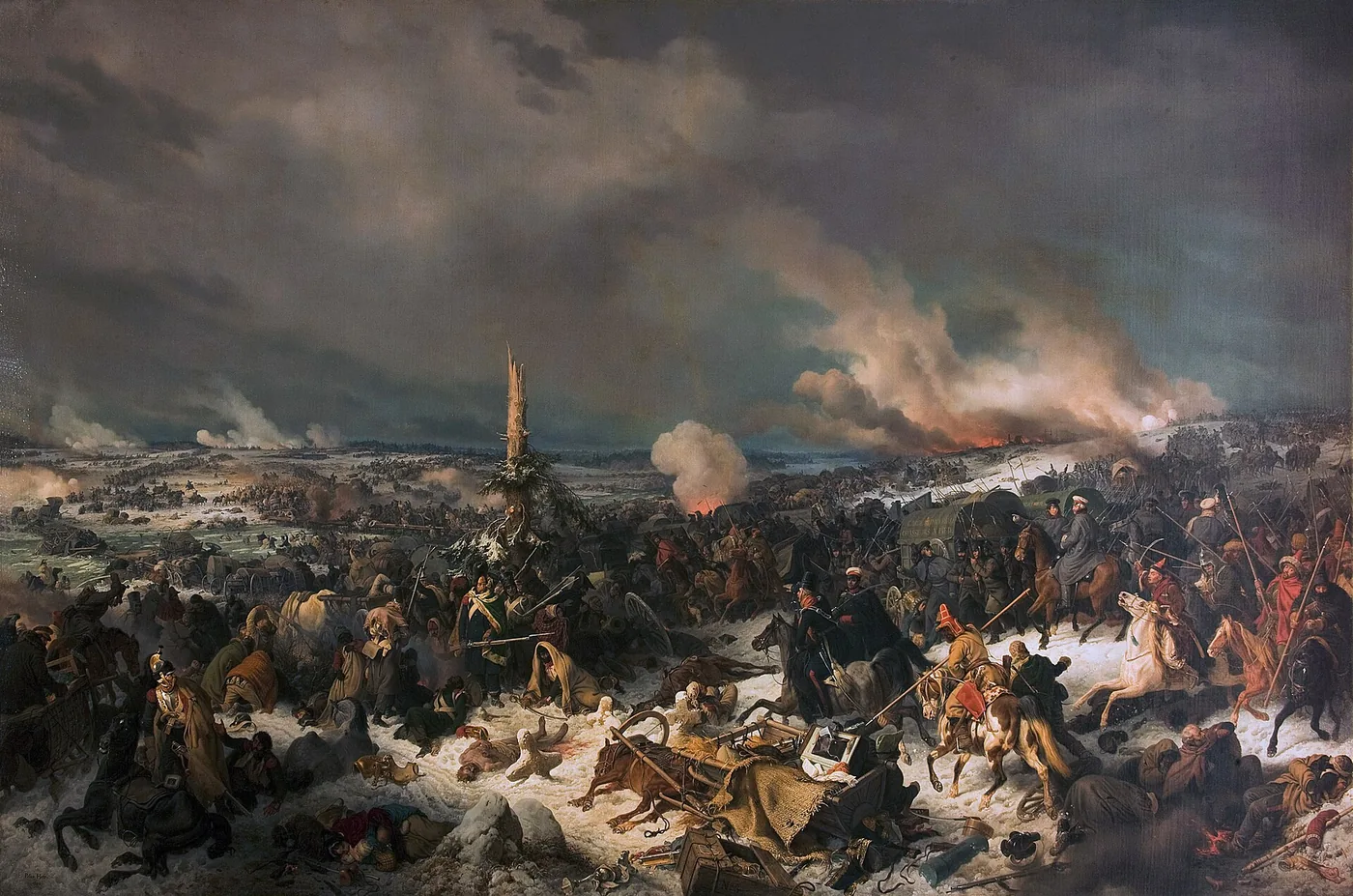
From 26 to 29 November 1812, caught between three Russian armies, the remains of the Grande Armée crossed the Berezina near Studianka on two bridges built in icy water by Éblé's pontoneers. The crossing succeeded and saved the core of the army, but at a dreadful cost, above all among the stragglers left on the left bank when the bridges were set on fire.
Forces at play
Outcome: Crossing achieved at enormous cost


France · Rhine allies · Poland · Switzerland
- Napoléon
- Oudinot
- Victor
- Ney
- Éblé
A few tens of thousands of fighting men, followed by at least 40,000 stragglers
Casualties: 20,000 to 30,000 combatants and perhaps 30,000 non-combatants, according to Chandler

Russia
- Tchitchagov
- Wittgenstein
- Tchaplits
About 65,000 men under Wittgenstein and Chichagov, with Kutuzov following at a distance
Casualties: At least 10,000 killed and many wounded
Flags: TRAJAN 117, CC BY-SA 3.0, Wikimedia Commons
Battle coordinates
The Berezina
Coordinates 54.2800° N · 28.5000° E
Battle narrative
An army trapped
In November 1812, having left Moscow and fought at Maloyaroslavets, Vyazma and Krasnoi, the Grande Armée was streaming back westwards. Napoleon intended to cross the Berezina at Borisov, on the road to Minsk. But on 21 November Admiral Chichagov's army, coming from Minsk, seized Borisov and its bridge; on the 23rd a French counter-attack tried to retake the town, but the Russians destroyed the bridge and remained masters of the right bank. To the north Wittgenstein was approaching with some 30,000 men; behind, Kutuzov's forces followed at a distance. Napoleon had only a few tens of thousands of fighting men left, followed by a crowd at least as large of stragglers, wounded and civilians.
The weather worked against the French: a thaw had melted the ice that would have allowed a crossing, and the river, lined with marshes, was carrying ice floes. On 23 November, for lack of serviceable horsemen, a "Sacred Squadron" made up entirely of officers was even formed to escort the Emperor.
Studianka
General Corbineau's cavalry brigade had found a ford near the village of Studianka, some fifteen kilometres upstream from Borisov. The river was only about twenty metres wide there, but its banks were marshy: bridges had to be built. General Éblé, commander of the pontoneers, had disobeyed the order to destroy his equipment during the retreat; he had kept his forges and tools.
To deceive the Russians, Napoleon made repeated demonstrations south of Borisov. Chichagov fell for them and stripped the Studianka sector. On the morning of 26 November the French saw that the Russian camp opposite was empty. Horsemen forded the river, infantry followed in boats, and Éblé's pontoneers, largely Dutch, went into the icy water to set up the trestles, using timber taken from the village.
26–27 November: the crossing
At about 1 p.m. on the 26th the first bridge, reserved for infantry, was finished: Oudinot's corps crossed and took up position on the right bank to hold the exit. The second bridge, for the artillery and vehicles, was completed in the afternoon but gave way twice; each time the pontoneers repaired it. On the 27th Napoleon and the Guard crossed, followed by the corps of Davout and Eugène. On the left bank, Victor's corps covered the crossing against Wittgenstein. During the night of the 27th to 28th Partouneaux's division, left behind near Borisov, was surrounded and had to surrender.
28 November: battle on both banks
On the 28th the Russians at last attacked on both sides. On the right bank, in the woods of Brili and Stakhov, Chichagov ran into the corps of Oudinot and Ney, in which many Poles and the Swiss regiments were fighting. Oudinot was wounded, Ney took command, and a charge by General Doumerc's cuirassiers threw the Russians back. On the left bank Victor's corps, some 10,000 men, held the heights of Studianka against Wittgenstein all day; Fournier's cavalry charged repeatedly. But early in the afternoon the Russian artillery managed to bring the bridges under fire: the cannonballs fell on the mass of stragglers, and a terrible crush surged towards the crossings; many drowned.
At nightfall Victor in turn crossed to the right bank. The bridges were then free; but most of the stragglers, exhausted, preferred to stay by their campfires. Éblé had word spread that the bridges would be destroyed and had wagons set alight to persuade them to cross, with little success.
29 November: the bridges in flames
On the morning of the 29th Éblé received the order to burn the bridges at 7 a.m. He delayed until about 8.30, then set them on fire while thousands of stragglers, women and children were still crowding the left bank. Many tried to cross through the flames or by swimming and perished. The Cossacks and Wittgenstein's troops captured them in great numbers. Without bridges the Russians could not pursue; on the right bank the French also destroyed the bridges carrying the Zembin road across the marshes towards Vilna. According to an often-quoted count, only a handful of the roughly 400 pontoneers who built the bridges survived; Éblé himself, worn out, died at Königsberg at the end of December.
Outcome
The losses will never be known precisely. The historian David Chandler estimated that 20,000 to 30,000 French combatants were put out of action during these three days, to which perhaps 30,000 non-combatants must be added, most of whom, once captured, died of cold and hunger. The Russians lost at least 10,000 killed and many wounded. But the essential had been saved: Napoleon, his marshals, the Guard, thousands of officers and veterans and most of the artillery had crossed the river. Without them he could not have rebuilt his army for the campaign of 1813.
A victory that became a byword for disaster
The retreat went on: on 5 December Napoleon left the army to return to Paris, and its remnants recrossed the Niemen in mid-December. In France the word "bérézina" has become a synonym for rout. Many historians, such as Jean Tulard, nevertheless point out that the battle was, in extreme conditions, a French military success: the Russian manoeuvre intended to trap Napoleon had failed, and Chichagov was disgraced. Balzac, in Adieu, and then Victor Hugo, in L'Expiation ("Il neigeait…"), fixed the tragic image of the crossing. In Switzerland the Beresinalied keeps alive the memory of the Swiss regiments that fought there.
Go further
Recommended books to dig deeper (affiliate links)

Napoleon the Great
Andrew Roberts · 2014
A monumental biography drawing on Napoleon’s 33,000 surviving letters, admiring but rigorous.
See on Amazon
Napoléon ou le mythe du sauveur
Jean Tulard · 1977
The book that reshaped how the man is read: how France gave itself a saviour, and what it cost.
See on Amazon
Nouvelle histoire du Premier Empire
Thierry Lentz · 2002-2010
Four reference volumes on institutions, diplomacy and collapse: the scholarly synthesis of the subject.
See on AmazonAs an Amazon Associate, this site earns from qualifying purchases.
Support the encyclopedia
Napoleon Empire is an independent project. Your contribution helps grow the content and keep the site running.
DonateSecure payment on the platform you choose.