A taste that came before the Empire
People often speak of the "Empire style" as if Napoleon had, in 1804, ordered a brand-new décor from his architects. The reality is more nuanced. The repertoire that dominates under the Empire — columns, palmettes, pediments, furniture with straight lines and bold, flat planes — is that of Neoclassicism, which had taken shape all over Europe from the middle of the eighteenth century. The discovery of Herculaneum and Pompeii, the writings of Winckelmann and the stays of young architects and painters in Rome had put Antiquity back at the centre of taste long before the Revolution. Under Louis XVI, and then under the Directory, furnishing had already given up the curves of the rocaille for more austere forms.
What the Consulate and the Empire add is a political purpose and a sense of scale. Decoration stops being a matter of private taste and becomes the language of a regime that wants to look stable, orderly and lasting. The name itself came late: contemporaries spoke of the "modern taste" or the "antique taste", and the expression "Empire style" was adopted afterwards, for a family of forms that in fact extends well beyond the years 1804-1815.
Two men gave this taste its French shape. Charles Percier (1764-1838) and Pierre-François-Léonard Fontaine (1762-1853) met in the studio of the architect Antoine-François Peyre and found each other again in Rome at the end of the 1780s. Their partnership was to last a long time. Percier drew with exceptional delicacy; Fontaine, appointed architect to the government in 1801, ran the building sites and knew how to deal with the administration. In 1801 they published together the Recueil de décorations intérieures, a collection of designs for furniture, lighting, hangings and chimneypieces, reissued in 1812, which became a bedside book for cabinetmakers, bronze-founders and decorators across Europe.
Malmaison, laboratory of Consular taste
The first testing ground was a country house. Joséphine bought the estate of Malmaison, at Rueil, in the spring of 1799, while her husband was still in Egypt. After Bonaparte's return, now First Consul, Percier and Fontaine carried out extensive remodelling there from 1800. The château became the weekend residence of the government: the First Consul received guests there, worked there and sometimes gathered his ministers.
The council chamber is the best-known example. The architects conceived it as a campaign tent, with striped hangings stretched over the walls and the ceiling and spears serving as columns. The idea is a clever one: deliberations take place in the setting of a general on campaign, without ceasing to be luxurious. It also tells us about the moment, when the leader's prestige still rested on Marengo and the army rather than on a crown.
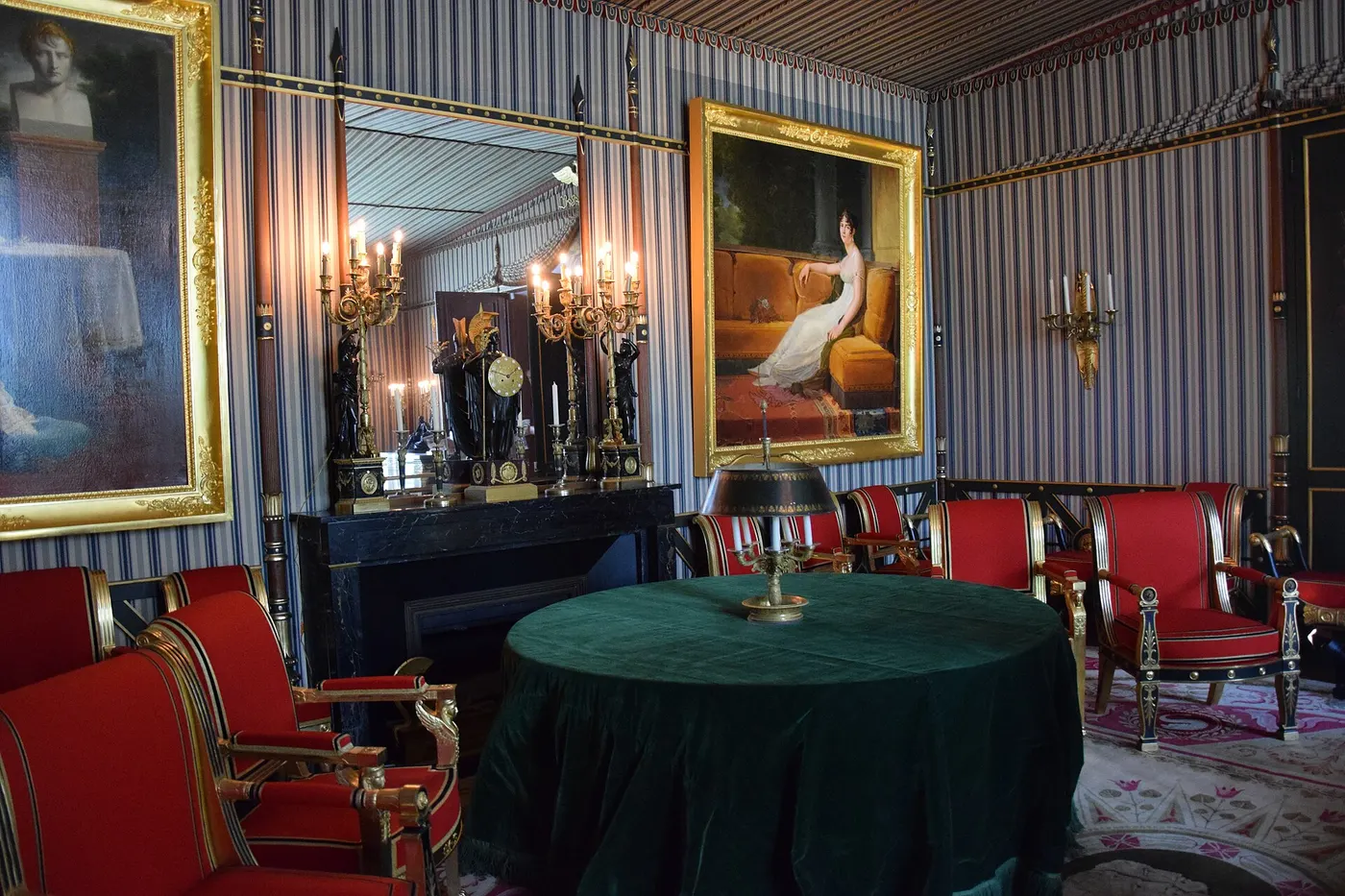
At Malmaison the collaboration between architects, cabinetmakers and bronze-workers took shape. The bronze-founder Pierre-Philippe Thomire (1751-1843), who had already worked under the Ancien Régime, supplied gilt bronzes; the Jacobs, a Parisian family of cabinetmakers and chair-makers, delivered seating. The repertoire grew richer with motifs that would be found everywhere afterwards: the lion, the sphinx, the swan, the palmette, the rosette, the laurel wreath.
A style in the service of power
Once Bonaparte moved into the Tuileries, in February 1800, and then became emperor, the question changed in nature. It was no longer a matter of adorning a house but of showing who governed. The antique repertoire lent itself superbly to this purpose, because it evoked in turn the Roman Republic, the Empire of Caesar and Augustus and, for the new dynasty, the idea of continuity with Charlemagne. The eagle, the attribute of Jupiter and the standard of the legions, took its place on the army's flags and on the decorative schemes. The letter N crowned with laurels became a monogram that was engraved, embroidered or cast everywhere.
The bees follow a similar logic. They refer to the tomb of the Frankish king Childeric I, discovered at Tournai in 1653, where small gold ornaments had been found which were interpreted at the time as bees. By adopting them, Napoleon gave himself a lineage older than that of the Capetian fleurs-de-lis and broke with the emblems of the overthrown monarchy. Many details of the coronation of 1804, from the laurel crown to the mantle strewn with golden bees, belong to the same register; the article devoted to the ceremony describes its insignia.
Another contribution weighed heavily: Egypt. Dominique Vivant Denon (1747-1825) had followed the expedition of 1798-1799 and drawn tirelessly whatever he saw. His Voyage dans la Basse et la Haute Égypte, published in 1802, was a great success and gave decorators a new repertoire: sphinxes, lotus flowers, obelisks, Hathor heads. Denon, who became director general of the Musée central des arts in 1802 and then of the Musée Napoléon, supervised a large part of the regime's artistic commissions. The Egyptian taste remained an accent rather than a system, but it explains the singular look of many clocks, pedestal tables and pieces of tableware. The article on the Egyptian and Syrian campaign tells the story of the expedition itself.
Furniture: wood, bronze and velvet
Empire furniture is recognisable by its geometry. Surfaces are broad and smooth, often veneered in mahogany, a dark reddish wood imported from the colonies and made scarcer by the naval war and the Continental Blockade; cabinetmakers then turned more readily to native woods such as walnut, elm or lemon wood. On these surfaces were set mercury-gilt bronzes — palmettes, stars, masks, winged Victories — that concentrate luxury at precise points. Lion-paw feet, sheath-shaped or animal-leg supports, armrests in the form of sphinxes or swans, and back rails curved like a gondola show the direct influence of Greek, Roman and Egyptian forms.
Types of furniture were renewed too: the boat bed, the athénienne (a tripod with a basin), the cheval mirror known as a psyché, the pedestal table with marble top, the méridienne and the fall-front secretaire all became commonplace. Seats were covered in velvet, plain silk or Lyon silk fabrics. Napoleon backed the Lyon silk industry, which had suffered during the Revolution, with substantial orders for his palaces.
The master builder of this furnishing was François-Honoré-Georges Jacob-Desmalter (1770-1841), son of the cabinetmaker Georges Jacob. After his elder brother's death in 1803 he ran the family firm under the name Jacob-Desmalter et Cie, and became one of the main suppliers of the Garde-Meuble for the imperial residences. He worked from designs by Percier and Fontaine, but also by other designers.
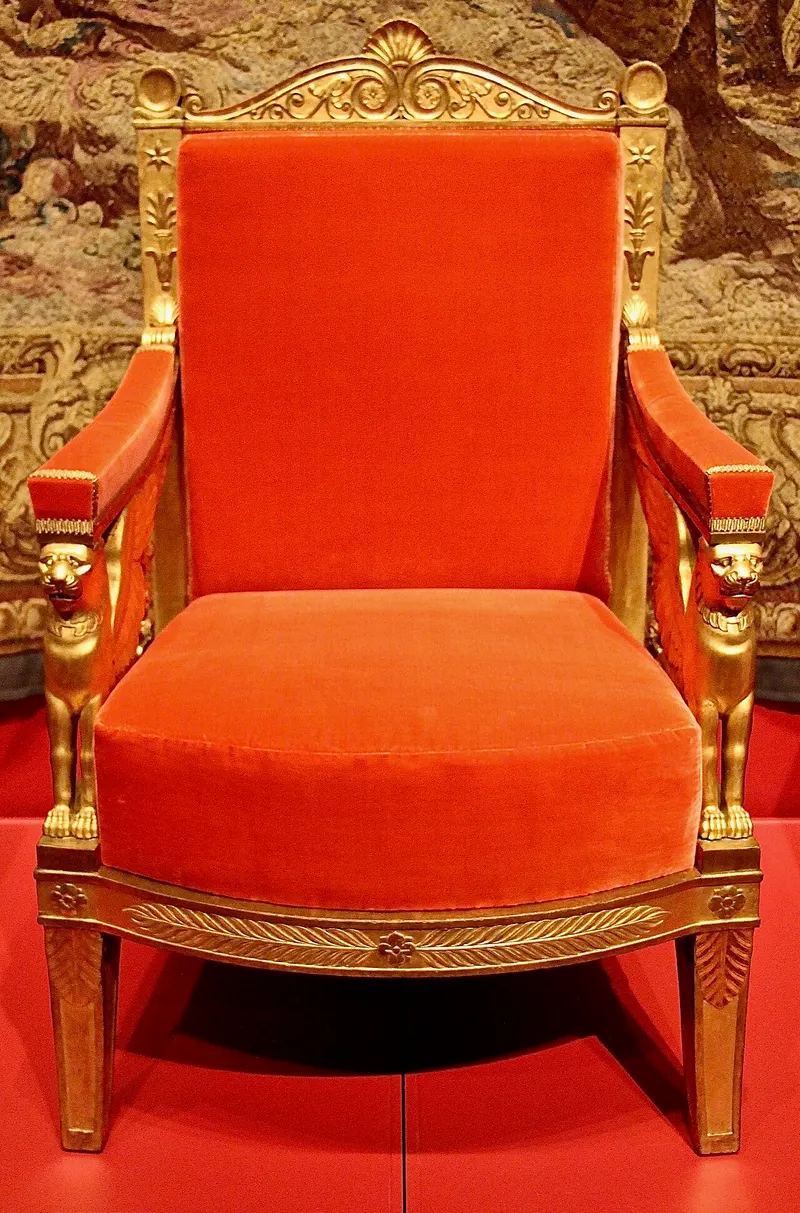
This output was produced on a large scale. As the Empire expanded, suites were ordered in Paris for new residences: those of the annexed departments, such as the Quirinal in Rome, then known as Monte Cavallo, or the palaces prepared for the Emperor's stays in the provinces. An armchair from the Monte Cavallo throne, dated to about 1810 and kept at the Mobilier national, bears witness to this effort. Empire furniture was therefore also an instrument of government: it put an unmistakable setting wherever one was needed.
Palaces, manufactories and goldsmiths
The Emperor's residences became the showcases of this taste. At the Tuileries, which Bonaparte occupied from 1800, at the Louvre, at Saint-Cloud, Compiègne, Fontainebleau, Versailles and Trianon, apartments were taken in hand, refurnished and redecorated. At Fontainebleau the throne room was fitted out in 1808 in the former bedchamber of the kings; taking over a place of monarchical memory was part of the message. Many rooms were designed for receiving guests: the etiquette of the imperial palace, laid down with great care, imposed a visible hierarchy in the placing of seats, the arrangement of the salons and the colour of the hangings.
The national manufactories joined the movement. The Sèvres manufactory, directed from 1800 by the scientist Alexandre Brongniart, produced services decorated with antique subjects, portraits, battles or views of Egypt; the Egyptian service, begun in 1810 from drawings by Denon, is one of its most remarkable achievements. Lyon silk, the tapestries of the Gobelins and the Savonnerie, crystal, bronzes and silverware all took part in the same effort.
The goldsmiths played a leading role. Martin-Guillaume Biennais, a goldsmith and cabinetmaker, was an appointed supplier to Napoleon; Jean-Baptiste-Claude Odiot, also a goldsmith, often worked with Thomire. The most famous piece is probably the cradle of the King of Rome, presented to Marie-Louise by the City of Paris for the birth of the heir in 1811. Designed by the painter Pierre-Paul Prud'hon and executed by Thomire and Odiot in silver-gilt and gilt bronze, it is now kept in Vienna.
Paris, imperial capital
Urban architecture extended the decorative programme. Napoleon wanted to make Paris a capital worthy of Rome, but his means were limited and colossal building sites were rare; many projects were left unfinished in 1814. What was achieved nonetheless marked the urban space for a long time.
The rue de Rivoli, opened from 1802 along the Tuileries and named after the victory of January 1797 in Italy, gave Percier and Fontaine the chance to create a new urban model: a straight street lined with uniform arcaded façades, making regularity a principle. This discipline, which was extended in the nineteenth century, inspired many other streets in Europe.
The monuments, for their part, celebrated victory. The Arc de Triomphe du Carrousel, decreed in 1806 and completed in 1808 by Percier and Fontaine, drew on the Arch of Constantine in Rome. Its columns are of pink marble and its bas-reliefs tell the story of the 1805 campaign, from Ulm to Pressburg. It was originally crowned by the horses of St Mark's, taken from Venice in 1797; they were returned to the city in 1815 and replaced in 1828 by the Quadriga of Peace, sculpted by François-Joseph Bosio. The Arc de Triomphe de l'Étoile, decided by a decree of February 1806 on a design by Jean-François Chalgrin, would not be finished until 1836. The column in the place Vendôme, raised from 1806 to 1810 by Jacques Gondouin and Jean-Baptiste Lepère on the model of Trajan's Column and clad in bronze cast from cannon captured from the enemy, carries at its summit a statue of Napoleon as a Roman emperor. Pulled down under the Commune in May 1871, it was raised again in 1875.
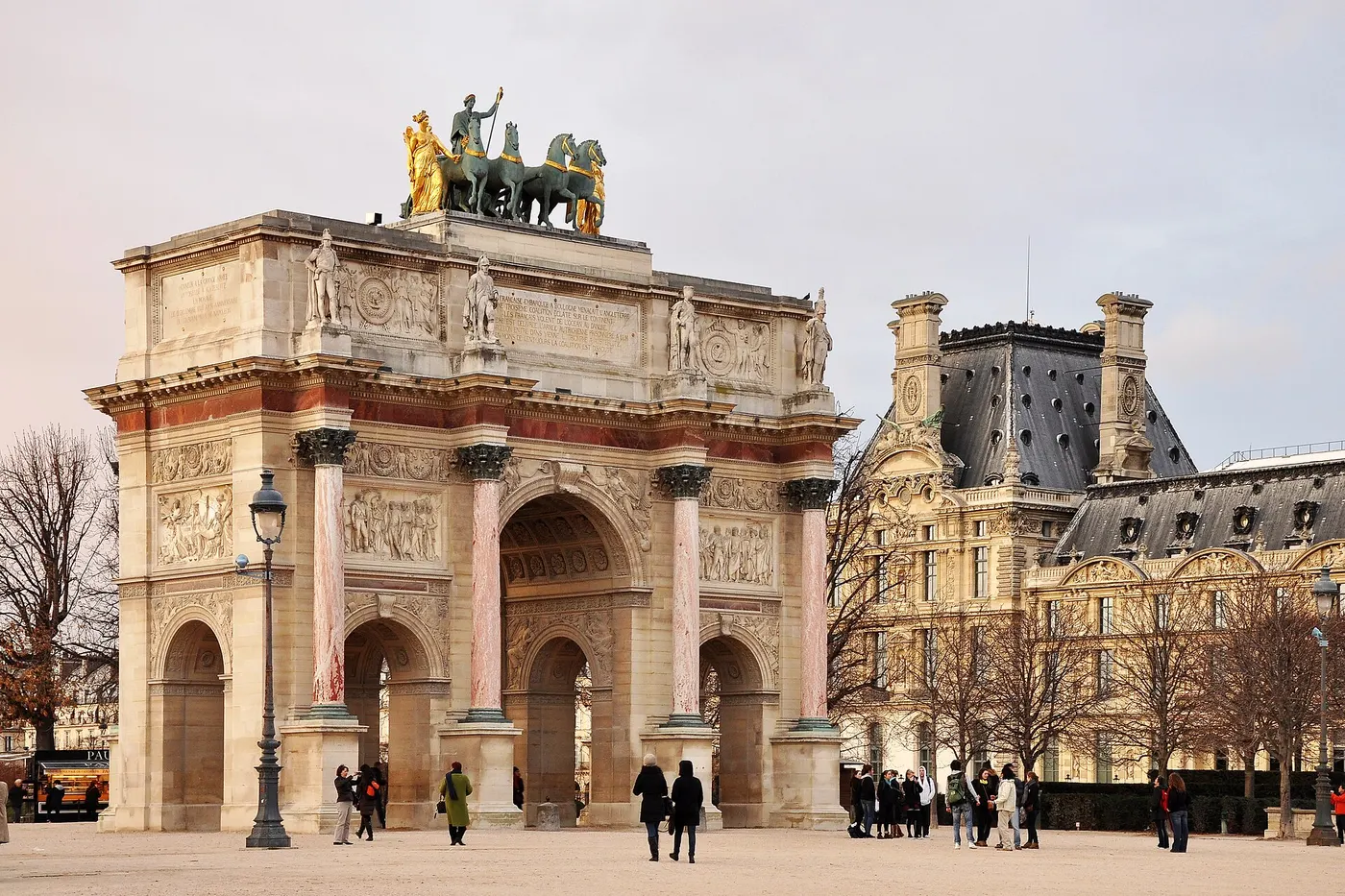
Other buildings followed the same logic. From 1806 the Madeleine was intended to become a "temple of Glory" in memory of the Grande Armée, to plans by Pierre Vignon; turned into a church under the Restoration, it was finished only well after the fall of the Empire. The Bourse, the work of Alexandre-Théodore Brongniart, was begun in 1808. The Pont d'Iéna, undertaken the same year, would not be completed until 1813. The antique face of Paris, with its porticoes and temples, was thus as much a programme as a reality.
Painting, dress and the art of ceremony
The same spirit animated the figurative arts. Jacques-Louis David, a former revolutionary, was named First Painter to the Emperor in December 1804 and signed the great canvases of the coronation. Antoine-Jean Gros, with The Plague-Stricken of Jaffa (1804) and then his great battle scenes, fixed the image of the leader on the field; François Gérard supplied the state portrait, and in 1806 Ingres painted a Napoleon I on the Imperial Throne of hieratic severity. The painter served power, but remained capable of invention: the contrast between the clarity of David and the sensuality of Girodet or Gros shows that official art was never entirely uniform.
Dress followed. The high-waisted gown, straight and flowing, inherited from Directory fashion, became the women's uniform of the Court. It was worn with a cashmere shawl, which Joséphine helped to make popular. For men, the rules of etiquette required the embroidered court coat in silk, intended to keep the workshops of Lyon and Paris busy. Designed by Jean-Baptiste Isabey, the costumes of the coronation fixed the image of a ceremonial that was at once Roman, Carolingian and modern.
It would be wrong to attribute this taste for grandeur to Napoleon alone: it owed a great deal to his architects, to Denon and to craftsmen who had learned their trade under the Ancien Régime. But the government understood, probably better than its immediate predecessors, what an image can do for the legitimacy of a regime born of war and a coup d'état.
Influence and legacy
The Empire style quickly crossed frontiers. Allied or subject courts adopted it, sometimes out of political imitation and sometimes out of sincere taste: at Naples under Murat, in southern Germany, in Russia under Alexander I, where Neoclassical architecture reached a particular scale in Saint Petersburg. The "Karl Johan style" in Sweden owes its name to Marshal Bernadotte, who became crown prince. Elsewhere the Biedermeier, the British Regency and the American Federal style, independent in their origins, answered the same classical inspiration with accents of their own.
The style outlived Napoleon's fall. Under the Restoration and the July Monarchy, people went on furnishing in mahogany and gilt bronze, even if the forms grew heavier and plainer. It declined with the rise of historicist styles and Romanticism, only to be reborn under the Second Empire, when Napoleon III brought back the memory of his uncle without really imitating him, since Empress Eugénie's taste inclined rather towards the eighteenth century.
Two centuries later, the Empire style remains one of the most recognisable in the history of the decorative arts. It keeps something of what it was: an official art, coherent and carefully designed, which sought to give a new regime the prestige of an ancient civilisation. One may see propaganda in it; one must also recognise the work of artisans and artists of the first rank, whose skill survives in the collections of the Mobilier national, Fontainebleau, Malmaison and many museums.
Further reading
- Charles Percier and Pierre-François-Léonard Fontaine, Recueil de décorations intérieures, Paris, 1801; enlarged edition, 1812.
- Dominique Vivant Denon, Voyage dans la Basse et la Haute Égypte pendant les campagnes du général Bonaparte, Paris, 1802.
- Jean-Philippe Garric, Percier et Fontaine. Les architectes de Napoléon, Belin, 2012.
- Denise Ledoux-Lebard, Le Mobilier français du XIXᵉ siècle (1795-1889). Dictionnaire des ébénistes et des menuisiers, Éditions de l'Amateur, 1989.