A prisoner who chose his judge
On 13 July 1815, off Rochefort, Napoleon wrote to the Prince Regent of England. He compared himself to Themistocles, the defeated Athenian who sought refuge with his enemy, and asked for the protection of British law. The next day he went aboard the Bellerophon, Captain Maitland's ship, convinced that he would be allowed to live as a private gentleman somewhere in England. He was wrong. The government in London, in agreement with the other three great powers of the coalition, had already resolved never again to risk a return like the one from Elba: what was needed was a place from which no one escaped.
The choice fell on Saint Helena, a volcanic speck in the South Atlantic, more than 1,800 kilometres from the nearest African coast. A convention signed in Paris on 2 August 1815 by Britain, Austria, Russia and Prussia entrusted the custody of the prisoner to Britain, while the other powers could send commissioners to the island. On 4 August, still aboard the Bellerophon, Napoleon drew up a solemn protest: he had placed himself under England's hospitality, he said, and had met only force. The Northumberland, under Admiral Cockburn, sailed four days later. The protest already foreshadowed the next six years: a man who had lost all power over events set about ruling over the account that would be given of them.
The ship dropped anchor off Jamestown on 15 October 1815. Napoleon was first lodged for a few weeks with the Balcombe family at The Briars, before moving on 10 December to Longwood, on a windswept and damp plateau. A handful of loyal followers had obtained permission to go with him: General Bertrand, Grand Marshal of the Palace, with his wife Fanny and their children; Count de Montholon and his wife Albine; General Gourgaud; and Count de Las Cases, accompanied by his son. The valet Louis Marchand and a few servants completed this small court, transplanted to the other side of the world.
Longwood: a court in exile
Life there was at first one of organised boredom. Napoleon rode as long as he was permitted to, played chess, had books read aloud, gardened now and then, and dictated. Longwood House, formerly the summer residence of the lieutenant-governor, was poorly insulated, battered by wind and overrun with rats, and the fog could linger for days. The state of the house and its furnishings would give the exiles, and later the writers who took up their cause, a constant argument about the harshness of the captivity.
Matters worsened in April 1816 with the arrival of the new governor, Sir Hudson Lowe. A meticulous officer, he had been instructed to prevent any escape. He multiplied the regulations: limits on where Napoleon could ride, a British officer to keep him in sight, inspection of his correspondence, restrictions on visitors. The two men first clashed over a point of protocol. For the British, the former emperor was merely "General Bonaparte"; he refused that title, which would have wiped out both his coronation and the recognition once granted to him by the sovereigns of Europe. He sometimes stayed shut indoors rather than appear under a name that was not his. Lowe, for his part, reported every incident to London, and the quarrel soon took on the character of a public trial, with each side appealing to European opinion.
The little society of Longwood was no more peaceful. The wives of Bertrand and Montholon, the lack of privacy, and jealousy over the emperor's attention fed tensions that Gourgaud's journal, published only in 1899, records with merciless frankness. Gourgaud left the island in 1818. The Irishman Barry O'Meara, a naval surgeon who had become Napoleon's physician, was dismissed in 1818 after disagreements with Lowe. In 1819 the Corsican doctor Francesco Antommarchi arrived, together with two priests, the abbés Buonavita and Vignali. Meanwhile, the emperor's health was slowly deteriorating.
Dictating for posterity
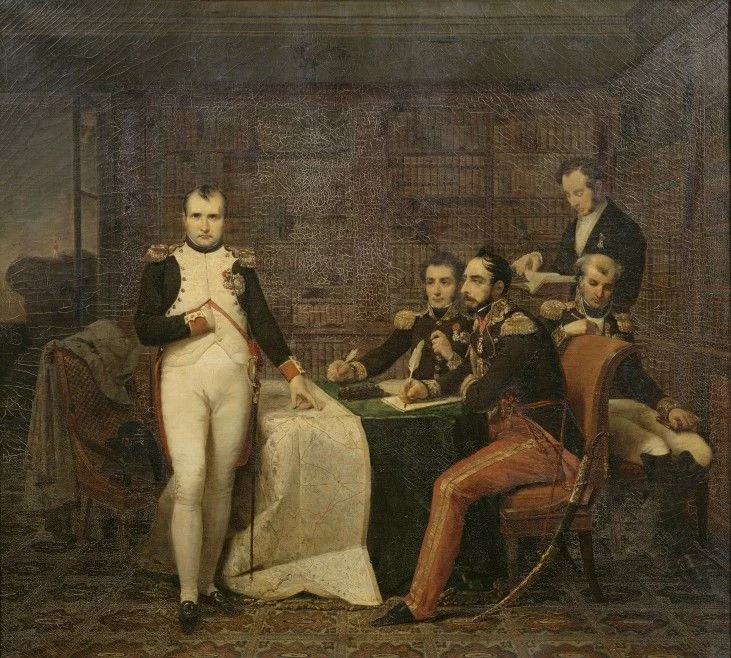
What Napoleon did most on Saint Helena was talk. From the voyage aboard the Northumberland and through the years at Longwood, he dictated to Las Cases, Montholon, Gourgaud and Bertrand an account of his campaigns and his government. He returned to Italy, to Egypt, to the 18 Brumaire, to the wars of Caesar and Turenne, and to the causes of his fall. He corrected, annotated and commented on the books that reached him from Europe, at times with great vehemence. Part of these dictations appeared after his death, in 1823, as the Mémoires pour servir à l'histoire de France sous Napoléon, écrits à Sainte-Hélène par les généraux qui ont partagé sa captivité.
None of this was a confession. Napoleon knew he was addressing a future audience, and he had long been in the habit of composing his own image: as early as the Italian campaign of 1796 he had had newspapers published for the army and for France, and his bulletins had then fixed, for fifteen years, the official version of every victory. On Saint Helena the method was the same, but the stakes had changed. He was no longer governing the present; he was trying to persuade the future. His wars became defensive wars forced on him by England; the Consulate and the Empire became the means of safeguarding the gains of the Revolution; despotism became a provisional dictatorship that peace would have allowed him to relax. In this version, the emperor had wanted to unite Europe on the basis of nationalities and liberal principles, and only the obstinacy of his enemies had prevented it.
These claims were not made out of thin air, and some of them contain a measure of truth. Napoleon did preserve, by codifying them, civil gains of 1789 such as equality before the law, freedom of conscience and the abolition of privileges of birth. But historians point out that the words come from a man reflecting after the fact, choosing his memories, and saying little about the police regime, censorship, the unending conscription or the restoration of slavery. What tradition would call the "legend" is not a tissue of lies: it is a skilfully selective narrative, built by the very man who was its hero.
Las Cases and the Mémorial
Of all the testimonies, the one that left the deepest mark was that of Emmanuel de Las Cases. A former naval officer who had emigrated, then rallied to the Empire and served as chamberlain and councillor of state, he followed Napoleon to Saint Helena with his son and, from 1815, kept a journal of their daily conversations. In it he set down the emperor's accounts of his career, his judgements of men, his childhood memories, and his thoughts on religion and politics. In November 1816, Lowe had him arrested after a clandestine letter was discovered; his papers were seized, and he was expelled from the island and held at the Cape before returning to Europe. His manuscripts were not given back to him until after Napoleon's death.
The Mémorial de Sainte-Hélène appeared in 1823 and was an enormous success, one that did not fade for decades. Much of the book's appeal lay in its form: neither continuous apology nor treatise of history, but a series of conversations in which the reader seems to hear the prisoner talking by the fireside, by turns grave, ironic and familiar. The reader meets a Napoleon weary of glory, attached to liberty, and the victim of the coalition and of English perfidy. This was the portrait that would take hold of the nineteenth-century imagination.
Yet the Mémorial has to be read with the usual caution. Las Cases wrote and reworked his journal; he published it at a time when the Restoration kept a close watch on this kind of literature; and he made no secret of his devotion to his master. Historians today see in it a valuable source for the exile's state of mind and for the way he wished to be seen, much more than a faithful record of events. Other witnesses, through their frankness or their hostility, help correct the picture: Gourgaud, often bitter; O'Meara, whose Napoleon in Exile; or, A Voice from St. Helena appeared in London in 1822 and was damning of Lowe; Antommarchi, whose Derniers moments de Napoléon came out in 1825; and, on the British side, the governor himself and his subordinates, who defended their conduct.
Death and the will
From 1820 Napoleon's health declined sharply. Stomach pains, vomiting, weight loss and fatigue kept him in his room more and more often. By the end of March 1821 he rarely left his bed. He wrote or dictated his last wishes between mid-April and early May. The will, dated 15 April 1821, declared that he died in the Catholic faith, named his executors, distributed bequests and keepsakes, and expressed his wish that his ashes should rest "on the banks of the Seine, among the French people whom I loved so much". It also asserted that he was dying a victim of the English oligarchy and of its envoy, that is, Lowe, an accusation that would be repeated again and again.
He died on 5 May 1821 at 5.49 in the evening, aged fifty-one. The autopsy, performed the next day by Antommarchi in the presence of British doctors, found a stomach ulcer that had turned cancerous, the illness of which his father Charles had died in 1785. This conclusion has been questioned several times since the twentieth century: the hypothesis of arsenic poisoning, put forward in 1961, has not withstood scrutiny by most specialists, who point instead to a gastric disease aggravated by the climate, inactivity and punishing treatments. Nothing proves a crime.
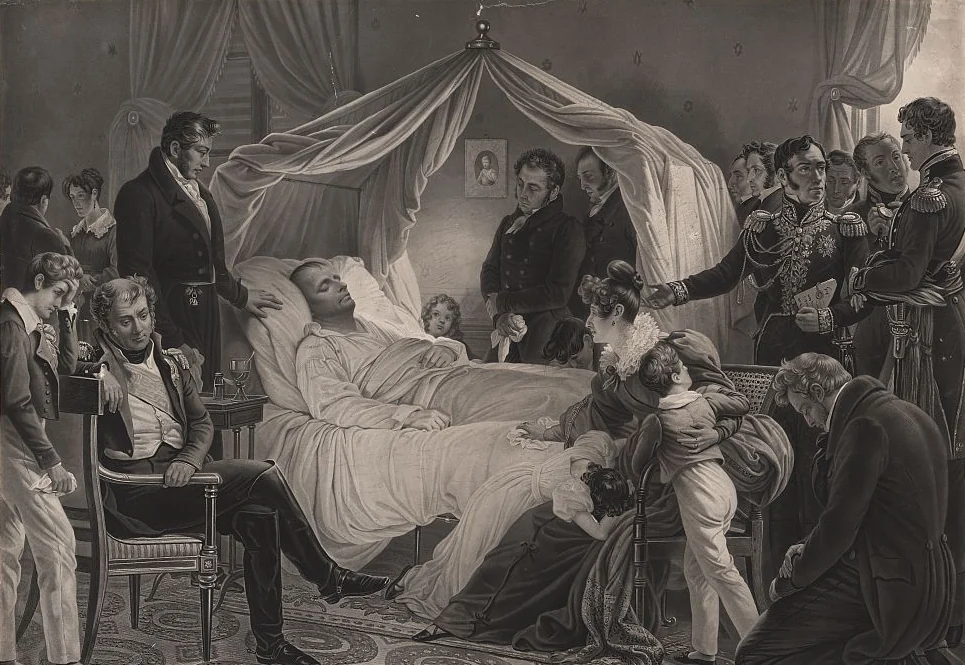
The burial took place on 9 May, with military honours rendered by the British garrison, in a small valley of the island that Napoleon had liked for its spring. Lowe refused the inscription that the emperor's companions wanted, simply "Napoleon", and insisted on the addition of "Bonaparte". The disagreement could not be resolved, and the slab remained anonymous.
The image restored under the Restoration
When news of the death reached Europe in the summer of 1821, it provoked no uprising. The Bourbons were back, Europe was tired of twenty-five years of war, and the news caused no visible political stir. But the memory of the Empire, rather than fading, was transformed. Half-pay officers, veterans and liberals disappointed by the restored monarchy found in Napoleon's name a way of voicing their discontent. The regime kept watch over them and banned seditious images, but could not stop songs, prints and almanacs from circulating.
Literature followed the movement. Béranger made the emperor a popular hero in Le Vieux Drapeau in 1820 and Les Souvenirs du peuple in 1828. Victor Hugo, at first a royalist, wrote the Ode à la colonne in 1827 and then Lui in Les Orientales (1829), and his drift towards the figure of the emperor mirrored that of a whole generation. Stendhal has Julien Sorel read the Mémorial in Le Rouge et le Noir (1830): the young man of ambition finds there a model of success founded on merit, at a time when birth and favour had regained their hold. Musset would later describe a youth born on tales of campaigns and condemned to a century without war or glory.
After the July Revolution of 1830, Louis-Philippe's monarchy in turn took over a memory that had not been hostile to it. In 1833 it had a statue of Napoleon, Seurre's "little corporal", set back on top of the Vendôme Column, where the Restoration had replaced it with a white flag. The Arc de Triomphe was inaugurated in 1836. The regime sought to win over opinion by reconciling the heirs of the Revolution with those of the Empire, and it discovered that there was no better way than to make the emperor a national hero, detached from every partisan quarrel.
The return of the ashes
It was in this spirit that the government led by Adolphe Thiers decided in 1840 to ask London for the return of the remains. The Minister of the Interior, Charles de Rémusat, announced it to the Chamber on 12 May 1840; a credit of one million francs was voted, and the British government agreed. The Prince de Joinville, the king's son, commanded the frigate La Belle Poule, which left Toulon in July and reached Saint Helena in October. The exhumation took place on 15 October 1840, exactly twenty-five years after Napoleon's arrival on the island. The coffin was handed over to the French with honours, then embarked for the long voyage home.
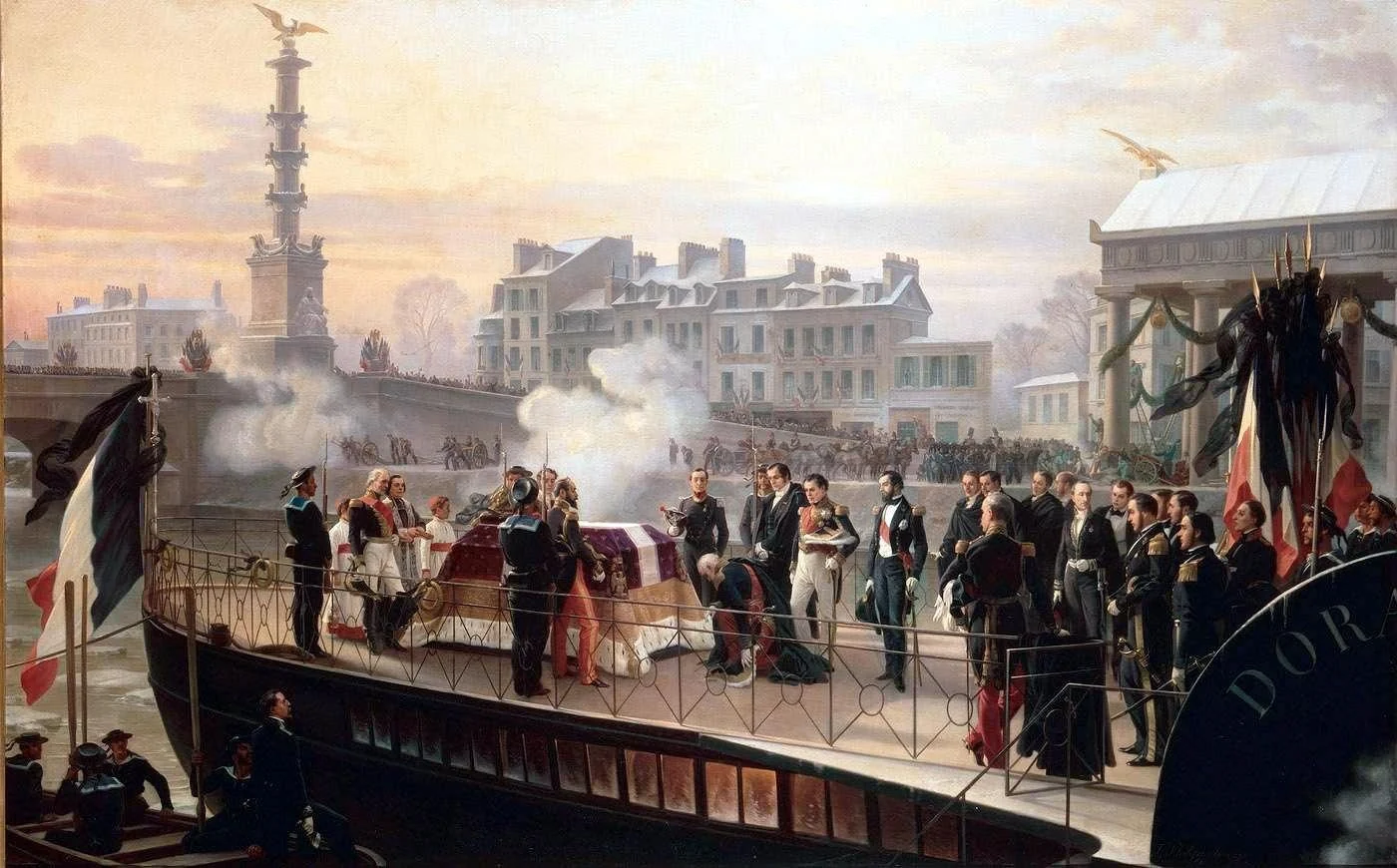
The frigate reached Cherbourg on 30 November. The remains were then taken up the Seine aboard a steamer, the Dorade, as far as Courbevoie. On 15 December 1840, in bitter cold, an immense procession crossed Paris from the Arc de Triomphe: the funeral car, drawn by sixteen horses, went down the Champs-Élysées, crossed the Place de la Concorde and reached the Invalides before a dense crowd. Louis-Philippe received the coffin at the entrance to the church. The king had hoped to profit from popular fervour; the ceremony mostly made more present a legend from which others would benefit.
The final tomb, designed by Louis Visconti, was not completed until 1861. The coffin therefore remained for more than twenty years in the Saint-Jérôme chapel before being moved to the crypt hollowed out beneath the dome, at the centre of a great quartzite sarcophagus. By then the emperor's memory was no longer a stake in opposition politics; it was a state heirloom.
From legend to power
The return of the ashes had an effect its organisers had not foreseen. In 1840 Louis-Napoleon Bonaparte, the emperor's nephew, had just tried once more to raise the garrison of Boulogne; in 1839 he had published the Idées napoléoniennes, which presented the Empire as a synthesis of order and progress. The prince drew on the immense fund of sentiment that had gathered around his uncle. On 10 December 1848 he was elected President of the Republic with more than 74 per cent of the vote, and the imperial legend, given shape by the Mémorial, contributed to that result more surely than any programme of his own. The Second Empire extended it: the Saint Helena Medal, created in 1857, was awarded to more than four hundred thousand survivors of the wars of 1792 to 1815, and in 1858 France acquired the island's Longwood house and the valley of the tomb.
The legend's success lay in the fact that it answered several expectations at once. For some, Napoleon was the heir of the Revolution, the soldier of liberty betrayed by the Europe of kings; for others, the restorer of order, religion and the state; for still others, the leader who had given France its greatest military glory. Everyone could find in it what they were looking for, and the prisoner of Saint Helena, the object of a kind of martyrdom, bore admiration more easily than the sovereign who had laid the burden of conscription on the country.
Legend, counter-legend and history
The Saint Helena narrative itself provoked a counter-legend. Liberal, then republican, critics recalled the wars, the censorship, Fouché's police, the victims in Spain and Russia. Hippolyte Taine, in Les Origines de la France contemporaine (from 1875), drew a harsh portrait of an Italian condottiere transplanted into power. Adolphe Thiers, conversely, devoted twenty volumes of his Histoire du Consulat et de l'Empire (1845-1862) to the epic, serving it with talent under a show of impartiality. Between these two poles, modern academic scholarship, from the school of Georges Lefebvre to Jean Tulard, author of Le Mythe de Napoléon (1971), and then to Thierry Lentz, has tried to separate the actor from his narratives.
The task calls for nuance. It is wrong to believe that everything Napoleon said on Saint Helena was a lie; it is just as wrong to treat it as a neutral source. The "liberal Napoleon" of the Mémorial sits uneasily with the regime of the prefects, the censorship of 1810 and conscription; but it also records what the emperor wished to leave behind, which was an image. Perhaps the most remarkable thing is that he succeeded. Defeated, banished, stripped of title, troops and throne, he won from posterity what power had not always given him: a lasting popular allegiance that still makes him, two centuries after his death, one of the most studied, debated and commemorated figures in French history.
Further reading
- Jean Tulard, Le Mythe de Napoléon, Armand Colin, 1971.
- Jean Tulard, Napoléon ou le mythe du sauveur, Fayard, 1977.
- Thierry Lentz, Nouvelle histoire du Premier Empire, Fayard, 2002-2010.
- Emmanuel de Las Cases, Le Mémorial de Sainte-Hélène, 1823.
- Barry E. O'Meara, Napoleon in Exile; or, A Voice from St. Helena, London, 1822.
- Gaspard Gourgaud, Journal de Sainte-Hélène, published in 1899.