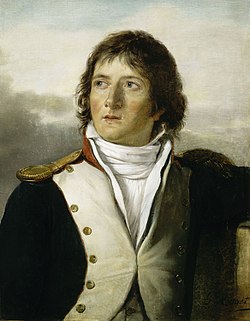
Laurent de Gouvion Saint-Cyr (1764-1830), count and Marshal of the Empire from 27 August 1812, embodies the Republican rise of the soldier without lineage who proved worth through battlefield geometry and infantry discipline. Tradition holds he was a natural child taken in at Toul and raised by a turner-craftsman; he added « de Saint-Cyr » from an estate name — a gesture old nobility mocked and he wore like other titles of glory. Under Bonaparte in Italy and Egypt he stood out for staff reports so dry they irritated the First Consul and fascinated Berthier; under the Empire Napoleon long denied him the baton, mistrusting any mind too argumentative in council. The siege of Barcelona (1808–1809) cost him months of trenches, typhus, and a military victory paid for by Catalan hostility; in Russia at Polotsk he checked Wittgenstein, was severely wounded, and was raised to the marshalate only after those trials — almost symbolic reparation. The 1814 campaign in France placed him again on the Rhine and the Marne; the marshals' refusal to ring Paris against Napoleon at Fontainebleau closed the imperial file without his claiming credit. Minister of War under Louis XVIII, he merged imperial and royalist cadres and published an infantry treatise that became standard; he did not rally to the Emperor in the Hundred Days and died in Paris on 17 March 1830, months before the July Revolution of that year. His name remains tied to the École spéciale militaire de Saint-Cyr by homonymy and by the ideal of the officer trained in method as much as courage — a recurring counterpoint to legend of dazzling genius alone. Recent scholarship crosses correspondence with Berthier, siege reports and Bourbon archives to reassess Barcelona and Polotsk; the Arc de Triomphe inscribes his name among the victors, inviting contrast between administrative trace and mediatised epic.
Toul, the Revolution, Italy, and the Army of the Orient
Laurent Gouvion was born at Toul in Lorraine on 13 April 1764. Family legend — a child left on church steps, taken in by a wood-turner who gave him his name — colours an ascent where military merit offset lack of aristocratic patronage. He enlisted, rose through NCO and officer ranks under the Old Regime and above all the Revolution, when fire at the front meant promotion: captain, adjutant-general, brigadier then divisional general according to victories and successive purges.
In Italy beside Bonaparte he stood out for holding difficult ground, rebuilding battered battalions, and reading terrain with almost geometric precision. His reports lacked courtiers' verbosity; they sometimes irritated the future First Consul, who still dealt with a collaborator who could turn vague orders into workable dispositions. The Egyptian expedition saw him organise marches, supplies and fighting against the Mamluks: a reputation as inflexible realist in a theatre where oriental mirage poorly hid logistical constraints.
Bonaparte's return in 1799 placed him near nascent power without granting intimate status on 18 Brumaire. Gouvion watched the coup with a corps general's distance: republican stability mattered more than the chief's name, provided the army kept cohesion and hierarchy. That reserve, readable as professional loyalty or political coldness, would long mark his relationship with the Empire.
Under the Consulate he notably commanded on the Rhine and in Switzerland, took part in manoeuvres that prepared Hohenlinden and consolidated his image as tactician able to coordinate several divisions on a wide front. Bulletins celebrated Davout, Masséna or Lannes; Gouvion piled up thankless tasks — cover, orderly withdrawal, liaison between corps — that military chronicle did not always headline.
When the Empire proclaimed its marshals in 1804, his name was among the great omitted: a recognised general, he did not receive the baton. The humiliation was relative — he kept prestigious commands — but the signal was clear: Napoleon reserved the highest dignity for those whose soul as well as sword he believed he held.
Rhenish and Italian campaigns of the mid-1800s finished forging his reputation as organiser: bridges, convoys, junctions between corps — all that Berthier's tables name without always citing field executors.
Catalonia, Barcelona, and the Price of an Imperial Siege
From 1808 the Peninsular War imposed another scale of violence on the French army: partisans, broken supply lines, hostile populations. Gouvion Saint-Cyr, already divisional then corps general, received responsibilities in Catalonia. This was no longer set-piece battle on the Central European plain: it was positional war around fortresses, artillery against modernised medieval walls, typhus in the parallels.
The siege of Barcelona became the central trial: months of approaches, counter-mines, bombardments, failed negotiations. Gouvion imposed sapping and fire discipline that finally broke resistance — a technical victory paid for by Catalan memory hardened against the occupier. The Emperor, absorbed in other theatres, read dispatches impatiently: why so much time and loss for one city? The general's logistics tables answered a court that preferred one-line bulletins.
Rivalries with other marshals or generals — Soult was not far on the peninsular map — complicated coordination already infernal between Madrid, Paris and corps commanders. Gouvion was neither sole author of Iberian misfortune nor a mere executor: he embodied the imperial machine when it met a society that refused the exported administrative model.
On return, laurels were mixed: honours, promotions, county, but not the long-coveted baton. Paris military opinion muttered about slowness; trench veterans knew what each metre under rampart fire cost. Gouvion kept the gunner's dry tone: facts, losses, ammunition, siege days.
For modern historiography this campaign fixes the contrast between tactical effectiveness and political cost: the Empire could take a regional capital and lose a battle of opinion feeding insurrection to Vitoria and beyond.
Polotsk, Wittgenstein, and the Baton of 27 August 1812
In 1812 the Grand Army crossed the Niemen; Gouvion Saint-Cyr commanded VI Corps on the northern flank of the advance, facing General Wittgenstein's Russian corps. His mission: stop Baltic Russians joining the main army opposing Napoleon after Borodino. This was not the dazzling centre of 7 September; it was the wing that, if it gave way, left the imperial scheme vulnerable for hundreds of kilometres.
The fighting at Polotsk in August and again in October after Gouvion was replaced by Oudinot then returned despite his wounds illustrated Russian attrition war: woods, marshes, sudden counter-attacks. The first clash earned Gouvion a severe wound; the second exhausted both sides. The Emperor, informed of results, finally conferred the title Marshal of the Empire on 27 August 1812 — a symbolic date that also marked belated recognition of a man whose record had justified the baton for years, many observers thought.
The wound kept Gouvion from the catastrophic retreat after Moscow's occupation; he thus missed the Berezina in the field, not in collective memory: his corps had held a sector of the front without which the map of 1812 would have been worse. Imperial bulletins stayed discreet on these flanks; corps archives, more talkative, show orders to hold forest crossings and minor rivers at all costs as strategic as the Berezina became in imagination.
Marshals of the « last hour » — raised after Russian losses — carry later stigma: sometimes pictured as fill-in promotions. Gouvion had commanded whole armies before 1812; his appointment looked as much like reparation as imperial need for credible figures to rebuild the staff.
For the reader, Polotsk recalls that the Russian campaign was not summed up in one day near Moscow: it was a succession of peripheral fights where overlooked generals bought days for the disintegrating army.
1814 — Defence of French Soil, Marshals, and Bourbon Ministry
In January 1814 the Coalition crossed the Rhine; the Empire tottered. Gouvion Saint-Cyr, ill and worn by years of sieges, still took critical posts on the eastern front or approaches to Champagne. This was no longer lightning offensive: it was defence of national soil, river by river, wood by wood, with exhausted numbers and a reduced Imperial Guard.
His name appears in the confused series of fights before Paris fell: Saint-Dizier, Bar-sur-Aube, manoeuvres to delay superior masses. Bourbon memorialists later stressed a « sense of monarchy »; Bonapartists saw suspicious prudence. Reality lay in the military verdict: the game was played, and prolonging bloodshed without strategic prospect was crime as much as courage.
When marshals refused to ring Paris to give battle to Napoleon entrenched at Fontainebleau, political logic joined tired generals. Abdication was not Gouvion's personal triumph; it was the end of a world he had served without worshipping the master. Under Louis XVIII he accepted the Ministry of War: merge Napoleonic and royalist cadres, reorganise budgets and garrisons, calm corps still marked by the imperial epic.
The infantry treatise — method, battalion training, line and skirmisher tactics — became the reference manual for decades. The Revolutionary officer became silent legislator of the nineteenth-century army. Court polemics passed; pages generations of sub-lieutenants would annotate in schools remained.
This civil phase finished defining Gouvion as figure of state as much as battlefield: less visible than on a parade horse, more durable in structures.
Ordinances signed between 1815 and 1819 dealt with regiment mergers, battalion corps size and preserving artillery and engineer know-how inherited from imperial campaigns: a Restoration trying to absorb Napoleonic heritage without breaking the technical machinery of changing European armies.
Hundred Days, Death in 1830, and Doctrinal Posterity
In 1815 Gouvion Saint-Cyr did not follow the Emperor back from Elba. This was no spectacular defection: it was refusal of a second gamble after a collapse already lived through. He kept apart, preserved already fragile health, watched the Coalition close the trap at Waterloo. The Bourbons returned; he resumed honorary duties without returning to operations' forefront.
He died in Paris on 17 March 1830 in the same year as the July Revolution he would not see: Louis Philippe would mount a throne built on barricades while the marshal already lay in the cemetery. An almost symbolic close for a man who had passed through Revolution, Empire and two restorations. Funerals mixed old grognards and Bourbon officers: the career summed a French army in permanent transition.
Modern historians class him among marshals whose baton only partly reflected real worth — late promotion, imperial slights, career split between secondary glories and structural tasks. His life poses the relation between a war leader's personal genius and subordinates who argue: how far can authority exclude without harming effectiveness? Gouvion embodies the pessimistic Napoleonic answer: far, and at the cost of delaying merited recognition.
Beyond manuals, his posterity passes through homonymy with the École spéciale militaire de Saint-Cyr — founded under the Empire, developed in the following century — which French culture links to the ideal of the trained officer. Direct genealogical tie is not the rule; the symbol binds discipline, study and national service.
For Empire Napoléon, Gouvion Saint-Cyr remains a useful counterpoint to the gilded legend: proof the imperial epic was also fatigue, siege, staff paperwork — and the tenacity of those who held forgotten sectors of the front when the eagles lost their shine.
Discover other characters
Napoleon Bonaparte
Emperor of the French
Louis-Nicolas Davout
Marshal of the Empire, Prince of Eckmühl
Jean-de-Dieu Soult
Marshal of the Empire, Duke of Dalmatia
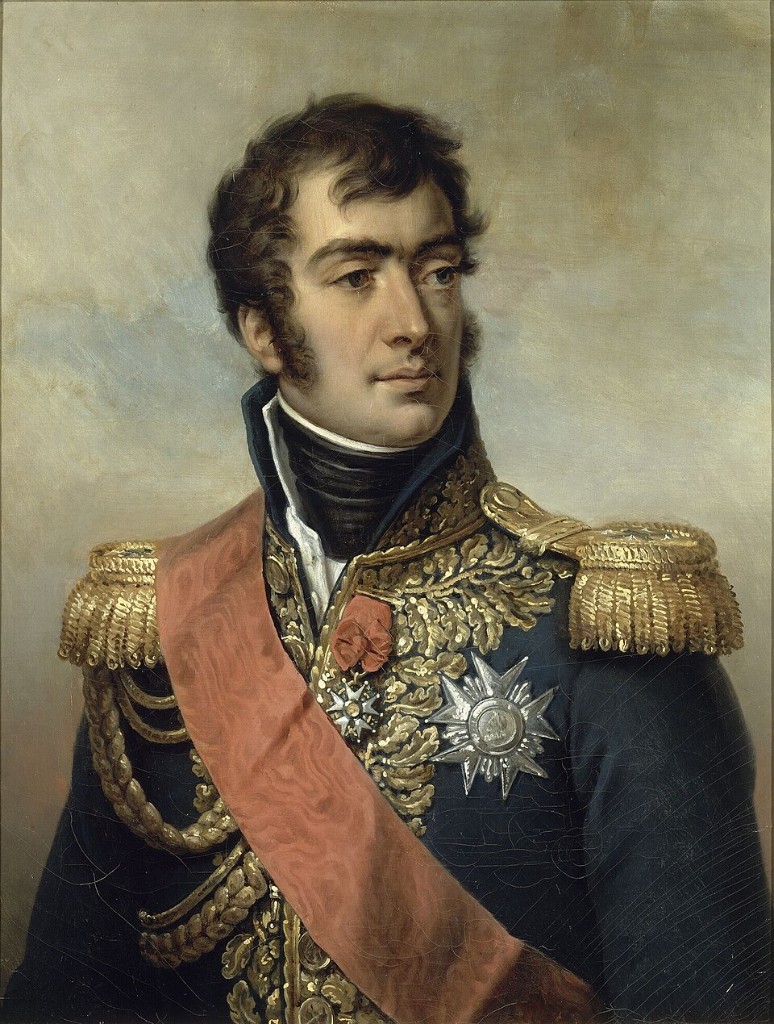
Auguste de Marmont
Marshal of the Empire, Duke of Ragusa
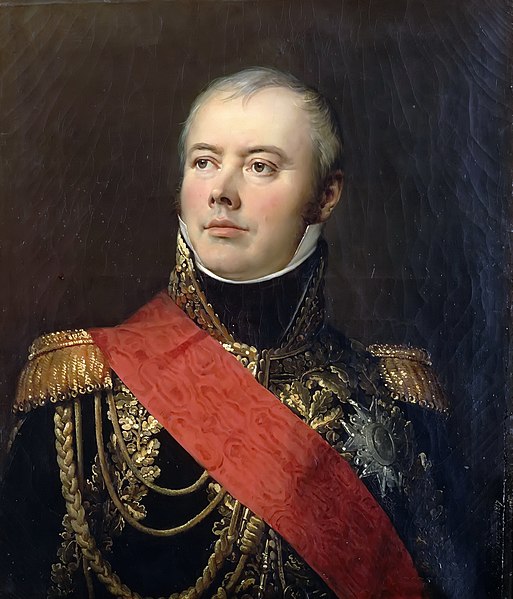
Jacques Macdonald
Marshal of the Empire, Duke of Taranto
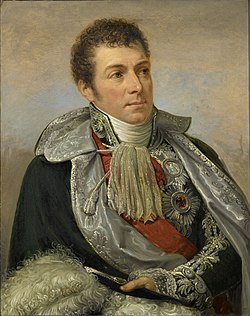
Louis-Alexandre Berthier
Marshal of the Empire, Prince of Neuchâtel and of Wagram, major-general of the Grande Armée (1805–1814)
Go further
Recommended books to dig deeper (affiliate links)
Napoleon the Great
Andrew Roberts · 2014
A monumental biography drawing on Napoleon’s 33,000 surviving letters, admiring but rigorous.
See on Amazon
Napoléon ou le mythe du sauveur
Jean Tulard · 1977
The book that reshaped how the man is read: how France gave itself a saviour, and what it cost.
See on Amazon
Nouvelle histoire du Premier Empire
Thierry Lentz · 2002-2010
Four reference volumes on institutions, diplomacy and collapse: the scholarly synthesis of the subject.
See on AmazonAs an Amazon Associate, this site earns from qualifying purchases.
Support the encyclopedia
Napoleon Empire is an independent project. Your contribution helps grow the content and keep the site running.
DonateSecure payment on the platform you choose.