From 15 to 17 November 1796, in the marshes of the Adige, Bonaparte tried to turn Alvinczy's Austrian army, which was threatening Verona. Three days of bitter fighting on narrow dykes around the bridge of Arcole finally forced the Austrians to retreat; the image of Bonaparte on the dyke, flag in hand, entered legend at once.
Forces at play
Outcome: French victory

French Republic
- Bonaparte
- Augereau
- Masséna
18,000 to 19,000 men according to the sources
Casualties: About 3,500 killed and wounded and 1,300 prisoners or missing

Austria
- Alvinczy
- Mittrowsky
- Provera
23,000 to 24,000 men according to the sources
Casualties: About 2,200 killed and wounded, 4,000 prisoners and 11 guns
Battle coordinates
Bridge of Arcole
Coordinates 45.3600° N · 11.2900° E
Battle narrative
The third relief of Mantua
In the autumn of 1796 Mantua was still besieged by the Army of Italy. Field Marshal Wurmser, beaten at Bassano in September, had shut himself up there with his troops; hunger and disease were ravaging the garrison. To relieve him, Emperor Francis II gave a new army to Feldzeugmeister Alvinczy, who planned a two-pronged offensive: he himself would march on Verona from Friuli with Quosdanovich's corps, some 26,000 men, while Davidovich came down from the Tyrol through the Adige valley with about 19,500. If the two columns joined and Wurmser broke out of Mantua, the French position would become untenable.
The campaign began badly for Bonaparte. On 6 November he failed to force the crossing of the Brenta at Bassano. In the north, Davidovich beat Vaubois at Calliano and drove him back towards Rivoli. Finally, on 12 November, in a sleet storm, Masséna and Augereau failed before the heights of Caldiero, close to Verona. The Austrians were almost at the gates of the city.
The manoeuvre of Ronco
Bonaparte now had only about 18,000 men against Alvinczy's 23,000 or so: he left 3,000 men in Verona, Vaubois was holding Davidovich with about 8,000, and the blockade of Mantua tied down more than 6,000. Rather than fight a third frontal battle, he decided to turn the enemy. By forced marches, Masséna and Augereau went down the Adige to Ronco, behind the Austrian left flank. From there, by moving north, the army could cut Alvinczy's line of retreat and seize his trains and artillery park.
Beyond the river the ground was impassable marsh. Movement was possible only along the dykes of the Adige and those of the Alpone, a small tributary about twenty metres wide. From Ronco a causeway followed the dyke for about 2.5 kilometres to a bridge; the village of Arcole lay on the far bank. Another dyke led north-west towards Belfiore and Caldiero. On these narrow embankments the Austrians' numerical superiority counted for little; but a column that ventured onto them could not deploy.
15 November: the bridge and the flag
At dawn, Chef de brigade Andréossy's engineers had a pontoon bridge in place at Ronco. Augereau crossed first and marched on Arcole; Masséna followed and took the Belfiore dyke to cover the left flank. Arcole was held by only two battalions and two guns of Colonel Brigido, but their fire threw back General Bon's leading demi-brigade, and the French had to take shelter behind the causeway. Augereau committed his brigades one after another; around midday Austrian reinforcements under Mittrowsky arrived. Generals Bon, Verdier, Verne and Lannes were wounded, and the attack stalled. On the other dyke, Masséna threw back the brigades sent to seize the pontoon bridge.
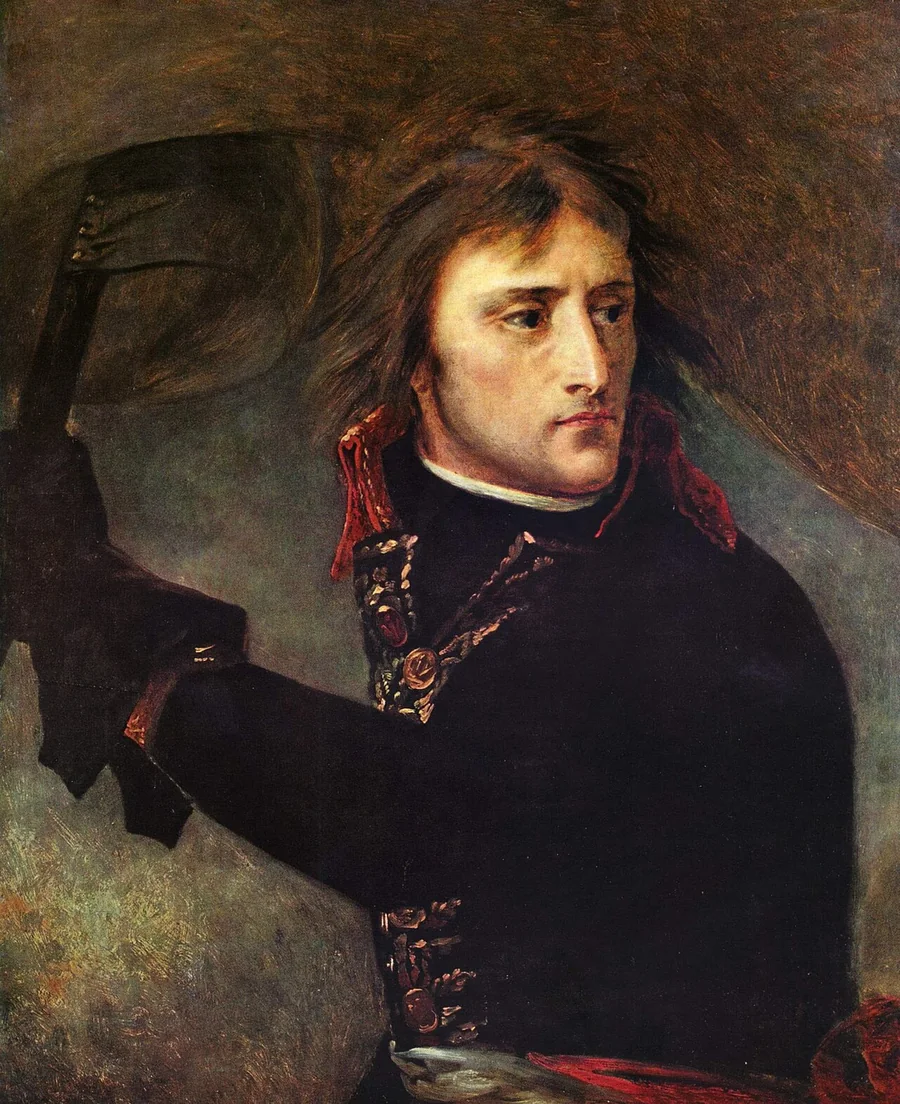
This is where the most famous episode of the battle belongs. Augereau is said to have already seized a flag without managing to carry his soldiers with him. Bonaparte took one in turn and stepped out into the open on the dyke, some fifty paces from the bridge. "The soldiers see him and not one of them follows him," wrote his aide-de-camp Sułkowski. Several members of his staff were hit; his aide-de-camp Muiron was killed at his side. In the confusion Bonaparte was dragged out of the line of fire and fell into a muddy ditch, from which he was pulled out. He had not crossed the bridge.
In the evening, Guieu's brigade, which had crossed by boat at Albaredo downstream, finally drove the Austrians out of Arcole. But at midnight, fearing that Davidovich would fall on his rear, Bonaparte had the village evacuated and brought most of his troops back to the right bank of the Adige, leaving only a garrison to hold the bridgehead.
16 November: deadlock
On the second day Alvinczy went over to the attack: Provera advanced from Belfiore and Mittrowsky, reinforced to fourteen battalions, came down from Arcole towards the bridgehead. Masséna beat Provera; the Austrian general Brabeck was killed and his troops were driven back to Belfiore with the loss of five guns. Augereau and Mittrowsky fought over the dyke all morning, then the Austrians fell back on Arcole, where Mittrowsky had posted his battalions on both dykes and in the village. Every French attack that day failed, as did the attempts to cross at Albaredo and at the mouth of the Alpone. According to tradition, it was on this day that the young drummer André Estienne threw himself into the water under fire with Sub-lieutenant Ramaud; it earned him fame as the "drummer of Arcole".
17 November: Arcole taken
During the night the French pontoneers built a bridge over the Alpone near its mouth. In the morning Augereau crossed to the left bank and fought his way up the eastern dyke, while Robert's brigade, from Masséna's division, attacked along the western dyke. Masséna beat Provera again before Belfiore early in the afternoon. But at about 3 p.m. a strong Austrian column burst out of Arcole and drove back Robert's troops; seeing this, Augereau's men gave way in turn and, by about 4 p.m., recrossed the Alpone.
The day seemed lost when Masséna came back from the left wing with reinforcements: he surprised the Austrians on the western dyke and threw them back towards Arcole. Augereau recrossed the Alpone, and at about 5 p.m. the village was finally taken. At the same moment, according to the accounts, a lieutenant and twenty-five Guides, who had slipped into the Austrian rear, sounded several trumpets to give the impression that a large force was arriving. Alvinczy committed Schübirz's brigade to hold off the French push towards the highway and let Provera escape to the east.
Outcome
The French lost about 3,500 killed and wounded and 1,300 prisoners or missing. The Austrians had only about 2,200 killed and wounded, but left 4,000 prisoners and eleven guns behind. General Robert was mortally wounded. Arcole did not end the campaign: on 17 November Davidovich routed Vaubois before Rivoli. Rid of Alvinczy for the time being, Bonaparte turned on Davidovich and drove him back up the Adige valley. Alvinczy, who had returned as far as Caldiero, learned of this defeat and retreated in his turn on 23 November. The same day Wurmser attempted a sortie from Mantua, too late. The third relief attempt had failed, by a narrow margin.
In his report to the Directory, Bonaparte summed up the first day: "It was in vain that the generals, feeling the full importance of time, threw themselves at the head to force our columns across the little bridge of Arcole: too much courage did harm: they were almost all wounded."
Birth of a legend
The flag and the dyke of Arcole very quickly became an image. Antoine-Jean Gros, then in Italy, obtained a few sittings in Milan, thanks to Joséphine it is said, and as early as 1796 painted Bonaparte with the flag in his hand; the painting, shown at the Salon of 1801, was widely reproduced in engravings. The flag itself, sent to the Directory, is said to have been presented to Bonaparte by the Legislative Body in 1798, and Bonaparte is said to have given it to Lannes. In 1799 he returned from Egypt aboard the frigate Muiron, named after the aide-de-camp killed at his side. Arcole is often seen as the beginning of the Napoleonic legend.
Go further
Recommended books to dig deeper (affiliate links)

Napoleon the Great
Andrew Roberts · 2014
A monumental biography drawing on Napoleon’s 33,000 surviving letters, admiring but rigorous.
See on Amazon
Napoléon ou le mythe du sauveur
Jean Tulard · 1977
The book that reshaped how the man is read: how France gave itself a saviour, and what it cost.
See on Amazon
Nouvelle histoire du Premier Empire
Thierry Lentz · 2002-2010
Four reference volumes on institutions, diplomacy and collapse: the scholarly synthesis of the subject.
See on AmazonAs an Amazon Associate, this site earns from qualifying purchases.
Support the encyclopedia
Napoleon Empire is an independent project. Your contribution helps grow the content and keep the site running.
DonateSecure payment on the platform you choose.