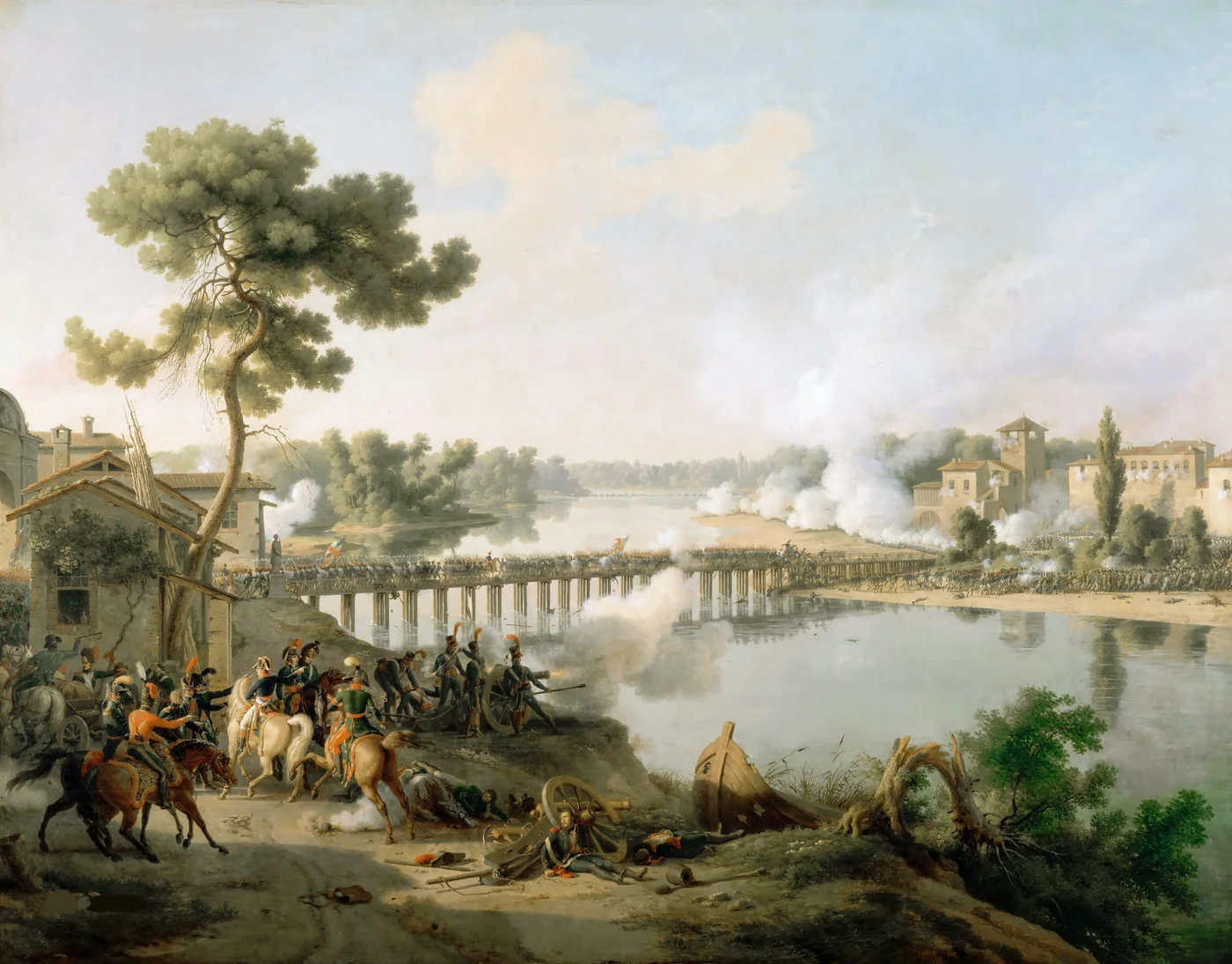
On 10 May 1796 the Army of Italy forced the crossing of the Adda at Lodi: under grapeshot, a column of grenadiers and carabiniers, driven on by Masséna, Berthier and Lannes, stormed a wooden bridge some 200 metres long. The Austrian rearguard escaped and the action decided nothing, but Lodi at once entered Bonaparte's legend.
Forces at play
Outcome: French victory

French Republic
- Bonaparte
- Masséna
- Berthier
- Lannes
- Beaumont
15,500 infantry and 2,000 cavalry, arriving gradually
Casualties: 350 to 900 men according to the sources

Austria
- Sebottendorf
- Vukassovich
6,500 to 10,000 men according to the sources, 14 guns
Casualties: About 2,000 men, mostly prisoners, and 14 to 16 guns
Battle coordinates
Bridge of Lodi
Coordinates 45.3140° N · 9.5030° E
Battle narrative
The lightning spring of 1796
Appointed to command the Army of Italy, General Bonaparte astonished Europe in the very first weeks of his campaign. In April 1796 he separated the Austrian and Piedmontese armies at Montenotte and Mondovì and forced the Kingdom of Sardinia to sign the armistice of Cherasco on 28 April. He then outwitted the Austrian general Beaulieu by crossing the Po at Piacenza, while Beaulieu was waiting for him some 80 kilometres upstream, at Valenza.
Beaulieu managed to avoid being cut off, but he had to abandon Milan and fall back behind the Adda. Bonaparte followed the river and reached Lodi, where an Austrian rearguard still held the bridge.
A bridge over the Adda
Lodi stands on the right bank of the Adda. The bridge, wooden and without a parapet, some 200 metres long, was the only crossing in the sector. On the far bank General Sebottendorf had orders to hold for twenty-four hours, then withdraw by night towards Crema. He had nine battalions drawn up in two lines — three battalions of Croats at the end of the bridge, the others about a hundred paces behind — and fourteen guns sweeping the bridge; his cavalry, Austrian and Neapolitan, waited a little further off at Fontana, and three battalions guarded another crossing downstream at Corte Palasio. The figures vary with the source: some 6,500 men according to some, nearly 10,000 according to others, worn out by a forced march. Against them Bonaparte fielded about 15,500 infantry and 2,000 cavalry, who arrived gradually.
The morning: advance guard and guns
At about 9 a.m. on 10 May 1796 the French advance guard caught the Austrian rearguard and followed it to Lodi. The town's defences were weak, and the French got in and reached the bridge. Bonaparte at once had guns placed to fire along the bridge to stop the Austrians destroying it: according to the grenadier François Vigo-Roussillon, enemy soldiers were already at work on it.
With the advance guard too weak to attempt the crossing, several hours passed while reinforcements came up. In the afternoon, as Masséna's troops arrived, a battery of twenty-eight guns was assembled at the foot of the walls facing the bridge and began a violent artillery duel; the Austrian guns, standing in the open, had to pull back. It was later told that Bonaparte had laid some of the guns himself and that his soldiers then nicknamed him "the little corporal"; no contemporary evidence supports this anecdote.
Storming the bridge
At about 6 p.m. Bonaparte decided to carry the bridge by force. While Beaumont's cavalry looked for a ford upstream, a close column of grenadiers and carabiniers, massed behind the walls, charged onto the bridge, the 2nd carabinier battalion leading. A blast of canister pinned it halfway; the column wavered and stopped. Several senior officers then rushed to its head — Masséna, Berthier, Lannes, Cervoni, Dallemagne — and drove it on.
Carabiniers climbed down the piles where the river was shallow and advanced through the water, firing as they went. The Austrians, exhausted, hungry, shaken by the cannonade and fearing to be outflanked by the French cavalry, gave way. Beaumont's cavalry, delayed by a harder ford than expected, arrived too late to cut off the retreat. Sebottendorf rallied his infantry at Fontana under the cover of his cavalry: the Hungarian hussars held up the French infantry for a while, and Neapolitan horsemen charged Augereau's division. Under cover of darkness the Austrians withdrew towards Crema in good order despite their losses; Colonel Count Attems was killed covering the retreat. The exhausted French infantry did not pursue.
The toll
French losses are estimated, depending on the source, at from at least 350 to 900 men. The Austrians lost about 2,000 men, most of them taken prisoner, and fourteen to sixteen pieces of artillery. The action was in no way decisive: the bulk of Beaulieu's army had escaped. But a few days later Bonaparte entered Milan, capital of Lombardy.
A legend in the making
Lodi holds a special place in the Napoleonic legend. The storming of a bridge swept by canister, carried by generals throwing themselves at the head of the column, struck people's imaginations; it is said to have convinced Bonaparte himself that he was superior to other generals and destined for great things. In 1798 Paris gave the battle's name to the rue du Pont-de-Lodi, in today's 6th arrondissement; Marseille has had its rue de Lodi since 1833.
Go further
Recommended books to dig deeper (affiliate links)

Napoleon the Great
Andrew Roberts · 2014
A monumental biography drawing on Napoleon’s 33,000 surviving letters, admiring but rigorous.
See on Amazon
Napoléon ou le mythe du sauveur
Jean Tulard · 1977
The book that reshaped how the man is read: how France gave itself a saviour, and what it cost.
See on Amazon
Nouvelle histoire du Premier Empire
Thierry Lentz · 2002-2010
Four reference volumes on institutions, diplomacy and collapse: the scholarly synthesis of the subject.
See on AmazonAs an Amazon Associate, this site earns from qualifying purchases.
Support the encyclopedia
Napoleon Empire is an independent project. Your contribution helps grow the content and keep the site running.
DonateSecure payment on the platform you choose.