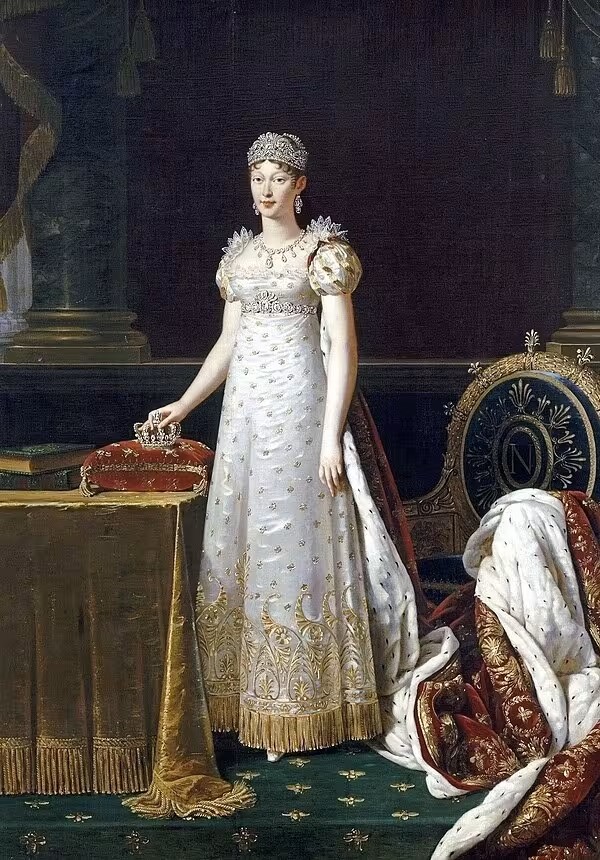
Born in Vienna under the shock of French victories, an archduchess raised for duty rather than salons, she embodied Habsburg raison d'état when Napoleon demanded an alliance after Wagram. From the "ogre" of her childhood nightmares to the wife of the crowned Emperor, she gave the Empire a male heir, assumed a façade regency, then slipped into shadow: Parma, Neipperg, political widowhood, a son dead at twenty-one. Reviled by Bonapartists, respected as a local sovereign, she remains Josephine's opposite by fate — the woman of the treaty, not of the love letters.
Schönbrunn Against the Ogre
Marie Louise was born on 12 December 1791 at the Hofburg palace, when Louis XVI's head had not yet fallen but the Revolution had already shattered the family compact. She was the daughter of Francis II — soon to be Emperor of Austria alone, once the Holy Roman Empire was dissolved — and Maria Theresa of Naples and Sicily. Her world was wool carpets, flawless French lessons, Haydn cantatas in the salons, and in the corridors the name Bonaparte spoken like a curse. No mangoes or Creole: a rigid, supervised German princess's childhood, where one learned to embroider before one learned to dream.
War bulletins structured her adolescence. Austerlitz, Jena, Wagram: each French victory was a humiliation carved into the family marble. She was told the Corsican usurper — son of an Ajaccio lawyer, Charles Bonaparte, dead before she was born — had cut the monarchy's throat and held Europe in thrall. She had never seen Joséphine, but she inherited a collective fantasy: France was a nation of fairies and traitors, and the Emperor a demon in green uniform. Yet her young woman's correspondence — what the archives let slip — betrays less hatred than anxiety: the duty of an archduchess who knows that one day, perhaps, her name will be bargaining coin.
In 1808, marriage to Archduke Anton was discussed; the project faded. What did not fade was war. After Wagram and the Treaty of Schönbrunn, Napoleon demanded what chancelleries no longer dared refuse: an archduchess to seal peace and replace the repudiated Empress. Metternich, cold calculator, saw an ambassador in title in Paris. Archduchess Sophie raged; Francis I decided. Marie Louise was told the news without veil. She answered what was expected: « I shall obey my father. » Another phrase, carried by rumour — « I marry France, not the man » — sums up the absolute distance from Joséphine: no prior passion, no Luxembourg salon; a peace treaty signed by an eighteen-year-old woman who never chose her century.
The Journey to a Foreign Court
On 11 March 1810, at Vienna's Church of the Augustinians, Marie Louise was symbolically wed to the absent Emperor by proxy. Who stood for Napoleon? Archduke Charles — the very man who had inflicted on Aspern the master's only major battlefield defeat — supreme irony: the Austrian victor swore for the French victor. The next day, carriages rolled west: Braunau, Munich, an Austria closing behind her like a curtain.
The road was an apprenticeship. She discovered imperial highways, relays, crowds at city gates. Parisian newspapers embroidered: the archduchess was cold, timid, a prisoner of her rank. At Soissons on 27 March, the meeting protocol forbade took place: Napoleon, unable to wait for Compiègne, had her carriage stopped, climbed in, looked her in the face. Memorialists revelled — the Emperor in love, the terrified wife discovering a man of flesh. She noted later, in simple terms: he did not have the eyes of the monster she had been shown.
On 2 April, at the Louvre, the Salon Carré became a chapel. She was pale, stiff, a stranger in the purple courtiers maliciously compared to Joséphine's gowns — less mystery, more Habsburg modesty. Napoleon showered her with attention: theatre at Compiègne, diamonds, walks. She wrote to her father with the regularity of a supervised boarder; she learned court French, not the French of battles. The first weeks were mutual training: he wanted a consort, she sought where to lodge her conscience. Gradually fear thinned; what remained was perhaps not the love of the Italian letters, but honest affection, tinged with gratitude — and the weight of a womb that must answer the Empire.
The King of Rome and the Imperial Couple
On 20 March 1811, at the Tuileries, after twelve hours of labour the doctors feared might kill her, the child Europe awaited was born: a son. Napoleon waited in the next room, unable to read a dispatch; when the sex was announced, he entered, kissed the child, then her — the gesture was public, almost theatrical. The next day, the title King of Rome rang out as a challenge to the Bourbons and a reminder of the Holy Empire: not merely a baby, but proof the dynasty could survive beyond military victories. Twenty-two cannon shots from the Invalides, Te Deums, festivities until courtiers dropped: Marie Louise had fulfilled the heaviest contract — the one Josephine, for all the Emperor's love, could not honour.
Official portraits multiplied the family against columns: she held the child, discreet smile, lowered gaze. Daily life was less idyllic: early rising, wet nurses, doctors' rounds, ministers bowing before the cradle as before a throne. Napoleon, between campaigns, played the attentive father; his letters from Spain or Russian forward posts mingled tenderness and strategy — he asked for news of the little one, Paris weather, the court. She replied in the register of the dutiful wife, sometimes with warmth that surprised secretaries. Historians still debate: conjugal love, or affection of convenience? The two are not mutually exclusive when power is the third in the bed.
Around her, the French court watched the "Austrian princess" with curiosity mixed with suspicion. The Bonaparte sisters measured her reserve; old faithfuls of Josephine whispered behind fans. Marie Louise did not seek to conquer with flamboyant charm: she embodied continuity, respectability, the legitimate womb. In that role she was perhaps closer to what the Napoleonic state expected than the Creole with millions in debts had ever been — and yet in popular legend Josephine remains "the woman", and she, the treaty wife.
Regent in Name, Not Sword
In June 1812, Napoleon left for Russia. Marie Louise became regent — a magnificent word covering a cramped reality. The Regency Council, chaired by Cambacérès, ensured no imperial signature exceeded the frame set in Paris. She presided over ceremonies, received ambassadors, signed decrees placed before her; she chose neither general, nor truce, nor alliance. When bulletins turned grim, when the Berezina became the name of a rout, she remained the calm face of the throne — the one engraved in print, not the one who decided.
In Paris, opinion swung between admiration and pity: she was pitied as the wife of the man freezing at Vilna; admired for holding the country upright when the Emperor brought back the army's remains. Her role was to be there, visible, maternal, Empress of continuity. When Napoleon returned in December, broken, she welcomed him without judging — or without showing it. The months of 1813 were a race against history: he left again for Germany, she stayed with the King of Rome, while Leipzig closed another page on Europe.
In the spring of 1814, Coalition invasion made the fiction unsustainable. On 29 March she left Paris with the child — not as a queen fleeing a capital, but as a mother protecting an heir the treaties would soon share like seized property. Blois, Rambouillet: regency councils met amid proclamations without force. Napoleon's orders told her to hold; military reality imposed otherwise. She was not Josephine refusing flight to receive the Tsar at Malmaison: she was a piece on the Allies' chessboard, and the game was played without her, in Vienna and London.
Parma, Neipperg, and Divided Memory
The abdication at Fontainebleau on 6 April 1814 freed her from the title without freeing her fate. The Allies promised Parma, Piacenza, and Guastalla in exchange for breaking with Napoleon and submitting to the new maps. The letters he sent from Elba were lost in Metternich's filters; papers were shown that persuaded — or forced — her to believe the indefensible. Count Neipperg, an Austrian officer, first lent her a shoulder, then far more: she had children by him before the Emperor's official mourning. When news came from Saint Helena, she did not throw herself into public crepe: her life was already elsewhere, on the Habsburg side and a provincial court she meant to govern seriously.
From 1816 at Parma she was no longer shadow of the Empress of the French: she was sovereign in fact, with her agricultural reforms, schools, hospitals, quarrels with local notables. The Parmesans found her cold at first, then recognised a diligent administrator — far from the Austrian doll cliché. Meanwhile at Schönbrunn, the King of Rome wasted away as Duke of Reichstadt, educated to forget his father. In 1832, when tuberculosis took him at twenty-one, Marie Louise was not at his bedside — prevented, indifferent, or both, depending on the witness. Bonapartists cried abandonment; Austrians spoke of political propriety. Legend blackened "the Austrian woman" while local history whitewashed the Duchess of Parma.
She died in 1847 from a fall on the palace stairs, aged fifty-six — the same symbolic age as so many destinies of the century. First buried at Parma, then brought to the Habsburg crypt in 1855, she now rests between two memories: that of the Europe of treaties, which used her, and that of Parma's subjects, who may have loved her without ever confusing her with Josephine. One embodied grace and debt; the other, duty and survival. Neither copy nor counterpart: the second act of a play where Napoleon had changed partners because the Empire itself would not accept half-measures.
Discover other characters



Go further
Recommended books to dig deeper (affiliate links)
Napoleon — A magisterial biography
An exhaustive biography of the Emperor, the fruit of rigorous research.
≈ £14.99Napoleon's Army
Organization, tactics and daily life of the Grande Armée soldiers.
≈ £18.00Austerlitz 1805
The detailed account of the Battle of the Three Emperors.
≈ £12.99As an Amazon Associate, this site earns from qualifying purchases.
Support the encyclopedia
Napoleon Empire is an independent project. Your contribution helps grow the content and keep the site running.
Donate