On 30 November 1808, on the road from Burgos to Madrid, the Grande Armée ran up against the pass of Somosierra, 1,440 metres up in the Sierra de Guadarrama, where General Benito de San Juan had staggered sixteen guns along the hairpin bends. The infantry stalled in the fog; unable to turn the position, Napoleon sent a squadron of the Polish light horse of his Guard up the road at a gallop, and it carried the batteries one after another. The road to Madrid was open: the capital capitulated on 4 December.
Forces at play
Outcome: French victory, the road to Madrid opened

France
- Napoléon Ier
- Victor
- Ruffin
- Kozietulski
A vanguard of about 8,000 men, detached from an army of 45,000 marching on Madrid
Casualties: About 300 killed and wounded
Spain
- Benito de San Juan
8,000 to 9,000 men and 16 guns at the pass; up to 12,000 in some accounts
Casualties: About 250 killed and wounded and up to 3,000 prisoners according to the sources; all 16 guns lost
Flags: FDRMRZUSA, CC BY-SA 4.0, Wikimedia Commons
Battle coordinates
Somosierra
Coordinates 41.1325° N · 3.5817° W
Battle narrative
Napoleon comes to take Spain in hand
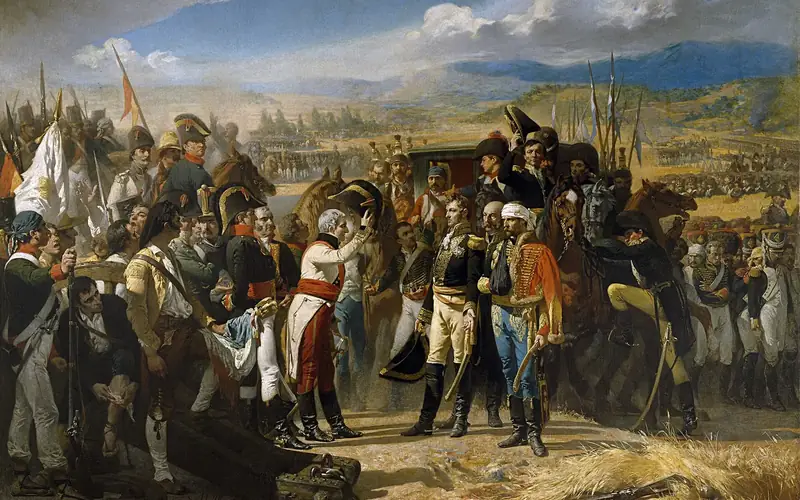
The capitulation of Bailén, in July 1808, had driven Joseph Bonaparte out of Madrid and shown Europe that an imperial army could lay down its arms. Napoleon decided to go himself. He left Bayonne on the morning of 5 November 1808 and took command that same evening at Vitoria, at the head of forces that crushed both wings of the Spanish army in three weeks: Soult at Burgos on 10 November, Victor at Espinosa on the 11th, Lannes at Tudela on the 23rd. The road to the capital was clear, and the Emperor took it with about 45,000 men.
Between him and Madrid rose the Sierra de Guadarrama. Two passes cross it: Guadarrama to the west, Somosierra to the north-east, on the main road from Burgos. That is where 30 November was decided.
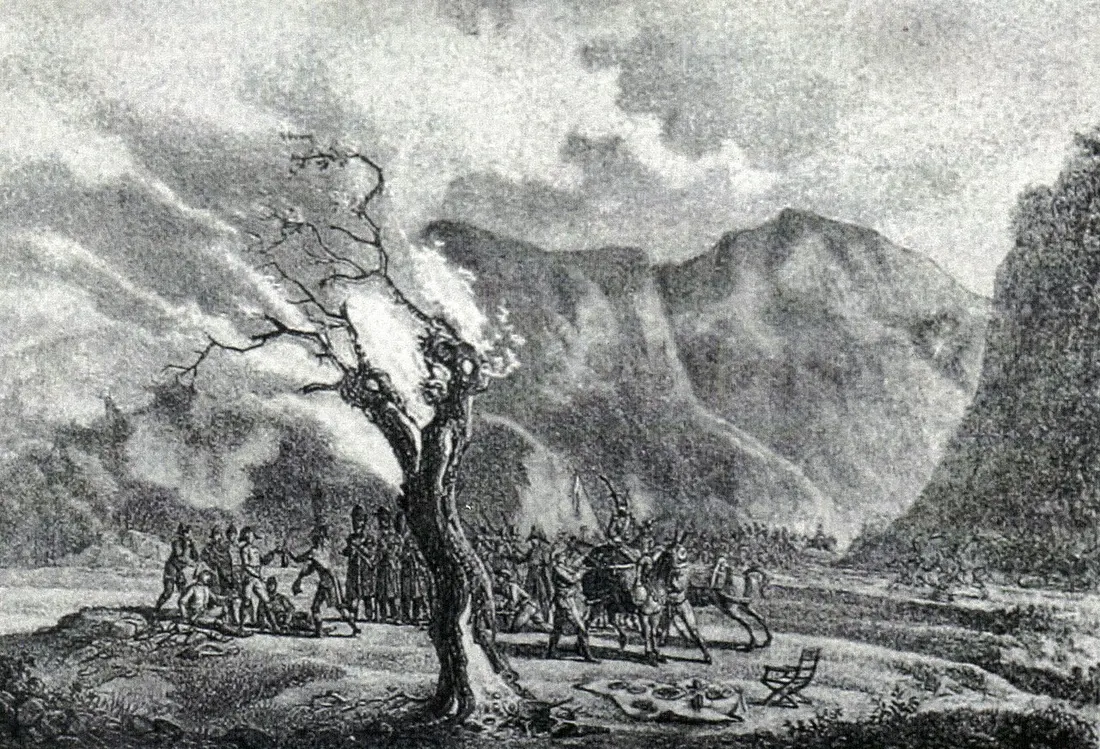
The bolt of Somosierra
To defend Madrid, General Benito de San Juan had gathered some twenty thousand men: a few regular battalions that had survived the disasters of November, militia battalions and newly raised units. He had to cover several roads at once and therefore scattered forces that were already too weak: about 8,000 men at the Guadarrama pass, 3,000 to 3,500 at an advanced post at Sepúlveda, and the rest — 8,000 to 9,000 men according to the sources — at Somosierra, with sixteen guns.
The ground was worth an army. The road climbs in hairpins to the 1,440 metres of the pass, through a gorge only a few dozen metres wide, backed by stony slopes on which infantry cannot deploy. San Juan staggered his artillery there in four successive batteries, two or three pieces each, the last one at the pass appreciably stronger according to French officers' estimates. Each battery swept the next bend: anything coming up the road took canister head-on, at point-blank range.
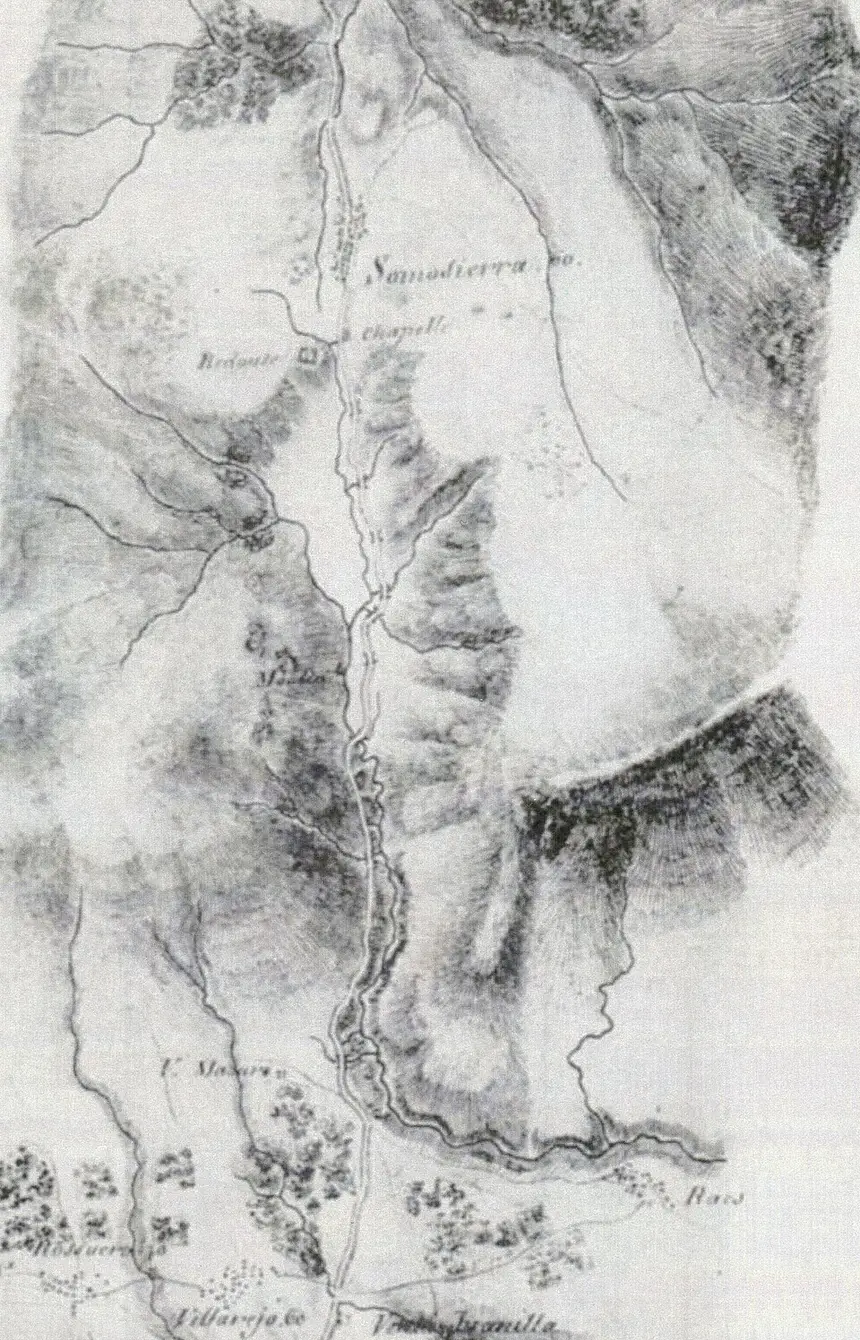
The day before: the clash at Sepúlveda
The first alarm came from the west. On the evening of 29 November the brigade detached to Sepúlveda repulsed a French attack led by the Guard fusiliers and inflicted serious losses on it; once night had fallen, it slipped away from an overwhelming superiority in numbers. The episode cost San Juan three thousand men who would not be at the pass the next day, but it warned the French that this time the Spaniards were not collapsing at the first shock.
Fog and batteries
On the morning of the 30th a thick mist drowned the gorge. Napoleon pushed his infantry straight at the pass — the vanguard of Victor's I Corps, with Ruffin's division — while small detachments climbed the flanks under cover. Volleys of musketry were exchanged from slope to slope. The Spaniards held, served by the ground and by a stubbornness that French accounts themselves acknowledge; the skirmishers gained ground, but slowly, and the hours were passing.
The charge of the Polish light horse
The position could not be turned in time. Napoleon then gave the order his lieutenants thought impossible: to take the batteries with cavalry, up the road. He is credited with the reply that made his fortune: "What? Impossible! I do not know that word! For my Poles nothing is to be impossible!"
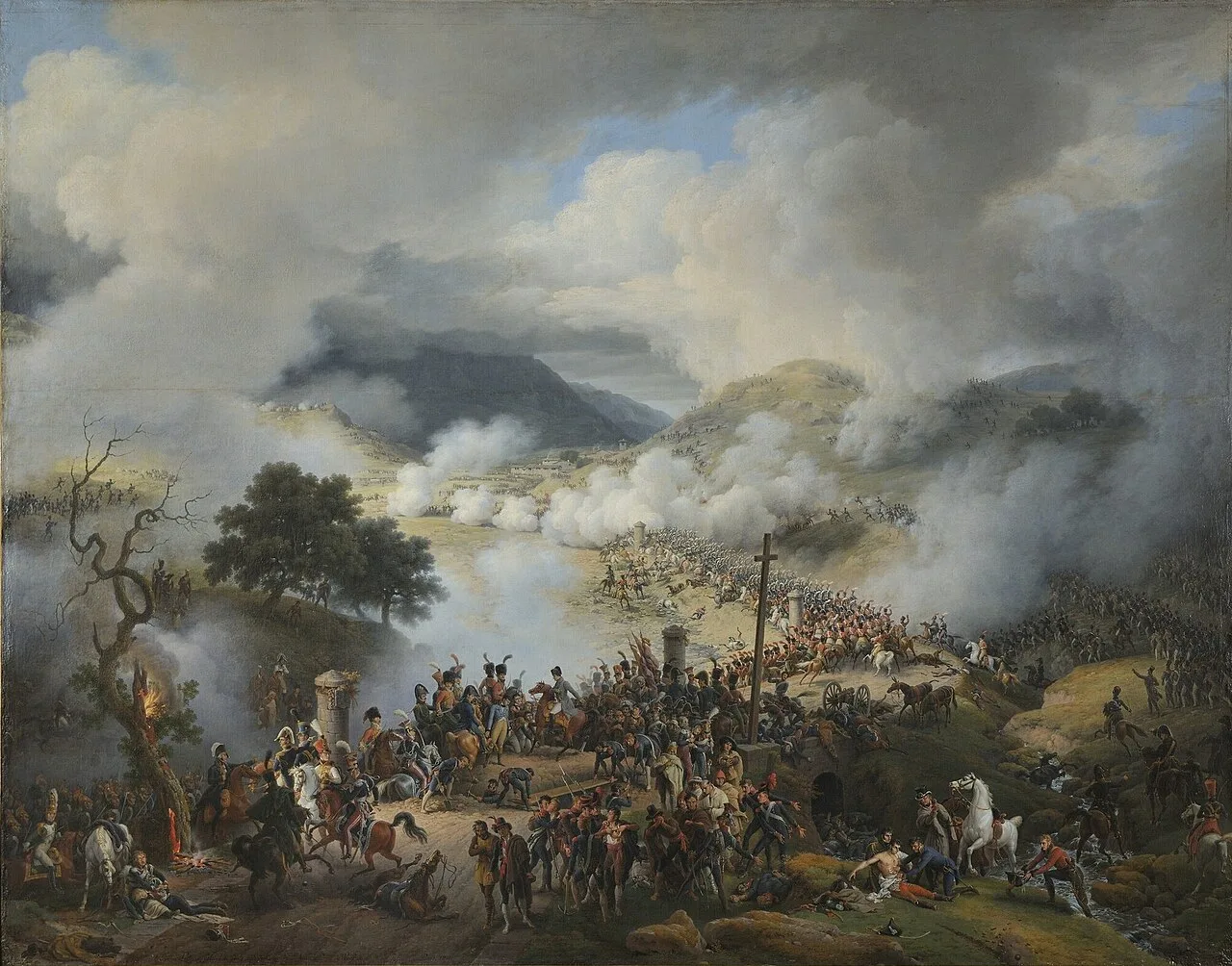
Squadron commander Stokowski being absent, it was Jan Kozietulski who gathered the 3rd squadron of the Polish light horse of the Guard — the 3rd and 7th companies, a hundred and twenty-five to a hundred and fifty troopers according to the accounts. Sabres drawn, in a column of fours because the road offered nothing wider, they set off at a gallop. Canister cut them down by the dozen; they carried the batteries one after another, sabring the gunners, leaving their dead all the way up the climb — Lieutenants Rudowski, Krzyżanowski and Rowicki among them. Kozietulski lost his horse after the first battery; Dziewanowski took the lead and fell after the third; Krasiński, then Niegolewski, carried on. The latter, the last unwounded officer, led the assault on the battery at the pass; the Spaniards briefly retook it and left him for dead, run through with nine bayonet wounds and cut about the head.
Napoleon at once committed the regiment's 1st, 2nd and 4th squadrons under Tomasz Łubieński, together with the Guard chasseurs à cheval and La Houssaye's dragoons. At the sight of these reinforcements the Andalusian militia broke, carrying the whole line back with it. The guns stayed in Polish hands.
Madrid, four days later
By the standards of the Empire's great days the butcher's bill was short: about three hundred killed and wounded on the Franco-Polish side; on the Spanish side some two hundred and fifty men out of action and up to three thousand prisoners according to the sources, all sixteen guns lost and an army falling apart as it retreated. San Juan fell back on Madrid with what was left. French patrols reached the suburbs on 1 December; on the 4th an artillery bombardment carried away the defence, Generals Morla and de la Vera signed the capitulation and the imperial army entered the city for the second time that year. As for San Juan, wounded, he still tried to gather troops: a few weeks later his own mutinous soldiers shot him.
A disputed glory
Somosierra was neither the manoeuvre of Ulm nor the vice of Austerlitz: a vanguard, a defile, a quarter of an hour of cavalry. Yet the battle fed one of the most stubborn quarrels of memory in the whole Empire. French officers attributed the success to Ruffin's infantry, which had indeed worn the defenders down all morning; the 13th bulletin of the Grande Armée, for its part, gives the decisive role to the Polish light horse. Among the Poles, Łubieński and Niegolewski disputed the honour of having taken the guns, each playing down the other's share. The truth is an addition: the infantry opened the way, the first charge carried all four batteries even if only briefly, and the second turned the breach into a rout.
The rest passed into the language. To generals who claimed that the Poles had taken the batteries because they were drunk, Napoleon is said to have answered: "Then, gentlemen, learn to be as drunk as Poles" — a phrase whose pejorative ring in French hides a strictly admiring origin. As for the Spanish gunners, who died at their pieces rather than abandon them, they had the tribute of their adversaries. For the Polish regiments of the Guard, Somosierra remains the founding feat of arms, the one cited before even the lances of Borodino or Waterloo.
Discover other battles
 Defeat
 Read the account
Bailén
16-22 July 1808
Bailén, Andalusia
 Inconclusive
 Read the account
Toulouse
10 April 1814
Toulouse, France
 Victory
 Read the account
Friedland
14 June 1807
Friedland (Pravdinsk), East Prussia
 Victory
 Read the account
Wagram
5-6 July 1809
Deutsch-Wagram, north-east of Vienna (Lower Austria)
Go further
Recommended books to dig deeper (affiliate links)
Napoleon the Great
Andrew Roberts · 2014
A monumental biography drawing on Napoleon’s 33,000 surviving letters, admiring but rigorous.
See on Amazon
Napoléon ou le mythe du sauveur
Jean Tulard · 1977
The book that reshaped how the man is read: how France gave itself a saviour, and what it cost.
See on Amazon
Nouvelle histoire du Premier Empire
Thierry Lentz · 2002-2010
Four reference volumes on institutions, diplomacy and collapse: the scholarly synthesis of the subject.
See on AmazonAs an Amazon Associate, this site earns from qualifying purchases.
Support the encyclopedia
Napoleon Empire is an independent project. Your contribution helps grow the content and keep the site running.
DonateSecure payment on the platform you choose.