On 14 February 1814, six kilometres east of Montmirail, Napoleon fought the last day of the Six Days’ Campaign. Blücher, who had just lost three corps in four days, had resumed the offensive and driven Marmont out of Étoges: he believed he faced nothing but an isolated marshal. In front of him stood the Emperor, come up from Château-Thierry during the night. The day was decided less by infantry than by cavalry: Grouchy got ahead of the Prussian retreat, reached the Champaubert road and caught the columns in the act of marching. Zieten’s squares broke on the open ground, the Army of Silesia left several thousand men behind, and Blücher himself narrowly escaped capture. It was the last clean victory of the most brilliant week of 1814 — and it changed nothing.
Forces at play
Outcome: French victory: Grouchy’s cavalry broke up Blücher’s retreat and closed the Six Days’ Campaign

France
- Napoléon Ier
- Marmont
- Grouchy
- Ney
- Nansouty
- Doumerc
- Bordesoulle
- Saint-Germain
- Drouot
About 18,000 men by the French account, some ten thousand actually engaged: Marmont’s VI Corps (Lagrange, Ricard and Leval divisions), Grouchy’s cavalry reserve (Saint-Germain, Doumerc and Bordesoulle divisions), Nansouty’s Guard cavalry, Drouot’s Guard artillery; Friant’s Old Guard and Curial’s Young Guard behind the front
Casualties: About 600 killed, wounded and captured according to Alain Pigeard


Prussia · Russia
- Blücher
- Kleist von Nollendorf
- Kaptzevitch
- Zieten
- Ouroussov
- Oudom
20,000 to 21,500 men of the Army of Silesia on the closest estimates — Kleist’s II Prussian Corps (about 13,500 men, brigades of Pirch, Zieten and Prince Augustus of Prussia), Kaptzevich’s X Russian Corps (about 6,500 men, Urusov and Turchaninov divisions) and some 1,500 survivors of Udom’s IX Corps; the French tradition puts the figure at 30,000
Casualties: 6,000 to 10,000 men depending on the author, including close to 2,000 prisoners taken from Zieten’s squares; 15 to 20 guns and about ten colours lost
Flags: David Liuzzo, Wikimedia Commons
Battle coordinates
Vauchamps
Coordinates 48.8811° N · 3.6164° E
Battle narrative
Four days after Champaubert
On 10 February 1814 Napoleon had destroyed Olsufiev’s Russian IX Corps in front of Champaubert; on the 11th he beat Sacken at Montmirail; on the 12th he threw Yorck back on Château-Thierry. Three allied corps defeated in three days, on roads the thaw had made all but impassable: the Six Days’ Campaign owes its reputation to that sequence. But the Army of Silesia had not been destroyed, and Blücher had no intention of leaving matters there.
The Prussian field marshal gathered what remained to him in the north-east, around Étoges and Champaubert, and resumed his march westwards. He meant to reopen the road to Paris and restore contact with his beaten corps. In front of him Marmont held Étoges with the VI Corps. During 13 February the columns of Kleist and Kaptzevich drove him out of it and pushed him back on Montmirail.
Napoleon, still pressing towards Château-Thierry, learned the news during the night. At about three in the morning on 14 February he left the town with the Guard cavalry and Grouchy’s cavalry reserve, and marched to his marshal’s relief. Blücher, for his part, occupied Champaubert in the morning and pushed his vanguard towards Fromentières and Vauchamps. He did not yet know who was coming to meet him.
The village taken and retaken
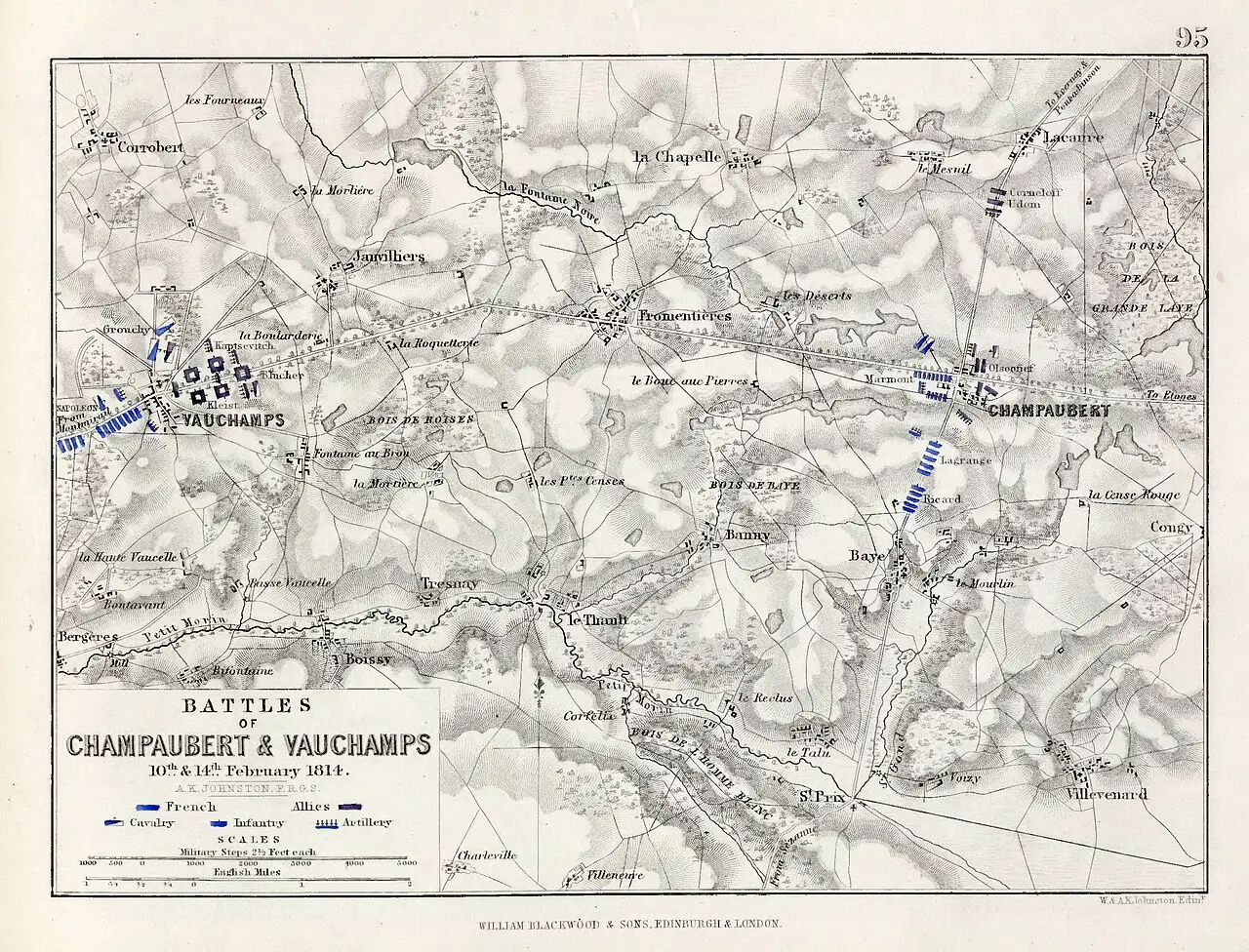
Vauchamps is a Marne village six kilometres east of Montmirail, on the Champaubert road. At about nine o’clock Zieten’s Prussian brigade debouched from it with some cavalry and advanced on Montmirail. Marmont, whose first reinforcements had come up, asked for nothing better: he counter-attacked, drove the Prussians back into the village and carried it. The VI Corps cavalry, in which Lion’s squadron distinguished itself, finished the business; a Prussian battalion was left in French hands.
Zieten fell back on Fromentières. Kleist and Kaptzevich took him in there and the front firmed up. Meanwhile the French army was deploying: Grouchy came up on the left with the cavalry divisions of Saint-Germain, Doumerc and Bordesoulle, Leval advanced on the right, and the Guard artillery came into battery under Drouot. Behind them Friant’s Old Guard and Curial’s Young Guard formed up, brought on by Ney. Of some twenty thousand men present, barely ten thousand would take part in the fighting; the rest arrived too late or stayed in support.
Blücher recognises the Emperor
At about two o’clock the field marshal finally grasped whom he was dealing with. The presence of the Guard, the weight of the artillery, the mass of cavalry deploying north of the road: it was not Marmont in front of him, it was Napoleon in person. He ordered an immediate general retreat through Champaubert.
That was precisely the moment Grouchy had been waiting for. Rather than follow the allied columns, he got ahead of them: his divisions went through the woods to the north, reached the road in front of Champaubert and sat down across it. There was nothing improvised about the manoeuvre — on the scale of a single day it repeated the principle that had governed the whole week: be at the point of passage before the enemy.
Zieten’s squares in the open
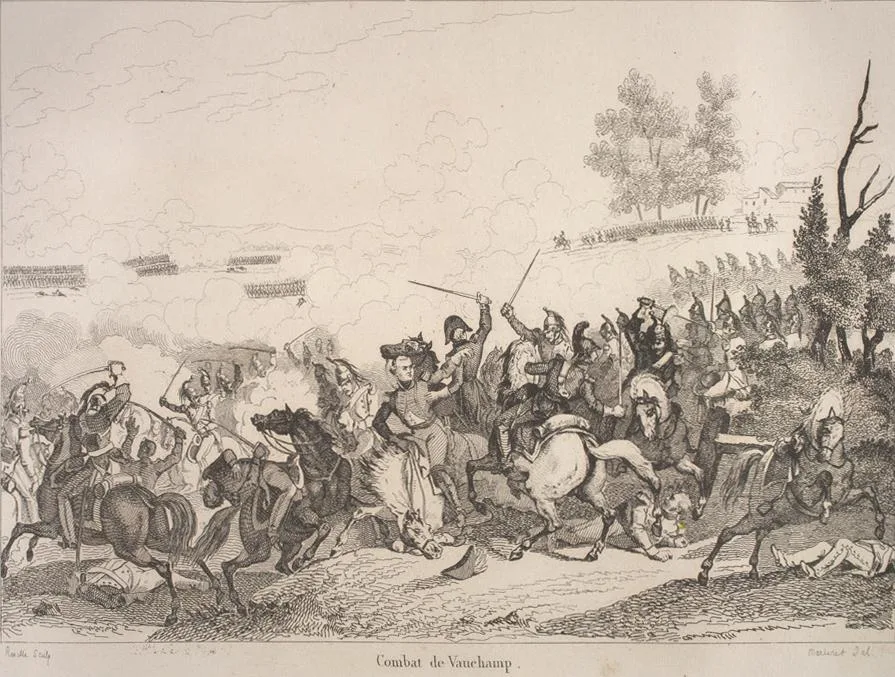
Beyond Fromentières and Janvilliers the ground opens out and offers not a fold to shelter in. Grouchy’s cavalry, supported by the Guard horse under Nansouty, cut Zieten’s brigade off from what lay ahead of it and charged. The Prussian squares, formed on sodden earth that slowed everything, held and then broke. Close to two thousand men were taken prisoner in that phase alone.
The mud, however, worked against the French as well. The horse artillery could not get into battery quickly enough, the infantry could not keep up with the squadrons, and Blücher managed to force the block before the pincers closed. Jacques Garnier saw there what was missing to turn the day into outright destruction: cavalry alone can break up a retreat, it cannot finish it.
The night at Étoges
After dark Grouchy’s divisions went on charging the retreating squares; Blücher, caught up in the melee with his staff, narrowly escaped capture. Further east, at Étoges, Doumerc’s cuirassiers surprised General Udom’s men in the darkness — what was left of the IX Corps ground up at Champaubert. Prince Urusov was taken with about six hundred men and eight guns. The last survivors of 10 February lost their last pieces there.
The fighting ended with the daylight. Blücher marched by night on Vertus and Bergères, then reached Châlons the next day, where he at last found Yorck and Sacken again. The Army of Silesia was out of the reckoning for a week.
A butcher’s bill the sources will not settle
As so often in 1814, the accounts diverge widely. On the French side Alain Pigeard puts losses at about six hundred killed, wounded and captured, and that modest figure commands general agreement. On the allied side the spread is considerable: the French tradition speaks of nine thousand killed and wounded and five thousand prisoners, twenty guns and ten colours; closer reckonings give five thousand five hundred Prussians and three thousand five hundred Russians with fifteen Russian pieces; Pigeard comes down to twelve hundred and fifty Prussians out of action plus two thousand prisoners, and two thousand Russian losses. The total of about six thousand men, split roughly evenly between the two contingents, is the one that recurs most often.
Part of the divergence comes from what each author counts in: some aggregate the losses of the 13th and those of the night at Étoges, others do not. In every version the ratio remains crushing, and it was the cavalry that produced it.
What the week did not deliver
Napoleon briefly considered pursuing Blücher to the end. News from the Seine turned him away from it: Schwarzenberg was coming down the valley, and the road to Paris was opening on that side. The Emperor left Marmont and Mortier to watch and turned south. He won at Mormant on 17 February and at Montereau on the 18th. The war resumed elsewhere.
Blücher, for his part, rebuilt. Winzingerode brought him some thirty thousand men of the Army of the North, and the Army of Silesia was moving forward again in the first days of March. Napoleon would meet it at Craonne and then at Laon, and get nothing more. Clausewitz, who followed the campaign closely, summed the sequence up in two symmetrical errors: Blücher had dispersed his corps and then sought battle at the moment his opponent was slipping away; Napoleon left the Marne theatre before he had finished his work.
The day itself remains. The six days of February 1814 gave staff colleges a textbook case of manoeuvre on interior lines, and Vauchamps is its last page: an army half the size of its enemy striking, moving, striking again, and in the end wearing the enemy down without ever destroying him. A memorial column at Vauchamps still recalls the victories of 1814 on this Champagne road. Seven weeks later, on 6 April, Napoleon abdicated at Fontainebleau.
Discover other battles
 Victory
Read the account
Montmirail
11 February 1814
Montmirail, Marne, Champagne
 Victory
Read the account
Champaubert
10 February 1814
Champaubert, Marne, Champagne
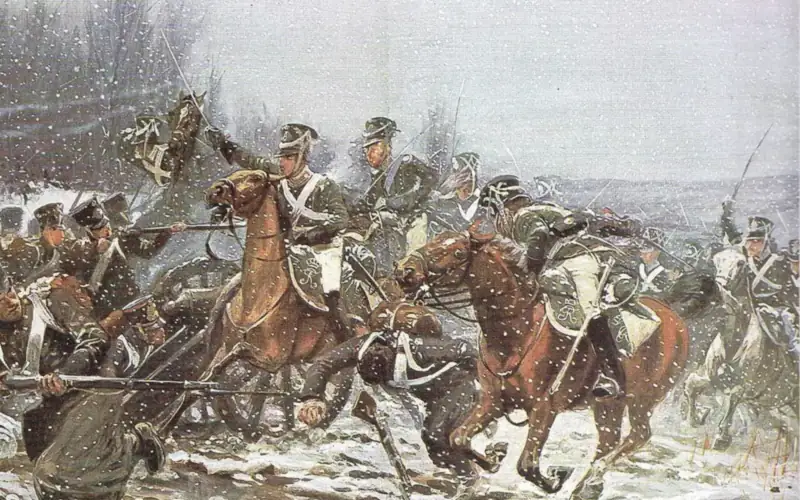 Defeat
Read the account
La Rothière
1 February 1814
La Rothière, Aube, Champagne
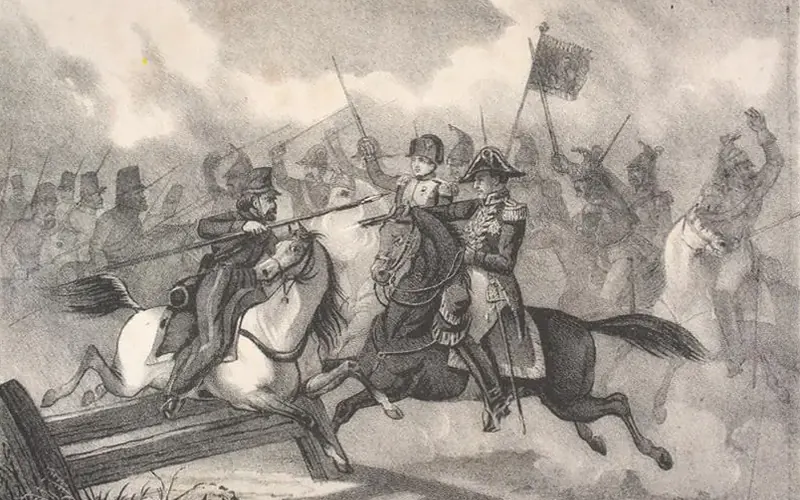 Victory
Read the account
Brienne
29 January 1814
Brienne-le-Château, Aube, Champagne
Go further
Recommended books to dig deeper (affiliate links)

Napoleon the Great
Andrew Roberts · 2014
A monumental biography drawing on Napoleon’s 33,000 surviving letters, admiring but rigorous.
See on Amazon
Napoléon ou le mythe du sauveur
Jean Tulard · 1977
The book that reshaped how the man is read: how France gave itself a saviour, and what it cost.
See on Amazon
Nouvelle histoire du Premier Empire
Thierry Lentz · 2002-2010
Four reference volumes on institutions, diplomacy and collapse: the scholarly synthesis of the subject.
See on AmazonAs an Amazon Associate, this site earns from qualifying purchases.
Support the encyclopedia
Napoleon Empire is an independent project. Your contribution helps grow the content and keep the site running.
DonateSecure payment on the platform you choose.