On 29 January 1814, some forty kilometres north-east of Troyes, Napoleon fought a battle beneath the walls of the school he had entered as a boy. He had left Paris four days earlier with an army of conscripts, hoping to catch Blücher's Army of Silesia before it could join the Austrians. An intercepted order ruined the surprise: the Prussian concentrated around Brienne-le-Château, and the affair turned into a night mêlée in which the Emperor came within a lance's length of a Cossack, and the Prussian field marshal within a few minutes of capture in the château he had made his headquarters. By morning the French held the town — but Blücher had slipped away intact.
Forces at play
Outcome: French victory: the town and château stayed in French hands, but Blücher withdrew intact

France
- Napoléon Ier
- Victor
- Ney
- Marmont
- Grouchy
30,000 to 36,000 men depending on the source: Victor’s II Corps, Marmont’s VI Corps, Ney’s Young Guard divisions, cavalry under Grouchy and Milhaud
Casualties: About 3,000 men according to Petre and Chandler, 3,500 and eleven guns lost according to Smith


Russia · Prussia
- Blücher
- Osten-Sacken
- Olsoufiev
- Pahlen
25,000 to 30,000 men of the Army of Silesia: the corps of Olsufiev and Sacken, Pahlen’s cavalry, Lanskoy’s hussars, Shcherbatov’s Cossacks
Casualties: About 3,000 men according to Petre and Smith, up to 4,000 according to Chandler
Flags: David Liuzzo, Wikimedia Commons
Battle coordinates
Brienne
Coordinates 48.3914° N · 4.5208° E
Battle narrative
An emperor short of everything
By 1 January 1814 the allies had crossed the Rhine: the war was now being fought on French soil. Napoleon left Paris on 25 January at six in the morning and dined that same evening at Châlons-sur-Marne, which became the first headquarters of the campaign. There he gathered some fifty thousand men — mostly young conscripts nicknamed the "Marie-Louises", led by cadres worn to the bone — against allied armies three to four times their number.
His one chance lay in the enemy's dispersion. Blücher's Army of Silesia was coming down the Marne, Schwarzenberg's Army of Bohemia across the Langres plateau; between them lay a gap the Emperor meant to exploit as he had once exploited the gaps between Austrian columns in Italy. He issued four days' rations and marched on Saint-Dizier, where he believed Blücher stood with twenty-five thousand men. On 27 January Milhaud's cavalry drove back a Russian detachment there; but the bulk of the Army of Silesia had gone, slipping away southwards.
The captured despatch rider
The manoeuvre he had in mind was of the kind that had made Marengo: while Mortier, setting out from Troyes, struck the head of the allied column, Napoleon would fall on its rear. It depended on secrecy. A French despatch rider fell into Cossack hands carrying the Emperor's dispositions; forewarned, Blücher stopped marching blind and drew his corps together around Brienne-le-Château. Instead of a column caught on the march, the French would find an army alerted and in position, on ground it had been given time to choose.
The thaw completed the ruin. The chalk roads of Champagne turned to mud, the artillery bogged down, the columns strung out: the attack meant to start in the morning was not ready until late afternoon.
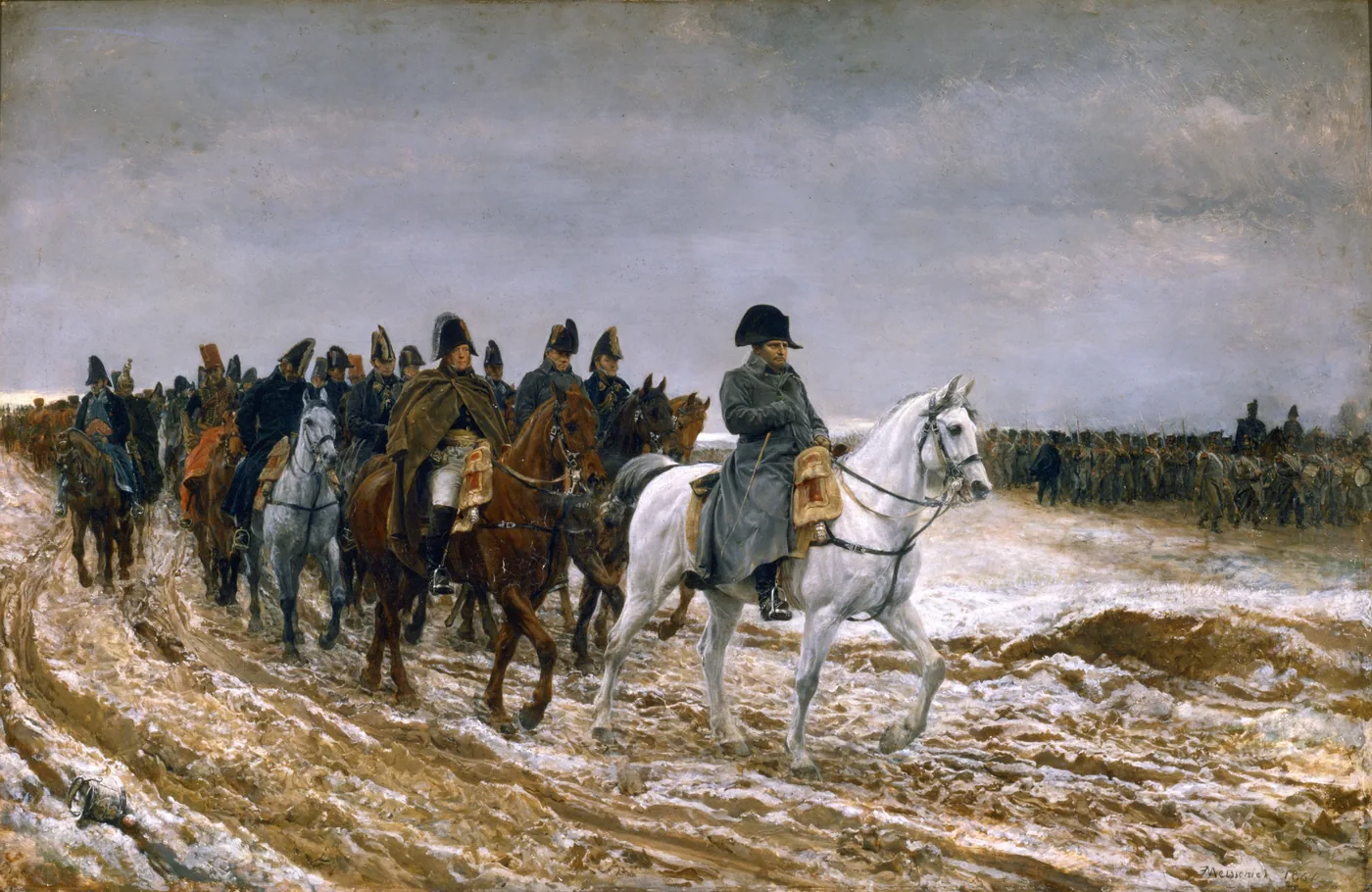
A château above the town
Brienne-le-Château takes its name from the building that dominates it: an eighteenth-century château built on the hillside above the rooftops, with a view across the whole plain of the Aube. For a staff it is the ideal observatory — Blücher and his chief of staff Gneisenau made their quarters there. For an attacker it is the key to the position: whoever holds the château commands the town.
Napoleon knew the place better than anyone. From May 1779 to October 1784, from the age of ten to fifteen, he had boarded at the military school of Brienne a few hundred metres away. Thirty years later he came back as emperor to fight one of the last battles of his reign in the landscape of his childhood — a coincidence his contemporaries did not fail to note, and about which he himself said almost nothing.
Three columns and forty squadrons
The first shots came from the cavalry: Piré's light division ran into three Cossack regiments under Prince Shcherbatov at Maizières-lès-Brienne, and General Lefebvre-Desnouettes was wounded there. Around three in the afternoon Pahlen's Russian cavalry fell back through Brienne; Napoleon ordered a general attack.
It went in as three columns, only one of which — the one aimed at the château — would take a lasting grip. Duhesme's division, of Victor's II Corps, came into line about half past three; between four and five, Decouz's division, from Ney's Young Guard, attacked the right of the town. Pahlen and Vasilchikov answered with a charge of some forty squadrons against the French left: Duhesme's division was broken and left eight guns to the Russians.
Gourgaud's pistol
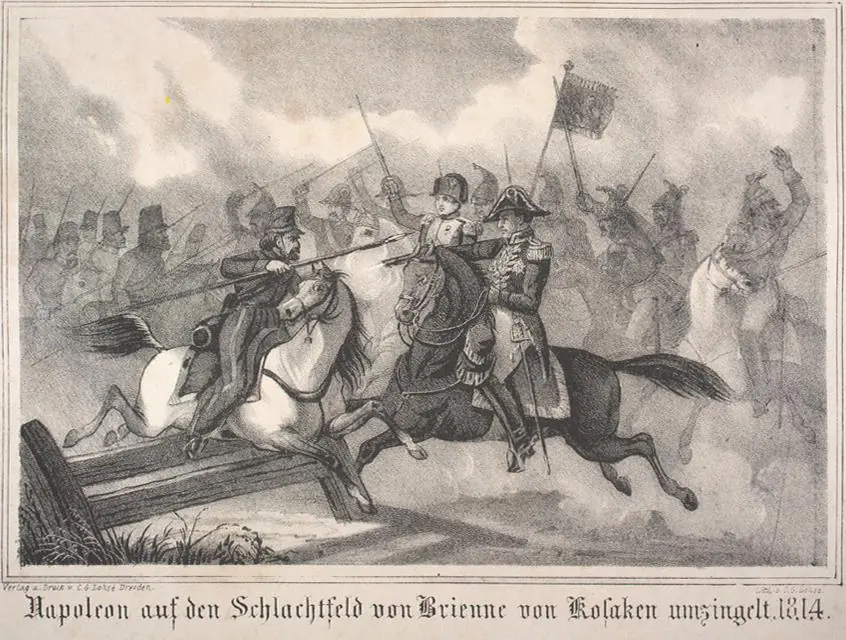
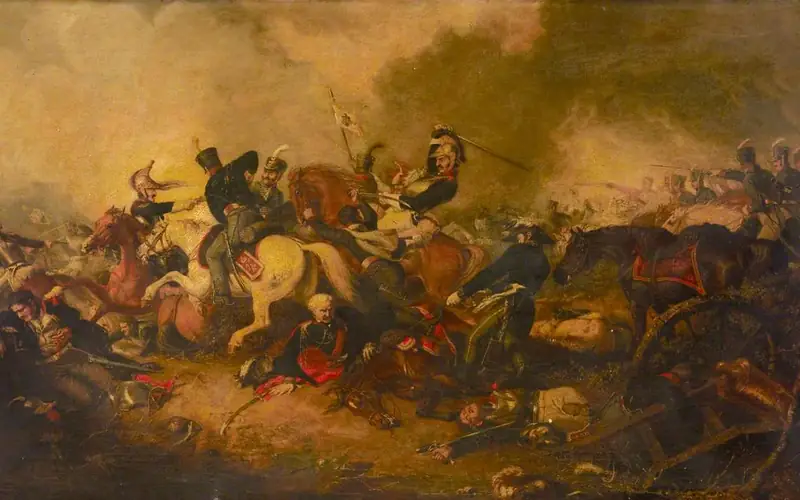
It was in that confusion, on the Juzanvigny road, that Cossacks enveloped the small knot of horsemen in which Napoleon was riding. One of them levelled his lance at the Emperor; his orderly officer Gaspard Gourgaud shot the man dead. The episode fed a whole nineteenth-century imagery, and Gourgaud took a pride in it, all the way to Saint Helena, that he did not trouble to hide. Napoleon himself simply rallied his shaken ranks and sent the attack forward again.
The storming of the château
Meanwhile some four hundred infantrymen of the 37th and 56th line regiments found an unguarded path up to the château and slipped along it. Blücher and Gneisenau escaped capture only by making hurriedly for the exit. Four guns were taken, then lost again in the counter-attack.
Olsufiev tried to retake the château and failed; Sacken, on the other hand, cleared most of the town. It was taken and retaken several times in a night action that witnesses counted among the fiercest of the campaign. The French officer corps paid heavily: General Decouz, mortally wounded, died on 18 February; Rear Admiral Pierre Baste, who had moved from the navy to the Young Guard, was killed outright; General Forestier died on 5 February.
Midnight, then four in the morning
At midnight Blücher ordered Olsufiev to disengage; two hours later it was Sacken's turn. The movement was made so quietly that the French did not notice at once and only occupied Brienne at four in the morning. The counts differ — about three thousand men on each side according to Petre, three thousand French against four thousand allies according to Chandler, three thousand five hundred French and eleven guns lost according to Smith. Out of thirty to thirty-six thousand French engaged against twenty-five to thirty thousand allies, the bleeding told above all on the army that could not replace its losses.
A victory on the ground, a failure of manoeuvre
Historians have never come down on the same side. Bodart and Digby Smith put Brienne to Napoleon's credit; Francis Loraine Petre judged that it was "scarcely a tactical victory" and that "strategically it was little short of a defeat". The two readings say the same thing from two angles: the French kept the field, but they obtained neither the destruction of the Army of Silesia nor even its separation from the Austrians.
Blücher fell back on Trannes, towards Bar-sur-Aube, and there made precisely the junction the battle was meant to prevent. Three days later, on 1 February, some hundred and twenty thousand allies attacked at La Rothière, a few kilometres south of Brienne, and inflicted on Napoleon the first defeat of the campaign on French soil. It would take the hammer blows of Champaubert, Montmirail and Vauchamps the following week for the Emperor to regain the initiative, and then only briefly. Brienne remains what it was: a night of mêlée won at the cost of time he no longer had.
Discover other battles
 Defeat
 Read the account
Leipzig
16-19 October 1813
Leipzig, Saxony (Germany)
 Inconclusive
 Read the account
Toulouse
10 April 1814
Toulouse, France
 Victory
 Read the account
Ligny
16 June 1815
Ligny, Belgium
 Defeat
 Read the account
Waterloo
18 June 1815
Mont-Saint-Jean, south of Brussels (Belgium)
Go further
Recommended books to dig deeper (affiliate links)

Napoleon the Great
Andrew Roberts · 2014
A monumental biography drawing on Napoleon’s 33,000 surviving letters, admiring but rigorous.
See on Amazon
Napoléon ou le mythe du sauveur
Jean Tulard · 1977
The book that reshaped how the man is read: how France gave itself a saviour, and what it cost.
See on Amazon
Nouvelle histoire du Premier Empire
Thierry Lentz · 2002-2010
Four reference volumes on institutions, diplomacy and collapse: the scholarly synthesis of the subject.
See on AmazonAs an Amazon Associate, this site earns from qualifying purchases.
Support the encyclopedia
Napoleon Empire is an independent project. Your contribution helps grow the content and keep the site running.
DonateSecure payment on the platform you choose.