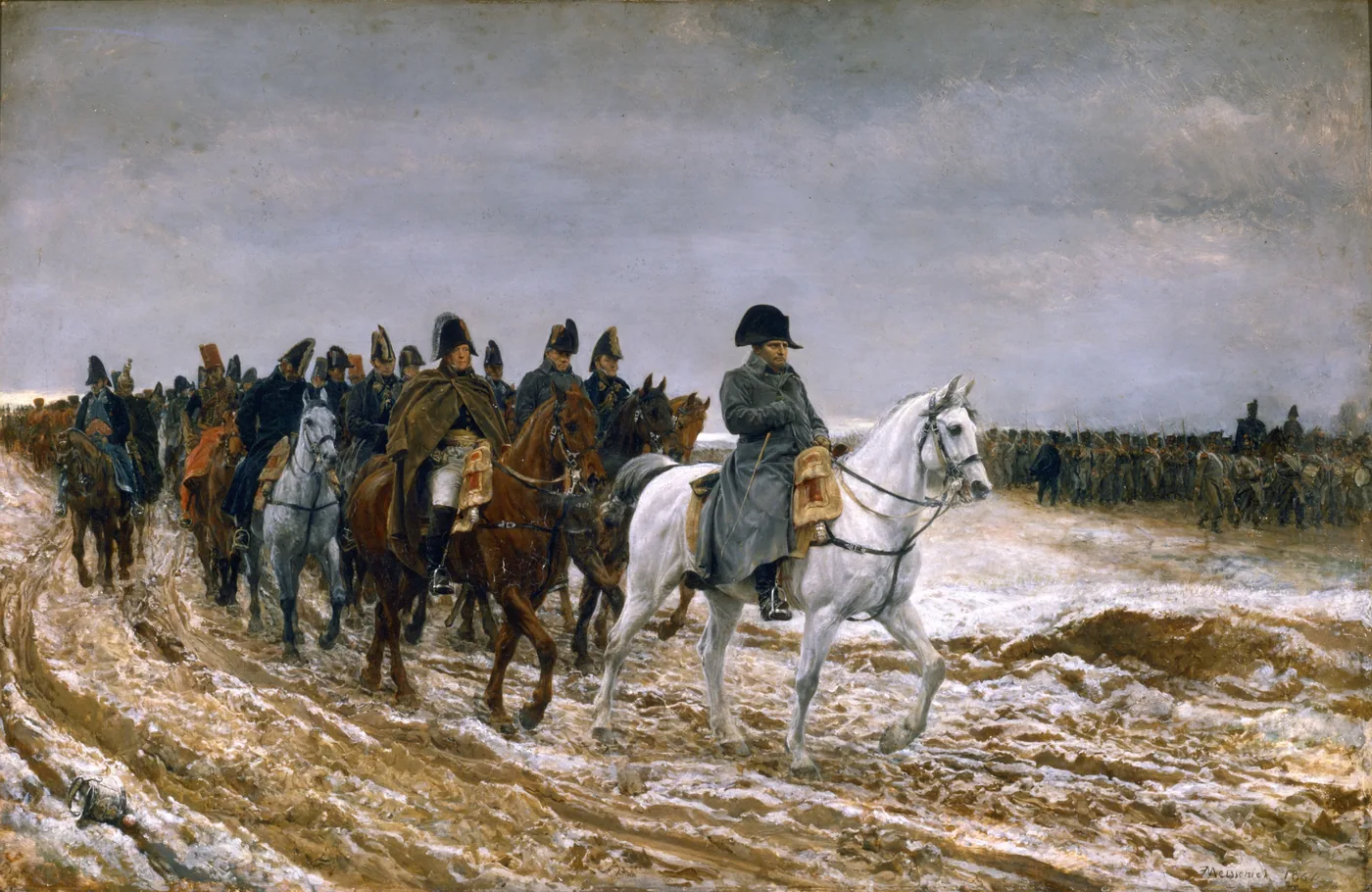
On 7 March 1814, on the narrow plateau running between the Aisne and the Ailette — already known as the Chemin des Dames — Napoleon attacked the rearguard Blücher had left across his path. Vorontsov’s Russian corps held the ridge around Hurtebise farm; the cavalry manoeuvre meant to take the French in the rear bogged down in the lanes of the Ailette valley. It was the bloodiest day of the 1814 campaign in France: the Young Guard, made up of barely trained conscripts, went up the slopes under canister fire, and it took the Guard artillery to wrest the plateau away at last. Vorontsov withdrew in good order without abandoning a single gun. The Emperor remained master of the field; he had lost as many men as his opponent, and the Army of Silesia was waiting for him, intact, at Laon.
Forces at play
Outcome: Costly French victory with no sequel: Vorontsov left the plateau in good order and Blücher concentrated at Laon

France
- Napoléon Ier
- Ney
- Victor
- Mortier
- Grouchy
- Nansouty
- Belliard
- Drouot
About 30,000 men on the field by the most common estimate (20,000 to 40,000 depending on the author, part of the Guard never being engaged): Ney’s and Victor’s corps, Young Guard divisions, Grouchy’s and Nansouty’s cavalry, Drouot’s Guard artillery
Casualties: About 5,400 killed and wounded according to French sources; up to 8,000 by other counts. Victor, Grouchy, Laferrière-Levesque and Boyer de Rebeval wounded


Russia · Prussia
- Blücher
- Vorontsov
- Sacken
- Winzingerode
About 22,000 to 23,000 men actually engaged — Henry Houssaye counts 18,300 infantry and 4,200 cavalry: Vorontsov’s Russian infantry, Sacken’s cavalry and artillery; the Army of Silesia, by then over 100,000 strong, stayed largely out of the fight
Casualties: About 5,000 men according to French sources; the Russians admitted 4,785 killed, wounded and missing. No gun or colour lost
Flags: David Liuzzo, Wikimedia Commons
Battle coordinates
Craonne
Coordinates 49.4411° N · 3.7242° E
Battle narrative
From the Marne to the Aisne
On the evening of Vauchamps, 14 February 1814, the Army of Silesia seemed to be out of the game. Napoleon had at once turned against Schwarzenberg, beaten at Mormant and then at Montereau, and the great allied Army of Bohemia had fallen back beyond Troyes. Blücher, however, had recovered faster than anyone expected. By the end of the month he was once again on the road to Paris down the Marne valley, on his own, leaving Schwarzenberg to his caution.
Marmont and Mortier, ordered to watch him, could do no more than slow his march; they managed it on the Ourcq, where they stood up to Kleist’s Prussian corps on 28 February. In the meantime the Emperor had left the Seine with the Guard and sent his columns northwards. On 2 March Blücher realised he was being followed. Rather than accept battle between the Marne and the Ourcq, he slipped away towards the Aisne, where reinforcements from the Army of the North, under Winzingerode and Bülow, were waiting for him.
Everything then hinged on Soissons, the only solid bridge on that stretch of the river. On 3 March its commander, General Moreau, capitulated to the corps surrounding him and was allowed to march out with his garrison. The Army of Silesia crossed the Aisne and joined its reinforcements. Napoleon had lost the chance to pin Blücher against a river; he never forgave that surrender.
Berry-au-Bac and the plateau
Another crossing was needed. On 5 March the French cavalry seized the stone bridge at Berry-au-Bac, downstream from Soissons, by surprise and took some three hundred prisoners there. The Guard crossed the Aisne the same day. Napoleon’s objective was Laon: to get there before Blücher would cut the Army of Silesia off from its communications with the Low Countries and force it to fight with its back to the river.
Blücher, who had no intention of being outflanked, chose to cover the road by blocking the plateau. This long limestone ridge, which separates the Aisne from the Ailette over some thirty kilometres, is in places so narrow that a single division can close it. Near Hurtebise farm the passage shrinks to a few hundred metres between two wooded slopes. That is where the field marshal posted General Vorontsov’s Russian infantry, with Sacken’s cavalry and artillery behind. His plan went further than mere defence: while Vorontsov held the French in place, Winzingerode, with some ten thousand horsemen and sixty pieces of horse artillery, would cross the Ailette to the north and fall on the Emperor’s flank and rear.
Late in the afternoon of 6 March two French divisions tackled the slopes. One took Craonne, at the eastern end of the plateau, whose houses the Russian jägers could not hold. The other tried to climb past Vauclair abbey towards Hurtebise and was thrown back at bayonet point. Napoleon spent the night at Corbeny, convinced that Blücher was retreating.
An attack launched too early
On the morning of 7 March Vorontsov stood in position in three lines, his right resting above Ailles and his centre at Hurtebise farm. Winzingerode’s manoeuvre had in fact already failed, though no one yet knew it: the lanes of the Ailette valley, poorly reconnoitred, were clogged, and his cavalry was still around Chevregny at the moment it should have been emerging on the Laon road.
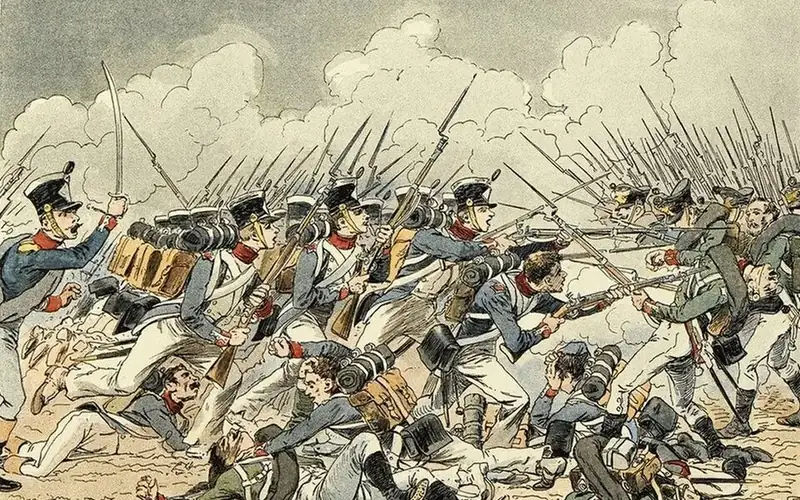
Napoleon wanted to wait until all his forces were in place. The Guard artillery opened fire at very long range, and Ney, posted to the north, took the cannonade for the signal to attack. He immediately sent the Young Guard divisions of Boyer de Rebeval and Meunier up the slope through the village of Ailles, without adequate preparation. The Russians set fire to Hurtebise farm and fell back to the ridge, from where their artillery struck the attackers head-on.
The young conscripts of 1814, raised only a few weeks earlier, nevertheless held the edge of the plateau at the cost of appalling losses. A single regiment, the 14th Voltigeurs, lost thirty-two officers there. Victor, leading his divisions into the same assault, was wounded in his turn. To the south, Nansouty’s cavalry was climbing the Paissy spur to outflank the Russian left.
The Guard wrests the ridge
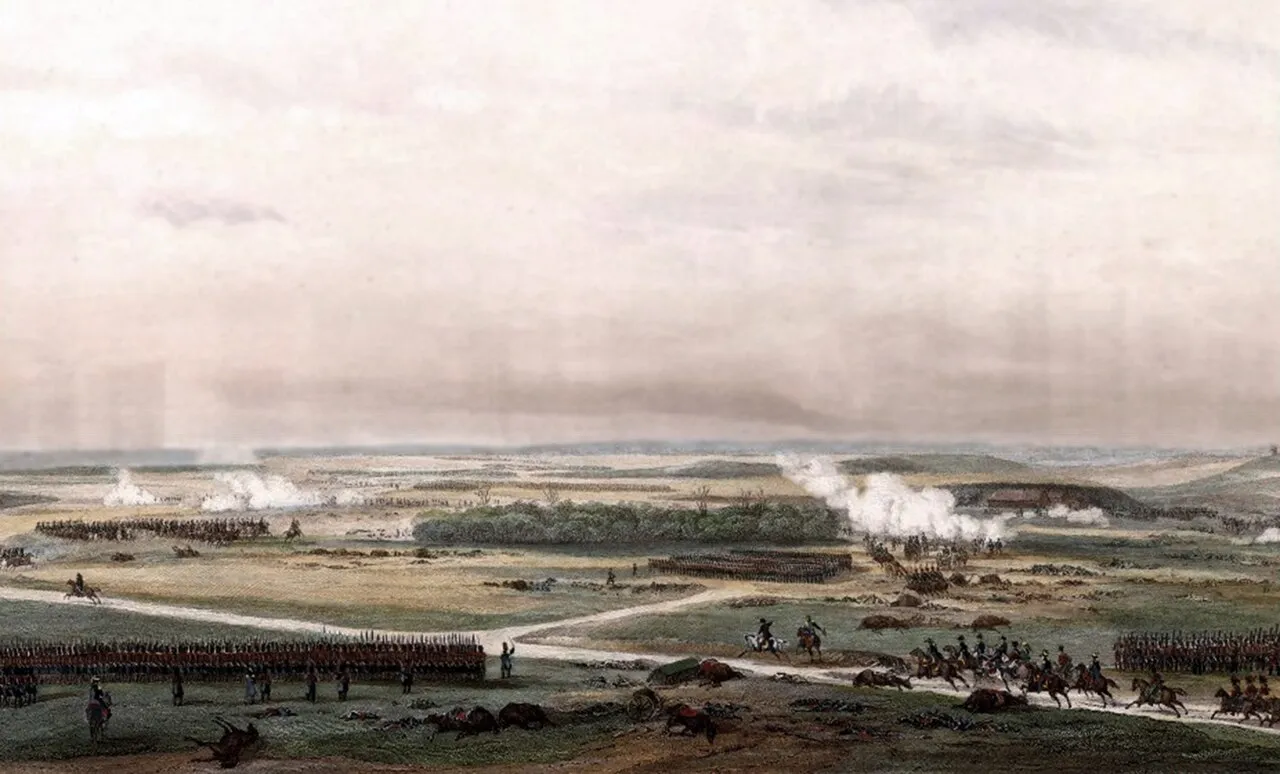
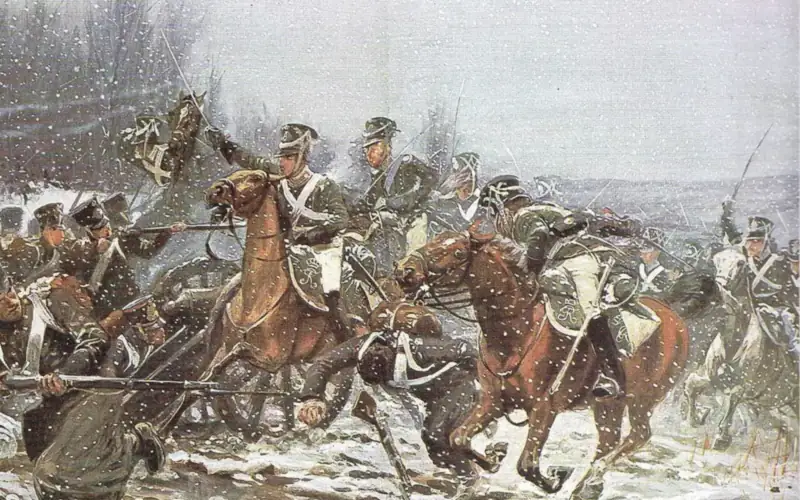
At about one in the afternoon a Russian counter-attack threatened to throw the French back into the valley; the Guard batteries under Drouot stopped it. A dragoon charge failed shortly afterwards, and Grouchy was wounded leading it; Belliard took command of the cavalry. General Laferrière-Levesque in turn launched the Guard horsemen, among them the newly raised Éclaireurs, against the great Russian battery in the centre. He lost a leg, and the charge spent itself against the squares.
The turning point came with the arrival of reinforcements. Charpentier’s division took the woods flanking the position and linked up with Nansouty, while Drouot massed several dozen Guard guns and crushed the Russian line with canister. The Russian skirmishers, out of ammunition, abandoned Ailles. The plateau had been taken.
Vorontsov’s retreat
Blücher had ordered the retreat by mid-afternoon, understanding that Winzingerode’s manoeuvre would not come. Vorontsov carried it out like a parade-ground drill: his battalions fell back westwards along the plateau, in echelons and squares, never allowing themselves to be broken. Near Cerny, Sacken’s artillery, drawn up across the ridge, stopped the pursuit dead and laid whole ranks of French infantry on the ground; the Russian cavalry covered the rest of the withdrawal.
Part of the allied troops went down to the Ailette and crossed it at Chevregny under fire; the rest reached the Laon road. The pursuit ended with nightfall. The Emperor slept at Braye, on a battlefield he had conquered but where the enemy had left neither gun nor colour.
A Pyrrhic victory
The tallies vary, as always in 1814. French sources put their own losses at about five thousand four hundred killed and wounded, while other counts go as high as eight thousand; Victor, Grouchy, Laferrière-Levesque and Boyer de Rebeval were among the wounded. The Russians admitted 4,785 killed, wounded and missing, and French authors credit them with around five thousand casualties. General Lanskoy was mortally wounded. Proportionally the day cost Napoleon far more: he lost nearly one in five of the men he had committed, whereas Blücher lost only a small fraction of his army.
Several historians have called it a Pyrrhic victory. The ground had been won, but nothing Napoleon was after had been: Blücher was neither cut off from Laon nor forced into battle on bad terms. The effort against Vorontsov had on the contrary stretched the French army towards Soissons and obliged the Emperor to pursue the Allies head-on, along the only road that led to their position.
Laon, then eclipsed by another war
Two days later, on 9 and 10 March, Napoleon attacked the Army of Silesia assembled on the hill of Laon. He could not dislodge it, and Yorck’s night attack on Marmont’s corps at Athies turned the check into a defeat. Craonne was thus the last day on which the Emperor gained the upper hand over Blücher during the campaign in France.
Before long the name of Craonne would call up something else. A century later the Chemin des Dames became one of the deadliest theatres of the Great War, and the village, razed in the fighting of 1917, was rebuilt below its former site. A first monument raised at Hurtebise farm for the centenary of 1814, inaugurated in March 1914, did not survive the fighting. The one that replaced it in 1927 joins the young conscripts of 1814 and those of 1914 in a single tribute. In 2014 the bicentenary of the battle was commemorated on the plateau.
Discover other battles
 Victory
Read the account
Vauchamps
14 February 1814
Vauchamps, Marne, Champagne
 Victory
Read the account
Montmirail
11 February 1814
Montmirail, Marne, Champagne
 Victory
Read the account
Champaubert
10 February 1814
Champaubert, Marne, Champagne
 Defeat
Read the account
La Rothière
1 February 1814
La Rothière, Aube, Champagne
Go further
Recommended books to dig deeper (affiliate links)

The Campaigns of Napoleon
David G. Chandler · 1966
Eleven hundred pages on Napoleonic warfare, a staff-college standard for sixty years.
See on Amazon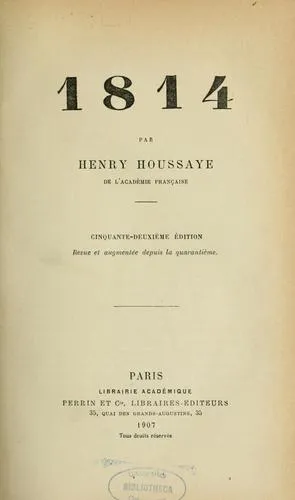
1814
Henry Houssaye · 1888
The narrative of the 1814 campaign in France, from the January invasion to the abdication at Fontainebleau, published by Henry Houssaye in 1888 and reissued many times; its troop counts are still cited by historians of 1814.
See on Amazon
Napoleon the Great
Andrew Roberts · 2014
A monumental biography drawing on Napoleon’s 33,000 surviving letters, admiring but rigorous.
See on AmazonAs an Amazon Associate, this site earns from qualifying purchases.
Support the encyclopedia
Napoleon Empire is an independent project. Your contribution helps grow the content and keep the site running.
DonateSecure payment on the platform you choose.