Origins and revolutionary inheritance
Napoleonic line infantry inherited the Revolutionary demi-brigades, reorganised as regiments under the Consulate. The decree of 24 September 1803 (1 Vendémiaire Year XII) restored the name "regiment" and fixed a structure that, with variations, lasted until 1815.
These units were no invention of the coronation: they already carried the traditions of the Italian and Egyptian campaigns. What the Empire added was scale — dozens of regiments aligned under one doctrine of manoeuvre, uniform and fire.
The line soldier was not always a veteran: conscription supplied young contingents, while cadres — corporals, sergeants, adjutants — ensured tactical continuity from campaign to campaign.
Organisation and strength
A line regiment comprised in principle several battalions; exact composition varied by year and wartime need. Around 1805-1808 one often finds two war battalions, later three or more in periods of expansion.
Each battalion fielded fusilier companies, a grenadier company and, after Consular then Imperial reorganisation, a voltigeur company. Grenadiers formed the shock elite; voltigeurs, the skirmishing elite.
Theoretical regimental strength often sat around two to three thousand men, but real field figures — after marches, disease and combat — were almost always lower. In 1812 line regiment numbering extended widely (into the hundreds on period lists), without every unit being at full strength.
Within a division, two brigades of two regiments was a frequent pattern, backed by divisional artillery. That combination — infantry mass and field guns — gave the Grande Armée its breaking power.
Uniform and armament
The blue coat with white lapels (or regimental distinction colours by period), trousers, shako and knapsack composed the familiar silhouette. Details — buttons, piping, shako number — identified the corps.
The main weapon remained the flintlock Charleville model 1777 musket (and corrected variants), bayonet fixed. Effective rate of fire stayed limited: a few rounds a minute for a trained soldier in dry powder and fire discipline.
The short sabre equipped part of the elite companies; most fusiliers relied on musket and bayonet. Cartridges, pouch and pack weighed heavily on daily marches — as much as combat itself.
Battlefield tactics
Napoleonic doctrine combined line for fire and column for assault. The line maximised musketry volume; the attack column concentrated mass to pierce or carry a position.
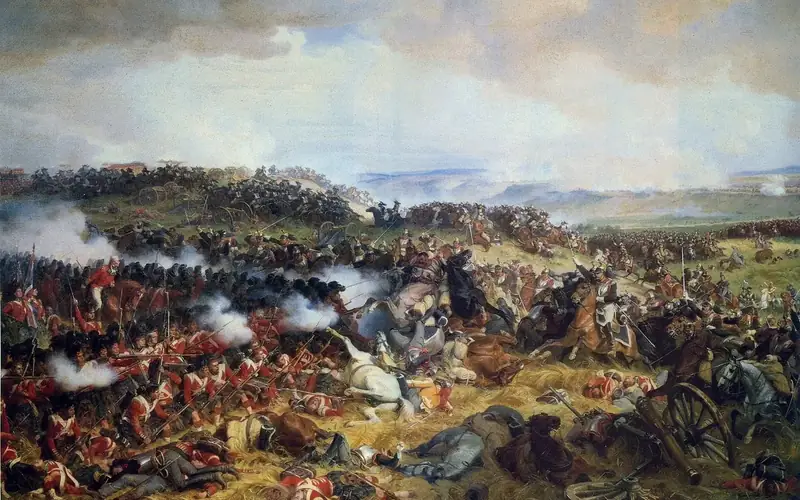
Skirmishers often preceded the mass: voltigeurs and detached companies harassed the enemy, masked movement and prepared the battalions' arrival. When cavalry threatened, the infantry square remained the classic answer.
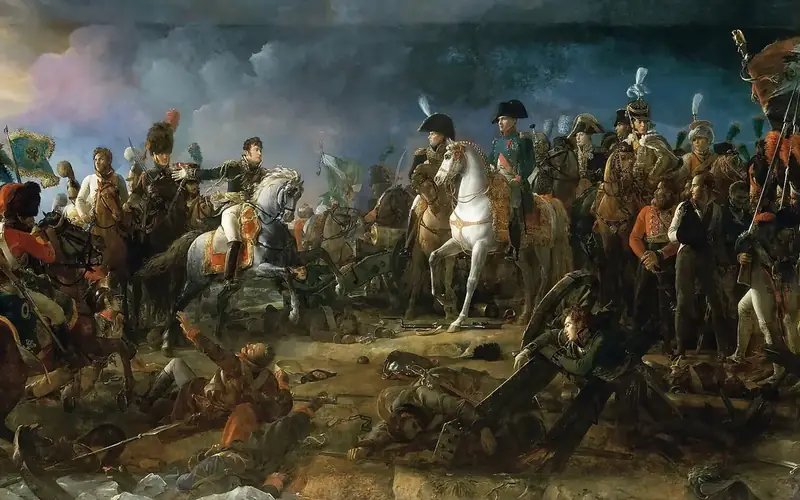
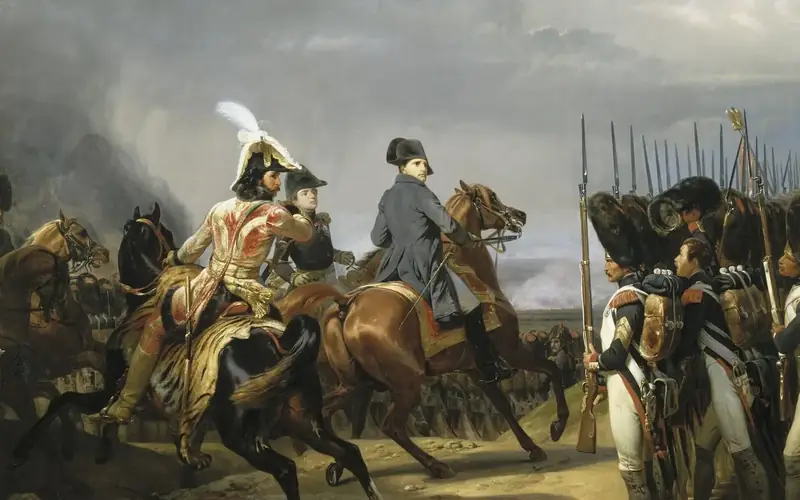
At Austerlitz (2 December 1805), line regiments of Soult's corps climbed the Pratzen Heights and fixed the Allied centre. At Jena (14 October 1806), the same methodical advance broke Prussian dispositions. These were not isolated charges: this was manoeuvre infantry, backed by guns.
Battle honours
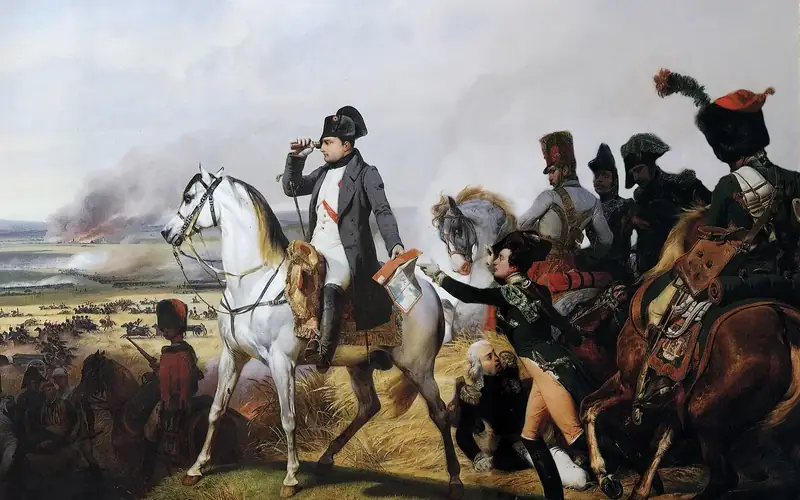
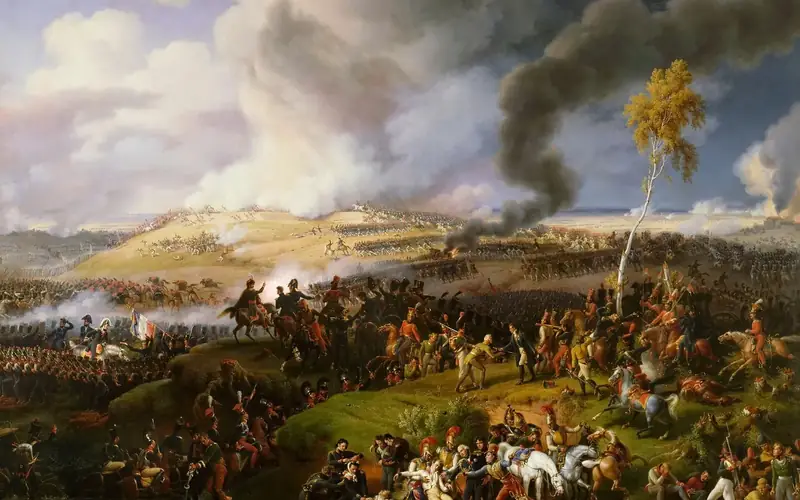
Besides Austerlitz and Jena, line infantry bore the weight of Eylau (8 February 1807), Wagram (5-6 July 1809) and Borodino (7 September 1812). Losses were often cruel: tactical "success" was paid in decimated companies.
In Spain and Portugal, line regiments met a war of attrition — ambushes, sieges, marches in a hostile country — far from the German set-piece battles. At Waterloo (18 June 1815), French columns met a firmly established Anglo-Allied defence; line infantry fought there until the army's final rupture.
Regimental eagles, issued after 1804, crystallised corps honour: capturing them became an enemy trophy, defending them a moral duty for the battalions.
Legacy
Line infantry fixed, for nineteenth-century Europe, the image of the blue-shakoed foot soldier advancing under fire. Regulations, drill manuals and veterans' memoirs transmitted that memory.
For Empire Napoléon it remains the people in arms of the epic: less spectacular than the Guard or the cuirassiers, yet indispensable to every victory and every defeat of the Empire.