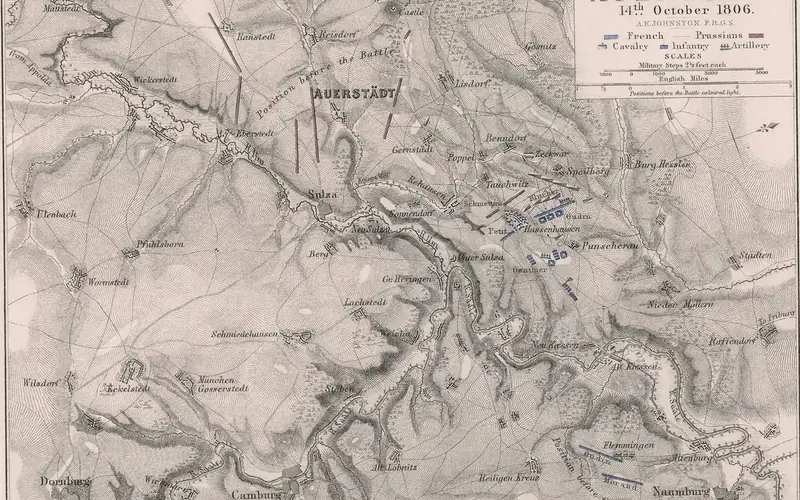
The Battle of Jena, fought on 14 October 1806 on the plateau above the Saale in Thuringia, pitted Napoleon against Prince Hohenlohe's Prussian and Saxon army. Emerging by surprise from the Landgrafenberg in the fog, the Grande Armée broke Tauentzien's advance guard, outflanked the Prussian wings and then crushed, in front of Vierzehnheiligen, an infantry that had stood for hours in the open. Rüchel's corps, arriving too late, was swept away in turn. The same day, at Auerstedt, Davout alone defeated the King's main army. Within weeks, the double victory brought about the collapse of Prussia.
Forces at play
Outcome: Decisive French victory

France
- Napoléon
- Lannes
- Ney
- Soult
- Augereau
- Murat
Up to 96,000 men present, of whom 40,000 to 54,000 engaged
Casualties: 5,000 to 7,500 killed and wounded depending on the source

Prussia · Saxony
- Hohenlohe
- Tauentzien
- Grawert
- Holtzendorff
- Rüchel
~38,000 men and 120 guns (Hohenlohe), then 15,000 (Rüchel)
Casualties: ~10,000 killed and wounded, 10,000 to 15,000 prisoners, ~150 guns
Flags: David Liuzzo, Wikimedia Commons
Battle coordinates
Jena
Coordinates 50.9733° N · 11.5358° E
Interactive tactical map
Follow the battle hour by hour — hover over or tap a unit for its details.
Lannes on the Landgrafenberg
Lannes’s corps has taken Jena and the Landgrafenberg ridge, abandoned by a Saxon battalion. Napoleon arrives there at about 4 p.m. with the Guard. All night guns are hauled up the Steiger, and more than 40,000 men crowd onto the ridge. Opposite, Tauentzien’s advance guard camps at Closewitz and Lützeroda, with Hohenlohe’s main body further west.
The Prussian commanders think it impossible to haul guns up the slope and do nothing. Napoleon sleeps among his Guard on the Windknollen.
Positions reconstructed from accounts of the battle and placed on the actual locations of the villages and heights of the Jena plateau. Timings, on which sources do not always agree, are indicative. The battle of Auerstedt, fought the same day some twenty kilometres to the north, is not shown.
Battle narrative
Prussia goes to war
After Austerlitz, Napoleon redrew the map of Germany. The Peace of Pressburg, signed on 26 December 1805, enlarged his southern allies: Bavaria and Württemberg became kingdoms, Baden and Hesse-Darmstadt grand duchies. In July 1806 sixteen German princes formed the Confederation of the Rhine under his protection and left the Holy Roman Empire; on 6 August Francis II laid down the imperial crown, and the Holy Roman Empire ceased to exist.
Prussia, neutral in 1805, watched the threat grow on its doorstep. Napoleon had won it over by offering Hanover, a possession of the King of England, in exchange for territories ceded to France and Bavaria; the treaty, toughened in Paris in February 1806, set Prussia at odds with London. When Berlin learned the following summer that Napoleon, negotiating with the British, was considering handing that same Hanover back to them, the court swung round. The war party gathered around Queen Louise, the minister Hardenberg, the Duke of Brunswick and Prince Hohenlohe prevailed over King Frederick William III and the minister Haugwitz, who wanted peace. Mobilisation began in August. On 26 August 1806 an ultimatum demanded that Napoleon withdraw his troops beyond the Rhine by 8 October.
Two armies, two eras
The Prussian army still lived on the glory of Frederick the Great, who had died twenty years earlier. Its linear tactics had changed little since his wars; only a few units had mastered skirmishing. It had been organised into divisions only on the eve of the war, its generals were old, and its supply depended on heavy wagon trains. Command was divided: the main army was under the elderly Duke of Brunswick, in the King's presence; a second army under Prince Hohenlohe; a third under General Rüchel. Three officers even shared the post of chief of staff: General Phull and Colonels Scharnhorst and Massenbach. Plans followed one another without any being settled, and the initiative passed to the French.
Facing them, the Grande Armée had emerged victorious from the 1805 campaign. It was organised into army corps capable of acting on their own, lived off the land rather than on supply trains, marched fast and combined skirmishers, columns and lines. Napoleon committed between 180,000 and 190,000 men to the campaign, depending on the count. The Prussians and their Saxon allies fielded some 150,000, including about 20,000 Saxons.
The battalion square through the Thuringian Forest
Napoleon wanted to beat Prussia before the Russians arrived. Having ruled out other routes, he concentrated his corps in Franconia and struck north-east towards Leipzig and Berlin, to cut the Prussians off from their capital and the Saxons from their country. On 8 October, the very day the ultimatum expired, the Grande Armée crossed the Thuringian Forest in three columns: on the left Lannes and Augereau towards Saalfeld; in the centre Bernadotte, Davout, the Guard and Murat's cavalry through Kronach and Lobenstein; on the right Soult and Ney towards Hof. The columns marched close enough to support one another: this was the "battalion square".
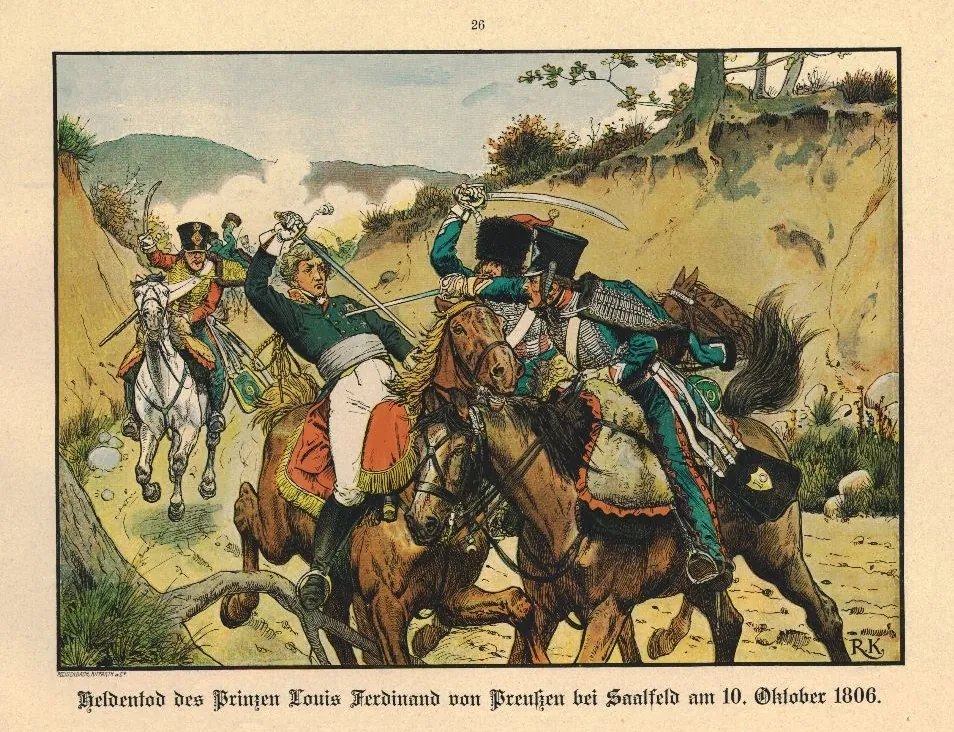
On 9 October at Schleiz, Murat's cavalry, backed by Bernadotte's infantry, drove back the Prusso-Saxon advance guard of General Tauentzien: it was the first serious clash of the war. The next day, at Saalfeld, Lannes crushed the advance guard of Prince Louis Ferdinand of Prussia, a nephew of Frederick the Great and a musician whose piano playing Beethoven admired. The prince was killed in a cavalry fight, most probably by Sergeant Guindey of the 10th Hussars. News of his death demoralised the Prussian troops.
13 October: Lannes seizes the Landgrafenberg
Napoleon did not know exactly where the enemy army was; he believed it further north, around Gera or Leipzig, and sent part of his cavalry that way, while Davout and Bernadotte marched on Naumburg. The Prussians, for their part, had decided on 12 October not to give battle straight away: Brunswick's main army was to move north by way of Auerstedt so as not to be cut off from Berlin, while Hohenlohe near Jena and Rüchel at Weimar covered the movement.
On the morning of 13 October, Lannes's corps, 22,000 men, crossed the Saale and entered Jena. Above the town, the Landgrafenberg ridge was held by a single Saxon battalion, which withdrew without serious resistance. The Prussian commanders were not concerned: they thought it impossible to haul guns up such a steep slope. Lannes discovered Hohenlohe's bivouacs on the plateau. Napoleon, convinced he had at last found the bulk of the Prussian army, brought his corps together on Jena. He reached the Landgrafenberg at about 4 p.m. with the Guard.
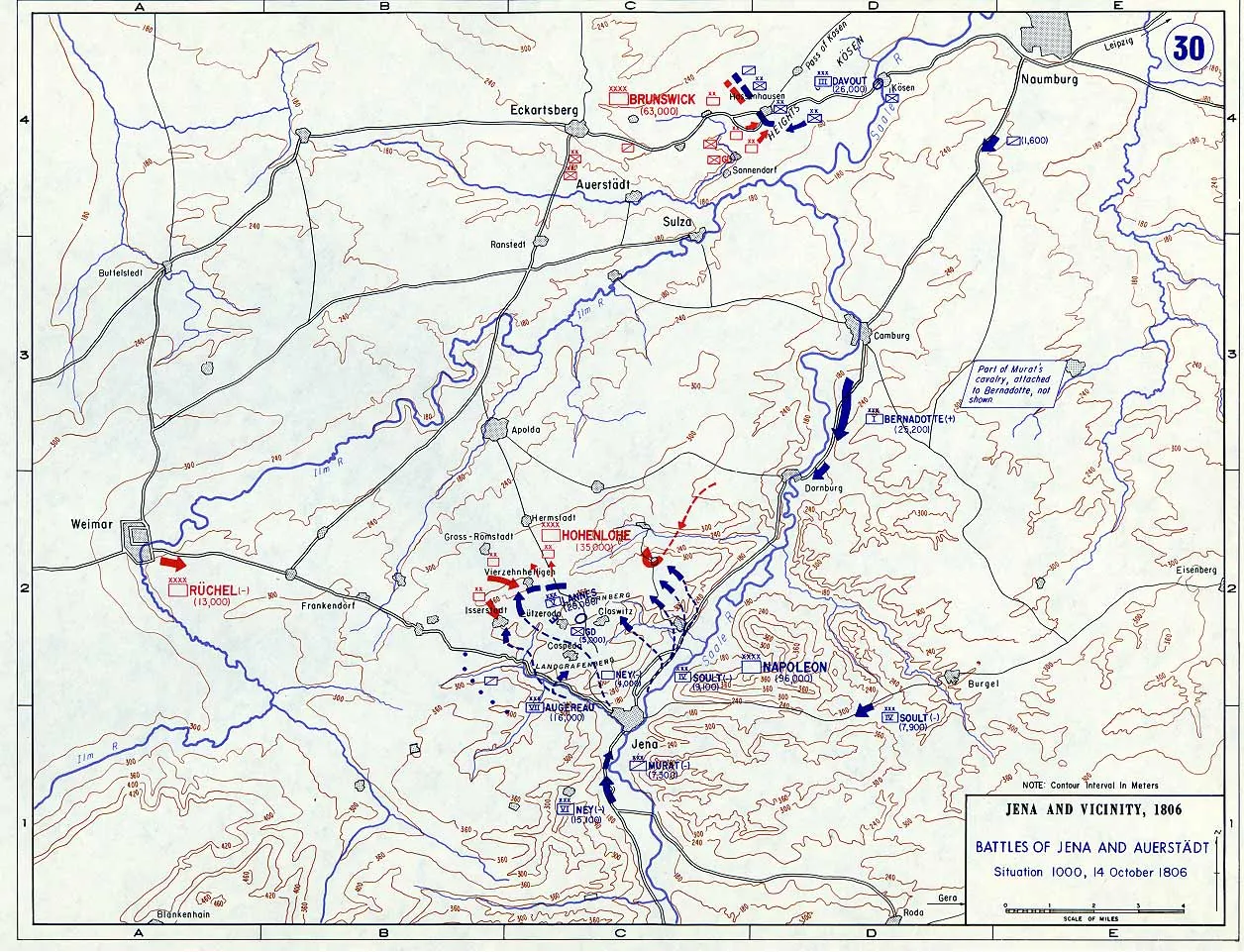
The ground explains the surprise. Jena lies deep in the Saale valley, overlooked to the west by a steep-sided plateau cut by ravines and wooded valleys. On the edge of the plateau, the Landgrafenberg, at 280 metres, and the Windknollen, at 363 metres, command a view of the whole valley in clear weather. On the plateau, the villages of Cospeda, Lützeroda, Closewitz and, further on, Vierzehnheiligen and Isserstedt line the road from Jena to Weimar. Colonel Massenbach had laid out the Prussian camp along that road, facing south-west, the direction from which the French were expected. They would come from the south-east, up the escarpment of the valley.
During the night the artillery was hauled up the steep Steiger path; when the column jammed, the Emperor stepped in personally to get it moving again. Soult's and Augereau's corps arrived during the night. More than 40,000 men crowded onto a narrow ridge, packed so tightly that each rank almost touched the one in front, less than half a cannon shot from the Prussian outposts, without the enemy noticing. Napoleon slept among his Guard on the southern slope of the Windknollen. At about 10 p.m. he had written to Davout to march by way of Apolda and head towards the sound of the guns.
In the occupied town, the philosopher Hegel, who taught at the university, had just finished the manuscript of the Phenomenology of Spirit in great haste. On 13 October he wrote to his friend Niethammer that he had seen the Emperor, "this world-soul", riding past.
The opposing forces
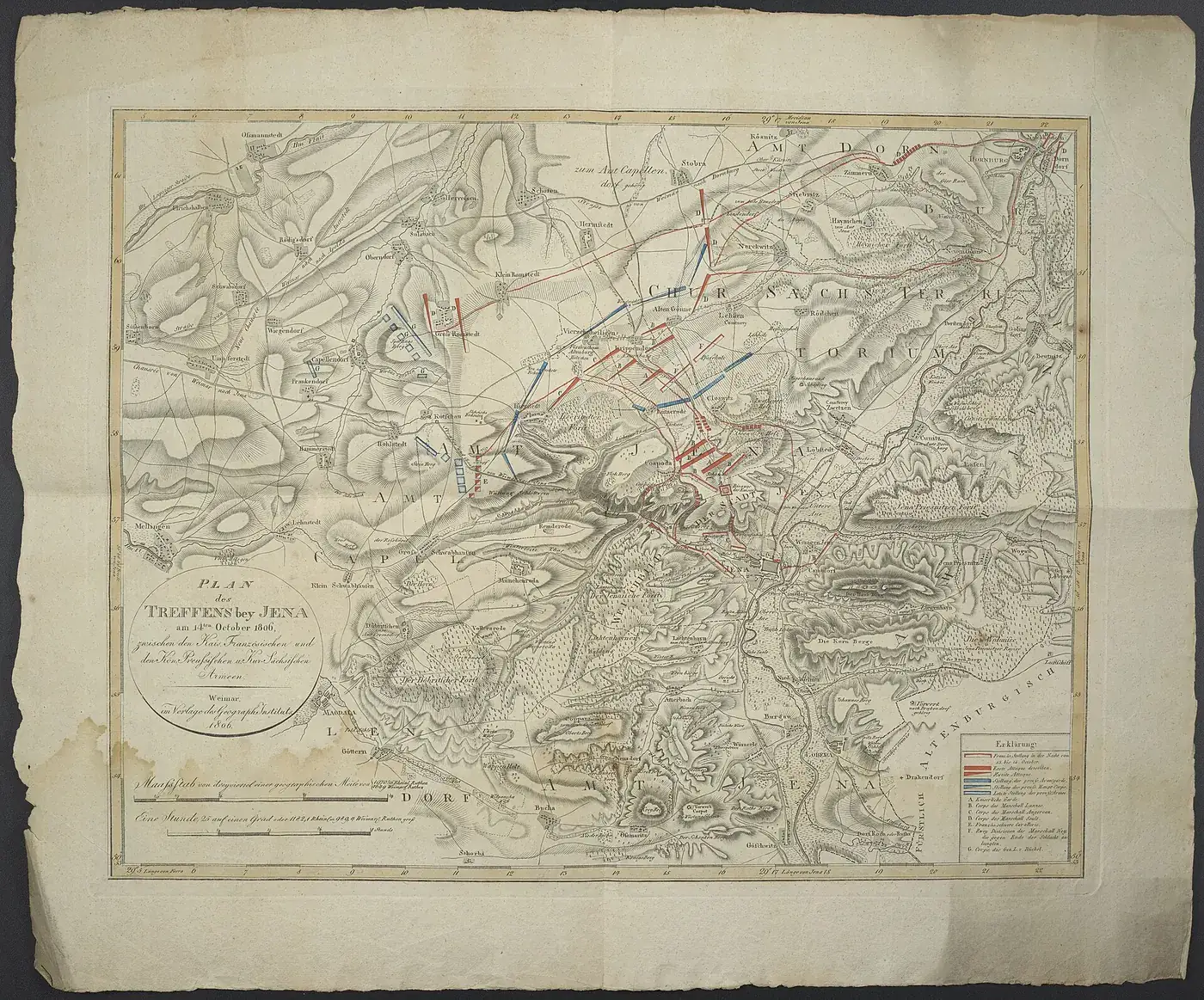
At dawn on 14 October Napoleon had about 46,000 men and 70 guns on the Landgrafenberg and in the neighbouring valleys, 56,600 according to other counts. The reinforcements arriving during the morning, Soult's and Ney's corps and Murat's cavalry, brought his strength up to 96,000 men, but only half of them, 40,000 to 54,000 depending on the estimate, actually took part in the fighting. The Emperor still believed he faced the entire Prussian army, which he put at over 100,000 men.
In reality Hohenlohe had only about 38,000 Prussians and Saxons and 120 guns at hand, spread over several kilometres. Tauentzien's advance guard, 8,000 men, was camped opposite the Landgrafenberg around Closewitz and Lützeroda; the bulk of the army was camped further west, between Vierzehnheiligen and Kapellendorf, where Hohenlohe was quartered with his staff in the castle; General Holtzendorff covered the left towards Dornburg. Rüchel's corps, 15,000 men, was still at Weimar, 17 kilometres from Vierzehnheiligen. Many units had not recovered from the confusion of the previous days: some battalions were at half strength, and hunger was sapping morale.
Six o'clock: the attack in the fog
At about 4 a.m. Napoleon gave Lannes his final instructions, then rode along the ranks and reminded the soldiers of the victory at Ulm a year earlier. A thick fog covered the plateau, as at Austerlitz ten months before. It hampered the Emperor's last reconnaissance, but it also hid from the Prussians the mass crammed onto the ridge; in clear weather, General Savary would later note, every Prussian round would have struck home.
At about 6 a.m. the French artillery opened fire on Closewitz. Lannes's two divisions went down into the fog, Suchet's on the right, Gazan's on the left. Visibility was barely a hundred paces. The columns ran into Tauentzien's battalions and fighting broke out at point-blank range amid confusion. Suchet took Closewitz; Gazan, first thrown back before Cospeda, broke the Prussian counter-attack with the fire of his artillery. Lannes, unable to judge the forces in front of him, believed the enemy stronger than it was.
At headquarters in Kapellendorf, no one imagined that Napoleon would dare attack from Jena with a river and steep slopes at his back. Breakfast was taken at leisure until about 7 a.m.; Hohenlohe did not take the first reports seriously and, around 8 a.m., was still countermanding General Grawert's order to strike camp. The fog then began to lift. Tauentzien, having abandoned Closewitz, Cospeda and Lützeroda, fell back towards Vierzehnheiligen; with 5,000 men he launched a vigorous counter-attack that briefly split the French, and there was fighting around 8.30 a.m. on the Dornberg, the highest point of the plateau. Then he withdrew towards Klein Romstedt. Only at 8.30 did Hohenlohe order his army to react.
Augereau and Soult on the wings
While Lannes opened up the plateau, the neighbouring corps came out on his flanks. On the left, Augereau advanced up the Mühltal valley, the natural route from Jena to Weimar; Desjardin's division broke into Isserstedt, followed by Heudelet's division. Facing them were General Zezschwitz's Saxons, in a defensive position on the height known as the Schnecke.
On the right, Saint-Hilaire's division of Soult's corps came out of Löbstedt and Zwätzen and climbed onto the plateau, where it ran into Holtzendorff's 5,000 men coming from Dornburg. Shortly after 10 a.m., Saint-Hilaire, hidden behind a fold in the ground near Rödigen, burst onto the Prussians' left flank. They fell back across the Nerkewitz stream, covered by their cavalry, which the French horsemen broke through: 400 prisoners, 6 guns and 2 colours fell into their hands. Rallied behind Nerkewitz, Holtzendorff was outflanked and charged again; his troops fled towards Apolda. He saved only his cavalry and one battery. General Sanitz was wounded and captured.
Hohenlohe commits his army
At about 9 a.m. Hohenlohe at last understood that he was not facing a mere detachment. The arrival of the beaten Tauentzien convinced him. He urgently asked Rüchel to join him from Weimar, had three Saxon brigades form along the Weimar road to keep it open, then called up the rest of his Prussian infantry and sent Grawert's division to contest the plateau.
The reinforcements arrived piecemeal. By 11 a.m. eleven battalions stood in line facing Lannes's corps, with the Saxons on their right and the Prussian cavalry drawn up alongside. Grawert's Prussians advanced in oblique order towards the village of Vierzehnheiligen. Napoleon, for his part, had halted the offensive in the centre and on the left: he was waiting for his reinforcements to cross the Saale and extend his line.
Ney's initiative
It was then that Marshal Ney entered the battle without orders. Impatient, he threw his advance guard, two light cavalry regiments and five battalions, into the gap between Lannes and Augereau, south of Vierzehnheiligen, still screened by a bank of fog. He attacked a powerful Prussian battery and at first succeeded: the Prussian right gave way, the gunners abandoned their pieces, and the cavalry about to charge Lannes briefly fell back.
But Ney had gone too far. The Prussian cavalry recovered and surrounded him; he had to form square, cut off from both Lannes and Augereau. Napoleon sent General Bertrand to his aid with the two cavalry regiments forming the army's reserve, ordered Lannes to break through towards Vierzehnheiligen to reach Ney, and Augereau to form a second line. The pressure eased, but no more. Lannes's troops ran into Grawert's Prussians; the fighting was fierce and costly on both sides. The French were driven back, Lannes's skirmishers fell back into the village, and Ney had to give up Isserstedt and its woods. The Emperor was displeased by this initiative but handled the matter discreetly.
Vierzehnheiligen: two hours under fire
The battle reached its climax, and Hohenlohe had his chance to reverse the morning's setbacks. His entourage urged him to attack Vierzehnheiligen. He hesitated and preferred to wait for Rüchel. For an hour and a half to two hours, nearly 20,000 Prussian infantrymen stood in line in the open in front of the village, within range of French muskets and guns that cut them down. Their howitzers destroyed a few French pieces and blew up some caissons, but the situation kept getting worse. A Prussian general would later write that the approaches to the village were the scene of the most terrible slaughter.
Lannes tried to break the deadlock with a frontal and flank attack on the Prussian left. Hohenlohe bent back his left, the Prussians gave ground, then a sudden charge by the Saxon cavalry threw the French back. Once again Hohenlohe could not exploit his success: on his right, Ney, supported by Lannes, pushed through the Isserstedt woods and reached the main Weimar road, cutting off three Saxon brigades from the rest of the army, while fresh French columns appeared from the direction of Jena. By 1 p.m. all of Hohenlohe's troops were engaged except Tauentzien's shattered division. Rüchel, meanwhile, had advanced barely five kilometres in two hours.
One o'clock: the general assault
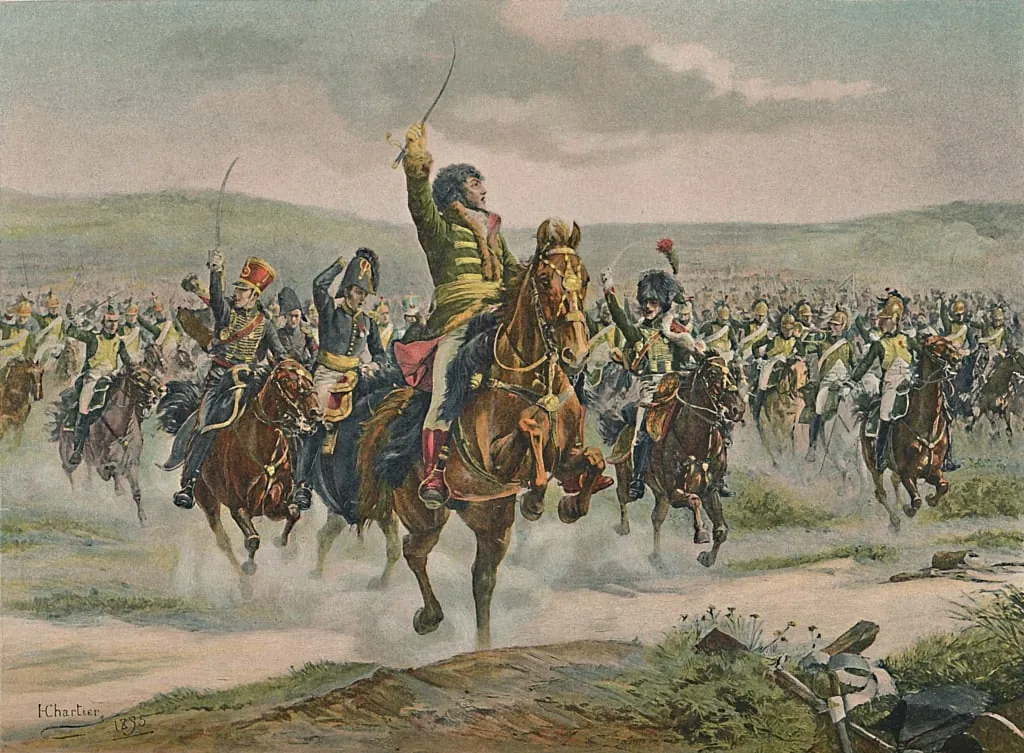
Meanwhile French reinforcements had been pouring across the Saale. At noon Napoleon held some 42,000 men in reserve, Murat's cavalry and the main bodies of Soult's and Ney's corps, on top of the 54,000 already engaged. He ordered a general attack. On the right, Saint-Hilaire was to fall on the remnants of Holtzendorff; on the left, Augereau, in action since 11.30, on the Saxons entrenched in the Schnecke pass; in the centre, Ney and Lannes would deliver the main blow, to be exploited by Murat's cavalry once the wings were broken. At about 1 p.m., with Saint-Hilaire ready, Napoleon gave the signal. The Guard remained in reserve, much to the frustration of its grenadiers.
The Prussian cavalry and artillery tried to check the assault, but their movements opened gaps that the French exploited at once. The line broke up. Hohenlohe ordered a general retreat towards Gross and Klein Romstedt. It began in good order, then Murat's cavalry fell on the columns and turned it into a rout. The fugitives streamed back towards Weimar. A battalion of Saxon grenadiers under Colonel Winkel withdrew in square without being broken and covered part of the flight. Further north, Tauentzien held the French up for a while at Gross Romstedt, but lost 2,500 prisoners, 16 guns and 8 colours there.
Rüchel arrives too late
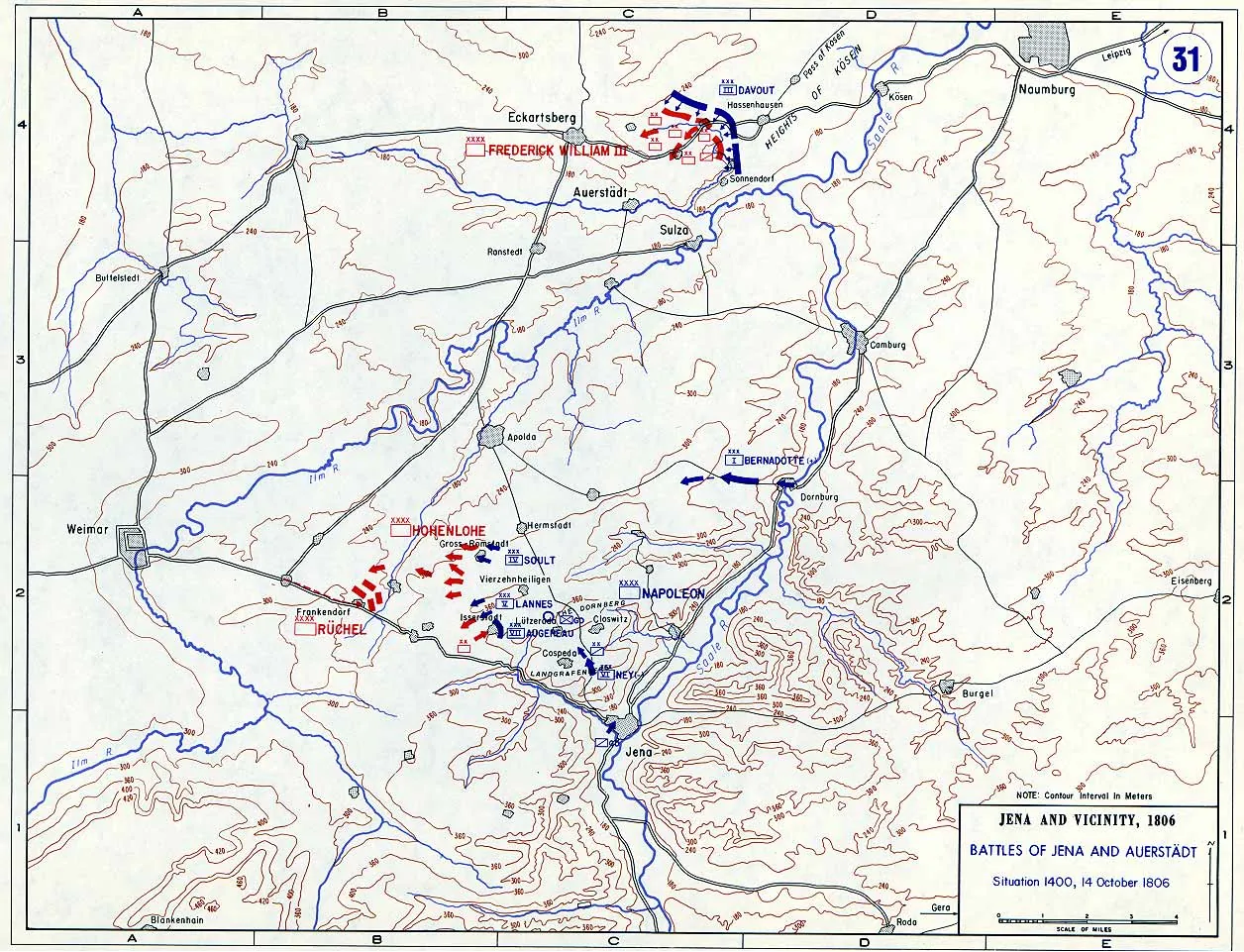
At about 1 p.m. Rüchel's corps reached Kapellendorf, where it met the flood of Hohenlohe's fugitives. Instead of holding the line of the Sulzbach to cover the retreat, Rüchel deployed his 15,000 men between Kötschau and Romstedt and attempted a counter-attack. The arrival of Lannes's and Ney's infantry made the position untenable. The retreat, orderly at first, collapsed under French artillery fire and the charge of Murat's cuirassiers. Rüchel's corps lost 4,000 prisoners and 5 colours; its commander was severely wounded. His soldiers merged into the mass of fugitives streaming towards Weimar and the fortress of Erfurt.
By about 3 p.m. all organised resistance had ceased. The pursuit went on all afternoon. At about 5 p.m. Murat entered Weimar. Tauentzien withdrew towards Apolda, holding Soult at bay; elsewhere only nightfall saved the survivors.
Weimar was plundered. In his house, Goethe was threatened by French soldiers; his companion Christiane Vulpius intervened and got him out of danger. He married her five days later, on 19 October 1806, and had the date of the battle engraved on the wedding rings.
Meanwhile, at Auerstedt
Some twenty kilometres to the north, another battle was fought the same day without Napoleon knowing anything about it. Davout's III Corps, about 27,000 men and 44 guns, was marching south from Naumburg through the Kösen defile, in accordance with orders received during the night. In the fog near the village of Hassenhausen, at about 7 a.m., its advance guard ran into the main Prussian army marching north with the King and the Duke of Brunswick: 50,000 to 64,000 men depending on the estimate, with far superior cavalry and artillery.
Davout threw Gudin's division into Hassenhausen, then committed Friant's division on Gudin's right when it arrived at about 9.30. Formed in squares, his battalions repulsed Blücher's cavalry and successive Prussian attacks. Under the canister, the only words heard in the French ranks were the order to "close ranks". Davout kept his chasseurs à cheval under cover behind a reverse slope and launched them at the decisive moment against Blücher's squadrons, already battered by infantry and artillery fire. Shortly before 10 a.m. Brunswick ordered a general assault on Hassenhausen. At about 10 a.m. the Duke of Brunswick was struck in the head by a musket ball that blinded him; he was mortally wounded. General Schmettau was also badly wounded. No one took over supreme command, and the Prussian generals each fought on their own. At about 10.30 Oswald's infantry and the Prince of Orange arrived; the King made his only decision of the day, splitting these troops between the two wings. On the French side, Morand's division, arriving in turn, secured Gudin's left. At about 11 a.m., seeing the Prussians waver, Davout went over to the offensive. By noon Schmettau's centre had been driven back across the Lissbach stream and Blücher's cavalry was spent. In the early afternoon the King ordered a retreat, without having committed Field Marshal Kalckreuth's reserve.
Davout had lost more than 7,000 men killed or wounded, a quarter of his corps; the Prussians about 10,000 killed or wounded and 3,000 prisoners. As they withdrew, their columns, still in order, ran into the crowd of fugitives from Jena, and the two beaten armies merged into a single disaster.
Bernadotte, the great absentee
Marshal Bernadotte and his I Corps fought neither at Jena nor at Auerstedt. During the night Davout had passed on to him an order from Berthier: if Bernadotte was with him, they could march together, but the Emperor hoped he would be at Dornburg, his planned position. Bernadotte chose Dornburg. His troops struggled up the slopes above the Saale and reached neither battlefield; by evening they held the heights of Apolda, on the Prussian line of retreat.
His conduct caused a scandal within a week. Davout and Bernadotte became bitter enemies. On Saint Helena, Napoleon would say that but for his affection for Bernadotte's wife, Désirée Clary, he would have had him shot. Yet the affair is less clear-cut than it seems: no order instructing Bernadotte to march with Davout has ever been found in the archives, and Bernadotte followed the last written instructions he had received. Napoleon sent him a severe reprimand but went no further.
"Your marshal is seeing double"
On the evening of 14 October Napoleon believed he had beaten the bulk of the Prussian army. At the first report that III Corps alone had defeated the King's army, he refused to believe it and is said to have replied that the marshal must be seeing double, an allusion to Davout's poor eyesight. He came round to the truth, and his praise was unstinting: Davout would be made Duke of Auerstedt. On 15 October at 3 a.m. he wrote to Joséphine: "My dear, I have carried out some fine manoeuvres against the Prussians. Yesterday I won a great victory. They were 150,000 men; I took 20,000 prisoners, 100 guns and colours."
The historian Martin van Creveld summed up the paradox of the day: Napoleon knew nothing of the main action, forgot about two of his corps, gave no orders to a third, was surprised by the initiative of a fifth and saw one of his principal subordinates disobey; yet he won what was perhaps the greatest single triumph of his career. Clausewitz, who took part in the campaign in the Prussian ranks, judged that the battle of Jena had not been lost in advance: cramming the troops onto the Landgrafenberg was a considerable risk, and a determined Prussian attack early in the morning could have thrown the French back into the streets of Jena and onto the only two bridges over the Saale. Hohenlohe had prepared such an attack; he abandoned it just as it was about to be launched, when Massenbach returned from headquarters with orders to avoid combat.
The toll
At Jena, French losses are estimated at 5,000 to 7,500 killed or wounded depending on the source. Those of the Prussians and Saxons came to about 10,000 killed or wounded, plus 10,000 to 15,000 prisoners and some 150 guns. At Auerstedt, Davout's corps lost more than 7,000 men and the Prussians more than 13,000 killed, wounded and captured. Both Prussian armies were beaten on the same day; the pursuit finished them off.
The collapse of Prussia
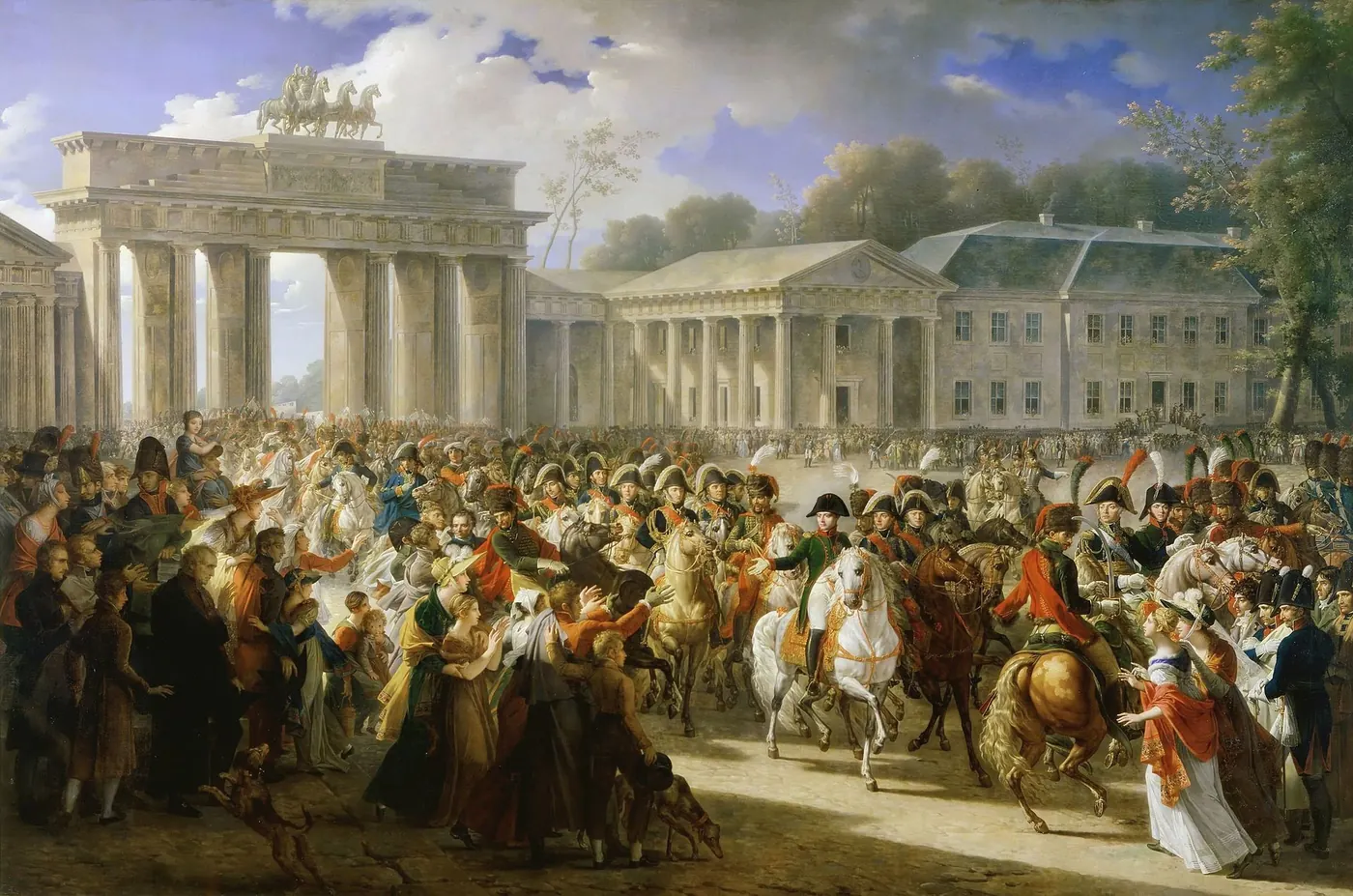
Unlike after Austerlitz, this time Napoleon launched a general pursuit, and it completed the work of the battle. On 16 October Erfurt surrendered to Murat with several thousand men. On the 17th Bernadotte crushed the Prussian reserve of the Duke of Württemberg at Halle. On 25 October, as a reward for Auerstedt, Davout was the first to enter Berlin; Napoleon made his formal entry on the 27th. Passing through Potsdam, he had visited the tomb of Frederick the Great and is said to have told his officers that if that king were still alive, they would not be there.
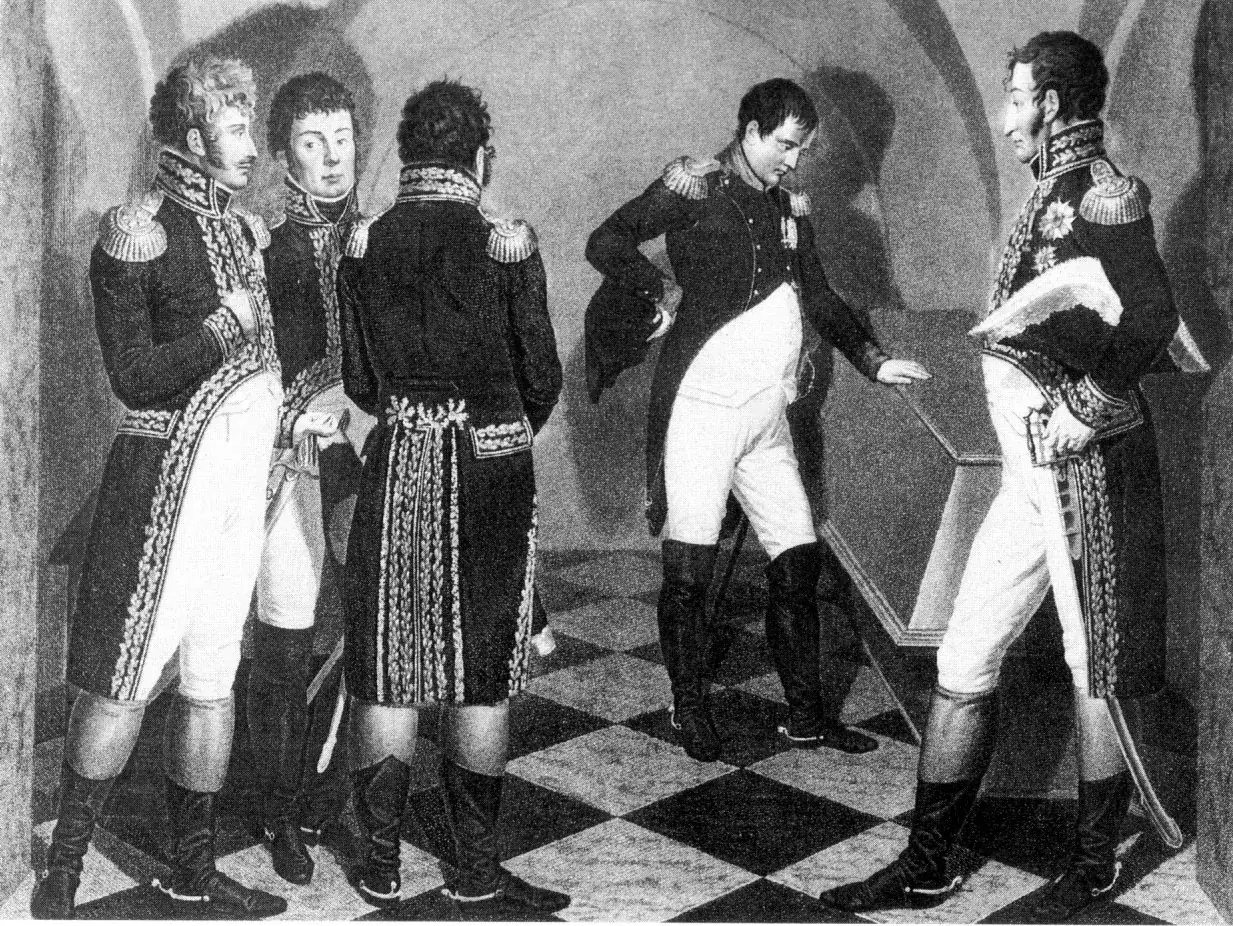
The last Prussian forces were run down one by one. Hohenlohe surrendered at Prenzlau on 28 October. Blücher, who had gathered some 21,000 men west of the Oder, was relentlessly pursued by Bernadotte, Soult and Murat. Unable to cross into Denmark, he violated the neutrality of the free city of Lübeck and entrenched himself there. On 6 November Bernadotte's corps forced the city gates and captured his command post, together with his chief of staff Scharnhorst; on the 7th Blücher surrendered with 9,000 men. Magdeburg opened its gates to Ney on 11 November; other fortresses, Spandau, Stettin and Küstrin, surrendered without a fight. The King and Queen fled east, as far as Memel. From Berlin, on 21 November 1806, Napoleon signed the decree establishing the Continental Blockade against the United Kingdom.
The ease of these surrenders outraged the King. On 1 December, in the Publicandum of Ortelsburg, Frederick William III threatened to have shot any commander who failed to defend his fortress to the utmost. Other fortresses, such as Breslau, Glogau, Danzig and Neisse, then held out until their means were exhausted, and a few, including Kolberg and Graudenz, were still Prussian when peace came. The commanders of the surrendered fortresses were court-martialled; two were sentenced to death, but neither sentence was carried out.
Yet the war was not over: Russia entered the fray, and it would take the winter campaign in Poland, the bloody battle of Eylau and then the victory of Friedland to impose peace. Under the Treaties of Tilsit in July 1807, Prussia lost half its territory. The Convention of Paris of 1808 set its indemnity at 120 million francs and limited its army to 42,000 men.
Jena, the crucible of the Prussian reforms
For Prussia, the double defeat was a watershed. Several of the men who lived through it on the field, Scharnhorst, Gneisenau, Clausewitz, Boyen and Blücher, would be the architects of its revival. The reforms of the following years transformed army and state: the abolition of serfdom, self-government for the towns, military service and the founding of the University of Berlin. It was this reformed Prussia that rose against Napoleon in 1813 and played a decisive part at Leipzig and then at Waterloo. The humiliation of 1806 and the recovery that followed became one of the foundations of German nationalism; Bismarck is credited with saying in 1871: "Without Jena, no Sedan."
The memory of Jena
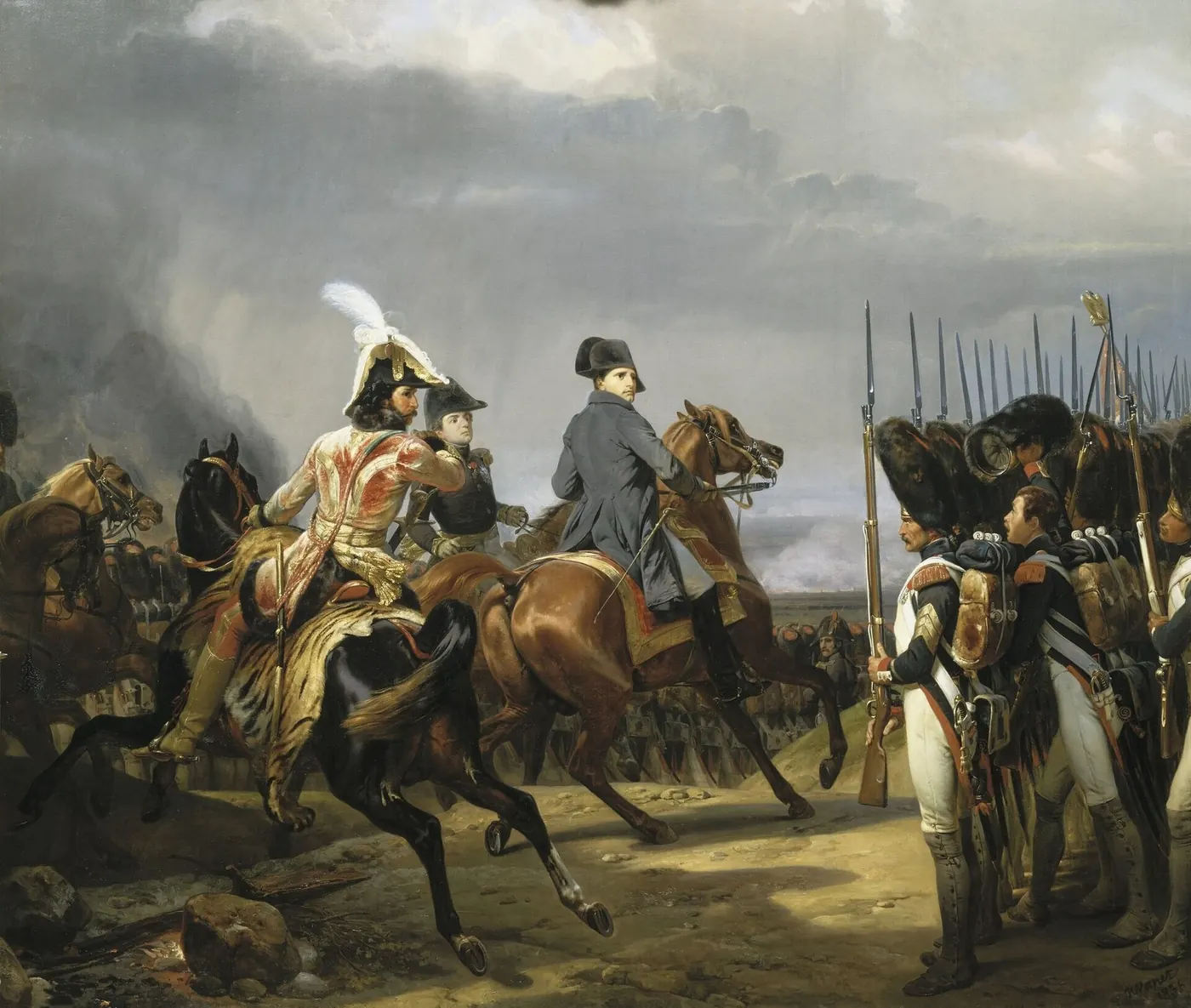
In Paris, Napoleon decided by a decree signed in Warsaw in 1807 to give the name of the victory to the bridge being built opposite the École Militaire. The Pont d'Iéna was built between 1808 and 1814. In 1815, during the second occupation of Paris, Blücher wanted to destroy it; it took the intervention of Tsar Alexander to dissuade him. The Avenue d'Iéna, opened in 1858, and its metro station also bear the name of the battle, as did several ships of the French navy, including the battleship Iéna, destroyed by an explosion in the port of Toulon in 1907.
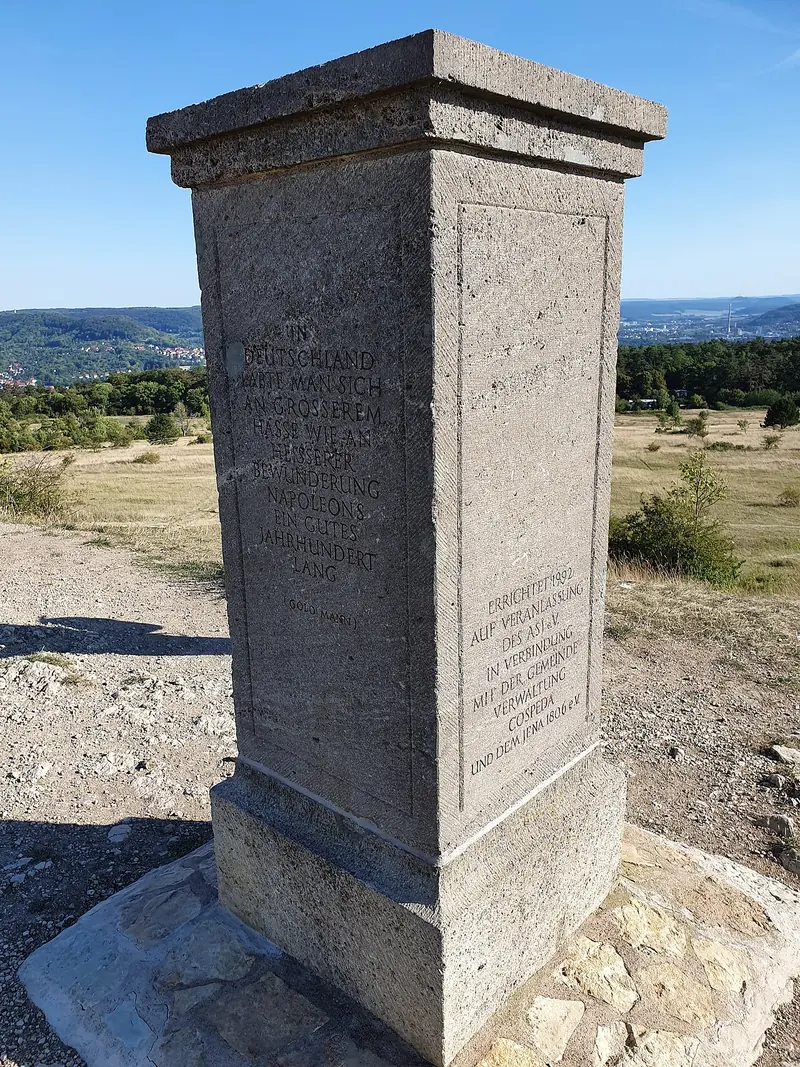
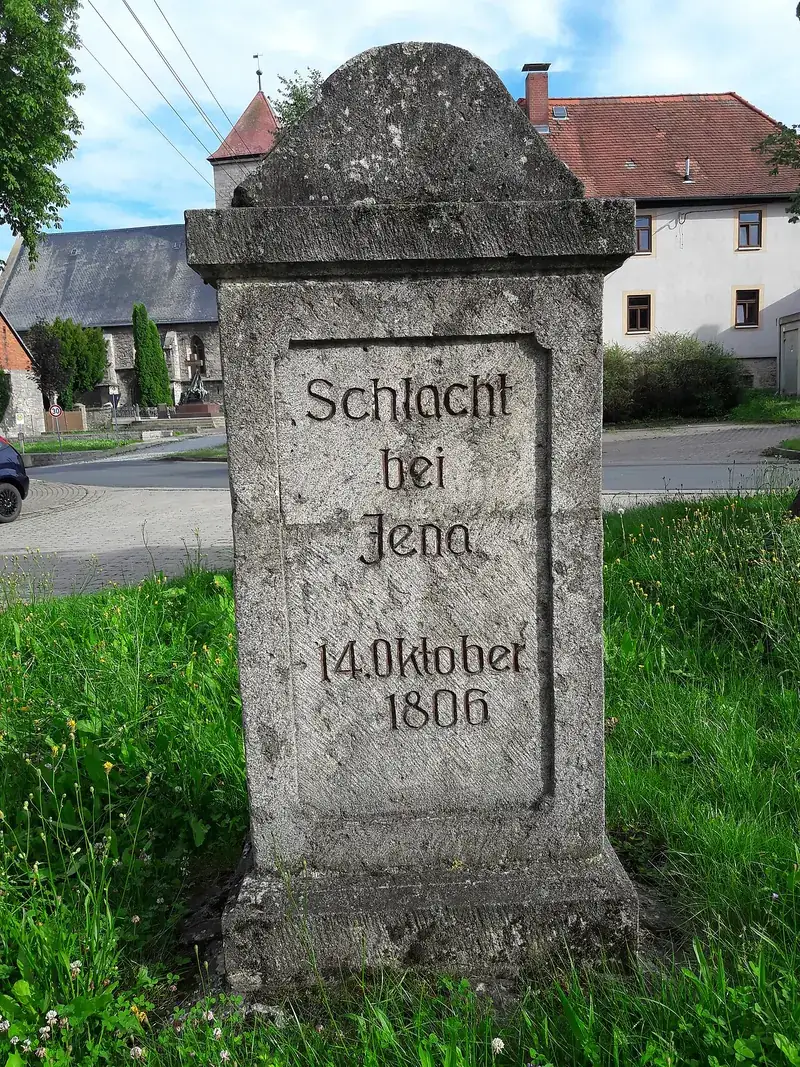
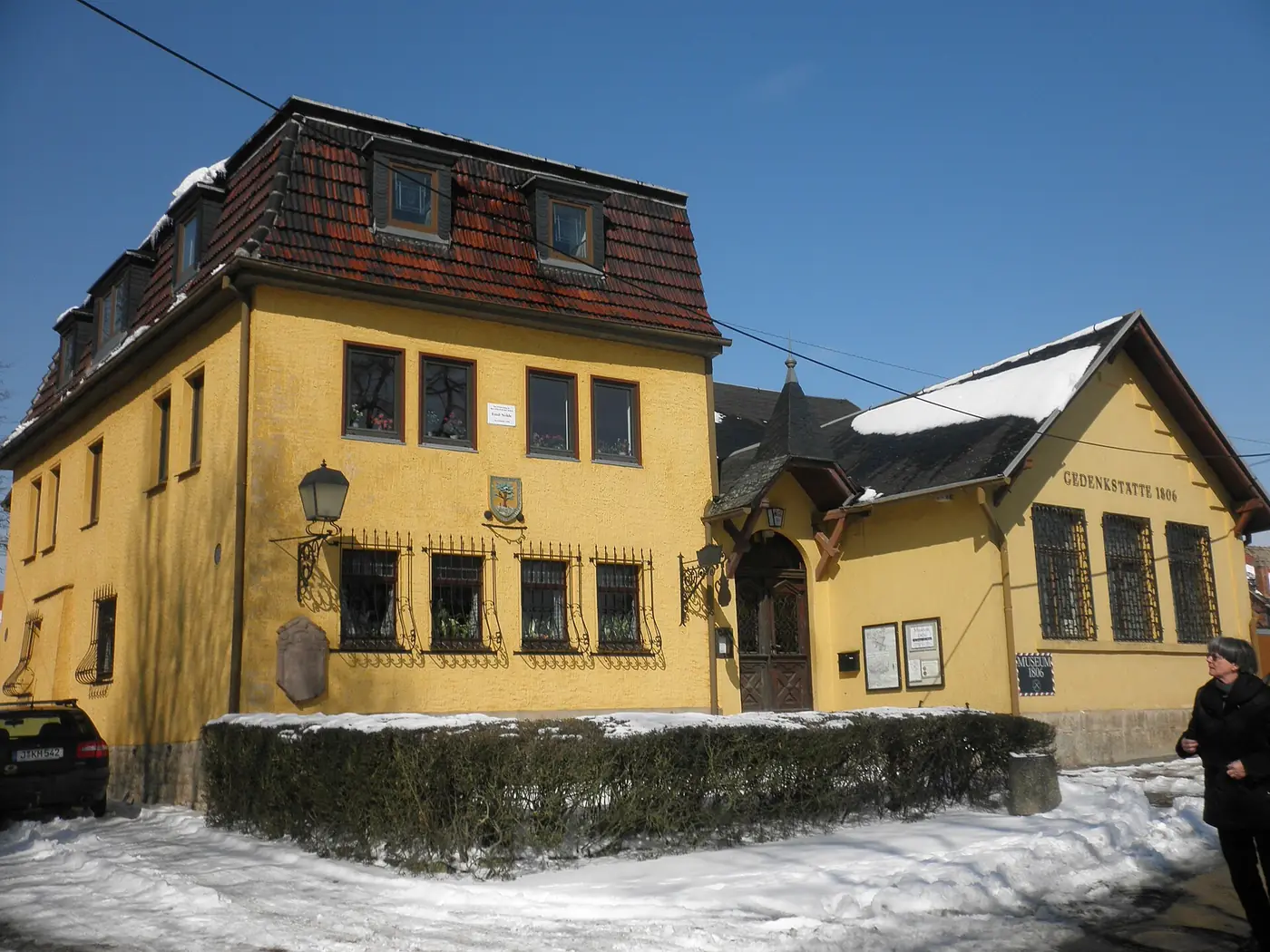
Around Jena the battlefield can still be read. On the Windknollen, at 363 metres, the Napoleonstein, erected in 1992, bears the date of the battle and the distances from this spot to the stages of the Emperor's life, from Paris to Saint Helena. Memorial stones, plaques and murals mark Cospeda, Lützeroda and Vierzehnheiligen; in front of the church of Vierzehnheiligen, a monument raised in 1906 honours the French and German soldiers who fell in the battle. In Cospeda, the Museum 1806 is devoted to the twin battle. Every October the association Jena 1806 organises commemorations; for the bicentenary, on 14 October 2006, 1,800 participants re-enacted the fighting near Cospeda.
Discover other battles
 Victory
 Read the account
Auerstedt
14 October 1806
Auerstedt, Thuringia
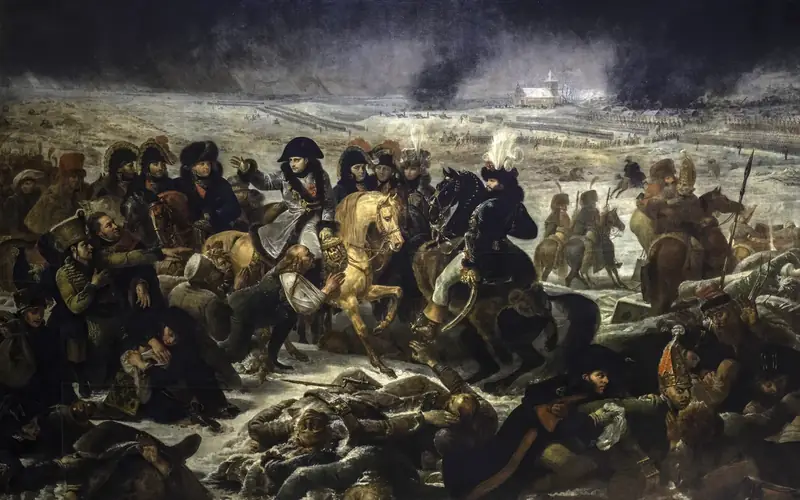 Inconclusive
 Read the account
Eylau
7-8 February 1807
Preussisch Eylau (Bagrationovsk), East Prussia
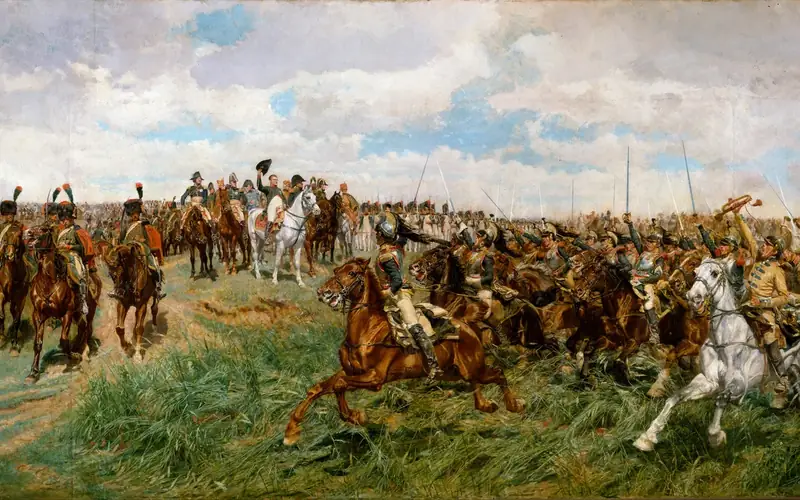 Victory
 Read the account
Friedland
14 June 1807
Friedland (Pravdinsk), East Prussia
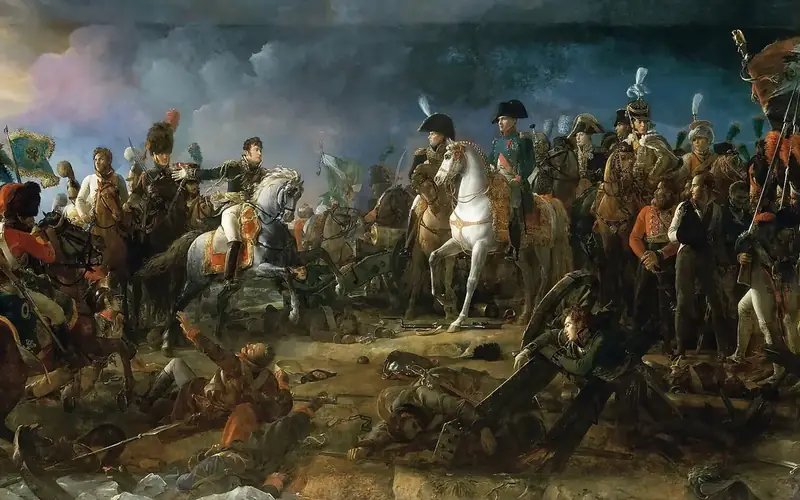 Victory
 Read the account
Austerlitz
2 December 1805
Pratzen plateau, Moravia (Czech Republic)
Go further
Recommended books to dig deeper (affiliate links)

Napoleon the Great
Andrew Roberts · 2014
A monumental biography drawing on Napoleon’s 33,000 surviving letters, admiring but rigorous.
See on Amazon
Napoléon ou le mythe du sauveur
Jean Tulard · 1977
The book that reshaped how the man is read: how France gave itself a saviour, and what it cost.
See on Amazon
Nouvelle histoire du Premier Empire
Thierry Lentz · 2002-2010
Four reference volumes on institutions, diplomacy and collapse: the scholarly synthesis of the subject.
See on AmazonAs an Amazon Associate, this site earns from qualifying purchases.
Support the encyclopedia
Napoleon Empire is an independent project. Your contribution helps grow the content and keep the site running.
DonateSecure payment on the platform you choose.